The first week of school runs on adrenaline, and if you handle marketing on top of running the building, it can slip by before you capture a single frame. That is a missed opportunity, because this one week gives you more honest, usable content than any other stretch of the year. The hugs at drop-off, the new kindergartner finding a cubby, the teacher who has greeted families at the same door for a decade; these moments tell prospective families what your school actually feels like. Cube Creative Design works with faith-based and independent schools that want to capture that energy without a production crew. This guide gives you concrete first-week school content ideas and a simple way for a one-person team to capture, post, and reuse them all year.

Written By: Hannah Kilpatrick | July 06, 2026
Hannah Kilpatrick Cube Creative DesignHannah Kilpatrick graduated from Western Carolina University in 2021 with a Bachelor of Science in Communication with a Minor in Marketing and a Concentration in Public Relations. She has been around social media since its creation. (Meaning, she was in the first grade when Facebook became available to the general public.) As our very own professional Gen-Z, Hannah is a whiz when it comes to social media creation and paid advertising.
You're comparing Cube Creative Design and IronChess SEO. Good. You run a pest control company with somewhere between 11 and 30 trucks, your route board has good weeks and slow weeks, and two agencies are in your inbox promising the same thing: more calls, better rankings, your phone ringing. One of them is us. The other is IronChess SEO. You're trying to tell them apart before you write a check, and the websites aren't making it easy.
I'm Chad, and I run pest control marketing at Cube Creative Design. We work with pest control companies and nobody who sells homes, cars, or insurance. I have an obvious stake in which way you lean, so I'm going to tell you exactly where that bias sits, give you only verifiable facts about IronChess, and then hand you the questions that actually settle this.
Yes, I wrote this, and yes, I want your business. So does IronChess. The difference I'm betting on isn't that we want it more. It's how we earn it. There are things an agency can publish in plain sight: its prices, its results with real numbers, who owns the work when you leave. There are things it can keep behind a sales call. We publish ours. Where IronChess does not publish something, I'll say "not published" and leave it there. You're smart enough to draw a conclusion from a blank line.
If I skip the parts that make us look bad, nothing else on this page is worth reading. So I'll start with what makes IronChess appealing, because the appeal is real.

Written By: Chad J. Treadway | July 04, 2026
Chad is our Chief Smarketing Officer. He will help you survey your small business needs, educating you on your options before suggesting any solution. Chad is passionate about rural marketing in the United States and North Carolina. He also has several certifications through HubSpot to better assist you with your internet and inbound marketing.
You are paying a marketing agency every month, and you genuinely cannot tell if it is working. The reports look busy. The numbers mostly go up. But the only number you actually care about, booked jobs, has been flat, and nobody wants to say so out loud. If that is where you are, you are not being paranoid. You are asking the right question, and most owners never ask it directly.
I run an agency that competes for pest control marketing work, so take this for what it is: an honest framework from someone on the inside. Plenty of agencies earn their fee. Plenty coast. The difference is not how polished the report looks. It is whether the work produces leads and booked jobs that you can trace back to the money you spent. This post gives you the metrics that matter, the red flags that should worry you, and the exact conversation to have before you decide to stay or go.
One fair warning before you judge anyone, including yourself, if you run marketing in-house. The channel changed in 2024, and results that dropped industry-wide are not automatically your agency's fault. The skill is telling "they stopped earning it" apart from "the whole field got harder." Both are real, and the rest of this guide helps you tell which one you are looking at.
Written By: Chad J. Treadway | July 03, 2026
Chad is our Chief Smarketing Officer. He will help you survey your small business needs, educating you on your options before suggesting any solution. Chad is passionate about rural marketing in the United States and North Carolina. He also has several certifications through HubSpot to better assist you with your internet and inbound marketing.
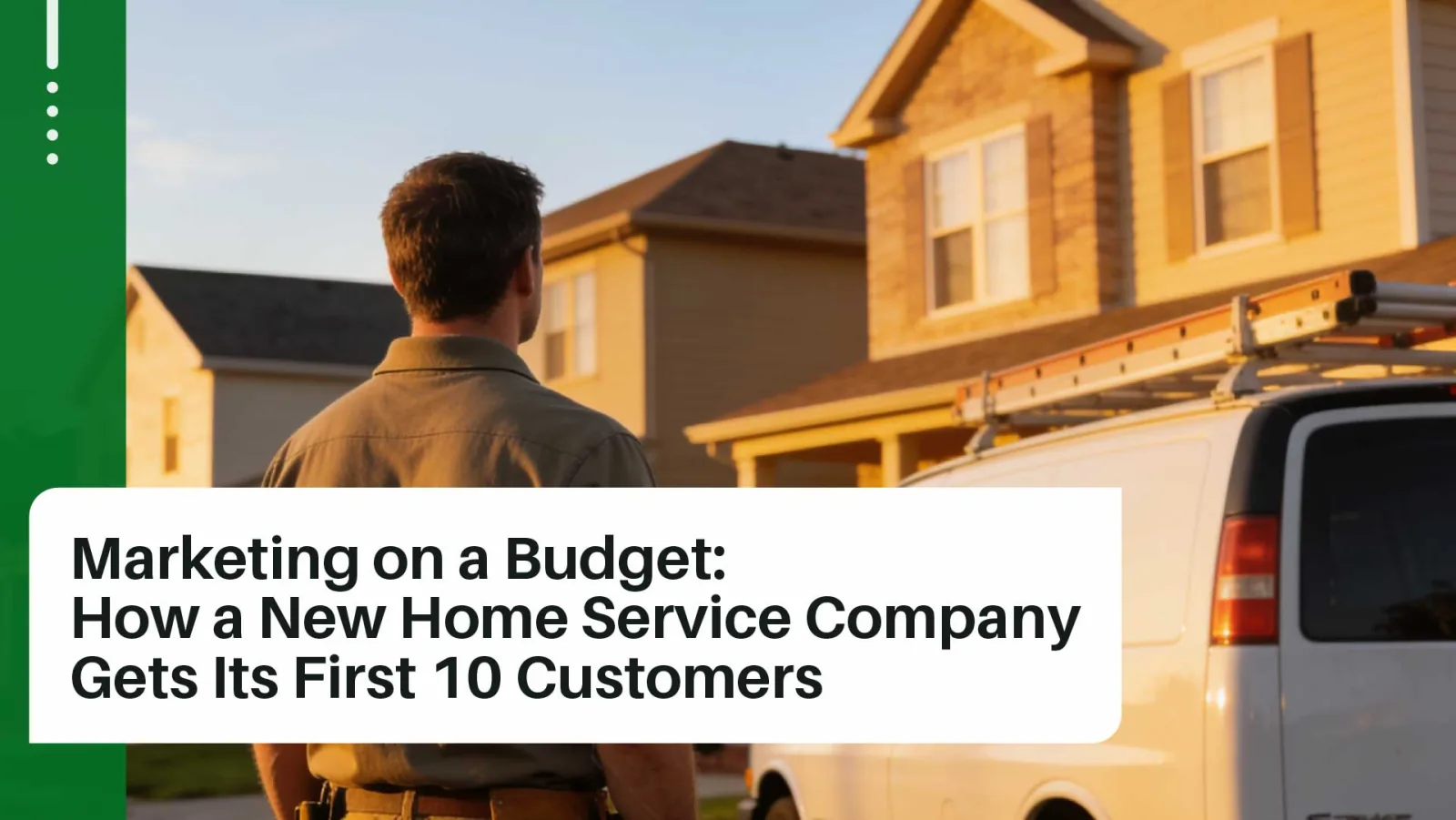
The big regional HVAC outfit across town runs a $15,000 monthly marketing budget. You have $200 and a work van with a coffee stain on the passenger seat. Sounds like a mismatch. It isn't. For a new home service company, the marketing budget matters far less than where you point it. We help home services companies sort the noise from the work that actually books jobs, and the honest truth is that your first 10 customers almost never come from paid ads.
If money is tight, you are in good company. Direct mail firm PostcardMania reported that 41% of small and midsize businesses spend less than $500 a month on advertising. The U.S. Small Business Administration says that it is fine for a while, because, as the Small Business Administration put it, "Tactics such as word-of-mouth, social media marketing and volunteering at community events are all virtually free ways to get your business in front of the public."
This is the $0 to $500 playbook: five neighborhood-level tactics that get a new contractor in front of local homeowners before you spend a dime on ads. Each one wins on proximity and trust, the two things the big company with the giant budget can't buy in your zip code.
Written By: Chad J. Treadway | July 03, 2026
Chad is our Chief Smarketing Officer. He will help you survey your small business needs, educating you on your options before suggesting any solution. Chad is passionate about rural marketing in the United States and North Carolina. He also has several certifications through HubSpot to better assist you with your internet and inbound marketing.
Pest control marketing stops working for one of five reasons, and they usually show up together: the search channel changed under you, your website quietly stopped converting, your local presence went stale, your agency stopped earning its fee, or the math on your cost per lead stopped adding up. If you are asking why your pest control marketing is not working anymore, the answer is almost always one or more of those five, not bad luck.
Here is the good news buried in that. Marketing rarely breaks for some mysterious reason you will never figure out. It breaks for reasons you can name, and naming the reason is most of the fix. Your marketing used to work. The phone rang, the route board filled, and you did not spend much time wondering where the calls came from. Then it slowed down, either as a quiet quarter that turned into a quiet year or as a sudden drop nobody warned you about.
I run a marketing agency that works with pest control companies, and I want to be straight with you about where these numbers come from. They are not borrowed from some generic small business blog. In 2026, I evaluated 300 pest control companies across the country, putting their websites, SEO, and Google Business Profiles through the same review I run for clients. That audit is the closest thing our industry has to a mirror right now, and most owners do not love what they see in it. This guide walks through all five root causes, shows you how to tell which one is hitting you, and gives you the order to fix them.
Written By: Chad J. Treadway | July 01, 2026
Chad is our Chief Smarketing Officer. He will help you survey your small business needs, educating you on your options before suggesting any solution. Chad is passionate about rural marketing in the United States and North Carolina. He also has several certifications through HubSpot to better assist you with your internet and inbound marketing.

On a Tuesday morning, a homeowner drops the kids off at school and passes a plumbing truck wrapped in clean blue-and-white graphics. She doesn't think twice about it. Two weeks later, the pipe under her kitchen sink starts dripping. She grabs her phone, types "plumber near me," and there it is in the results: the same logo from that truck. She calls. The plumber she barely remembers seeing just won the job.
That is home service company visual branding doing its work, and it happens every day in your service area, whether you planned for it or not. For home services companies, the truck in the driveway, the tech at the door, and the sign in the front yard are marketing moments that play out constantly. The only question is whether they are working for you or just driving past.
If you have ever watched a competitor's shiny wrapped fleet roll through town and wondered why they seem to be everywhere, this post is for you. We'll cover the five visual touchpoints that decide whether people remember your company, and where to put your first dollar if you can't do all of them at once.
Written By: Chad J. Treadway | July 01, 2026
Chad is our Chief Smarketing Officer. He will help you survey your small business needs, educating you on your options before suggesting any solution. Chad is passionate about rural marketing in the United States and North Carolina. He also has several certifications through HubSpot to better assist you with your internet and inbound marketing.
Most private schools start planning their fall enrollment campaign in August. By then, the families they're trying to reach have already visited three schools, had lunch with a current parent, and asked ChatGPT which school in their area has the best STEM program. By the time the open house invitations go out, the decision has already narrowed to two finalists, and your school is probably not one of them.
This is the structural problem with how most schools approach fall enrollment campaign planning. The school's calendar starts in late summer. The family's calendar started six months earlier. That gap is where strong-performing schools have spent the spring building a pipeline, and where everyone else is improvising in real time.
This post is for K-12 private school leaders who want to stop running a sprint and start running a relay. We'll walk through the actual 12-month enrollment cycle from the family's perspective, the funnel benchmarks that separate strong performers from average ones, where digital ad budgets pay off and where they don't, how AI is reshaping the way families build their consideration set, and the operational infrastructure that has to be in place before fall starts, not during it. The schools that get this right convert 34% more inquiries than the ones that don't, and the gap is widening every year.

Written By: Adam Bennett | June 30, 2026
Adam is the president and founder of Cube Creative Design and specializes in private school marketing. Since starting the business in 2005, he has created individual relationships with clients in Western North Carolina and across the United States. He places great value on the needs, expectations, and goals of the client.
You wrap up the last stop on a Friday route, get home, eat dinner, then open your Google Business Profile to catch up on paperwork. Three new reviews this week. Two five-stars and a three-star. You give the five-stars a thumbs up and a copy-paste "Thanks!" The three-star sits unanswered for days because you're not sure how to respond to a pest control review that's lukewarm and specific.
That's the default for a lot of pest control businesses, and it's also why some of the best operators in town are missing from the local map pack. Every review response is content. Every response is a signal to Google that the profile is alive. And every response is a billboard for the customers reading reviews before they ever pick up the phone.
This is a tactical post for pest control companies that already get reviews but aren't sure what to write back. We'll cover what to say to the good reviews, the middle-of-the-road reviews, the one-stars, and the fakes, plus how fast to respond and who should be the one writing.
Written By: Chad J. Treadway | June 30, 2026
Chad is our Chief Smarketing Officer. He will help you survey your small business needs, educating you on your options before suggesting any solution. Chad is passionate about rural marketing in the United States and North Carolina. He also has several certifications through HubSpot to better assist you with your internet and inbound marketing.
It is late July. Somewhere in your inbox is a three-month-old chain of emails from a family that toured in April and went quiet. Your social media has not been updated since the spring concert. Open house dates are on the calendar but not on the website. And the inquiry list you meant to clean up in May is sitting in the same spreadsheet you opened last August.
If any of that sounds familiar, you are not behind because you are bad at your job. You are behind because summer at a school is not a break; it is a compressed sprint of re-enrollment, new family onboarding, staff orientation, and facilities work. Marketing is the thing that gets pushed when something has to give.
Here is the problem. The schools that own September and October are not starting back-to-school marketing in August. They started in June. Whether you run a budget-conscious K-8 or a 600-student independent, marketing for private school leaders follows the same rhythm: prep in summer, execute in fall, recover in winter. Skip the prep, and the execution falls apart in slow motion.
This post is a working framework for the next eight weeks. It is not a pep talk, and it is not a checklist for beginners. It is what veteran school marketers wish someone had handed them in early June.
Written By: Adam Bennett | June 30, 2026
Adam is the president and founder of Cube Creative Design and specializes in private school marketing. Since starting the business in 2005, he has created individual relationships with clients in Western North Carolina and across the United States. He places great value on the needs, expectations, and goals of the client.
You've invested time and resources into a family tour. The parents walked the halls, met teachers, and watched your students collaborate in a classroom. You sent follow-up emails. Maybe you scheduled another conversation. Then: silence. Months later, they enroll somewhere else.
Here's the uncomfortable truth: you probably don't know when they're actively shopping again. And if you did, you'd be guessing about what changed in their situation. Most private school marketing teams treat these families as lost. But they're not lost. They're dormant.
This post shows you how to recognize when dormant leads warm back up, understand what they're actually looking for this time, and reach out with intelligence instead of desperation.
Written By: Adam Bennett | June 29, 2026
Adam is the president and founder of Cube Creative Design and specializes in private school marketing. Since starting the business in 2005, he has created individual relationships with clients in Western North Carolina and across the United States. He places great value on the needs, expectations, and goals of the client.
You spent real money on your pest control website. The homepage looks sharp, your phone number sits in the header, and your services are listed in the menu. But the service pages themselves often do nothing. They don't bring in calls, they don't show up when someone searches "termite treatment near me," and they sit there like a service truck stuck in the shop with a busted alternator. After auditing 300 websites built for pest control companies in 2026, the same pattern keeps showing up: service pages that look fine to a visitor but read like wallpaper to Google.
Written By: Chad J. Treadway | June 29, 2026
Chad is our Chief Smarketing Officer. He will help you survey your small business needs, educating you on your options before suggesting any solution. Chad is passionate about rural marketing in the United States and North Carolina. He also has several certifications through HubSpot to better assist you with your internet and inbound marketing.

Your admissions team is drowning in routine tasks. Inquiry responses, family record creation, status updates, and email sequences. They're all necessary, but they're eating the time your counselors should spend on actual conversations with families. And here's the tension: you know your school's greatest competitive advantage is the personal touch. So how do you modernize without becoming a robot?
The answer isn't choosing between automation and human connection. It's recognizing that private school admissions work best when systems and people play different roles. Automation handles what's predictable. People handle what's nuanced.
This post walks you through where to place automation in your admissions workflow and, more importantly, where to keep humans in charge. You'll see how the best-performing schools aren't the ones doing everything by hand or the ones that fire-and-forget emails to families. They're the ones that let technology free up human attention so meaningful conversations can actually happen.
Written By: Adam Bennett | June 29, 2026
Adam is the president and founder of Cube Creative Design and specializes in private school marketing. Since starting the business in 2005, he has created individual relationships with clients in Western North Carolina and across the United States. He places great value on the needs, expectations, and goals of the client.