Community marketing for a pest control company with a chamber membership, a wrapped truck, and three crew members is the most undervalued revenue lever in the industry, and most owner-operators run right past it. You drive your truck through the same service area five days a week, you waved at the same coach at last week's Little League practice, and you still cannot figure out why so many homeowners on your route are paying a national chain you have never met. The problem is not your treatment, your pricing, or your technicians. The problem is that you are still a stranger. For a 3-truck shop or an 8-employee operation pulling somewhere between $180,000 and $750,000 a year, the path forward is not a bigger ad budget. It is being recognized at the gas station, the coffee shop, and the school fundraiser before the homeowner ever has a roach problem.
I work with independent pest control companies at this size every week, and most of them treat their chamber membership like a gym membership: paid for, rarely used, and quietly making them feel guilty. The chamber is not a directory. It is a referral engine. The same is true of a $300 sponsorship banner on the outfield fence, a $1 handwritten thank-you card, and the yard sign you forgot to ask the customer's permission to leave. Each of those is a community marketing pest control chamber-style asset that builds the local trust national chains cannot buy at any price. This post lays out how to use them, what realistic numbers look like at your size, and where small companies usually leave money on the table.

Written By: Chad J. Treadway | May 12, 2026
Chad is a Partner and our Chief Smarketing Officer. He will help you survey your small business needs, educating you on your options before suggesting any solution. Chad is passionate about rural marketing in the United States and North Carolina. He also has several certifications through HubSpot to better assist you with your internet and inbound marketing.
PPC for pest control is a lot like managing inventory for a seasonal retailer. You can't sell what you didn't stock, and you can't stock what you didn't budget for. The pest control owners who win peak season are not the ones with the biggest annual budgets; they're the ones who allocated correctly across months that don't look anything like each other.
A pest control company spending $5K per month in February and $5K per month in May is leaving leads on the table. February is shoulder season; the demand isn't there to absorb the budget efficiently. May is peak; $5K runs out by the second week, and the company stops bidding while competitors keep showing up. Same total budget. Worse outcome. This post is about fixing that pattern for pest control companies running paid search through 2026's summer demand cycle.
I'll cover the seasonal demand curve, how to allocate budget across the year, bid strategy adjustments for peak, daily and dayparted pacing, competitor bidding dynamics, and the specific tactics that protect your cost per lead when CPCs spike. None of this is theoretical. It's the same playbook we run for the pest control PPC accounts we manage.
The specific percentages in this post are drawn from Cube Creative's pest control PPC management across clients in mid-sized U.S. markets. Your account's numbers will vary based on market seasonality, service mix, and competitive intensity. Use these as directional benchmarks, not prescriptions. Where an industry source applies directly, I will link it.

Written By: Adam Bennett | May 11, 2026
Adam is the president and founder of Cube Creative Design and specializes in private school marketing. Since starting the business in 2005, he has created individual relationships with clients in Western North Carolina and across the United States. He places great value on the needs, expectations, and goals of the client.
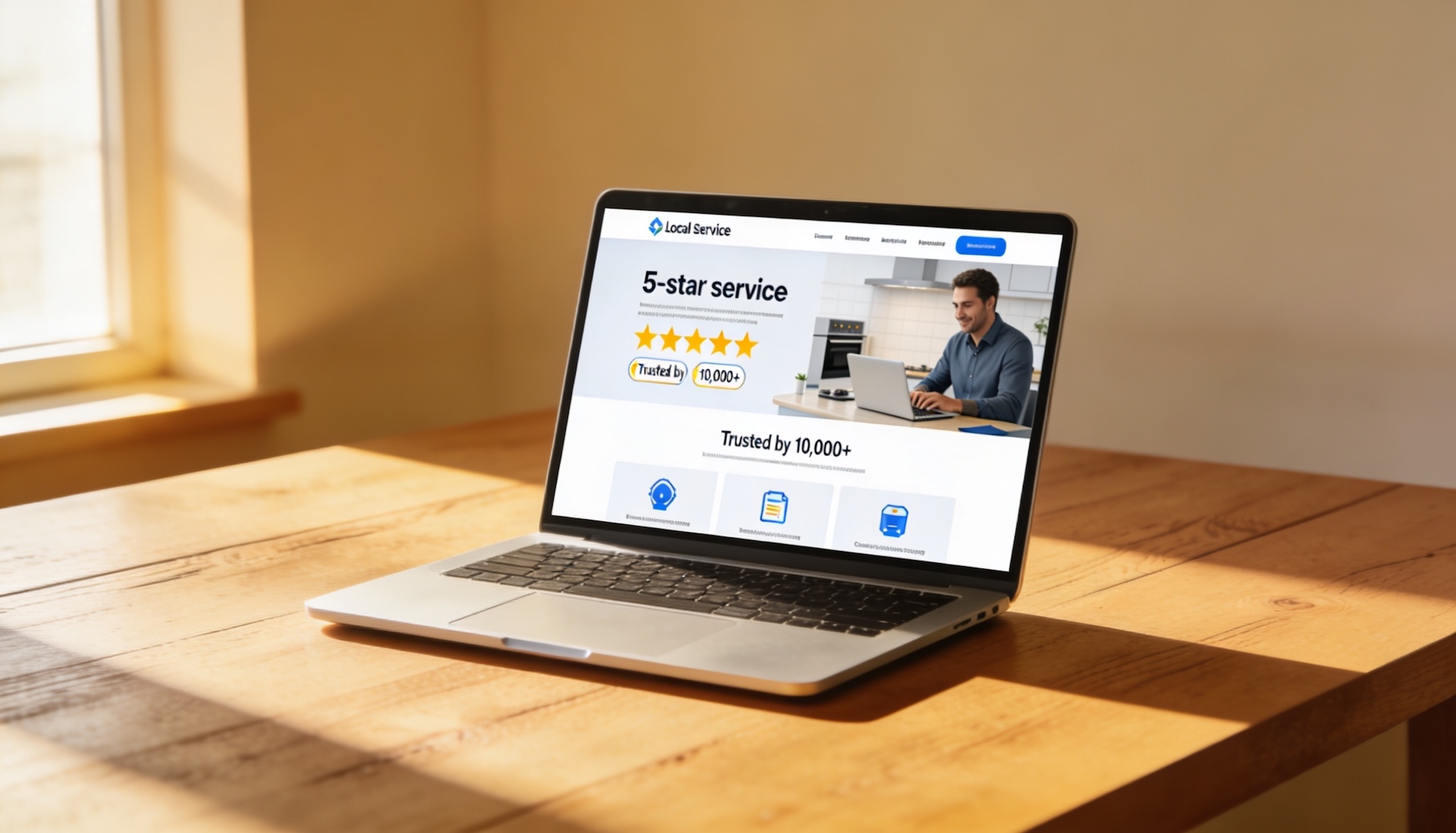
Building trust — particularly in industries where your prospects don’t have the opportunity to see and try out physical products before making a conversion decision — can be exceptionally difficult. And the fact that people’s trust in most organizations is eroding isn’t helping either.
While research clearly demonstrates that a growing number of people are taking brand credibility and competence into account before committing to a purchase, data also indicates that earning consumer trust has never been as difficult as it is right now.
People no longer rely solely on traditional trust signals to make their buying decisions. Nowadays, they’re taking into account value-based factors and benevolence signals. Furthermore, the economic outlook is making many consumers rethink their spending, driving them to prioritize value-for-money rather than pure quality of service.
So what does this mean for service area businesses trying to establish positive reputations? Well, it demonstrates that they need to identify effective methods to earn customer trust. Content marketing — especially on social media — can be a great method to do this (as well as to build brand awareness). However, for conversion-driving results, brands have to invest in trust-building web design, more specifically, user experience elements that effectively turn web visitors into customers.
So, what’s the best method of designing for trust? And how can SABs employ UX strategies to boost conversions and brand reputation? Read on to find out.
You worked the phones, drove the route, did the inspection, walked the crawlspace, and emailed a clean quote. Then nothing. The estimate sits in "sent" status for a week. The homeowner has not said yes, has not said no, and has quietly gone back to ignoring the ants in the kitchen because the panic that made them call has worn off. If you run an operation somewhere between $450,000 and $2.5 million in revenue, this is where most of your real lost revenue lives: not in leads you never got, but in estimates you already paid to produce. A working pest control estimate follow-up sequence is the cheapest revenue lever you have, and most companies of your size do not have one.
I work with pest control business owners every week who can quote you their cost per lead to the dollar but cannot tell you what their estimate-to-close rate looks like, how many touches they make on a quote before quitting, or which day in the sequence prospects actually sign. That blind spot is expensive. The fix is not a personality transplant for your CSR or a new sales hire. It is a written, repeatable cadence that runs the same way every time, with the right channel on the right day saying the right thing. This post lays out what that cadence looks like, what the numbers say about why it works, and where the field-to-office handoff usually breaks for companies in your size band.
Written By: Chad J. Treadway | May 08, 2026
Chad is a Partner and our Chief Smarketing Officer. He will help you survey your small business needs, educating you on your options before suggesting any solution. Chad is passionate about rural marketing in the United States and North Carolina. He also has several certifications through HubSpot to better assist you with your internet and inbound marketing.