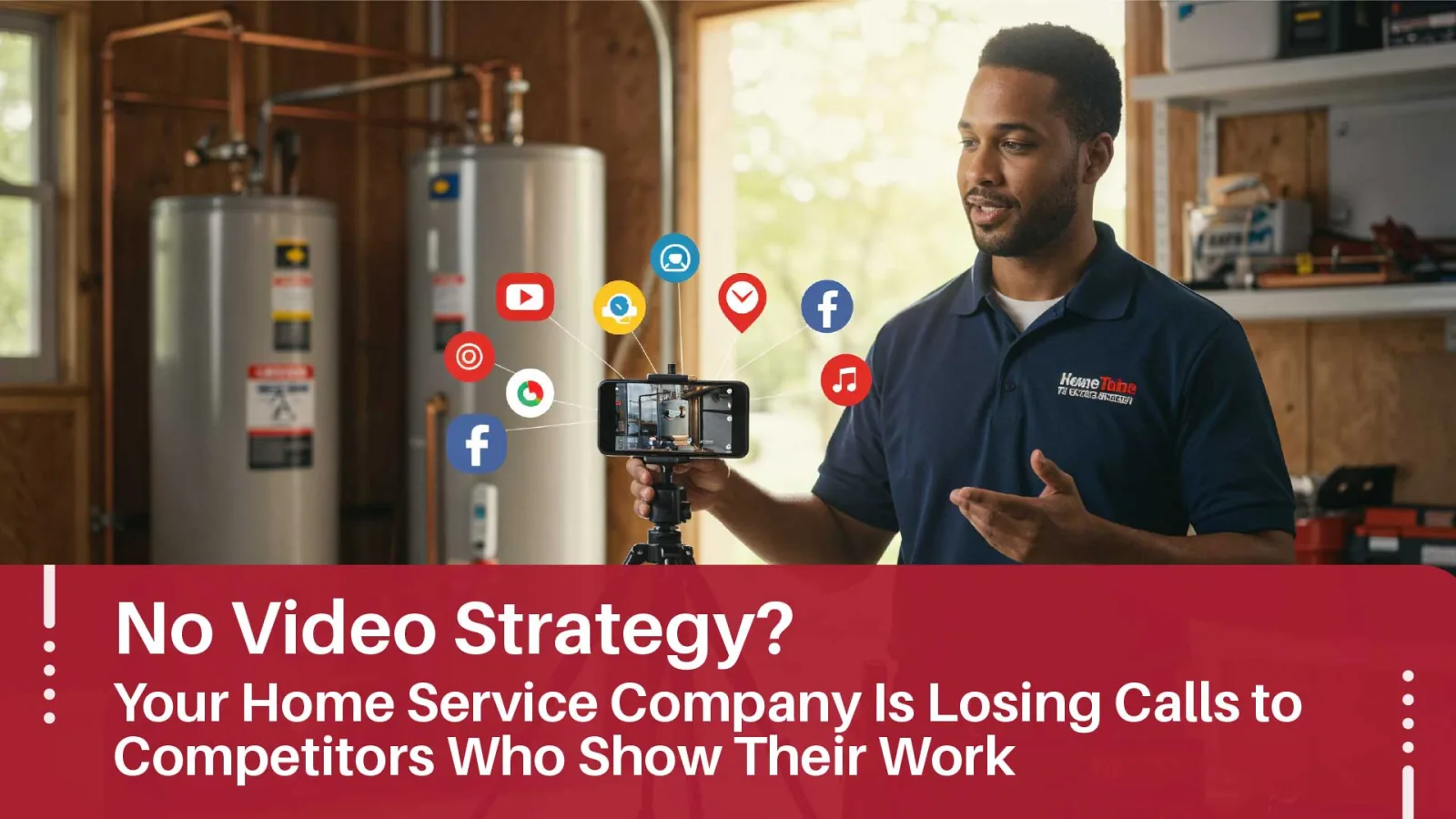
Here is a question every home service business owner should ask themselves: When was the last time you watched a video to learn how to do something? Yesterday? This morning? Your customers are doing the same thing; they just happen to be watching videos about plumbing problems, HVAC installations, and roof repairs.
Video is not optional anymore. It is how homeowners research, evaluate, and choose service companies. And the best part? You do not need a film crew. You need a phone, a willingness to show your work, and about 60 seconds of your time.
This post covers exactly how home service businesses can use video across the three platforms that matter most: YouTube, Google Business Profile, and social media. No theory. No expensive production advice. Just practical steps you can start this week while your crews are already out on job sites.
Why Does Video Marketing Work for Home Service Companies?
The numbers make the case better than I can.
Wyzowl's 2026 State of Video Marketing survey found that 91% of businesses now use video as a marketing tool, and 82% of marketers report that video provides a good return on investment. Those are not niche numbers. That is mainstream adoption, and service companies that are not participating are invisible to a growing segment of homeowners.
Video works for home services specifically because your business is visual. A homeowner cannot see the difference between a good and a bad plumbing job from a text description. But a 60-second video showing a clean copper repipe, a neatly routed drain line, or a properly sealed roof flashing? That tells the story instantly.
Wyzowl's research also found that 85% of people have been convinced to buy a product or service by watching a video. For a service company, "buy" means picking up the phone. Every video you post is a chance to be the company a homeowner calls when they need help.
And the search benefits are significant. Companies that use video in their marketing get 41% more web traffic from search than those that do not, according to research compiled by Kapwing. Video signals to Google that your content is engaging, which helps your pages rank higher for local search terms.
Do You Really Need Expensive Equipment?
No. Let me say that again: no.
The most effective service company videos are shot on a smartphone. The homeowner watching your video does not care about cinema-grade resolution. They care about seeing real work done by real people. In fact, overly polished videos can feel inauthentic for a local business. A phone video that shows your tech explaining a water heater installation at the job site is more trustworthy than a scripted commercial.
Here is what you actually need. A smartphone made in the last three years (the camera is already good enough). Natural lighting or a clip-on LED light for indoor shots. A basic tripod or phone mount if you want stable footage. And someone on your team who does not mind being on camera.
That is it. No editing software required for most platforms. YouTube Shorts, Facebook Reels, and Google Business Profile all accept raw uploads. Film, post, done.
For audio, stand close to the camera and speak clearly. If you are filming outdoors near equipment, consider a $15 clip-on microphone. Bad audio is the one thing that makes viewers click away. Bad lighting, they will tolerate. Bad audio, they will not.
How Should Service Companies Use YouTube?
YouTube is the second-largest search engine in the world, and homeowners use it to research everything from "how to unclog a drain" to "is my furnace worth repairing." If your company has videos answering those questions, you show up when competitors do not.
Wyzowl's data shows that YouTube remains the most widely used video marketing platform at 82%, and 69% of marketers using YouTube say it is effective for them. For home service companies, YouTube serves two purposes: it positions you as the local expert, and it drives traffic to your website.
The best YouTube content for service companies falls into three categories.
First, educational videos. Answer the questions homeowners ask most. "How much does a new AC system cost?" or "What are the signs my roof needs replacing?" Keep these under 5 minutes. The homeowner gets their answer, sees your expertise, and finds your contact information in the description.
Second, project walkthroughs. Walk through a completed job: show the before, explain the problem, show the solution, and share the result. These perform well because homeowners searching for a specific service can see exactly what you deliver.
Third, YouTube Shorts. These 60-second vertical videos are YouTube's fastest-growing format. Social Insider's analysis of YouTube Shorts shows the platform averages a 5.91% engagement rate, outperforming TikTok (5.75%), Instagram Reels (5.53%), and Facebook Reels (2.07%). A quick tip, a fast before-and-after, or a "day in the life" clip of your crew works perfectly in this format.
Title your videos with local keywords: "Water Heater Installation in Burke County" ranks better than "We Replaced a Water Heater." Include your service area, phone number, and website link in every video description.
How Do Google Business Profile Videos Help You Win Local Search?
Your Google Business Profile is the first thing most homeowners see when they search for a service company. If your listing has photos and videos while your competitor's listing has nothing, you win the trust comparison before anyone picks up the phone.
Research from Birdeye's State of Google Business Profile report confirms that fully populated, verified Google Business Profiles surface 80% more often in search and generate 4x more website visits, 12% more calls, and 10% more direction requests than incomplete or unverified listings. Home services companies ranked among the highest for photo volume per location on the platform.
GBP videos are underused by most service companies, which means there is an opportunity. Google allows videos up to 30 seconds for most businesses (longer for some), and these videos can auto-play on mobile search results. A homeowner searching "plumber near me" sees your listing with a video of a recent job, and suddenly, you are not just a name with a phone number. You are a company that they can see in action.
Post these types of videos to your GBP: recent completed projects (30-second walkthroughs), seasonal tips ("3 things to check on your AC before summer"), and team introductions ("Meet our lead technician"). If you need help setting up your Google Business Profile, we have a full guide for that. Update your GBP with fresh video content monthly. Google rewards active profiles with better visibility in local search results. Think of your GBP videos as your digital handshake. The homeowner has not called you yet, but they have already seen your team's work. When they do pick up the phone, they feel like they already know you.
What About Social Media Video?
Facebook and Instagram are where your local community spends time, and video content on these platforms gets significantly more engagement than photos or text posts.
Research compiled by Vidico indicates that short-form videos deliver 2.5 times more engagement than long-form content, and 73% of consumers prefer short-form videos to learn about products or services. For a service company, that means a 30-60 second before-and-after video on Facebook will reach more people than a paragraph describing the same job.
The best social media videos for home services are informal and real. Post a time-lapse of a roof replacement. Share a quick tip about maintaining a garbage disposal. Show your crew arriving at a job and then the finished result. These are not productions; they are glimpses of your daily work that build familiarity and trust with your local audience.
If you want more social media tips for your home service company, we cover the full strategy in a separate guide. Facebook Groups are especially valuable. Many communities have local "recommendations" groups where homeowners ask for service company referrals. When your company consistently posts helpful video content, your name comes up in those conversations.
One practical tip: repurpose everything. Film a 60-second video at a job site. Post the full version on YouTube. Trim it to 30 seconds for a YouTube Short. Post the same clip on Facebook and Instagram. Upload a version to your GBP. One video, four platforms, five minutes of posting time.
What Video Marketing Mistakes Do Service Companies Make?
The biggest mistake is not starting. Most service company owners talk themselves out of video because they think it needs to be perfect. It does not. The homeowner watching your video cares about seeing real work, not production quality.
The second mistake is inconsistency. Posting one video and then disappearing for four months tells potential customers nothing. Aim for one video per week. If that feels like too much, start with two per month and build from there.
The third mistake is forgetting the call to action. Every video should end with a clear next step: "Call us at [number]," "Visit our website for a free estimate," or "Check the link in the description." Without a CTA, you are entertaining viewers, not generating leads.
The fourth mistake is ignoring YouTube SEO. Titles, descriptions, and tags matter. "Emergency Plumbing Repair" will not rank as well as "Emergency Plumbing Repair in Caldwell County NC." Add your location, your service, and your phone number to every video's metadata.
The fifth mistake is only posting when you remember. Treat video like any other part of your workflow. If your techs do a morning meeting, add "who has a good video opportunity today?" to the agenda. Build it into the routine, not into the "when I get around to it" pile.
How Do You Get Started This Week?
Here is the simplest way to start. Pick one job this week. Before your tech starts, take a 10-second "before" video. After the job is complete, take a 30-second "after" video where the tech explains what was done. Combine them into a 60-second clip.
Post that clip to YouTube with a descriptive, location-specific title. Upload a version to your Google Business Profile. Share it on your Facebook page. That is three platforms from one video, and it took less than 10 minutes total.
Do not overthink the editing. The homeowner watching your video is not comparing it to a Netflix documentary. They are comparing it to the competitor, which has no video at all. That is a comparison you win every time just by showing up.
For a company with 5-10 technicians covering a county-wide service area, assign each tech one video per week. After a month, you have 20+ pieces of video content across your platforms. After three months, homeowners in your area start recognizing your brand. After six months, your YouTube channel and GBP listing are generating inbound calls you were not getting before.
Wyzowl reports that 82% of video marketers say video has helped them increase traffic to their website, and 85% say video has helped them generate leads. At zero cost beyond the phones your techs already carry, video marketing has the best ROI of any channel available to a service company right now.
If you want help building a video strategy that fits your team and your service area, contact me, and we'll map it out together.
Frequently Asked Questions
How Long Should Marketing Videos Be for a Home Service Company?
Keep most videos between 30-60 seconds for social media and Google Business Profile, and 2-5 minutes for YouTube educational content. Wyzowl's research shows that shorter videos consistently outperform longer ones for engagement. For project walkthroughs on YouTube, 3-4 minutes gives you enough time to show the work without losing viewers. Always front-load the most important information in the first 10 seconds.
Do I Need to Edit My Videos Before Posting?
For most service company videos, no. Raw footage from a smartphone is perfectly acceptable for YouTube Shorts, Facebook Reels, and Google Business Profile. If you want to add a simple title card or your company logo, free apps like CapCut or InShot handle basic editing on your phone. Only invest in professional editing if you are creating a company overview video or a longer project showcase meant for your website homepage.
How Often Should a Service Company Post Videos?
Start with one video per week across your main platforms. If your team can handle it, aim for two or three. Consistency matters more than volume. A service company posting one video every week for six months will outperform one that posts 10 videos in January and nothing until June. Assign video responsibilities to specific team members so it becomes part of the workflow, not an afterthought.
Can I Use the Same Video on YouTube, GBP, and Facebook?
Yes, and you should. Repurposing is the smartest approach for a busy service company. Film one video, then post the full version to YouTube, trim a 30-second highlight for YouTube Shorts and Facebook Reels, and upload a short version to your Google Business Profile. One shoot produces content for three or four platforms. Adjust the aspect ratio if needed (horizontal for YouTube, vertical for Shorts and Reels).
What Types of Videos Get the Most Engagement for Service Companies?
Before-and-after project videos consistently perform best because they are visual, satisfying, and show real results. Educational "how-to" or "what to look for" videos rank well on YouTube because they match homeowner search queries. Team introduction videos and "day in the life" content build personal connections. Seasonal tip videos ("3 things to check before winter") get strong engagement because they are timely and useful. Mix all four types into your monthly content plan.