The most expensive marketing mistake in pest control isn't picking the wrong channel. It's picking the right channel at the wrong time. A solo owner-operator running brand awareness campaigns is burning money he can't afford to burn. A $3 million company still relying on word-of-mouth and one Google Ads campaign is leaving serious revenue on the table. Every growth stage has different priorities, different budget math, and a different mix of channels that actually move the business forward.
For independent pest control companies, the opportunity is real. The U.S. structural pest control industry climbed to $13.416 billion in 2025, growing 6% year-over-year and outpacing real GDP, according to the National Pest Management Association. The catch is that 81.4% of the country's 16,565 firms operate just one or two locations. You're competing with thousands of other independents, many of them better funded, some of them backed by private equity, for the same set of homeowners typing the same search queries. Doing the right marketing at the wrong stage hands those homeowners to your competition.
This post is a stage-by-stage decision framework. Find your revenue range, figure out what works there, learn what to spend, and identify what to stop doing. No theory. No fluff. Just a working playbook for every step from solo operator to multi-region operation.

Written By: Chad J. Treadway | June 05, 2026
Chad is a Partner and our Chief Smarketing Officer. He will help you survey your small business needs, educating you on your options before suggesting any solution. Chad is passionate about rural marketing in the United States and North Carolina. He also has several certifications through HubSpot to better assist you with your internet and inbound marketing.
Two operators in the same metro market sell the same general pest control plan at the same price. Same technicians, same products, same average ticket. One ends the year at a 20% net margin. The other is hovering around 5% and wondering why their accountant looks tired. They both think they have a sales problem or a labor problem. They actually have a route problem, and most owner-operators of pest control companies have never been taught to look at it this way. This post breaks down what route density actually is, the math behind it, the software that runs it, and why it touches everything from your Google Ads spend to the price your business sells for someday.
Written By: Chad J. Treadway | June 04, 2026
Chad is a Partner and our Chief Smarketing Officer. He will help you survey your small business needs, educating you on your options before suggesting any solution. Chad is passionate about rural marketing in the United States and North Carolina. He also has several certifications through HubSpot to better assist you with your internet and inbound marketing.

Most private schools' market research strategy is a post-open-house gut check, a glance at the application numbers, and a prayer. The director of admissions tells the head of school the event "felt well-attended." Someone overheard a parent mention safety. Applications are down 10% from last year, and nobody can quite say why. That is not a strategy. That is anecdotal evidence dressed up in a meeting agenda, and for private schools competing in 2026, it is the most expensive habit on the calendar.
The schools winning enrollment battles right now do the unglamorous work of measuring things. They survey the families who left. They benchmark inquiry-to-tour rates against industry data. They know which touchpoint moves a family from "interested" to "applied." This is the discipline of market research, and it is what separates a school marketing director who keeps her job from one who explains, again, why this fall's class came in short. For private school marketing teams ready to trade impressions for intelligence, the methodology is well-defined, the benchmarks exist, and the tools are accessible. This post is the working tour.

Written By: Adam Bennett | June 04, 2026
Adam is the president and founder of Cube Creative Design and specializes in private school marketing. Since starting the business in 2005, he has created individual relationships with clients in Western North Carolina and across the United States. He places great value on the needs, expectations, and goals of the client.
Your school probably has a strategic plan. It probably took months to produce, involved a consultant, and is currently sitting in a binder on a shelf in the development office. Nobody has opened it since the board approved it. That is not a strategy. That is a compliance document.
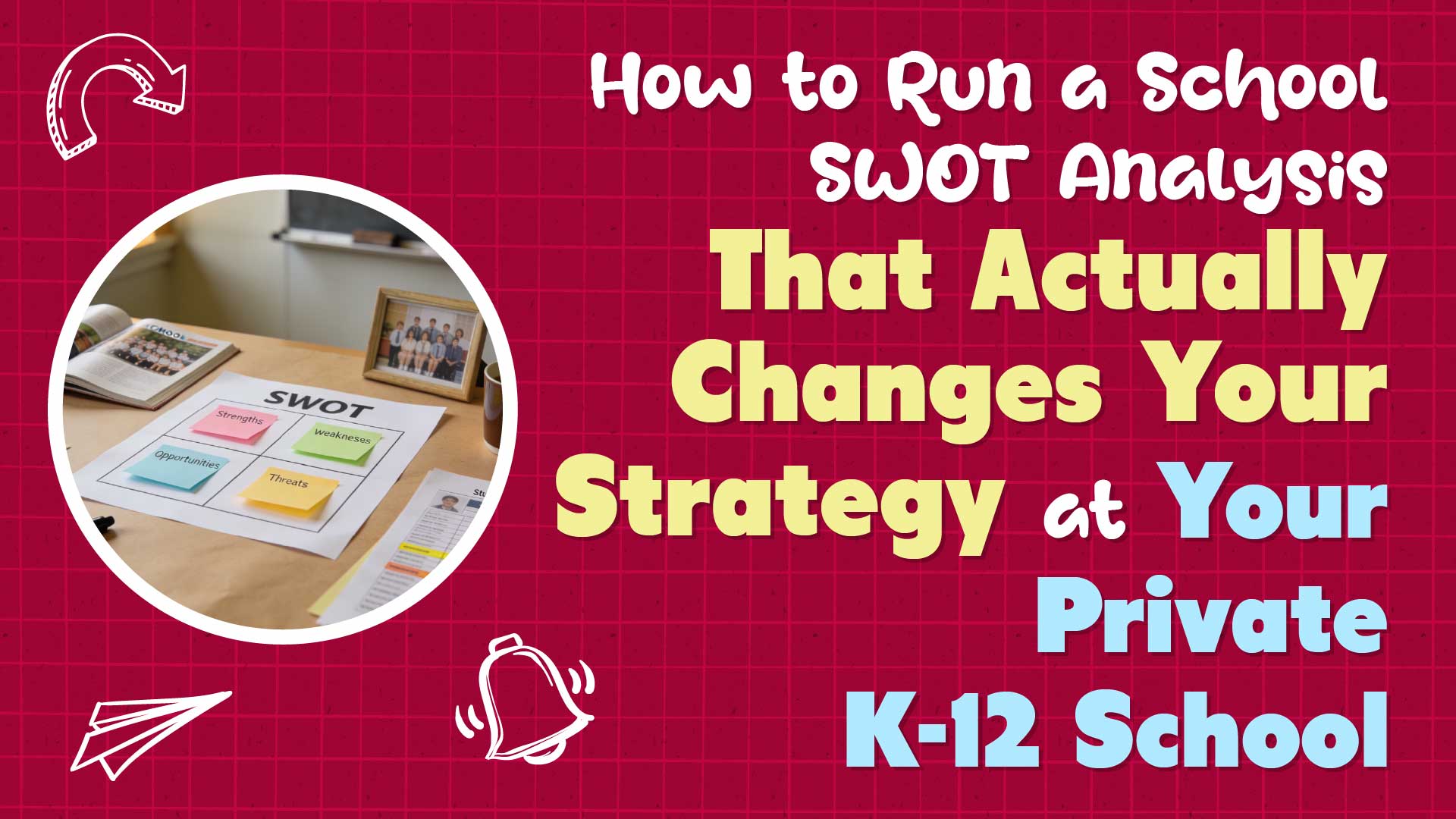
A real SWOT analysis is supposed to be the diagnostic that drives every enrollment and marketing decision you make for the next year. Most schools do not use it that way because most schools have never been shown how. They treat SWOT as a brainstorming exercise; it should be a stress test.
This guide is for the principal who is also the marketing director, the admissions counselor, and the person fixing the website at 10 PM. We work with private school leaders every week who tell us their last SWOT produced exactly zero decisions. Here is how to run one that does.
Written By: Adam Bennett | June 03, 2026
Adam is the president and founder of Cube Creative Design and specializes in private school marketing. Since starting the business in 2005, he has created individual relationships with clients in Western North Carolina and across the United States. He places great value on the needs, expectations, and goals of the client.