Local search engine optimization (local SEO), also called local link building, refers to optimizing your websites or web pages for better local exposure in the search engines. Local SEO is like organic SEO in that it also is a method affecting the visible presence of a site or a page in the search results of a particular search engine, often called the "organic" or "unpaid" results. Organic search results are those that are generated by the engines based on natural user searches for a given keyword/phrase. These natural searches are what your organic optimization efforts are aimed at.

Written By: Chad J. Treadway | April 10, 2021
Chad is a Partner and our Chief Smarketing Officer. He will help you survey your small business needs, educating you on your options before suggesting any solution. Chad is passionate about rural marketing in the United States and North Carolina. He also has several certifications through HubSpot to better assist you with your internet and inbound marketing.

When any of us have a question, we often go to the great curiosity and question answering service, also known as Google. Now the question becomes how do you ensure that your business shows up for those searches. To answer this question, you should take a multi-pronged approach.
To increase your rankings in the search engines, primarily Google, and ultimately drive more online visitors to your website, you need to focus on search engine optimization (SEO) and content marketing.
While doing your own SEO is doable, it can be a bit of an overwhelming process, but it doesn’t have to be.
What is SEO?
SEO is an umbrella term for optimizing your website for the search engines. Under this umbrella, you will find:
All of these combined helps to ensure your website can be found by the search engines.

Utilizing Buyer Personas to target the right audience
With SEO and content marketing, it is imperative to understand who your target audience is. Google is continuously evolving to ensure searcher intent is maximized. In other words, they keep tweaking things to make sure searchers get the best results for their query. By utilizing a buyer persona, you have previously built, you can focus on content, keywords, and keyword phrases.
The key to SEO lies in the keywords and keyword phrases
Whenever you write content for your site, be it for your blog, homepage, landing page, or geographic landing page, you should be using keywords naturally throughout that content. This also includes any meta descriptions or title tags you create. Ultimately, keywords and keyword phrases help tell the search engines what your page is about.
For example, if you had a website that talked about cars, given the context of your site and keywords used on your site Google and the other search engines will know if you were talking about automobiles, the band, or the movies.
Keep in mind as you are searching that not all searchers use the same jargon or language as you do or your industry uses. By targeting the “layman’s terms,” you may be able to edge out ahead of your competition if they aren’t targeting those.
How to find keywords
Unlike doing a research paper when you were in school, you can’t simply copy information from the encyclopedia or copy and paste information from the internet for the younger audiences. You need to use your buyer persona to help determine the best keywords for the content you are writing.
Here are 17 tools, both free and paid, you can use for research:
- Adwords Keyword Planner
- Ahrefs Keywords Explorer
- Google Search Console
- Google Trends
- Jaaxy
- Keyword Snatcher
- Keywords Every Where
- KeywordTool.io
- KWFinder
- Moz Keyword Explorer
- QuestionDB
- SECockpit
- SEMRush
- Serpstat
- SpyFu
- Ubersuggest
- Wordtracker
As you start searching, you will find other keywords you might not have thought about. You will want to look at the search volume and difficulty scores, then prioritize which words you want to go after.
Keep in mind that there are also golden opportunities in long-tail keywords or keyword phrases. Often users will ask an entire question into the search bar. You may be able to target those searches with your content.
If you are looking for more specifics on keywords, check out this blog from Ahrefs.

Technical SEO
The line between Technical SEO and On-page SEO is somewhat blurred. For this post, I am breaking them into two. Technical SEO involves SEO elements and structure on your site you can control, like the title tag and meta description that show up in the search results. On-page revolves more around the keywords, content including text, images, and multimedia.
Don’t you forget about me?
When a user comes to your site, do they start singing “Don't You (Forget About Me)” because you forgot who is supposed to be using your website? Is your website overloaded with jargon and terms that your industry uses but the layperson wouldn’t know? Is your website keyword-stuffed, or have you used enough keywords that your text is difficult to read?
Currently, Google’s algorithm can not only determine if you have keyword stuff, but it can also determine and measure a website’s user experience (UX) and reward with great UX. Things such as a clean and straightforward navigation/menu structure and sitemaps help Google discover content to show searchers.
We live in a mobile world.
Think about how you use your mobile device on a day-to-day basis. I care to bet you use it to perform more searches than you realize, from getting directions to a business or looking up business hours. According to Think With Google, there are more searches on mobile than on desktop. Think With Google said, “75% of smartphone users expect to get immediate information while using their smartphone.” Also, studies have shown that 70% of mobile searches lead to online action within just one hour.

With mobile being so prevalent, Google has developed a mobile-friendly website tester that you can run your site through to see how it fares.
The Fast or the Furious
Have you ever gone to Google and searched for something, then clicked one of the top links, and the webpage takes what seems like forever to load? How did that make you feel? What if you waited all that time only to find out that they didn't have the answer you were looking for?! I am sure you might be frustrated or even furious with the precious time you wasted. Well, Google realizes that speed matters and how quickly your website loads are critical to how Google ranks your site for SEO. The load time will not only impact your rankings, but it also adds friction to the user experience. I call friction “The F-word” of the internet. Ideally, a web page should load in 1-2 seconds, but sometimes 5 seconds is acceptable.

Titles, Headings, and Meta descriptions
One part of the technical SEO that is overlooked is ensuring the proper usage of the title tag, headings, and meta descriptions.
Need an image of the SERPs here for an example
Title Tags
Sometimes a minor, common-sense tweak to a title tag can make a big difference. Your title tag will show up in the search engine results pages (SERPs) and is often what will catch a searcher’s eye to read the description of your page.
Be sure your title and your first-level header don’t match. If your page's title and h1 tags match, then Google may think that your page is over-optimized (yes, that is a thing) or you are attempting to keyword stuff. Besides, using the same content in titles and headers means a lost opportunity to incorporate other relevant keywords for your page. Google has a great article on creating good titles and snippets for the SERPs.
Proper heading usage
According to the HTML5 standards, multiple h1 tags are allowed. However, it is typically a bad idea to have more than one per page. The easiest way to think about the title tags and the “h tags” is to think about it as a book. The title tag would be the title of your book. The h1 would be the chapter’s title, then the headings inside the chapter would be h2 to h6. You also want to keep your headings sequential. In other words, you shouldn’t have an h2 with an h4 directly under. That h4 should be an h3.
Meta description
A meta description tag is a brief summary (150-160 characters) of a webpage's content that helps search engines understand what the page is about and can be shown to users in search results. Google says that meta descriptions do not directly impact search engine rankings. However, they can and will indirectly affect your SEO through click-through rates.
Think about this; a good description helps users know what your page is about and encourages them to click on it. If you would like to learn more about meta descriptions, Google has an article about creating good titles and snippets, and SEMRush has one about meta descriptions.
Other technical SEO items
There are a few more things to think about that are beyond the scope of this post. They include:
- Enabling HTTPS
- Checking your htaccess file for the proper www resolve
- Checking canonical URLs
- Having a robots.txt file
- Having a sitemap.xml file properly formatted and not too large

On-page SEO: Feed me, Seymour
Now that you have an idea of what people are looking for, you can start to focus more on the on-page SEO and develop content on your site for the search engines to find and consume. Think of Google as Audrey II, the plant in the play Little Shop of Horrors. The more you feed it, the more it wants, and the more it comes around. Thankfully, unlike Audrey II, you don’t have to feed Google a person to make it happy, just content.
Ideal forms of content can be:
- Blogs
- Pillar pages
- Landing pages
- Geographic landing pages
Utilize a blog to build authority and keep Google coming back
As I mentioned before, you need to feed Google with consistent content. Posting a few blogs in one month then another six months later isn’t going to cut it. You will need to figure out how much you need based on your audience, your buyer persona, and what your competitors are doing. For most of the small businesses we work with, on average, about one to two blogs per month are sufficient. If you are in a very competitive industry, you may need more to build up your authority.
Your blog doesn’t have to be full of text. Utilizing videos and infographics can also be a great way to add some variety. We recommend that you post a video that you consider getting it transcribed and placed on the website.
With your blog, there are a few things you will want to do and some you don’t want to do:
Don’t scrape content from another site!
While it is acceptable to use a competitor’s site to help you get started, you don’t want to copy it directly. It is one of the easiest ways to drop in the rankings and get punished by the search engines!
Use Internal Links
As you are building out your blog, you will want to incorporate links to other blog posts and other pages on your site. If you think of your website as a neighborhood, Google doesn’t want to come to a cul de sac. It would much prefer to get lost in it, just like that neighborhood that is easy to get lost in unless you live there or know it well.
Landing Pages
Landing pages are simply pages on your website, and like any other page on your website, they are there to provide value and information to a searcher. Generally, there are three types of landing pages:
- A marketing landing page is typically used in conjunction with some type of campaign where traffic is directed to it. This may be for a content offer or from a social media or advertising campaign.
- SEO landing pages, as the name implies, are highly optimized for search engines and user intent. Google strives to serve the most relevant content to what a searcher is searching for, and an SEO landing page can help with that.
- Geographic landing pages, geo-targeted landing pages, or local landing pages, as they are sometimes called, will focus on one keyword or keyword phrase and a geographical location. They are designed primarily for local searches. These work best with service area businesses or businesses that have a geographical target area or territory.
Off-page SEO
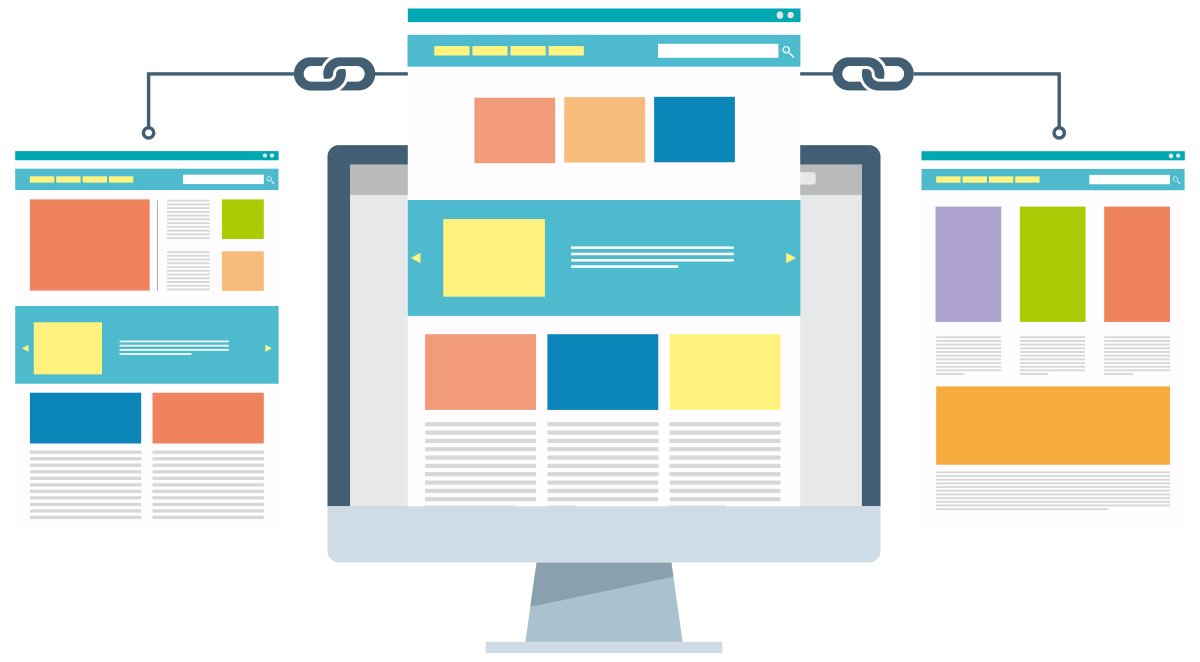
Of all the items I have talked about thus far, off-page SEO is the most difficult. With this, you are looking to get links from reputable sites. The best way to think about this is to think about a piece of research written by a scholar. The scholar will have referenced others' work in their article. Then they hope that another scholar will pick it up and reference it as well. Have this happen enough, and the researchers' authority will go through the roof! Now replace the scholar with your website. If you have a blog or a page on your site, your goal is to get others to link to it, thus sending your website and your authority through the roof!
Getting Backlinks
The SEO community will often refer to these types of links as backlinks since they link back to your site. This begs the question of how do you get more backlinks?
Let’s first look at what you don’t want to do, which is, for whatever reason buying links! You can get penalized in the SERPs faster than you can say the word penalized. This will also negate any of the hard work you’ve put into your site’s SEO.
The easiest way is to have great content that people want to link to. To go back to our scholarly example, the research was sound. Thus, others wanted to cite and link to it. You want the same for your content.

Local SEO
If you are a service area business or service, a geographical area, focusing on local SEO is a must. As I mentioned before, geographical landing pages are essential. In addition to having geo pages, you will also want to focus on your Google My Business listing page. While I won’t go into all the details here, I have a detailed post that you can find here about Google My Business.
Build Your Social Media Network
Social media enables you to connect with your clientele, industry partners, and the general public. If you are a small business, you should have a social media presence on at least Facebook, Instagram, Twitter, or LinkedIn.
Sharing your content on social media helps drive traffic back to your website and helps keep you top of mind with those that like and follow your social media channels.
Is it difficult to do SEO yourself?
As you can see, SEO and developing content monthly isn’t for the faint of heart. While it is 100% doable by most businesses, the question becomes, what is your core business? Unless you are a website designer, web developer, or marketing agency, you may be better off either hire someone in-house to manage and take care of this for you or hire an outside agency.
If you are looking for an agency, we would love to have a conversation with you to determine if we are the right fit. Even if we aren’t, we are here to help you succeed in finding the right fit for your small business.
Written By: Chad J. Treadway | April 07, 2021
Chad is a Partner and our Chief Smarketing Officer. He will help you survey your small business needs, educating you on your options before suggesting any solution. Chad is passionate about rural marketing in the United States and North Carolina. He also has several certifications through HubSpot to better assist you with your internet and inbound marketing.

When marketing, it’s imperative to know who is your target customer or client. You want to make a personal connection on social media and through marketing to make the most impact and defining that audience will help accomplish that task.
Florist Francine. Pastor Paul. General Contractor George. A buyer persona (or marketing persona) is a description of a sample customer that helps you can create marketing materials that will affect that sample customer. It's important to understand who your target audience is so that you can get the most bang for your marketing dollars. Past data from your website, past customers, and social media can help determine who your past audience is. Creating personas for the type of customer you want to work with in the future is important to help your business grow.

Written By: Adam Bennett | March 29, 2021
Adam is the president and founder of Cube Creative Design and specializes in private school marketing. Since starting the business in 2005, he has created individual relationships with clients in Western North Carolina and across the United States. He places great value on the needs, expectations, and goals of the client.

What is inbound marketing? HubSpot’s definition is "Inbound marketing is focused on attracting customers through relevant and helpful content and adding value at every stage in your customer's buying journey. By creating content designed to address the problems and needs of your ideal customers, you attract qualified prospects and build trust and credibility for your business." In other words, inbound marketing is about educating the user through various online media. You may have also heard it called digital marketing or content marketing. The bottom line is you are providing the answers searchers, visitors, prospects, and even clients need when they want them and need them, leading them to seek your business services.
In contrast, traditional or "outbound" marketing involves reaching out to potential customers using advertising, distribution promotions, or sales campaigns in hopes that they need your services now or will remember you when they do need your products or services.
Does inbound replace outbound?
The short answer is no. Every business benefits from more exposure and brand awareness! However, we live in a time where information is just a click away. On average, today's buyers are 70% through the buyer’s journey before a salesperson enters the picture. In the next few years, it is expected to be around 80%! Success comes when businesses are savvy enough to incorporate their sales and marketing together, then add in the perfect mix of innovative inbound marketing with their tried-and-true marketing efforts.
Let your website supply the answers
As I stated earlier, your website needs to answer the questions that your prospects are asking. The best way to do this is to create pages or utilize a blog that answers the questions that you frequently get from customers and the general public. According to Pardot, 72% of buyers turn to Google during their awareness stage, and 70% return to Google in the consideration stage of the buyer’s journey.
Inbound is a marathon, not a sprint.
Inbound marketing takes time and is an exercise in patience. According to Sparktoro, Google owns 93% of the search market among all their properties. Google is continuously evolving to help provide the most relevant content for the user, called searcher intent. It will reward you and reward you handsomely for helpful content that ultimately answers the buyers’ questions. The old search engine optimization (SEO) tactics and black hat tricks don't work anymore.
Let’s not put the cart before the horse
Every website needs a call-to-action (CTA) item such as a Contact Us button or form. The problem is that 99% of your website visitors aren't ready to buy the cart yet. Stretch your idea of a CTA from a sales-oriented call (to sell the cart) to giving your web visitors something useful and educational (the horse). Examples of useful gifts include a case study, infographic, whitepaper, ebook, or checklist.
Hey Jenny I got your number...
Always have a way for your prospect to reach out to you either by phone or email. We have found contact forms work well. Additionally, always list your phone number for those who prefer calling versus emailing a company.
Want to know how inbound can help your business? Contact us, and we will be happy to have a conversation with you!
Written By: Chad J. Treadway | March 23, 2021
Chad is a Partner and our Chief Smarketing Officer. He will help you survey your small business needs, educating you on your options before suggesting any solution. Chad is passionate about rural marketing in the United States and North Carolina. He also has several certifications through HubSpot to better assist you with your internet and inbound marketing.