The best SEO services for pest control lead generation are the ones that work on what happens after a homeowner finds you. That means review generation, complete and honest listing information, service-area pages that answer real questions, and lead tracking that connects a phone call to a booked job. Ranking work gets you seen. This work gets you called.
That difference is missing from most SEO proposals. Plenty of pest management companies are paying for better rankings and getting exactly that, while the route board looks the same as it did last year.
You know the feeling if you have ever opened your analytics on a Tuesday morning, watched traffic climb, then checked the schedule and found the same four openings sitting there. Traffic went up. Nothing else did.
This post covers why rankings and booked jobs are two separate problems, which SEO services fix the second one, and how to tell whether your monthly invoice is buying leads or charts.

Written By: Chad J. Treadway | September 03, 2026
Chad is our Chief Smarketing Officer. He will help you survey your small business needs, educating you on your options before suggesting any solution. Chad is passionate about rural marketing in the United States and North Carolina. He also has several certifications through HubSpot to better assist you with your internet and inbound marketing.
Every pest control owner I talk to has the same reaction to pest control certifications. Somewhere between "we already have licenses, isn't that enough?" and "my competitor put a badge on his truck, and now I need one too." Both reactions are honest. Neither one is a strategy.
Here is the part almost nobody explains clearly. Licensing and certification are not the same thing; they do not do the same job, and only one of them helps you win a customer. Licensing is the permission slip that lets you operate. Certification is the proof that you operate better than you legally have to.
I work with pest control companies that range from two-truck startups to regional operations running six figures a month in ad spend, and the certification question comes up at every size. So this guide covers all of it. What the law actually requires. What the voluntary credentials are, what they cost, and who qualifies. Which ones are worth pursuing at your company's size. And the part most certification guides skip entirely: what to do with the credential once you have it, because a credential your customers never see is an expensive filing cabinet decoration.
Written By: Chad J. Treadway | September 02, 2026
Chad is our Chief Smarketing Officer. He will help you survey your small business needs, educating you on your options before suggesting any solution. Chad is passionate about rural marketing in the United States and North Carolina. He also has several certifications through HubSpot to better assist you with your internet and inbound marketing.
The best SEO services for pest control companies come down to three: Google Business Profile and local pack work, on-site technical and content SEO built around your service areas, and steady review plus local citation work. Buy those three and skip the rest until they are working.
That is the short answer. Three more questions decide whether you get value out of it, and this post covers each one: how organic SEO stacks up against Google Ads and Local Services Ads, what the three services should cost you, and how to tell a pest-control-specific agency from a generalist.
Now the part nobody puts in a sales deck. Most SEO proposals sent to pest control business owners bundle 30 line items into one monthly price, and half of those line items do almost nothing for a service-area business. SEO for pest control is a lot like a termite treatment: the work you cannot see from the curb is what holds the house up, and the decorative stuff on top does not stop anything from chewing. Knowing which three services carry the weight is how you stop paying for the decorative stuff.
Written By: Chad J. Treadway | September 02, 2026
Chad is our Chief Smarketing Officer. He will help you survey your small business needs, educating you on your options before suggesting any solution. Chad is passionate about rural marketing in the United States and North Carolina. He also has several certifications through HubSpot to better assist you with your internet and inbound marketing.
If your school's website gets 10,000 visitors during enrollment season and converts at the private school average of under 2%, that's fewer than 200 inquiry form submissions. If you convert at 5%, that's 500. Same traffic, same ad spend, same SEO effort; 300 more families in your admissions pipeline because the website did its job.
That gap is what a school website conversion audit is designed to close. Not a redesign. Not a rebrand. A systematic review of the pages, forms, and pathways families use when they're deciding whether your school is worth a phone call. (If you need a broader look at your enrollment season website strategy, start there and come back here for the conversion-specific audit.)
For school admissions teams heading into the spring enrollment window, this is the highest-return project you can run right now. You've already spent the money driving traffic. The question is whether your website is converting that traffic into inquiries or quietly sending families to the school down the road.

Written By: Adam Bennett | September 01, 2026
Adam is the president and founder of Cube Creative Design and specializes in private school marketing. Since starting the business in 2005, he has created individual relationships with clients in Western North Carolina and across the United States. He places great value on the needs, expectations, and goals of the client.
You did not sit down five years ago and design a technology stack. Almost nobody did. You bought a scheduling tool because dispatch was a mess. You added call tracking because you could not tell which ads were working. Somewhere along the way, a CRM showed up, then a review tool, then a second thing that does half of what the first thing already does.
By the time you are running 60 or 80 technicians across several locations, that pile of tools is your pest control technology stack whether you planned it or not. We help regional pest control companies sort out what that stack should look like, and the honest answer for 2027 is that most operations your size are paying for redundancy, sitting on gaps, and guessing at the numbers that should be driving decisions.
This post is not a software roundup. It is an assessment framework. The point is to step back, look at the whole picture, and ask the questions a 75-technician operator should be asking about every tool they pay for. Once you know what you have, deciding where to spend in 2027 gets a lot easier. That investment decision is its own conversation, and we cover it separately.
Written By: Adam Bennett | August 28, 2026
Adam is the president and founder of Cube Creative Design and specializes in private school marketing. Since starting the business in 2005, he has created individual relationships with clients in Western North Carolina and across the United States. He places great value on the needs, expectations, and goals of the client.
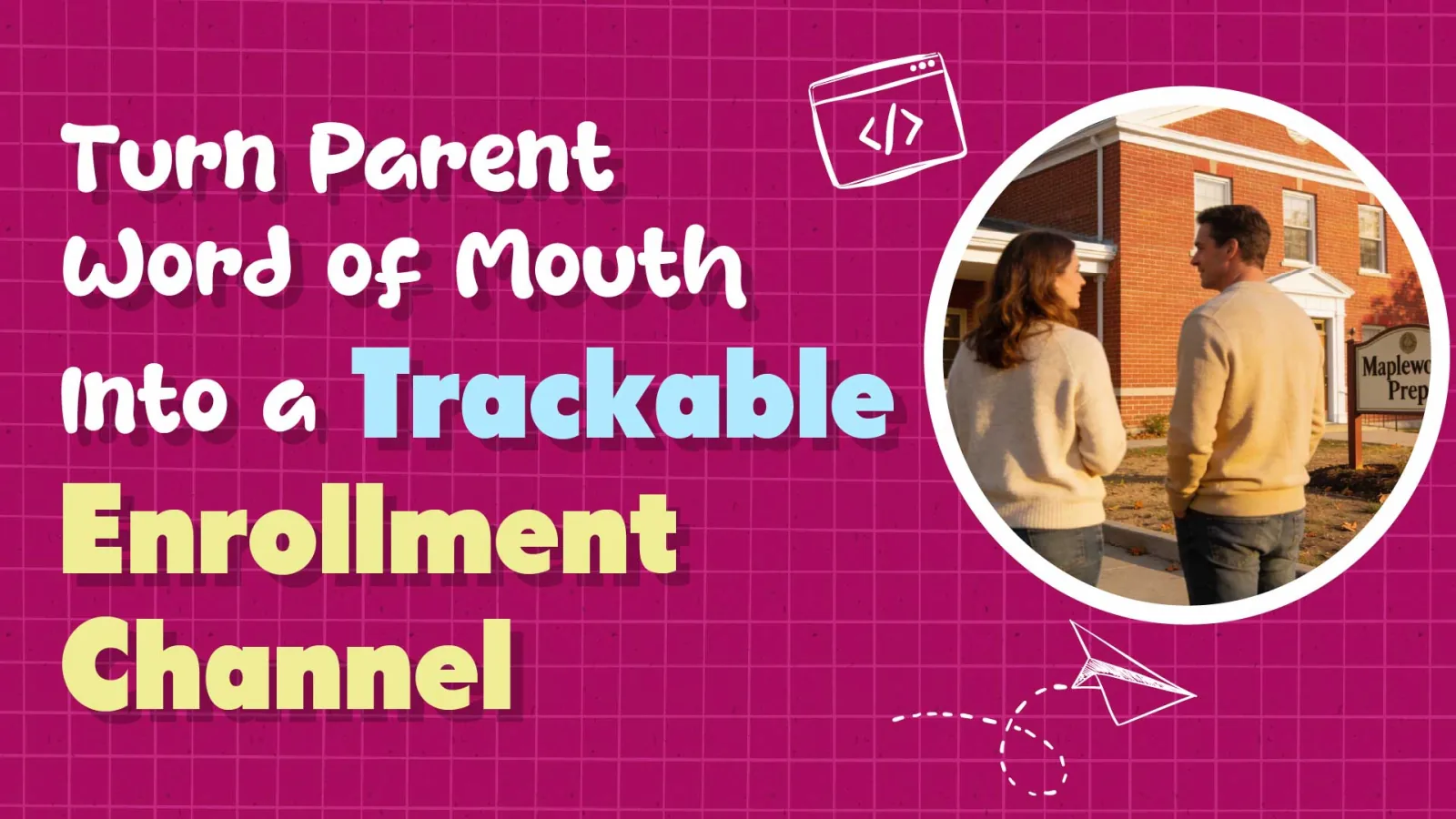
You have families who would recommend your school to a neighbor tomorrow. The trouble is you have never asked them to, and you do not have the ad budget your better-funded competitors spend to chase strangers. A school referral program solves both problems at once, and it is one of the few marketing moves that pays for itself. For the faith-based and independent schools we work with, it is often the highest-return option available to a principal who runs admissions, marketing, and half of everything else without a dedicated team.
This is not a piece about why word of mouth matters. That case is already settled, and we made it in detail in our guide to why word of mouth drives school enrollment. This is the build-it-yourself manual: how to design the incentives, track the results, write the rules, and defend the whole thing to a board that watches every dollar. If you have been treating recommendations as a happy accident, this is how you turn them into a channel you can count on.
Written By: Adam Bennett | August 28, 2026
Adam is the president and founder of Cube Creative Design and specializes in private school marketing. Since starting the business in 2005, he has created individual relationships with clients in Western North Carolina and across the United States. He places great value on the needs, expectations, and goals of the client.

The user visits the small business website, looks around for a few seconds, and either decides to stay or leave. The choice is made quicker than most entrepreneurs think, and it happens without any words from the copy being read. This is the hidden and humble place where contemporary web design services win a lead or miss an opportunity.
Small firms have been thinking about their websites as digital pamphlets for decades - something to own and not something to work for them. This is an extremely old-fashioned method and does not apply to our times anymore. A properly built website is a salesman who would never get sick, never miss a call back, and would always greet all guests in the same manner.

AI no longer requires a massive technology budget. Small businesses can now use AI for marketing, customer service, operations, reporting, scheduling, and other everyday tasks without building everything from scratch.
The bigger challenge is spending money on the right AI capabilities.
Small businesses often make one of these two mistakes. They either subscribe to too many AI tools because each one looks useful, or they invest in a custom AI system before proving that the problem actually needs one.
A smarter approach starts with the business process, not the technology.
Recent research from JPMorganChase shows that entry costs for small-business AI adoption have fallen significantly. Businesses adopting AI in 2025 started at a median monthly spend of about $20, compared with around $50 for businesses that adopted in 2019.
That makes AI more accessible, but businesses still need to control how they spend.

Ask an admissions director where their best-fit families come from, and the honest answer is rarely "our June Facebook campaign." It is some version of "a current parent told a friend." That answer is easy to shrug off as nice-to-have, right up until you try to put a number on it. If you lead marketing for one of the private and independent schools competing for the same families every spring, school word of mouth is not a soft metric you tolerate. It is the channel quietly doing the heavy lifting your paid budget gets credit for.
Here is the uncomfortable part. Most schools spend real money influencing awareness through ads, viewbooks, and open house promotion, and almost nothing influencing the conversations that actually move families to enroll. This post makes the strategic case for flipping that instinct: why personal recommendations outperform your own marketing, where they enter the enrollment funnel, what strengthens or quietly poisons them, and how to treat word of mouth as a channel you can shape instead of a happy accident you hope repeats.
Written By: Adam Bennett | August 26, 2026
Adam is the president and founder of Cube Creative Design and specializes in private school marketing. Since starting the business in 2005, he has created individual relationships with clients in Western North Carolina and across the United States. He places great value on the needs, expectations, and goals of the client.
You already know what October does to your phone. The temperature drops, mice and rats start hunting for somewhere warm, and suddenly every third call is about scratching in the walls. The problem is not that you fail to see rodent season coming. The problem is that your competitors see it too, and most operators start their push the same week. Good rodent control marketing is about showing up before that week, while homeowners are still Googling and your rivals are still asleep. This piece is written for the data-driven operator who runs the kind of pest control companies where every marketing dollar has to prove its worth, not the franchise owner who gets a playbook mailed from corporate.
You do not need a lecture on seasonality. You need a system that gets you in front of the customer before the customer admits they have a problem. That is what the next few thousand words lay out: how big the window really is, why your region changes the message, what to have ready before September, and how to turn the busiest season of the year into recurring revenue that lasts long after the cold breaks.
Written By: Adam Bennett | August 26, 2026
Adam is the president and founder of Cube Creative Design and specializes in private school marketing. Since starting the business in 2005, he has created individual relationships with clients in Western North Carolina and across the United States. He places great value on the needs, expectations, and goals of the client.
You have the monthly agency call on the calendar, and you already know how it goes. Traffic is up. Impressions are up. The team is "still fine-tuning the campaigns." You nod, you say thanks, and you hang up with the same feeling you had last month: something is off, and the slide deck isn't telling you what.
If you have started to wonder whether you should switch pest control marketing agencies, you are probably not being paranoid. You are being a good operator. Your route board is the truth. The reporting dashboard is a story, and lately the story and the route board don't match.
Here is the honest part most articles skip. By the time a busy owner or marketing manager starts asking this question out loud, the answer has usually been brewing for six months or more. The feeling you can't quite name has a name. It is the compounding cost of staying: a little less lead flow, a few more "we're refining the targeting" calls, a slow drift where the agency keeps getting paid and your route board keeps getting lighter.
That drift is the trap. Nothing breaks loudly enough to force a decision, so you keep paying and keep waiting for the rebound that never comes. At Cube Creative Design, we work only with pest control companies, and we have seen both sides of this: the relationships that quietly stopped working, and the ones worth saving.
This is not a "seven warning signs" listicle. It is a framework. We will sort the real problems from the fixable ones, do the math on what staying costs you, and walk through the mechanics of switching without torching your lead pipeline along the way.
Written By: Adam Bennett | August 26, 2026
Adam is the president and founder of Cube Creative Design and specializes in private school marketing. Since starting the business in 2005, he has created individual relationships with clients in Western North Carolina and across the United States. He places great value on the needs, expectations, and goals of the client.

Your best families are already talking about your school. The question is whether anyone at your school has a plan for it. A parent ambassador program gives that talk a structure, so the trust your happiest families carry actually reaches the prospective parents sitting on the fence. For directors of admissions and marketing at private and independent schools, that structure is one of the highest-return, lowest-cost moves available. This guide walks through what a parent ambassador program is, why it works, and how to recruit, train, support, recognize, and measure the parents who run it.
Written By: Adam Bennett | August 24, 2026
Adam is the president and founder of Cube Creative Design and specializes in private school marketing. Since starting the business in 2005, he has created individual relationships with clients in Western North Carolina and across the United States. He places great value on the needs, expectations, and goals of the client.