Small pest control companies have three realistic SEO options. You can do the free local work yourself. You can hire a freelancer or budget service for roughly $500 to $1,200 a month. Or you can retain a full-service agency for roughly $1,500 to $3,000 a month. DIY covers your Google Business Profile, your listings, and your reviews. A freelancer adds on-page work and citation cleanup. An agency adds strategy, content, technical fixes, and reporting you never have to build yourself.
That answer raises a harder question: which tier fits a company your size right now? Independent pest control companies running two or three trucks are not picking between a good option and a bad one. They are picking between what the checkbook allows this month and what the business will need in 18 months.
Termite work makes a fair comparison. You can set a few bait stations yourself and slow the problem down. Eventually the job needs a licensed crew, a full inspection, and a warranty behind it. Search works the same way. Here is what each tier delivers, what it really costs, and the exact point where each one runs out of road.

Written By: Chad J. Treadway | September 14, 2026
Chad is our Chief Smarketing Officer. He will help you survey your small business needs, educating you on your options before suggesting any solution. Chad is passionate about rural marketing in the United States and North Carolina. He also has several certifications through HubSpot to better assist you with your internet and inbound marketing.

Your school has a list of what makes it special. Prospective parents have a different list. The two overlap less than most admissions teams want to believe, and the gap costs you applications every single cycle.
Ask a marketing director what parents look for in a school, and you usually get the viewbook answer: small classes, caring faculty, strong college placement, a warm community. None of that is wrong. It is just unranked, unproven, and identical to what the school across town is saying. Meanwhile, the national research on parent decision-making is unusually specific about which factors carry weight, which ones parents cannot evaluate from a website, and which ones quietly decide the whole thing.
We build enrollment marketing for private and independent schools, and the same pattern shows up almost everywhere. The channels are already running. Somebody posts to Instagram, somebody sends the monthly email, the blog gets a few posts a quarter. What is missing is a connection between those channels and the handful of things a family is actually weighing at the kitchen table.
This post walks through what the research says parents prioritize, then repoints each of your existing marketing levers at a specific decision factor. Social proof, content, email, search, and community work all stay. What changes is the job each one has to do.

Written By: Adam Bennett | September 14, 2026
Adam is the president and founder of Cube Creative Design and specializes in private school marketing. Since starting the business in 2005, he has created individual relationships with clients in Western North Carolina and across the United States. He places great value on the needs, expectations, and goals of the client.

Plenty of the families who RSVP to your fall open house will never walk through the door. Most of the ones who do show up are not enrolling this year. That sounds like an argument for skipping the whole thing. It is really an argument for planning it better. The event is one of the strongest tools an admissions office has, and the private school leaders we work with treat it as the anchor of their entire fall campaign. This guide walks the full arc in order: plan the event, fill the room, and turn the room into applications.
Written By: Adam Bennett | September 14, 2026
Adam is the president and founder of Cube Creative Design and specializes in private school marketing. Since starting the business in 2005, he has created individual relationships with clients in Western North Carolina and across the United States. He places great value on the needs, expectations, and goals of the client.
Two proposals sit on your desk. One quotes $1,200 a month. The other quotes $3,400. Both use the phrase "monthly SEO management," and neither one explains what that phrase buys you.
Knowing how to compare pest control SEO packages starts with a single rule: do not compare the price first. A dollar figure means nothing until you know the work behind it. I have watched plenty of local pest control businesses sign the cheaper proposal, then spend a year wondering why the phone stayed quiet.
Think of it like a termite bid. Nobody picks a treatment plan on price alone without asking what gets treated, what gets warrantied, and who comes back if the swarmers show up again. Buy SEO the same way. Below are seven criteria to run every quote through.
Written By: Chad J. Treadway | September 10, 2026
Chad is our Chief Smarketing Officer. He will help you survey your small business needs, educating you on your options before suggesting any solution. Chad is passionate about rural marketing in the United States and North Carolina. He also has several certifications through HubSpot to better assist you with your internet and inbound marketing.
Search for QualityPro certification cost, and you will find a remarkable number of pages that confidently tell you the price is not published. It is. It has been sitting on QualityPro's own application page the whole time, in nine sales-volume bands, and it takes about 11 seconds to find.
That tells you something about the state of information on this decision. Owners have to weigh a credential with real fees, real paperwork, and a real annual audit. The pages they read to do it were written by people who never opened the application page.
So here is the version with numbers in it. I work with pest management companies that range from two-truck operations to regional brands, and QualityPro comes up constantly in that middle stretch where an owner has stopped competing on price and started looking for something defensible to say. This post covers what accreditation costs at your sales volume, what the 18 standards will make you change, what the audit involves, and where the return is real versus where the marketing copy oversells it. For the wider view of how QualityPro fits alongside licensing and individual credentials, the complete guide to pest control certifications maps all three layers.
Written By: Adam Bennett | September 09, 2026
Adam is the president and founder of Cube Creative Design and specializes in private school marketing. Since starting the business in 2005, he has created individual relationships with clients in Western North Carolina and across the United States. He places great value on the needs, expectations, and goals of the client.
An SEO provider specializing in home services and pest control is an agency that takes only pest control, HVAC, plumbing, and roofing clients. It already knows how those companies get found. It sets up your Google Business Profile, your service areas, your trade listings, and your review process without a warm-up. Cube Creative Design is one of these shops, built around pest control SEO services instead of general marketing. So are a handful of others.
The harder question is why that focus is worth paying for when a general agency quotes you the same monthly fee.
Here is the honest answer. A generalist bills you for the time it spends learning your business. You pay for the discovery calls, the category mistakes, the seasonality questions, and the blog posts written for homeowners in the wrong month. A specialist starts at month one with those decisions already made. Pest control business owners who have switched usually describe the difference the same way: less explaining, faster starts.
Think of it like hiring a termite tech. Any licensed applicator can read a label. The one who has crawled 400 Carolina crawlspaces finds the damage in 20 minutes instead of two hours. Same license, different speed.
This post covers what a trade focus really changes, what a specialist gets right on day one, how your website platform fits in, and what to ask before you sign.
Written By: Chad J. Treadway | September 09, 2026
Chad is our Chief Smarketing Officer. He will help you survey your small business needs, educating you on your options before suggesting any solution. Chad is passionate about rural marketing in the United States and North Carolina. He also has several certifications through HubSpot to better assist you with your internet and inbound marketing.
Local pest control SEO underperforms for six reasons, and almost all of them sit outside your website. The usual causes are a generic Google Business Profile category, an address setting that fights your service area, an incomplete profile, too few recent reviews, thin content for the towns you cover, and a technical problem Google hit before a customer did. Each one is checkable in an afternoon.
That is the short answer. The rest of this post is the self-audit, cause by cause, with the fix next to each one.
Here is the part that stings. Most owners at pest control companies assume flat rankings mean they need more SEO. Usually they need less broken SEO.
Local search is a lot like a termite inspection. The problem is never where the homeowner points, and the damage sits behind a wall nobody has opened in years. Opening that wall does not take a bigger budget. It takes a flashlight and a list.
Written By: Chad J. Treadway | September 08, 2026
Chad is our Chief Smarketing Officer. He will help you survey your small business needs, educating you on your options before suggesting any solution. Chad is passionate about rural marketing in the United States and North Carolina. He also has several certifications through HubSpot to better assist you with your internet and inbound marketing.

Most schools build admissions content the way they build a viewbook. Start with what the school is proud of, arrange it attractively, and hope the right families see themselves in it. It is a reasonable instinct and a poor strategy, because it assumes families read your material in the order you wrote it. They don't. Understanding how parents choose a private school means accepting that the family runs its own process, on its own schedule, and your website is one input among many.
The good news for private and independent schools is that the process is not random. Researchers have been asking parents how they decide for decades, and the pattern holds across survey instruments, school types, and years. Families follow a sequence. At each step, they need a specific thing from you, and most schools have built content for step two and step four while leaving steps one and three empty.
This post walks the sequence, names the data behind each step, and tells you what to build for it. Consider it a funnel design document rather than a research summary. The parent behavior is the evidence. Your admissions funnel is the deliverable.
Written By: Adam Bennett | September 07, 2026
Adam is the president and founder of Cube Creative Design and specializes in private school marketing. Since starting the business in 2005, he has created individual relationships with clients in Western North Carolina and across the United States. He places great value on the needs, expectations, and goals of the client.

No one hands you a syllabus for this. You decide your child might do better somewhere else, you read four school websites, and you get four versions of the same soft promise: apply this winter, we will be in touch. Then you learn that a private school application has six or seven separate parts, and that other people have to finish half of them for you.
I work at Cube Creative Design, where we build websites and enrollment marketing for private school administrators. I read admissions pages for a living. Most of them are written by people who already know the process, for people who do not. The information is technically there. The sequence almost never is.
This guide lays out what the application actually requires, when each piece comes due, how financial aid changes the schedule, and where families lose the most time. Individual deadlines vary by school, and you should confirm every one of them. The shape of the year does not vary much at all.
Written By: Adam Bennett | September 07, 2026
Adam is the president and founder of Cube Creative Design and specializes in private school marketing. Since starting the business in 2005, he has created individual relationships with clients in Western North Carolina and across the United States. He places great value on the needs, expectations, and goals of the client.
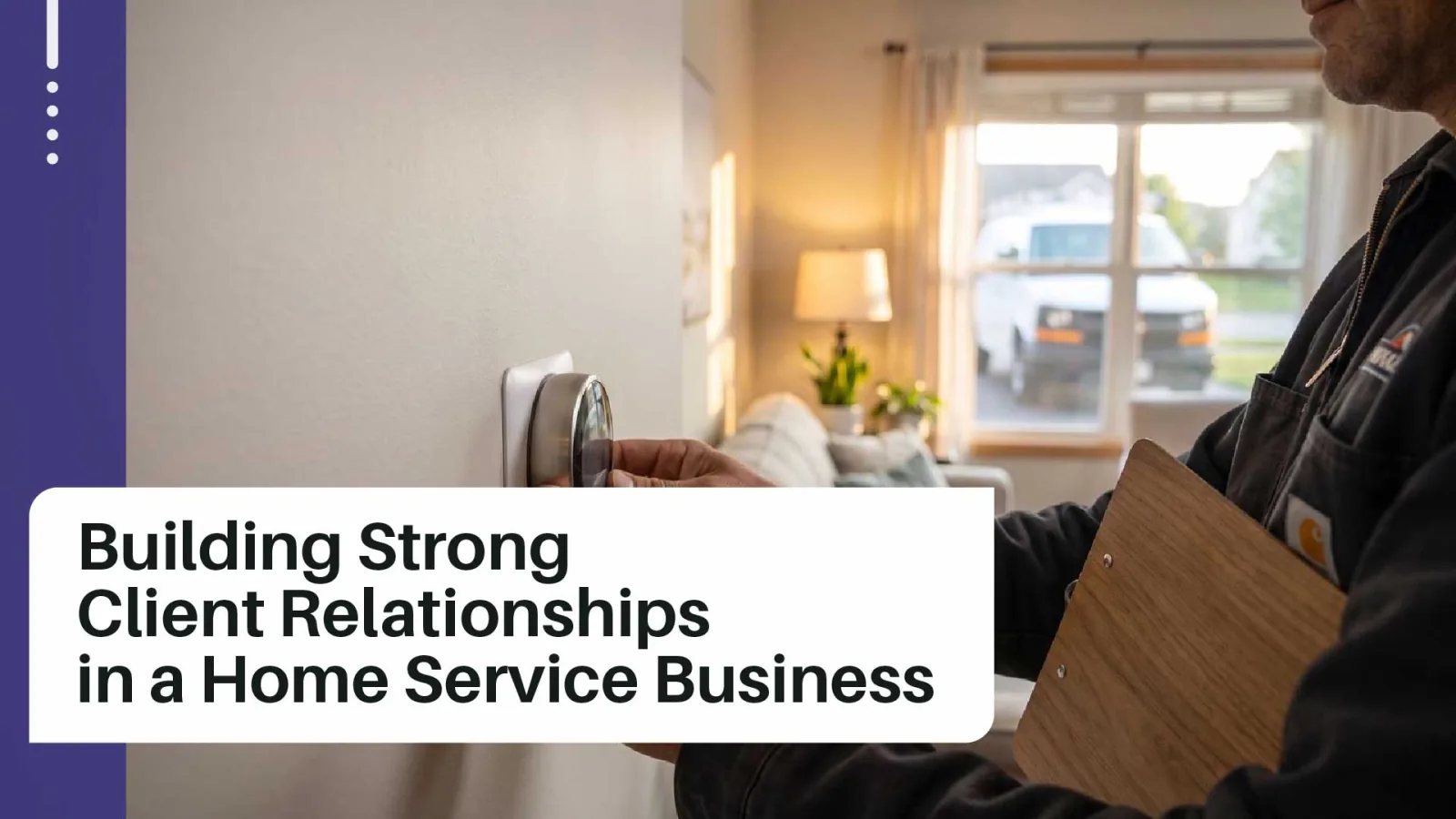
Two technicians finish the same repair on the same afternoon. One closes the ticket, hands over the invoice, and drives off. The other explains what failed, mentions the part that will probably go next spring, and asks whether the customer wants a reminder before the season turns. Six months later, only one of them gets the call.
That is what client relationships in a home service business come down to. Not a soft skill you either have or you don't. A revenue system with moving parts you can actually fix. We market to independent home services companies for a living. The same pattern shows up across every trade. Owners pour money into winning the first call while the second one quietly leaks out the back.
This post covers the three levers that keep customers from shopping around: response speed, service agreements, and seasonal check-ins. Then it covers where all three become visible to the next homeowner who looks you up.
Written By: Chad J. Treadway | September 04, 2026
Chad is our Chief Smarketing Officer. He will help you survey your small business needs, educating you on your options before suggesting any solution. Chad is passionate about rural marketing in the United States and North Carolina. He also has several certifications through HubSpot to better assist you with your internet and inbound marketing.
The best SEO service for pest control franchises is the one that can show you its process for handling profiles, pages, and reviews one branch at a time. Not the one with the slickest deck. Almost every "top pest control SEO agency" list you will find was written for an operator with one office, one phone number, and one map pin. You have a dozen of each, and the tactics do not simply multiply.
If you run multiple locations, judge a vendor on five things:
- Google Business Profile management at scale. Can they verify, structure, and maintain a profile for every branch without creating duplicates?
- Location page architecture. Do their branch pages hold real local content, or the same 400 words with the city name swapped?
- NAP consistency across the network. Is there a system for keeping name, address, and phone identical everywhere each branch appears?
- Per-location review generation. Does every branch run its own review engine, or does one flagship office collect all the stars?
- Pricing that tracks unit count. Does the fee change when you open location 13, and do they tell you how before you sign?
That list is the answer. The rest of this post covers what good looks like on each one. It is the same lens I use with pest control businesses that have outgrown single-site advice.
Written By: Chad J. Treadway | September 04, 2026
Chad is our Chief Smarketing Officer. He will help you survey your small business needs, educating you on your options before suggesting any solution. Chad is passionate about rural marketing in the United States and North Carolina. He also has several certifications through HubSpot to better assist you with your internet and inbound marketing.
Pest control certification marketing is the part nobody plans for. Owners plan the studying, the paperwork, the exam, and the check. Then the certificate shows up, somebody scans it, a logo gets dropped in the website footer, and that is where the story ends. Months of work, filed.
I have watched this happen at companies of every size, from two-truck shops to regional operations. The credential is real. The pride is real. The marketing is a JPEG nobody scrolls to.
That is a fixable problem, and fixing it is cheaper than earning the credential was. This post is for pest control business owners who already hold a credential, or are about to, and want it to produce booked jobs instead of wall art. If you are still deciding which credentials to pursue and what they cost, start with the complete guide to pest control certifications. This one picks up the morning after the certificate arrives.
Written By: Chad J. Treadway | September 04, 2026
Chad is our Chief Smarketing Officer. He will help you survey your small business needs, educating you on your options before suggesting any solution. Chad is passionate about rural marketing in the United States and North Carolina. He also has several certifications through HubSpot to better assist you with your internet and inbound marketing.