If you run a pest control company and your website traffic dropped sometime in 2024, you are not imagining it. You are not behind on something everyone else figured out. And no, your old web guy did not break something on the way out. Three separate Google changes landed inside a nine-month window, and pest control sites took the brunt of all three because of how the industry built its websites between 2015 and 2023. The companies that held up did three specific things differently. The companies that did not are the 90%.
This post is the longer mechanical explainer behind what we have been calling the Triple Convergence. We work with pest control marketing clients across the country, and the same three patterns show up everywhere. If you want the audit summary and the diagnostic, the companion field report covers that. This post is for the owner who wants to understand why the rules changed and what an industry-wide algorithm shift actually looks like at the page level.
What Happened to Pest Control Website Traffic in 2024?
Pest control website traffic collapsed in 2024 because three separate Google changes hit in the same window: AI Overviews launching in May, the free Google Business Profile websites shutting down in March, and a site diversity adjustment compressing through the rest of the year. Each one alone would have been recoverable. Together they wiped out a generation of pest control website traffic.
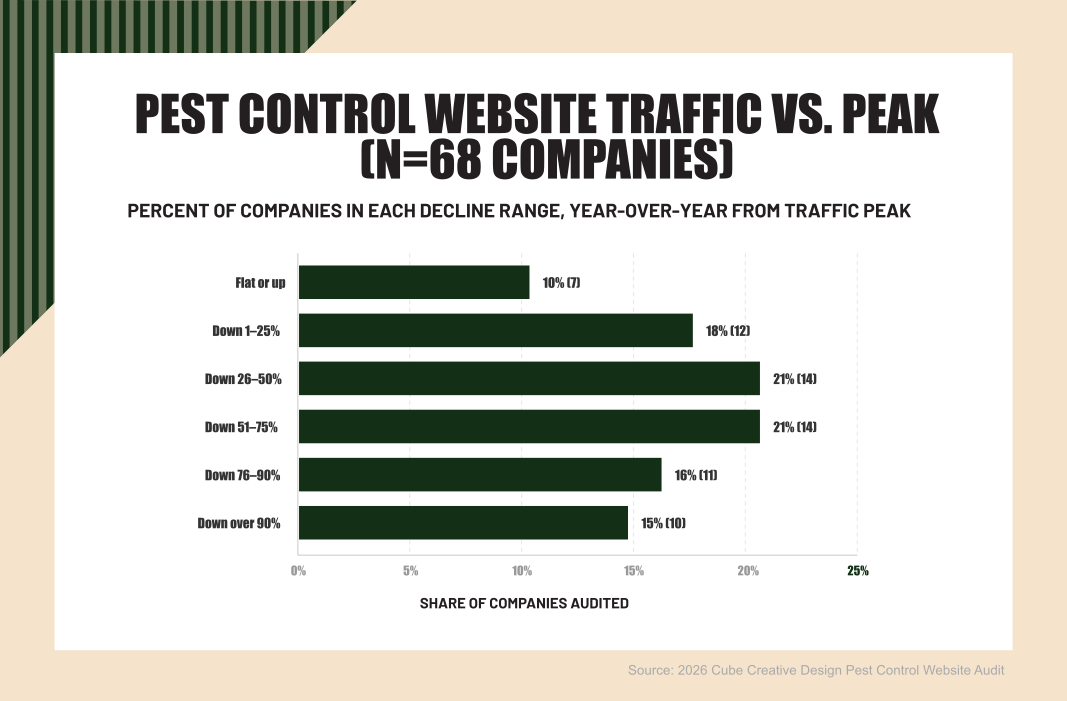
The audit data tells the story plainly. Of the 68 companies with measurable year-over-year traffic data, about 9 in 10 are declining. The median company is down roughly 57% from its previous peak. More than half are down 50% or more. Nearly a third are down 75% or more. Roughly 15%, about 1 in 7, are down more than 90%. The drop is not spread evenly, but the direction is the same almost everywhere.
Source: 2026 Cube Creative Design Pest Control Website Audit
The timing pattern is just as clean as the magnitude. Audited sites were not on a slow gradual slide. They were stable, even seasonal, through early 2024, and then dropped off a cliff in the summer
| Period | Notes |
|---|---|
| 2020–2021 | COVID peak then decline |
| 2022 | Seasonal |
| 2023 | Seasonal |
| Early 2024 (Jan–May) | Seasonal |
| Summer 2024 (Jun–Aug) | THE BIG DROP |
| Fall 2024 (Sep–Nov) | Post-summer decline |
| 2025 | Recent/current peak |
Source: 2026 Cube Creative Design Pest Control Website Audit
The disorienting part is the timing. A site that ranked steadily through 2023, doing the same things it had done for six years, lost half its traffic in a six-month stretch with no penalty notice, no big content change, and no obvious explanation. Owners blamed their websites. They blamed their agencies. They blamed themselves. The reality is the channel itself changed under their feet, and most of the field is still in denial about it.
How Did Google AI Overviews Affect Pest Control Search Traffic?
Google AI Overviews started writing a short AI-generated answer at the top of search results in May 2024, drawing from across the web before any blue links appear. For pest control, that move ate the informational traffic at the top of the funnel. Questions like "what does a termite look like" or "how do I get rid of mosquitoes" now get answered on the results page, with the actual website becoming optional.
According to Google's announcement of generative AI in Search, AI Overviews launched broadly in the United States in May 2024 after the experimental Search Generative Experience phase. Pest control queries were a natural target. They have clear, factual, repeatable answer patterns, and the topic is non-controversial enough that Google's AI is willing to summarize confidently.
Pest control sites had spent the prior decade building exactly the kind of content AI Overviews now replaces. A typical site had 30 to 80 blog posts answering "what is a German cockroach," "are silverfish dangerous," "how often should I spray for ants," and similar questions. That content used to pull in steady traffic that occasionally converted to a service call. AI Overviews short-circuited the click. The blog post is still there. It is still indexed. It is just no longer the place the customer goes for the answer.
Think of it like a customer calling your shop with a question. You used to walk them through the answer on the phone, and a portion of those calls turned into appointments. Now Google answers the question before the customer ever picks up the phone. The phone is not broken. The conversation just stopped happening.
The informational traffic is not coming back. Owners can argue with that or accept it. The 10% who held up made a different call: they shifted their content investment away from "what is" and "how do I" content and toward transactional and local intent. "Termite treatment near me" and "exterminator [city]" still pay. "What do termites look like" no longer does.
How Did the Google Business Profile Website Shutdown Affect Pest Control Companies?
Google retired the free websites that came bundled with Google Business Profiles in March 2024, with URLs redirecting to the underlying Business Profile through June 10, 2024, when the redirects ended, and those pages began returning errors. For pest control operators who relied on the free GBP site as their primary online presence, traffic dropped to zero overnight. The dead URLs still show up in directories, citations, and old customer bookmarks years later.
Search Engine Journal covered the shutdown timeline in detail. The change hit small pest control operators hardest. The free site was a common starting point for newer one-truck and two-truck companies that did not want to pay for a real website and did not have anyone in charge of digital. Some had been running on the free site for five years.
The collateral damage is what owners did not notice until later. Customer reviews and local citations pointed to URLs that no longer existed. Older directory listings on local chamber sites, BBB pages, and pest control association pages kept the dead links live. New customers searching for the company hit a redirect to a bare-bones Business Profile that did not look like a real business. Some called and asked why the website was broken. Most just called the next pest control company in the search results.
The fix is not subtle. Every operator needs a real website with a domain they own, hosted somewhere reliable, with all old GBP-site backlinks pointed at the new site. That work is unglamorous, and most operators put it off. The companies that did the cleanup in 2024 absorbed the shutdown without much pain. The ones that did not are still showing up in our audit as having broken external link signals two years later.
What Did the Google Site Diversity Update Do to Pest Control SERPs?
Google's site diversity system limits how many results from one domain can appear on a single search page, and through 2024 that limit became a much stricter cap on pest control SERPs that had been stacking multiple pages from the same site. Pest control companies that ranked a homepage, a service page, and a geo-page on page one for the same query collapsed into one position. Two positions' worth of traffic disappeared without anyone touching the pages.
The general site diversity behavior is documented in Google's ranking systems guide and was first announced as a site diversity change in Google Search Liaison's 2019 update. The 2024 tightening was not announced under a formal name. SEO industry coverage tracked the effect across home services verticals through the back half of 2024, with pest control showing one of the cleaner before-and-after signatures because pest control SERPs had historically been stuffed with same-domain stacking.
The pest control twist is specific. Before 2024, pest control SERPs had a particular shape: aggregator sites like HomeAdvisor, Angi, and Yelp held several positions, and one or two actual pest control companies stacked a homepage, a service page, and a city page on top of each other for the same query. When Google reduced same-domain stacking, the aggregators lost positions, which was supposed to help small businesses. But the same rule knocked the secondary pages off for the pest control sites that had been stacking. The net real estate per query went down, not up.
The fix is consolidation. The companies that built one strong page per intent did better than the companies that had three thin pages all chasing the same keyword. That is also the connection back to the two most common architectural problems we see in audits. Pest control sites with sprawling, half-overlapping geo-pages got hit harder than sites with a tighter set of focused pages. Same story with thin service pages competing against each other.
Why Did These Three Changes Compound Instead of Cancel Out?
The three 2024 changes compounded because each one hit a different layer of how pest control sites earned traffic, and most sites depended on all three layers at once. AI Overviews took the top of the funnel. The GBP website shutdown took the bottom-tier free presence. The diversity update took the middle-tier coverage. Any one of them would have hurt. Together, they removed almost every path a pest control site had been using to show up.
The audit pattern bears this out. The companies that survived 2024 with traffic intact had three things in common. They had real websites with real domains, not free GBP sites and not Wix landing pages glued together. They had focused service-page and geo-page architecture, not thin duplicate pages competing for the same query. And they had transactional, intent-driven content as their core, not blog libraries built for informational searches.
The companies that got hit hardest had built their entire visibility on informational top-of-funnel content. That was a perfectly reasonable bet in 2018. It is no longer the right model. The phone calls that used to come from "what do termites look like" content are gone. The phone calls that come from "termite treatment [city]" content are still there for the companies that built that work right.
How Do I Know If My Pest Control Website Was Hit by the 2024 Changes?
A simple check covers most of the diagnostic work. If your traffic dropped 25% or more from peak, you are inside the 90%. From there, look at where you are losing traffic and what your site was built on. The three changes each leave a recognizable fingerprint.
Run through this checklist on your own site:
- Has your traffic dropped at all from peak? If yes, you are in the 90%. The decline started in 2024 and has not reversed for most companies.
- Is most of your remaining traffic on informational pages (blog posts about pests, identification guides, "how to" content)? AI Overviews are eating that traffic. The pages still rank. The clicks stopped.
- Are you still relying on a free Google Business Profile site or a third-party landing page as your main web presence? The GBP shutdown is hitting you, and any old backlinks are pointing at a dead URL.
- Do you have multiple thin pages competing for the same keyword (a homepage banner, a service page, a city page, and a blog post all targeting "ant control")? The diversity update is hitting you. Two of those pages are dragging the others down.
Three or more checked, and the traffic loss is not coming back without architectural changes. The longer you wait, the more aggressive the consolidation work has to be.
What Should Pest Control Companies Do to Recover Website Traffic?
The work is consolidation, not expansion. Fewer pages, sharper intent, real local content, and a Google Business Profile that actually matches the website. The companies that recovered in 2025 did not add more content. They cut weak pages, rewrote the survivors, and rebuilt the architecture so each remaining page had a single clear job.
Pick the right starting point based on what is broken:
- If your geo-pages are missing, thin, or duplicated, the geographic landing pages guide covers the build and the cleanup. This is the highest-impact move for most operators.
- If your Google Business Profile is the weak link, the pest control GBP setup checklist walks through category selection, services, posts, and the foundational pieces most owners skip.
- If your reviews are sparse, old, or unanswered, the review response framework covers the request cadence and the reply templates that actually improve map pack ranking.
- If your service pages do not rank for the obvious queries, the service page rebuild guide covers the structure, the intent matching, and the internal linking that make a service page do real work.
The traffic from 2018 to 2023 is not coming back. The leads can come back, with different architecture and a tighter content footprint. If you want to see the full audit data behind these recommendations, the 2026 pest control website field audit breaks down the numbers across all 300 companies.
If you want a second set of eyes on which of the four problems is actually hitting your site, schedule a conversation. No pitch. No upsell. Fifteen minutes of honest feedback beats another year of guessing.
Frequently Asked Questions
When Did Google AI Overviews Start Affecting Pest Control Search Traffic?
Google AI Overviews launched broadly in the United States in May 2024 after the experimental Search Generative Experience phase. Pest control sites started seeing measurable click-through-rate drops on informational queries within a few weeks of the launch, and the decline accelerated through the rest of 2024 as Google expanded the query types AI Overviews covered.
Did Google Actually Shut Down Free Google Business Profile Websites?
Yes. Google retired the free websites that came bundled with Google Business Profiles in March 2024, with URLs redirecting to the underlying Business Profile through June 10, 2024, when the redirects ended, and the pages began returning errors. Pest control operators who relied on the free GBP site as their primary web presence lost their entire web footprint overnight, including dangling backlinks from old directory listings, citations, and customer bookmarks.
What Is the Google Site Diversity Update and How Did It Hit Pest Control?
Site diversity limits how many results from one domain appear on a single search page. Google introduced the rule in 2019 but tightened it through 2024. Pest control sites took the hit because many were ranking a homepage, service page, and geo-page for the same query and dropped from two or three positions per query down to one.
Is Pest Control Website Traffic Coming Back in 2026?
The informational top-of-funnel traffic from 2018 to 2023 is not coming back. AI Overviews are now permanent infrastructure inside Google Search, and Google expanded coverage through 2025. Transactional and local-intent traffic is still available, but only for sites that consolidated their architecture, rebuilt their service pages and geo-pages correctly, and aligned their Google Business Profile with the website.
Why Was the Pest Control Industry Hit Harder Than Other Home Services?
Pest control sites had built unusually large libraries of informational and "what is this pest" content over the previous decade, which made them more exposed to AI Overviews than home services categories with less informational content. They also had a higher rate of free GBP website reliance among smaller operators and a particularly stacked SERP pattern (multiple pages from the same domain) that the diversity update specifically targeted.