If you have ever wondered why a competitor with a worse website outranks you in the map pack, the answer usually sits inside their Google Business Profile, not their website. We audited 300 pest control websites going into 2026 and pulled the GBP data alongside it. The patterns repeat from Charlotte to Cleveland: incomplete profiles, mis-pinned service areas, residential addresses, and review counts that have not moved since 2022. This is the GBP companion piece to our pest control geo-page guide, written specifically for pest control companies trying to figure out why their local visibility has stalled.
Why Is Map Pack Visibility a Setup Problem, Not a Marketing Problem?
Map pack visibility starts with how your Google Business Profile is configured, not how much you spend on marketing. Of the 291 audited companies with stated map pack visibility, 164 of them, or 56 percent, were invisible in their own primary service area, according to our 2026 pest control field audit. Geo-pages help. GBP setup decides whether the help shows up.
Most owners assume the fix is more reviews or more ad spend. The audit data says otherwise. Of the 14 pest control companies that built their geographic landing pages correctly, only 8 of them, about 57 percent, showed up in their primary map pack. The other 6 did the geo-page work and still lost the local visibility race because their GBP was incomplete or misconfigured.
Think of it like termite bait stations. You can stake them in the ground all day, but if the placement is wrong, the colony never finds the bait. GBP setup is the placement. Geo-pages are the bait. Both have to be right, and our website diagnostic pillar covers the full picture if you want the broader view.
What Google Business Profile Mistakes Do Pest Control Companies Make Most?
The audit found nine GBP configuration failures that repeat across the industry: wrong service area pin placement, residential address used as a business location, miscategorized primary service, service radius set too broadly, sporadic or zero posting, outdated photos, unanswered reviews, outdated hours, and incomplete service lists. Most companies hit four or five at once.
The service area pin is the most common mistake. One operator in the audit had their GBP map point set below Atlanta when their actual route ran through Canton, Georgia, about 35 miles north. Google treats the pin as a strong signal about where you serve. A pin in the wrong city means you compete in the wrong map pack and lose every search in the city you actually work.
Residential addresses show up across newer companies and side-hustle operators. The audit found multiple GBP listings tied to clearly residential addresses, often with personal photos mixed in with truck shots. Google does not penalize a home-based business outright, but a residential address paired with a public-facing storefront category creates a verification conflict. Service-area businesses are supposed to hide the address.
Primary category errors are quieter but just as damaging. Pest Control Service is the correct primary category. Companies sitting under generic "Service" or "Contractor" categories drop out of pest-specific map results entirely. Lawn care, wildlife removal, and termite work belong as secondary categories, not primary.
Service area definition is the next failure that hurts most. A handful of audited companies had set a 50-mile radius from a single pin instead of listing the actual cities they serve. Google reads a radius as a soft signal and weighs city-by-city service areas more heavily for local ranking. A 3-truck operation serving four nearby towns ranks better with four city entries than with one large radius that includes 30 places they never run a route in.
The remaining failures show up in everyday neglect. Photos uploaded once in 2022 and never refreshed. Service descriptions copied word-for-word from the website. Hours never updated for holidays. Review responses left blank or filled with the same five-word template. Each one is small. Stacked together, they tell Google a profile is dormant.
What Belongs on a Pest Control Google Business Profile Setup Checklist?
A complete pest control GBP setup covers five categories of information: identity, contact, visual, service and description, and engagement. Each category has a short list of fields Google expects you to fill out completely and accurately. The full checklist below is the one we run against every GBP we audit in 2026.
Identity
- Business name: exact match to your legal or DBA name. No keyword stuffing like "Acme Pest Control, Best Exterminator in Tampa."
- Primary category: Pest Control Service.
- Secondary categories: Pest Control, Lawn Care if you offer it, Wildlife Removal Service if you offer it. Skip categories you do not actually service.
- Business address: your real address. For service-area businesses (no walk-in storefront), enter the address and then hide it during setup.
- Service areas: specific cities or counties, not a mileage radius from one pin. List up to 20 cities per Google's service area documentation; Google ignores anything past that.
Contact
- Phone number: a local area code matches better than a toll-free number for local search signals. The number must match what is on your website and on third-party citations.
- Website URL: link to your homepage or a dedicated GBP landing page, not to a URL loaded with tracking parameters that break attribution and look spammy to Google.
- Appointment URL: link to your booking page if you have one. If not, leave it blank.
- Hours of operation: accurate, including holidays. Set special hours for Memorial Day, July 4th, Labor Day, Thanksgiving, and Christmas at the start of each year.
Visual
- Logo: clean, high resolution, matches what is on your website. A truck wrap photo is not a logo.
- Cover photo: a team or truck photo beats a stock image every time. Customers want to see real techs.
- Service photos: minimum 10 photos of jobs in progress, equipment, technicians at work, and inspection shots. Multiple operators in the audit had fewer than 4 photos total.
- Photo refresh cadence: quarterly minimum. One audited company had photos that were 11 months old. Google reads photo recency as an activity signal.
Service and Description
- Service list: every pest type you treat, named specifically. "Bed bug treatment," "termite inspection," "mosquito misting system." Do not lean on "general pest control" as a catch-all.
- Service descriptions: one or two sentences each, written for the GBP. Do not paste the same paragraph from your website verbatim; Google flags duplicate content even on its own properties.
- Business description: 750 characters maximum per Google's guidelines. Write it like a human. Press-release voice ("Acme is committed to delivering excellence") gets skipped.
Engagement
- Posts: one per week minimum. Use the offer, update, and event post types. Seasonal pest alerts work well in spring and fall.
- Q&A: pre-populate the top 5 questions with your own answers. If you leave Q&A empty, competitors and spammers fill it for you.
- Review responses: every review gets a response within 48 hours. Template responses are obvious to readers and provide no SEO value. Our reputation management page covers response strategy if you want a deeper look.
- Messaging: turn it on only if you will actually respond within an hour during business hours. A 6-hour delay on a messaging request is worse than not offering the channel at all.
Want yours audited? It is free, no email capture, and you get a written report on which fields hit and which miss. Visit our free audit page for details.
How Many Google Reviews Should a Pest Control Company Have?
Source: 2026 Cube Creative Design Pest Control Website Audit
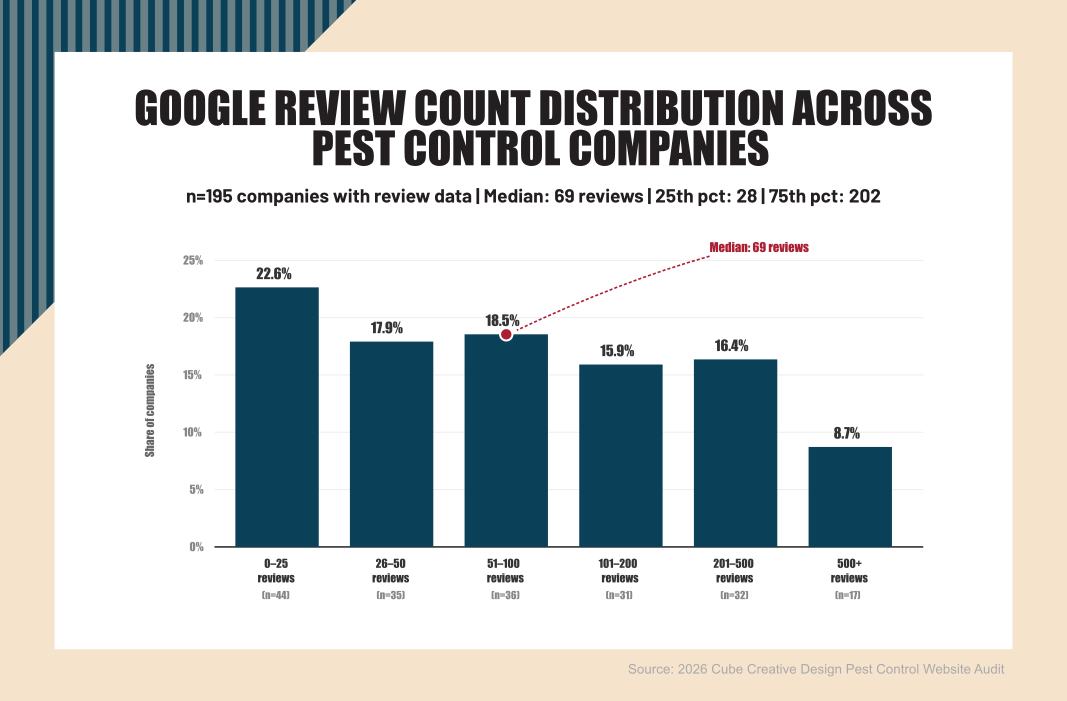
The right answer depends on where your competitors sit. The audit pulled review counts from 195 pest control companies and gives you a clear baseline. The median is 69 reviews. If you have fewer than 28, you sit in the bottom quartile of your peer group. Below the median, you are functionally invisible compared to direct competitors in most local markets.
Here is how the 195 audited companies break down by review count, based on our 2026 field audit data:
- 0 to 25 reviews: 22.6% of companies (44 of 195)
- 26 to 50 reviews: 17.9% (35)
- 51 to 100 reviews: 18.5% (36)
- 101 to 200 reviews: 15.9% (31)
- 201 to 500 reviews: 16.4% (32)
- 500 or more reviews: 8.7% (17)
Almost one in four audited companies sit under 25 reviews. That group is the most likely to be invisible in the map pack no matter how clean the website looks. Moving from the bottom quartile (under 28 reviews) to the top quartile (202+) takes the kind of steady monthly review program most operators never set up.
Below the median, your map pack ranking is at the mercy of whoever has more reviews and a more recent one. Above the 75th percentile, you are competitive but still beatable. Review velocity matters as much as the raw count.
Velocity is where most owners get it wrong. Asking 30 customers for reviews in a single week and then nothing for three months looks unnatural to Google and shows up in the review filter. A steady cadence (every customer, every job, every week) outperforms a burst push every time.
An established 8-truck operation in a mid-sized market sits at the median in most audits we run. They have 60 to 75 reviews, mostly from the past two years, and they wonder why a competitor with 180 reviews is sitting above them in the map pack. The answer is usually some combination of review count, review recency, and GBP configuration. Closing the review gap takes consistent monthly asks, not a one-time push. We covered review counts here; for what to say when the reviews come in, the pest control review response post is the next step.
How Do Pest Control Companies Verify a Google Business Profile in 2026?
Most pest control GBPs are now verified by video, not by postcard. Video verification is now the primary method Google assigns to service-area businesses. You record a short walkthrough of your truck, your equipment, and any signage or paperwork that proves the business is real, then upload it through the GBP dashboard. Postcard verification is still available for some categories but is increasingly the exception.
Do not try to game the address to make verification easier. Putting a friend's storefront address on the profile, or a UPS Store mailbox, gets profiles suspended. Suspensions take months to recover from and sometimes never resolve. If you are a service-area business with no walk-in office, enter your real address during setup and toggle the hide-address option. The address still verifies your account; it just does not display publicly. Google's official GBP verification page documents the current methods if your profile gets stuck.
An 8-truck operation expanding into a neighboring county runs into verification trouble most often. They open the new GBP, use the owner's home address by mistake, get flagged for category mismatch, and lose three months of momentum. Set the right address and the right service area before submitting, not after.
Where to Go From Here
GBP setup is the foundation. Reviews are the multiplier. Geo-pages are the bridge from local search into the rest of your site. The audit found that companies fixing all three together pulled out of the map pack invisibility group faster than companies that tried to fix one at a time.
If your GBP looks like the patterns above (wrong pin, stale photos, no posts, blank Q&A, residential address), it is fixable. Most of the fields can be corrected in a single afternoon. The hardest part is the verification recovery if the profile has already been suspended.
If you want a second set of eyes on your current GBP, or you are not sure where the gaps sit, send me a message. The audit is free, there is no email capture, and you get a written report you can act on whether you ever hire us or not.
Frequently Asked Questions
Should a Pest Control Company Hide the Business Address on Google Business Profile?
Yes, if you are a service-area business with no walk-in office. Enter the real address during setup so Google can verify the account, then toggle the "clear address" or "hide address" option. The address still satisfies verification; it just does not display to the public. Residential addresses left visible look unprofessional and create a verification conflict with the storefront category.
What Primary Category Should a Pest Control Company Use on Google Business Profile?
The primary category should be Pest Control Service. Secondary categories can include Pest Control, Lawn Care, Wildlife Removal Service, or Termite Inspection Service if you offer them. Avoid generic categories like "Service" or "Contractor" as your primary; they pull your profile out of pest-specific map results and into broader, less relevant search pools.
How Often Should Pest Control Companies Post on Google Business Profile?
At least once per week. Mix the post types: offer posts for promotions, update posts for seasonal pest alerts, and event posts for community work. The audit found that pest control companies posting weekly were noticeably more visible in their primary map pack than companies posting monthly or not at all. Posts are a freshness signal, and freshness is a ranking factor in local search.
Can a Pest Control Company Have More Than One Google Business Profile?
Only if you have more than one physical location with separate staff and hours, a multi-office operation with branches in Charlotte and Greensboro can have two profiles. A single service-area business covering 12 cities should have one profile with all 12 cities listed in the service area field. Creating multiple profiles for a single business triggers Google's spam policies and can result in every profile being suspended. For operations running offices in several markets, our multi-location pest control marketing page covers the full setup pattern.
Do Customer Photos Help My Pest Control Google Business Profile?
Customer photos help, and you cannot control them directly. The audit found pest control profiles where homeowner photos of cockroaches or rodent damage hurt rankings because the imagery looked rough in the map pack preview. Upload at least 10 of your own photos so the good ones outweigh the bad. Encourage satisfied customers to post photos of clean spaces after treatment rather than the original infestation.