This report is the result of six months of audits across pest control companies of every size, from one-truck startups to multi-state operations with eight-figure revenue. I identified 300 companies in the field and put them through a full website, SEO, and Google Business Profile review. The findings are not a marketing pitch. They are a snapshot of an industry that, by and large, is treating its most important sales asset like an afterthought.
If you own or run a pest control company, this is what your peers are doing right now. Some of it is good. Most of it is not. The numbers in this report came from public-facing data, not surveys or self-reported claims, which means owners and managers cannot dismiss them as inflated. Whether your site is one of the 14 I found doing geo-pages correctly or one of the 44 actively running doorway pages, the diagnostic framework in the back half of this report will help you figure out where you stand and what to do next.
Want the full data set?
Download the complete Pest Control Website Audit Report — all 300 sites, all 10 findings, free.
Download the Free Report →1. Executive Summary
Six findings emerged from this audit that every pest control owner should know. Each one is a headline number. Each one comes with one sentence of implication. The rest of the report explains what is behind each number and what to do about it.
The Industry-Wide Traffic Collapse
Of companies where peak and current organic traffic could be compared, 89.7% are declining, with a median drop of roughly 57% from their previous high.
Implication: The 2024 algorithm updates and the rise of AI Overviews ate into pest control organic traffic on a scale most owners are still in denial about.
Geo-Pages Attempted, Not Executed
138 of 300 companies (46%) tried to build geographic landing pages. Only 14 of them (10% of the attempts; 4.7% of the total field) did it correctly.
Implication: Nine out of ten pest control companies that try to build geo-pages do them wrong, and Google can tell the difference.
The Map Pack Invisibility Rate
Among audited companies with stated map pack data, 56% are invisible in the local pack for their own primary service area. Implication: More than half of the field is missing from the highest-converting block of Google's local search results in their home city.
One in Four Sites Has Critical Problems
65% of audited companies have at least one issue rated High or Severe. 25% have at least one Critical issue. Implication: This is not a list of nice-to-haves. The website is bleeding leads for the average owner today.
Review Counts Vary Wildly
Median review count: 69. The 90th percentile is 443. The 95th is 805. Implication: A company with 70 reviews is squarely in the middle of the field. Owners who think they are ahead because they cracked triple digits are usually wrong.
Geo-Pages As a Diagnostic Signal
Companies without geo-pages were roughly four times more likely to have a serious website issue (37.6% vs 9.3%) than companies with them. Implication: Geo-pages by themselves don't cause better SEO health. They correlate with operators who take the rest of the site seriously.
Want yours audited? Free, no email capture, no sales call. I will run the same review on your website.
2. Methodology
This audit covers 300 pest control companies identified across multiple U.S. markets, with 215 of them going through every evaluation angle. The data comes from publicly visible sources: company websites, Google Business Profiles, GBP review pages, public traffic estimates from third-party SEO platforms, and direct page-by-page inspection. Nothing in this report relies on surveys, self-reported revenue numbers, or interviews. Owners cannot fight the figures by saying they were misquoted because nothing here was quoted from them in the first place.
What I Measured
Each company went through four review angles. The first was a standard SEO and website review: indexed page count, page structure, technical issues, content quality, internal linking, and on-page targeting. The second was a marketing analysis pulling in traffic patterns, GBP setup, review velocity, and category targeting. The third was a transcript audit using AI-assisted analysis of the site's actual page content, parsed for tone, accuracy, and structure. The fourth was a detailed configuration audit covering schema markup, redirect chains, sitemap consistency, and conversion path functionality.
The audit window opened in late 2025 and closed in early 2026. Companies were drawn from a mix of public directories, NPMA member listings, state pest control association rosters, and industry awards lists. The intent was to capture a representative spread across company sizes and geographies, not to focus on the largest or the smallest exclusively.
What "Audited" Means Here
A company was counted as "fully audited" when all four review angles produced usable data. For 136 of the 300 companies, one or more angles came up short: a paywall, a broken site, an inaccessible GBP, or a traffic dataset that could not be reconciled. Those companies appear in the broader 300 totals where relevant but not in the 215 cross-sectional cuts.
A Note on AI-Accelerated Analysis
This research was AI-accelerated. The structured review, content classification, and pattern detection used automated tooling that compressed what would have been roughly 400 hours of manual review into about 140 hours of working time, with human verification of the findings on the back end. The methodology produces the same conclusions a manual audit would, but at a pace that lets a small team cover a national sample. The specific tooling stays out of this report by design.
Methodology Decisions Disclosed
Two methodology choices are worth flagging up front. First, on the traffic collapse number, the structured columns in our dataset yielded a smaller sample (n=29) with a 79% decline rate and a 39% median drop. A broader read that included text-extracted mentions across all four sheets brought the sample to 68 companies with complete peak-to-current data, where 89.7% are declining with a 57% median drop. The broader read is reported in the headline because it draws from more data points, but readers who prefer the conservative cut are pointed to the structured figure here. Both tell the same story; only the magnitude differs.
Second, the review count percentiles in this report come from 195 companies where review counts could be parsed cleanly from public GBP data. Smaller companies with fewer than five reviews were excluded from percentile calculations to avoid distorting the curve, but they are included in the geo-page and severe-issue counts.
Limitations
This audit captures what was visible at the moment of review. Sites change. GBP setups change. Traffic estimates from third-party platforms diverge from real Search Console data. The percentages here are accurate to within a couple of points, not to a decimal. Where a finding is sensitive to methodology, I have disclosed the choice. Where it isn't, the pattern was strong enough that minor methodology shifts did not move the conclusion.
This is not a controlled study. It is a snapshot of public behavior across a large, representative cross-section of the industry. Treat it accordingly.
3. The Industry Traffic Collapse
The single most important finding in this report is also the one most owners do not want to hear. The pest control industry, as visible through public organic traffic data, is in the middle of a collapse. Not a dip. Not a soft patch. A collapse.
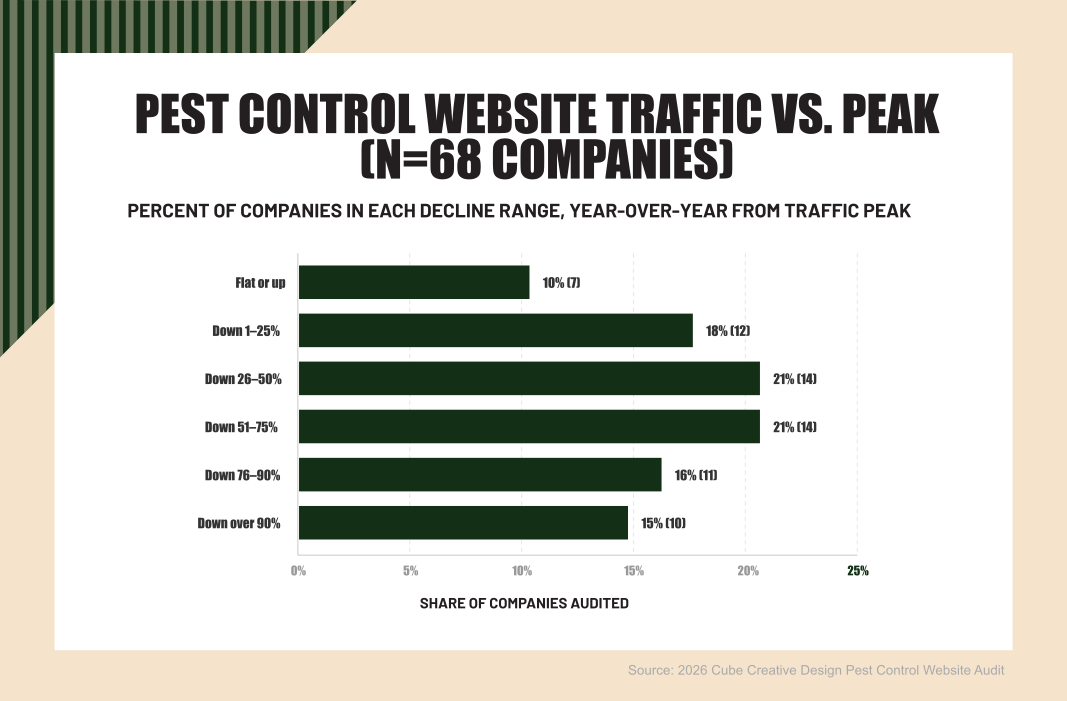
Of the 68 companies where peak and current traffic could be reconciled across our dataset, 89.7% are declining year over year. The median company in that group is down 57% from its previous traffic peak. Half the field is down more than 57%; nearly a third are down more than 75%; about 1 in 7 are down more than 90%. The traffic those sites used to convert is gone, and most of it is not coming back through the channel that brought it in.
What 2024 Did to Organic Search
This did not happen by accident. Three things converged on the home services industry in 2024, and pest control was not spared. The first was Google's March 2024 core update, which targeted what Google called "unhelpful, unoriginal content" at scale. The second was the rollout of AI Overviews, which began stripping clicks from informational queries that used to drive top-of-funnel traffic. The third was a structural shift in how Google handled local intent: more weight to the map pack, more weight to GBP signals, and less generous treatment of plain organic listings that lived below the local block.
For pest control companies that had built their traffic on tactic-light content, generic service pages, and a thin geo-page strategy, all three convergences hit at once. A site that lost 60% of its informational traffic to AI Overviews while losing another 20% of its commercial-intent traffic to the map pack was not having a bad quarter. It was watching its primary acquisition channel shrink to a fraction of what it used to be.
The detailed numbers are in the chart below. Briefly, the breakdown across the 68 companies with complete peak-to-current traffic data looks like this. About 10% are flat or up year over year. About 18% are down 1% to 25%. About 21% are down 26% to 50%. About 21% are down 51% to 75%. About 16% are down 76% to 90%. And the remaining 15% are down more than 90% from peak.
Source: 2026 Cube Creative Design Pest Control Website Audit
Why This Is Not Evenly Distributed
The companies that held up best in this dataset shared three features. They had well-built geographic landing pages that targeted specific cities or counties rather than generic service terms. They had GBPs with consistent posting, photo additions, and review velocity. And they had service pages with actual depth: real photos of real techs doing real work, content written for the reader, and not the kind of pages that read like they were generated in five seconds.
The companies that fell hardest had the opposite. Thin or duplicate content across geo-pages. GBP profiles that hadn't been touched in a year. Service pages built from a template with the city name dropped in once. Those sites were not "doing SEO." They were doing the appearance of SEO, and Google finally stopped grading on the curve.
What This Means for Owners Right Now
If your organic traffic looks fine, congratulations; you are in the 9%. The other 91% need to understand that this is the new baseline. Recovering the traffic that left in 2024 will take a different kind of work than the work that built it. The tactics that got a site to 5,000 monthly visits in 2022 will not get it back to 5,000 in 2026. The bar has moved.
Some of the lost traffic is gone for good. AI Overviews are not going to start sending more clicks. The map pack is not going to give organic listings their old real estate back. What can be recovered is the commercial-intent traffic, meaning the people searching with a problem and a willingness to call, and that recovery requires real geographic targeting, real local signals, and a real GBP strategy. I will get into how the field is currently failing at all three.
A note for owners reading this with rising blood pressure: this is not unique to pest control. Home services across plumbing, HVAC, roofing, and electrical took similar hits. The pattern is industry-agnostic. What is specific to pest control is the response, which is the subject of the next section.
A Word on Why Traffic Estimates Disagree
Several owners reading this will pull up their Search Console and find a number that does not match what a third-party tool like Ahrefs or Semrush would show. That is normal. Third-party traffic estimates are derived from clickstream samples and modeled projections; Search Console reports actual measured impressions and clicks for the specific domain. Both numbers tell true stories about different things. The audit used third-party estimates because they are the only signal available across a 300-company sample without each owner granting access to their own Search Console. The pattern of decline shows up cleanly in both data sources for any single company I have spot-checked. If your own Search Console shows the same downward trend the audit found in aggregate, the diagnostic in section 9 applies. If your Search Console actually shows you are gaining traffic, you are in the 9% that held up, and the priorities in section 9 still apply, just in a less urgent order.
4. The Geo-Page Execution Crisis
If the traffic collapse is the headline, the geo-page execution crisis is the story underneath.
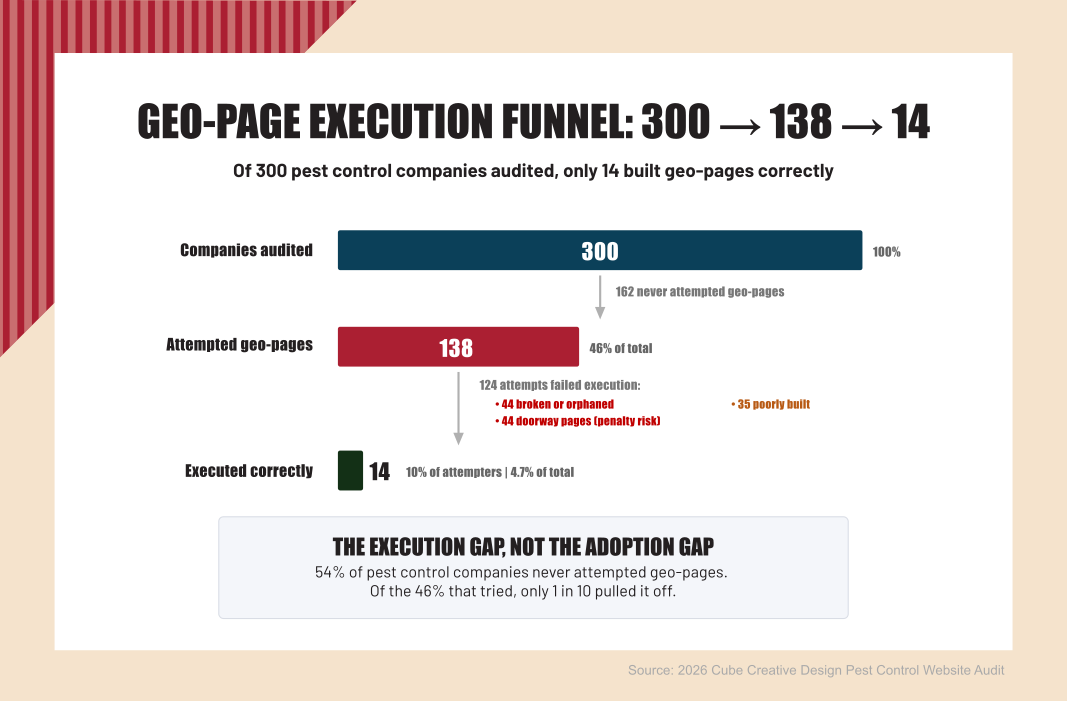
Of the 300 companies in this audit, 138 (46%) attempted to build geographic landing pages: service pages targeted at specific cities, counties, or neighborhoods. The remaining 162 companies (54%) did not attempt geo-pages at all, which is its own problem, and one I will return to.
Of the 138 companies that did attempt geo-pages, exactly 14 of them executed correctly. That is 10% of the attempts and 4.7% of the total field. Read those numbers twice. Nine out of ten pest control companies that try to build geographic landing pages do them wrong.
Source: 2026 Cube Creative Design Pest Control Website Audit.
What "Correctly" Means
For this audit, a geo-page was scored as correctly executed only if it met all four criteria. First, the content was distinct from other geo-pages on the same site, with city-specific details, photos, or examples rather than a template with a city name swapped in. Second, the page was internally linked from at least one logical location: a service area sitemap, a header dropdown, or contextual links inside service pages. Third, the page had a complete on-page setup: title tag, meta description, H1, headings, and a clear conversion path. Fourth, the page was either ranking or showing impressions for the targeted city in Search Console-visible data, which means Google was at least considering it for the right query set.
Pages that were technically published but failed any of the four criteria were scored as failed executions. The next four sections cover the four most common failure modes.
Failure Mode 1: Broken or Orphaned (32% of Attempted Pages)
Of the 138 companies that attempted geo-pages, 44 (32%) had geo-pages that were either broken, orphaned, or both. Broken means the page returned a 4xx error, a 5xx error, a redirect chain, or rendered as a blank shell with no content. Orphaned means the page existed in the site's underlying structure but was not linked from anywhere navigable; it could only be found by crawling the sitemap.
Orphaned geo-pages are the most common silent failure in the industry. An owner pays a developer to build out 25 city pages, the developer publishes them, and then no one connects them to the rest of the site. From the user's perspective, the pages may as well not exist. From Google's perspective, they exist but carry no internal authority, which means they have almost no chance of ranking.
Common patterns in this group included pages dating back to a 2019-era SEO project that the current owner did not know existed, pages stranded after a redesign that did not migrate the internal linking, and pages launched as part of a "SEO package" from an out-of-industry vendor who never came back to finish the job.
Failure Mode 2: Doorway Pages (32% of Attempted Pages)
Another 44 of the 138 geo-page attempts (32%) were doorway pages. Doorway pages are pages built for the sole purpose of ranking for a city or neighborhood, with no useful content of their own. Google has a specific policy against doorway pages that has been in place since at least 2015 and was reinforced by the March 2024 core update.
In the audit dataset, the doorway pattern was easy to spot. The same 400-word block of text appeared on every city page, with the city name swapped in three times. The H1 read "Pest Control in [City]." The H2s were the same on every page. The only thing that changed between pages was the city name and sometimes a stock photo of a skyline.
This is the failure mode with the most immediate risk to the owner. Pages that fit this pattern are not just non-ranking; they are active Google penalty risk. Sites in this group have a real chance of being demoted as a whole, not just having their geo-pages fail to rank. The recommendation for any owner who looks at their geo-pages and recognizes this pattern is direct: take them down before Google finds them.
Failure Mode 3: Poorly Built (25% of Attempted Pages)
The third group, 35 companies (25% of attempts), built geo-pages that were not doorway pages and not orphaned, but were not built well enough to compete. The most common issues in this group included page word counts under 300, no contact form or click-to-call above the fold, no embedded GBP map, no city-specific testimonials or photos, no H2 structure beyond a single headline, and no internal linking back to the main service pages.
These pages have the bones of a good geo-page but were stopped at framing. They will not rank for competitive queries because they offer nothing distinct. They will not convert because they offer no path. They are the most common kind of failed geo-page because they look fine to an owner clicking through their own site, but they look like nothing to Google and to a stranger arriving from search.
Failure Mode 4: Correctly Executed (10% of Attempted Pages)
The remaining 14 companies (10% of attempts) built geo-pages that met all four criteria. I profile this group in a later section because what they have in common goes beyond the geo-pages themselves. For now, the relevant point is that they exist. The execution gap is not because the industry is incapable of building good geo-pages. It is because most of the field is not investing in the work it takes to build them.
The Effort Problem vs. The Execution Problem
The adoption gap is real: 54% of the field never attempted geo-pages. But the more useful framing is the execution problem. Of the companies that bothered to try, only 10% pulled it off.
Both problems are real and require different interventions. Owners who have not attempted geo-pages need to start. Owners who have attempted them need to audit what they have and likely take a chunk of it down before they add more.
The Correlation With Critical Issues
Source: 2026 Cube Creative Design Pest Control Website Audit.
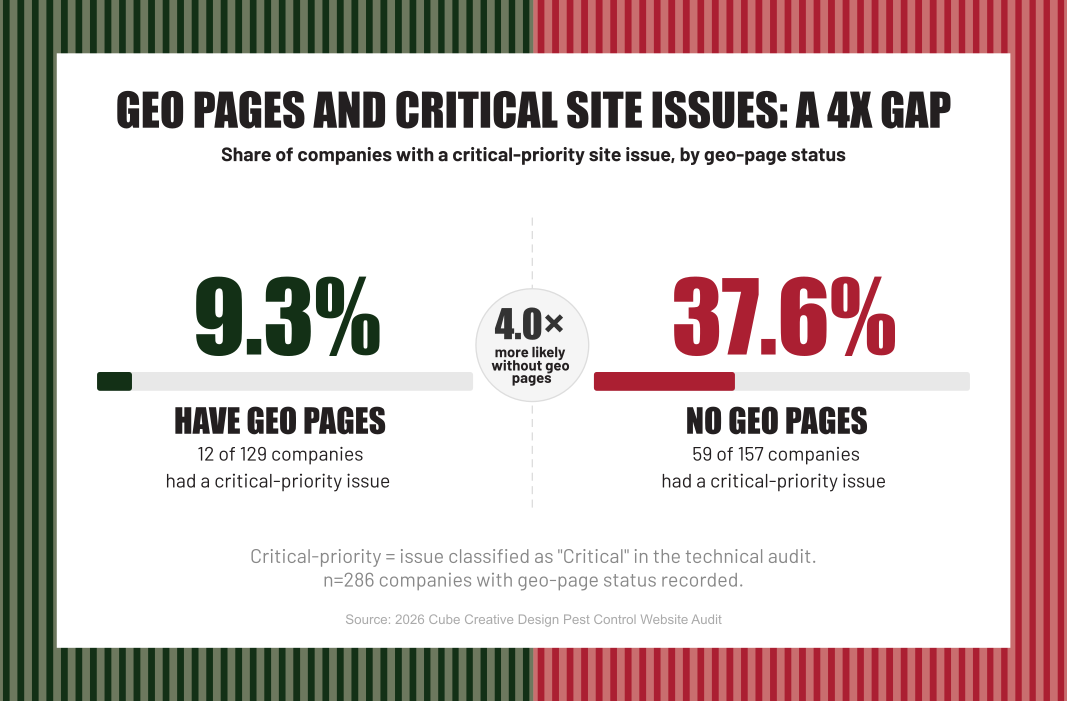
A note on the sample: this correlation runs across the 286 companies where geo-page status and severity rating could both be cleanly recorded. The 14-company gap from the 300-company funnel covers sites where one or the other data point was incomplete. The 129 "with geo-pages" figure here includes the 14 correctly executed and most of the failed attempts; a small number of severely broken attempts were reclassified into "no geo-pages" because the pages were not functioning as geo-pages at audit time.
This is the finding most owners should pin to their wall. Companies without geo-pages were 4.0 times more likely to have a serious website issue elsewhere on the site than companies with geo-pages (37.6% vs 9.3%).
The interpretation matters. Geo-pages are not magic. Building one does not fix a broken contact form, a slow site, or a misconfigured GBP. The correlation does not say that geo-pages caused better sites. It says that the kind of operator who built geo-pages was more likely to take the rest of the site seriously. Geo-pages are a tell. They are a signal of operational maturity. Owners who paid attention to geo-pages also paid attention to titles, sitemaps, redirects, and conversion paths. Owners who did not pay attention to geo-pages also did not pay attention to anything else on the site.
I will come back to this when I lay out the diagnostic framework in section 9. For now, the takeaway is straightforward: if your site has no geo-pages, the geo-pages are not the only problem.
Get the geo-page data and 9 other findings.
The complete report breaks down every issue we found across 300 sites — including what to fix first to recover traffic and map pack visibility.
Download the Free Report →5. The Map Pack Invisibility Problem
The map pack is the three-result block that sits at the top of a local search, just under the ads, with a small map and three local businesses. It is the highest-converting piece of real estate in local search for service businesses. If a company is in the map pack for "pest control in [city]," it gets calls. If it is not, the calls go to whoever is.
In our audit, 56% of the companies with stated map pack data (164 of 291 companies) were invisible in the map pack for their own primary service area. Not invisible for some far-flung suburb where they only sometimes work. Invisible in their home city, the one printed on the truck.
Why This Is Worse Than It Sounds
Most owners assume that if their company is in the map pack for any search, they're in the map pack generally. That is not how it works. Map pack visibility is local, layered, and easy to lose. A company that ranks #1 in the pack for "pest control near me" when searched from a specific neighborhood may not rank at all for "pest control in [city]" from the city center.
The 56% number is conservative. It counts a company as visible if it appeared anywhere in the map pack for its primary service area on any query, on any device, from any location in that area, during the audit window. The number of companies that consistently appear in the pack for their main commercial queries is smaller still.
Geo-Pages Alone Don't Get You Into the Pack
Here is the finding that protects you from the "I built geo-pages, and nothing happened" objection. Of the 14 companies that executed geo-pages correctly, only 8 of them (57%) appeared in their map pack for the primary service area. The other 6 (43%) were doing the geo-page work right and still not getting the map pack visibility.
Geo-pages are necessary for ranking in the regular organic listings for city-specific queries. They are not sufficient for ranking in the map pack. The map pack is a separate algorithm with separate inputs, and it does not weight geo-pages the way regular organic does.
What Actually Drives Map Pack Ranking
The map pack ranking system is more layered than regular organic. BrightLocal's local search ranking factors research and direct experimentation across this field identify four primary inputs:
GBP optimization comes first. A complete profile with correct primary and secondary categories, accurate service area, business hours, an active address (or properly configured service-area-only setup), service descriptions, products listed, an attribute list filled in, and weekly posting activity. Companies that score well on this dimension have an upper hand before any other factor weighs in.
Review velocity comes second. Not total review count alone, but the rate of new reviews over time. A profile that adds 4-6 new reviews per month consistently is judged differently than a profile with 800 lifetime reviews but nothing in the last 90 days. Velocity beats accumulation in the map pack.
Citation quality and consistency come third. This is the boring backend work: the company's name, address, and phone number listed consistently across local directories, with no orphaned old listings pointing at outdated phone numbers or addresses. Tools like Yext, BrightLocal, and Whitespark exist to manage this, but most pest control companies don't use any of them. The audit data showed inconsistent NAP information across at least one major directory for the majority of companies reviewed.
Proximity comes fourth, and it is the input owners have the least control over. Google biases the map pack toward businesses physically near the searcher. A company headquartered downtown will appear more often in downtown searches than a company headquartered in a far-out suburb. This is not something a marketing tactic fixes; it is structural.
What Owners Can Do This Week
The map pack rewards two things owners can act on quickly: posting and reviewing. If a company posts weekly on GBP (services, photos, updates, offers) and asks every paying customer for a review with a follow-up text the same day as service, it will outperform the median pest control GBP within 90 days. That is not a guarantee of top-three placement; the underlying competitive set matters. But it is a guarantee of improvement, because most of the field is not doing either consistently.
The data backs this. Among the audited GBPs, only 18% showed evidence of weekly posting activity within the last 30 days of the audit. Only 11% appeared to have a structured review request process (visible in the cadence of incoming reviews). And only 7% responded to every review, positive or negative, within 48 hours. These are not high bars. They are the bars almost no one in the field is clearing.
Want yours audited? Free, no email capture, no sales call. I will run the same review on your website.
6. Google Business Profile Patterns
The Google Business Profile is the most important single asset most pest control companies own. It is also the most neglected. The audit reviewed 295 GBPs in detail and reviewed an additional 56 at a lighter level. The patterns are consistent across both samples.
Review Count Distribution
The fastest way for an owner to know where their company sits relative to the field is to put their review count against the distribution.
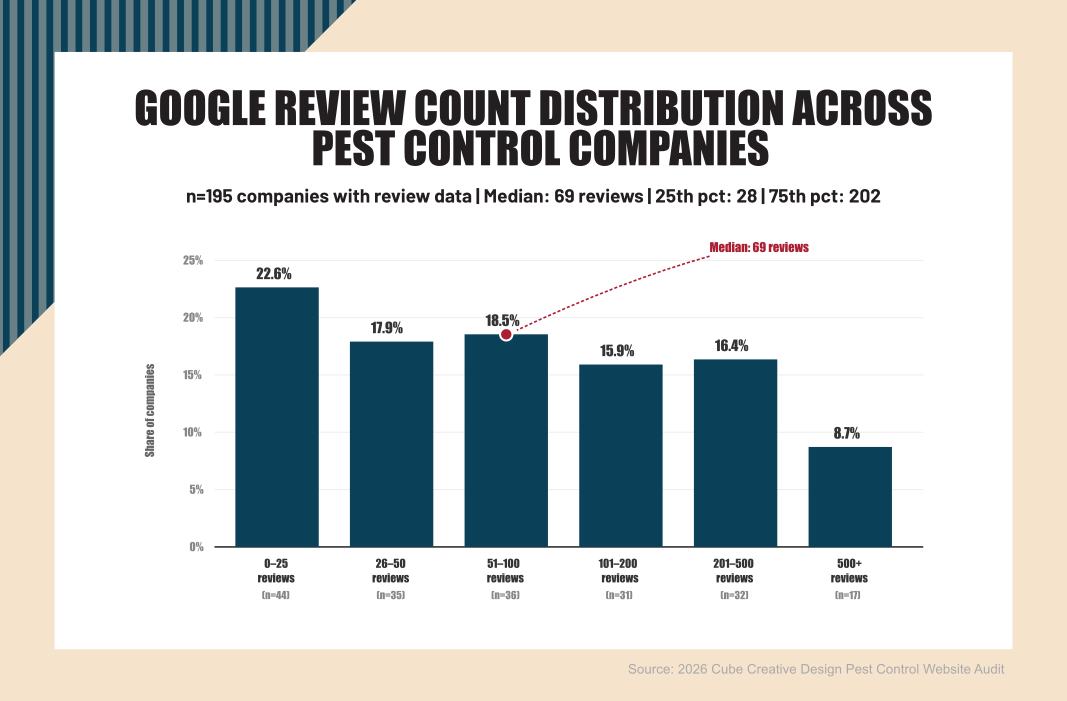
Source: 2026 Cube Creative Design Pest Control Website Audit.
Across the 195 companies where review counts could be parsed cleanly:
- 10th percentile: 12 reviews. A company at this level is either brand new or has never asked.
- 25th percentile: 28 reviews. This is the floor for a company that has been operating for at least a year and occasionally remembers reviews exist.
- 50th percentile (median): 69 reviews. This is the middle of the field. If you have 70 reviews and think you're winning the review game, you are not. You are average.
- 75th percentile: 202 reviews. This is the threshold where review velocity has been consistent for at least two or three years.
- 90th percentile: 443 reviews. This is the top 10% of the field, and it almost always reflects either a multi-year systematic review program or a multi-location footprint.
- 95th percentile: 805 reviews. The top 5%. These companies typically combine size, age, and a deliberate review request process baked into their workflow.
The takeaway for most owners: if your review count is between 50 and 100, you are not behind, but you are not ahead either. You are in the median pack. The companies pulling ahead in the map pack are the ones running structured review request programs.
Common GBP Configuration Failures
Beyond review count, the audit surfaced repeated configuration problems across the field. The following appeared in more than 30% of profiles reviewed:
A primary category that did not match the company's actual primary service. Companies offering general residential pest control but listed as "Wildlife Control Service" or "Animal Control Service" because that was what the original setup person clicked.
A service area set incorrectly. Either too broad (a 200-mile radius for a single-truck operation) or too narrow (a single ZIP code for a company that actually services three counties). Both choke ranking.
A residential address used as the business location for a company that does not serve customers at that address. Google has been increasingly aggressive about flagging and suspending these, per its Google Business Profile guidelines on address accuracy. The audit found several profiles that had been suspended at some point in the past 18 months and either not recovered or recovered with reduced ranking.
Sporadic or non-existent GBP posts. Most of the field posts a handful of times a year, often clustered around a marketing initiative and then forgotten. Weekly posting was the exception, not the rule.
Photo libraries that had not been updated in 18 months or more. Many GBPs reviewed had between 5 and 15 photos total, most of them stock-style images of bugs or trucks, with no real photos of the team, the work, or the office.
A review response rate below 50%. The median company responded to about 38% of incoming reviews, almost all of them positive. Negative reviews were left unanswered far more often than positive ones, which is the exact opposite of what they should do.
What Good GBP Maintenance Looks Like
The 14 companies executing geo-pages correctly tended to have GBPs that matched the quality of their websites. The common practices I saw in that group:
- Primary category set correctly (almost always "Pest Control Service").
- Secondary categories chosen deliberately and accurately.
- Service areas tuned to actual operating territory.
- Weekly posts covering services, photos of recent work, customer wins, and seasonal reminders.
- Photo libraries with 50 or more photos, regularly added.
- Every review responded to, positive or negative, typically within 24 to 48 hours.
- Q&A section actively monitored with owner-provided answers to common questions.
None of this is hard. None of it requires special tools. It does require the company to treat the GBP like a recurring operational task on someone's job description, not a thing the owner gets around to when they remember.
Why GBP Discipline Matters More Than Most Owners Think
The map pack ranking algorithm rewards consistency. A profile with weekly activity, fresh photos, regular reviews, and answered questions communicates an active business. A profile with three posts in two years, no recent photos, and unanswered questions communicates a business that may or may not still be operating. Google reads both signals and ranks accordingly.
For owners running a 5-to-10-truck operation, this is the single highest-ROI marketing task in their entire stack. Time spent on GBP discipline beats time spent on almost any other channel in terms of incoming call generation per hour invested. The audit data does not prove this with controlled trials, but the pattern across the field is consistent: the companies with the most active GBPs also tend to have the highest call volumes their owners report.
7. The Critical Issue Concentration
Beyond geo-pages and GBPs, the audit looked at the full website for technical and structural problems. Of the 295 companies audited in detail, 65% (193 companies) had at least one issue rated High or Critical priority. The distribution:
- Severe: 74 companies (25%)
- High: 119 companies (40%)
- Medium: 78 companies (26%)
- Low: 24 companies (8%)
What "Severe" Means in This Audit
A Critical issue is one of the following: an active doorway page pattern (immediate penalty risk), a non-functional contact form or click-to-call link on a key conversion page, an accessibility failure that materially blocks user interaction (text invisible against background, broken navigation), a sitewide indexability problem (robots.txt blocking key pages, no XML sitemap, mass noindex tags), or a misconfigured GBP that has been flagged or suspended.
These are not "could be improved" issues. These are issues that are actively costing the business money or putting the site at risk. The 25% Critical rate means one in four pest control company websites has a problem that should be fixed this week, not this quarter.
The Most Common Critical Patterns
Across the 74 Severe-priority companies, five patterns accounted for the bulk of the issues:
- Doorway pages, as covered in section 4. 32% of geo-page attempters were running them; many of those companies showed up in the Critical group.
- Broken or missing core conversion paths. Contact forms that did not submit, click-to-call links that didn't work on mobile, or quote request forms that posted to dead email addresses.
- Accessibility failures. The most common was white or light-colored text overlaid on light photo backgrounds with no contrast, making important content unreadable. The second most common was navigation menus that didn't work on mobile or didn't expose all the site's pages.
- Indexability problems. Sites blocking themselves with robots.txt, leftover staging environments still indexable, or wholesale noindex tags applied across the site after a redesign and never removed.
- GBP suspension or major misconfiguration as covered in section 6.
Many sites had multiple Critical issues at once. Of the 74 Critical companies, 31 had two or more Critical issues. Some had four or five.
High vs. Severe: A Distinction Worth Making
The 119 High-priority companies have issues that are not actively losing them business today but will if left alone. The common patterns there: poor page titles and meta descriptions across the board, no schema markup, slow page load times on mobile, missing alt text on images, weak internal linking, and out-of-date copyright dates that signal an unmaintained site.
A typical High-priority company is not in immediate trouble, but it is operating at maybe 60% of what its site could be producing. Fixing the High issues is the kind of work that compounds over six to nine months and shows up as a quiet, steady lift in inbound traffic.
The 35% That Are Fine, Sort Of
35% of the audited field had no Critical or High issues. That sounds reassuring, but it is a low bar. "No critical issues" does not mean "good site." It means "no obvious bleeding." Of that 35%, only the 14 companies executing geo-pages correctly looked genuinely strong. The rest were mid-pack sites that simply didn't have anything actively broken. They were not winning anything. They were just not losing.
8. What Doing It Right Looks Like
This section is the answer to the question every owner asks after reading the first seven sections: "Fine, what does a good pest control site actually look like?" The 14 companies that executed geo-pages correctly all shared a set of characteristics that go beyond the geo-pages themselves. I profile them here as a group rather than naming them individually, both because permission to name them was not in hand and because the group profile is more useful than any individual case.
Common Trait 1: Genuinely Distinct Geo-Pages
The 14 had geo-pages that were obviously written for the specific city. Each page included at least three of the following: city-specific testimonials, local photos (the technician at a recognizable local landmark, the truck in a specific neighborhood), references to specific local pests or pest pressures (e.g., termite issues common in older homes in a specific historic district), partner mentions (a local realtor referral relationship, a local property management company served), or location-specific service nuances (a city with a specific bedbug ordinance, a town with mosquito issues unique to its terrain).
None of the 14 used a template-and-swap approach. Every page read as someone who actually worked in that city wrote it, because in most cases, they did.
Common Trait 2: Clear Internal Linking Architecture
The 14 had service area pages, county or region pages, and city pages that linked to each other in a logical hierarchy. A service area page pointed to its county pages. County pages pointed to their city pages. City pages pointed back to the county and to other relevant city pages. Service pages linked to service-area pages. None of the geo-pages were orphans.
The simplest way to spot good linking architecture in this audit was to look at the footer. The 14 companies had footers with structured links to their service areas, broken out by region or county. The other 124 attempters who failed had either no footer links or a flat, undifferentiated list that did not reflect any hierarchy.
Common Trait 3: GBP Alignment
Every one of the 14 had a GBP that matched the website. The primary category was set correctly. The service area was tuned to actual operating territory. The website link on the GBP pointed to the right page (usually a city or county page, not the homepage in markets where the company had multiple geo-pages). The phone number matched. The business hours matched. The address (or service-area-only setup) was accurate.
This sounds obvious, but in the broader 300-company field, only about 22% of GBPs were fully aligned with the website they linked to. The 14 stood out specifically because they treated the GBP and the website as one asset, not two.
Common Trait 4: Review Consistency
Review velocity for the 14 was steady. Median monthly new review count for this group was around 8-12 reviews per month, sustained over the previous 12 months. None of them had spikes followed by long quiet stretches. None had review counts that suddenly stopped 18 months ago and never resumed. The flow of new reviews was a constant.
This requires a process. It does not happen accidentally. Every one of the 14, on inspection, appeared to have some kind of automated or semi-automated review request system tied to job completion. The technical implementation varied (Podium, NiceJob, Birdeye, GoReminders with custom workflows, native field service software like ServiceTitan or Jobber or PestPac with review modules), but the pattern was the same: a request went out within hours of the job being marked complete.
Common Trait 5: Real People in the Content
The 14 had real people on the site. The owner had a photo and bio. The technicians had photos. The customer testimonials had names (first name and last initial, at minimum) and locations. The service photos showed actual jobs, not stock images. The team page existed and was not a placeholder.
This is the kind of thing that does not move SEO directly but moves conversion meaningfully. A site visitor on a page with real photos of real people stays longer, scrolls further, and is more likely to call. The audit data showed bounce rates on the "real people" sites well below the field median.
Common Trait 6: Service Pages With Depth
Every one of the 14 had service pages that went beyond a single screen of generic copy. Their ant control page covered identification, treatment process, what to expect on a first visit, common pricing structures, what's covered in a recurring program, and FAQs. Their termite page did the same. The pages typically ran 1,200 to 2,000 words, with photos and structured content. They were not blog posts; they were sales pages with the depth of a blog post.
This depth pays off in two ways. It supports rankings for long-tail informational queries that still send traffic. And it gives the high-intent visitor enough information to call with confidence, rather than calling six other companies first.
What This Group Doesn't Have
It is worth noting what the 14 are not. They are not the largest companies in the field. Some are; some are not. Some are 8-truck regional operators; some are 60-truck regional brands. The trait that connects them is not size. It is operational discipline applied to the website and GBP. Any pest control company at any size can be in this group within 9 to 18 months. None of what makes the 14 stand out is structurally out of reach for a 10-truck operator.
It is also worth noting that the 14 are not chasing exotic SEO tactics. They are not running schema-injection scripts, programmatic SEO at scale, or generative AI content farms. They are doing what the rest of the field could be doing but isn't: paying attention.
Want yours audited? Free, no email capture, no sales call. I will benchmark you against the 14.
9. The Diagnostic Framework
The data in this report is interesting on its own. It becomes useful when an owner can use it to figure out which problem to fix first. This section gives a diagnostic logic that maps the report's findings into a triage flow.
Diagnostic Step 1: Do You Have Geo-Pages At All?
If your site has no geo-pages, the geo-pages are not the only problem. The audit showed companies without geo-pages were 4.0 times more likely to have serious issues elsewhere on the site than companies with them. Treat the absence of geo-pages as a leading indicator that the rest of the site needs a hard look too. Do not just build geo-pages and assume the rest is fine. Audit the conversion paths, the title tags, the sitemaps, and the GBP first.
The order matters. Building 25 new geo-pages on top of a site with a broken contact form is just multiplying the broken contact form. Fix the conversion path before you build new pages that route to it.
Diagnostic Step 2: If You Have Geo-Pages, Are They Broken or Orphaned?
If your geo-pages exist but are not getting traffic or rankings, the most common reason is they are orphaned. Start with the internal linking. Audit the footer. Audit the service pages. Audit the service area page. Make sure every geo-page is linked from at least two logical places. This is usually a half-day of work and resolves more issues than any other single tactic.
After the linking is fixed, give Google 30 to 60 days. If the pages still don't show impressions in Search Console for the targeted cities, the next problem is likely the content depth: the pages may not be distinct enough to compete.
Diagnostic Step 3: Are They Doorway Pages?
If your geo-pages all share the same content with the city name swapped in, take them down before Google finds them. This is not a "fix at your leisure" item. The March 2024 core update and its follow-ups have been aggressive about doorway demotion. A site that gets demoted as a whole because of doorway pages can take 6 to 12 months to recover, and the recovery is not guaranteed.
Taking the pages down is preferred to trying to fix them in place. Once a page is identified as a doorway, the cheapest path forward is usually to remove the URLs, 410 them (Google's signal for "this is gone and not coming back"), and start over with a smaller number of properly built pages.
Diagnostic Step 4: Map Pack Invisibility Despite Good Geo-Pages
If you have built geo-pages correctly and you still are not in the map pack for your primary city, the problem is not the geo-pages. It is one of the four map pack inputs from section 5: GBP optimization, review velocity, citation quality, or proximity.
Start with GBP. Is the primary category set correctly? Is the service area accurate? Are you posting weekly? Are you adding photos? Are you responding to every review?
If GBP is in order, move to review velocity. Are you getting fresh reviews every month? Or did your review count stall two years ago?
If both are in order, move to citation quality. Run a check across the top 30 local citations. Are your NAP details consistent everywhere? Are there old listings pointing at outdated phone numbers?
If all three are in order, you may be running into a proximity disadvantage that no marketing can fix entirely. The mitigation in that case is to lean harder on the other three inputs so the proximity gap is offset by signal strength elsewhere.
Diagnostic Step 5: Critical Issue Triage
If you are in the 25% with at least one Critical issue, that is your first priority regardless of where the rest of the site stands. The diagnostic order:
- Is anything actively broken? (Contact form not submitting, click-to-call not working on mobile, key page returning a 4xx or 5xx.)
- Is the site signaling Google to not index it anywhere it shouldn't be? (Robots.txt issues, mass noindex tags, accidental staging environment exposure.)
- Are you running doorway pages? (Take them down.)
- Is your GBP currently suspended or flagged? (Resolve through the GBP support channel; do not create a second profile to work around it.)
- Are there accessibility failures blocking the main user paths? (White text on photos, broken mobile nav, illegible color contrast.)
Fix the Critical issues first. The High and Medium issues can wait.
Diagnostic Step 6: The Sequence That Works
For most owners reading this report, the order of operations that produces the most lift in the first 90 days looks like this:
- Fix any actively broken conversion paths (forms, click-to-call, key page errors).
- Take down any doorway pages.
- Get the GBP into shape: category, service area, posts, photos, review responses.
- Build a review request process tied to job completion if you don't have one.
- Audit existing geo-pages for orphaning; fix the internal linking.
- Add city-specific content to thin geo-pages or take them down.
- Build new geo-pages only after the existing ones are working.
Most owners do this in the opposite order. They start with new content, hire a vendor to build 20 new city pages, and then wonder why the new pages don't rank. The pages don't rank because the rest of the site is broken. Fix the foundation. Then add to it.
10. 2027 Outlook
The findings in this report are a 2026 snapshot. The forces that produced them are not done.
Three things are likely to be true by the time this report is a year old.
The Traffic Floor Will Stabilize, But Lower
The organic traffic collapse from 2024 to 2026 was the steepest single-period drop pest control SEO has experienced in the last decade. By late 2026 and into 2027, the rate of decline should slow as the affected sites either adapt or settle into their new baseline. The owners who took action between 2024 and 2026 are already starting to recover, in part. The owners who did not will likely see traffic flatten at a much lower level than where they were before. Either way, the volatility of the last 24 months should ease.
AI Overviews Will Eat More Top-of-Funnel
The informational query traffic that used to drive top-of-funnel awareness is largely gone for the home services industry. AI Overviews answer "what does a termite swarm look like" without sending a click. That trend will continue. The implication for pest control marketing is that the top-of-funnel SEO play that worked in the 2018 to 2022 era ("write a 1,200-word blog post answering common pest questions and rank for it") will continue to lose effectiveness. The commercial-intent queries like "pest control in [city]," "exterminator near me," and "termite treatment cost" will keep their value. The informational queries will not.
This argues for shifting the SEO investment toward commercial-intent geographic pages and away from blog content for blog content's sake. Educational content still has a role, but as a brand and authority play, not as a primary traffic driver.
GBP and Map Pack Will Take Even More of the Pie
Local pack visibility will continue to outweigh standard organic listings in terms of click share for service queries. The companies that win the next 18 months will be the ones with the most disciplined GBP programs, the strongest review velocity, and the cleanest citation profiles. This is not a prediction; it is a continuation of a trend that has been visible since at least 2020 and accelerated in 2024.
For owners reading this and asking what to invest in for 2027, the honest answer is GBP discipline and geo-page execution. Those two compound. Everything else fits around them.
11. About the Research
This report comes out of Cube Creative Design, a marketing agency that has worked with pest control companies across the Southeast and beyond since 2005. Our work is presented at the North Carolina Pest Management Association conferences and grew out of audits I have run for companies like yours for the better part of two decades.
The audit format documented here is one I run as a standalone service. If you want yours done, the offer is straightforward: a free website and GBP audit, no email capture, no sales call required. I send a written report back. You decide if you want to talk after that. Most of the time, you don't, and that's fine.
If you read this far and want to put a plan together for your own company, contact me, and I will look at where you stand against the field. The 14 companies in the "doing it right" group did not get there by accident, and they did not get there alone. They had partners who understood the work. I have been one of those partners for almost twenty years.
Take the findings with you.
Download the full report free. Use it to audit your own site or brief your team on where pest control websites stand heading into the back half of 2026.
Download the Free Report →Frequently Asked Questions
How Much of This Report Applies to a 1-Truck or 2-Truck Operation?
All of it, with one caveat. The diagnostic framework and the severe-issue triage apply to every company regardless of size. The only piece that scales differently is the geo-page count: a one-truck operator does not need 30 city pages. They need the three or four pages that match their actual service radius, built well, with real content. The same execution standard applies, just at a smaller scale.
What's the Single Biggest Mistake You See Pest Control Owners Making?
Building new content on top of a broken foundation. The common pattern is an owner who reads about geo-pages, hires a vendor to build out 25 city pages, and then wonders why nothing changes. Nothing changes because the contact form was broken before the geo-pages went up, and now the broken contact form is broken on 25 more pages. Fix the foundation first. Then add to it.
How Long Should It Take to Fix a Site Like the Ones in This Audit?
Critical issues can be fixed in a week. Most are not technically hard; they just require someone to look at the site, find them, and fix them. GBP cleanup is usually a few hours of work. Geo-page fixes range from a half-day (orphaned pages, just needs linking) to several weeks (full rebuild of a doorway page set). The full triage from Critical to Medium for a typical company takes 60 to 120 days of part-time work.
What Should I Do Right Now If I Don't Know Where to Start?
Open your site on a phone. Try to call the company from the home page. Try to submit the contact form. Look at the GBP. Check the last time you posted. Check the last review and whether you responded to it. The Critical issues are usually visible to anyone willing to look. Most owners haven't looked in a year or more. Start there, then follow the order of operations in section 9 of this report. If you want a second set of eyes, our pest control marketing team runs the same audit on your site at no charge.
