I'm Chad, Chief Smarketing Officer at Cube Creative Design. WolfPack Advising comes up often enough in conversations with pest control company owners that I decided to write the honest, side-by-side comparison I'd want if I were the one signing the contract. This is not a hit piece. WolfPack does several things well, and I'll say so plainly before I make our case.
We're a marketing agency that works with pest control companies, so yes, I have a side. But a comparison that hides the parts where the other guy is stronger is worthless to you. So here is where WolfPack wins, where we win, and the trade-offs in between. I'll name the situations where WolfPack is the better choice, because for some companies it honestly is.
The Two Models in 60 Seconds
WolfPack Advising is a high-volume generalist. Founded in 2019 and based in Tampa, they serve roughly 15 home-services verticals, from pest control to HVAC to roofing. They sell services à la carte, with a low entry price and month-to-month terms. You buy the pieces you want, one subscription at a time, and you can leave whenever you like.
Cube Creative Design is a specialist. We've been in business since 2005, and pest control is the vertical we know best. We sell bundled plans at published prices, and we customize every plan to what your company actually needs. We don't force anything into your plan that won't help you. We ask for a 12-month initial term that then converts to month-to-month, and you own your website, content, and data with no lock-in and no exit fees. Fewer verticals, deeper in each one.
Cube Creative Design vs. WolfPack Advising: Side-by-Side Comparison
Here is the honest head-to-head across the factors that actually decide this. Read the "entry price" row carefully, because the real story is not who is cheaper at the door.
| Factor | Cube Creative Design | WolfPack Advising |
|---|---|---|
| Focus/verticals | Pest control is our deepest vertical; a few select niches since 2005 | Generalist across about 15 home-services verticals |
| Pricing model | Bundled plans, published prices | A la carte subscriptions; bundles listed "Coming Soon" as of July 2026 |
| Entry price | Foundation, $1,500/month, content included | SEO Basic, $389/month, zero blog posts, email-only support |
| Content per client | Roughly two to four times WolfPack's per-client volume at comparable tiers | 1 to 2 blogs per month on paid SEO tiers; none on Basic |
| Contract terms | 12-month initial term, then month-to-month | Month-to-month, optional annual discount |
| Ad-spend handling | Management included in higher tiers; you own the ad accounts | Ad spend paid directly to the platform; $500/month minimum per platform, plus a separate management fee |
| CRM | HubSpot, and we're a HubSpot Gold Partner | ActiveCampaign and HubSpot, white-labeled as "ActiveIntelligence"; entry about $199/month |
| Data/site ownership | You own your website, content, and data; no exit fees | You own your website, accounts, and data, per their stated policy |
| AI-visibility approach | The Cube Score, a 0–600, six-dimension measurement built on observed signals | AEO Grader, a free tool that asks three AI models to score your brand 0–100 |
| Published pest-control proof | Five pest-control case studies with real metrics | A single pest-control case study among 22 published, as of mid-2026 |
Where WolfPack Advising Is Stronger
I'd rather you hear the concessions from me than feel like I buried them. WolfPack has real advantages, and for some pest control companies those advantages matter more than anything we offer.
Their Entry Price Is Genuinely Lower
WolfPack's SEO Basic plan is $389/month as of mid-2026, and Cube Creative’s lowest published tier is $1,500/month. If your first goal is simply to get on the board with local SEO and Google Business Profile work for as little as possible, WolfPack lets you start for less. That is a real difference, and I'm not going to pretend otherwise.
Just know what that $389 does and does not include. It covers local SEO, Google Business Profile optimization, and a short list of keywords, with email-only support and no blog posts. For context on where that price sits, Ahrefs polled 439 SEO providers and found local SEO averages $1,557 per month, with the most common retainer band falling between $500 and $1,000. So $389 is below the common band, not an impossible unicorn price. The honest point is not that it's absurdly cheap. It's what gets left out at that number.
You Can Buy Only What You Want
WolfPack's à la carte model gives you control. Want SEO but not social media? Buy SEO. Want ads for three months and then pause? You can. As of mid-2026, their site lists bundles as "Coming Soon," so today the model is pick-your-pieces. For an owner who wants to add services only as cash flow allows, that flexibility is real.
I'll give them that, but "only what you want" isn't unique to à la carte. Our plans are bundled, but we customize every one to your business, and we won't put anything in your plan that won't help you. If a piece won't earn its keep for your company, we move that budget into the work that will, at the same published plan price.
The difference is that you get that tailoring without diagnosing which services you need yourself, and without managing five separate subscriptions to do it.
No Long-Term Commitment
WolfPack is month-to-month with an optional annual discount. If the idea of a 12-month term makes you nervous, or you've been burned by an agency contract before, their terms lower the risk of getting started. I'll explain later why we ask for 12 months, but the short version is that their flexibility is real, and for the right buyer it's reassuring.
Where Cube Creative Design Is Stronger
Now the other side of the ledger. This is where 20 years of focus and a specialist's depth show up.
We're a Pest-Control Specialist, Not a Generalist
We don't adapt an HVAC template for your business. Marketing a termite inspection is nothing like marketing a furnace replacement, and we build every strategy around how homeowners actually search for pest control. The clearest proof is our published work. Cube Creative's pest-control page carries five real pest-control case studies with actual metrics. WolfPack's published portfolio, by contrast, includes a single pest-control case study among 22 total as of mid-2026, with about 16 of those being home-inspection companies. That's not a knock on their ability. It's a fact about the demonstrated evidence: when you want to see pest-control results, we can show you five, and their published proof is one.
- A regional NC pest control company went from 298 monthly visitors to 6,802 at peak, a 2,278% increase, with 86.2% of all traffic coming from organic search and zero ad spend.
- A Southern California client achieved a $67 average cost per conversion in one of the most competitive paid search markets in the country.
- A Triangle-area company generated over 14,800 tracked phone calls and 14,400 form submissions through a two-phase organic-then-paid strategy.
- A Coastal NC client's Google Business Profile drove over 4,000 phone calls in a single year with 229% year-over-year call growth.
- A Western NC startup went from near-zero digital presence to ranking in the top 10 for its target communities in 14 months.
These are results we've delivered for pest control clients: one company reached 86% organic traffic share and grew organic visibility more than 2,278% over the life of the engagement. Another generated more than 4,000 Google Business Profile calls in a single year. A third, in one of the most competitive pest markets in the country, ran paid search at about $67 per conversion. I present these as our own reported figures, not as third-party-audited numbers, and the case studies show the methodology behind each one.
We Produce More Content Per Client
Content is the engine of long-term organic growth, and volume matters. At comparable tiers, Cube Creative produces roughly two to four times the content per client that WolfPack does. Their paid SEO tiers include one to two blog posts a month, and their Basic tier includes none. That gap compounds. A company publishing more useful, locally relevant content each month builds a bigger library of pages that keep earning traffic long after they're written.
One more honest note on publishing cadence. WolfPack's own output peaked in 2025 and has come down since. Through 2026, they're publishing closer to one post a week. That's a fine pace. It is simply not the firehose it once was, and it's worth knowing what you're actually buying today.
That library does more than earn search traffic. Well-structured content is also one of the strongest drivers of whether AI engines cite you, and that visibility is exactly what our Cube Score measures. More content, honestly structured, is how you build the authority that shows up in AI answers, and later in the comparison I'll explain how we measure it and why that measurement is built on real signals rather than a model's guess.
Bundled Simplicity Instead of Stacking Subscriptions
Here's the math that a-la-carte pricing tends to hide. A pest control company that wants SEO plus content plus ads plus social plus a CRM from WolfPack is buying several separate subscriptions. Add their CRM entry around $199/month, social around $629/month, SEO, and ad management, and the scope-matched total lands somewhere near $1,500 to $2,100/month. That's the same neighborhood as our Foundation or Growth plan, with less content in the box.
And a bundled plan doesn't mean a rigid one. Each plan is a starting point we tailor to your company. If part of it won't move the needle for you, we redirect that spend into the work that will, at the same published price, so nothing in your plan is dead weight. You get one invoice and one team instead of a stack of subscriptions you have to assemble and manage yourself.
So the entry-price gap is real, but the scope-matched gap mostly closes. When you compare full programs instead of starting prices, you're choosing between two similar monthly numbers. The difference is how much content you get and how deep the pest-control focus runs.
You Own It, and We've Been Here 20 Years
You own your website, your content, and your data, with no platform lock-in and no exit fees. We build on Joomla, an open platform we prefer for its security and low maintenance overhead. WolfPack builds on WordPress. WordPress powers a huge share of the web, and that's fair to acknowledge, but it carries real trade-offs: a heavier reliance on third-party plugins, more frequent security patching, and update breakage that quietly runs up maintenance costs over time. Both agencies say you own your assets, which is good. The platform underneath them is a fair thing to weigh.
And longevity counts for something. We've been doing this since 2005, roughly 20 years. WolfPack has been at it since 2019. Neither of us is going anywhere tomorrow, but two decades of watching Google reshuffle the rankings teaches you which tactics survive and which ones don't.
Our AI-Visibility Measurement Is Built on Real Signals
Both agencies talk about AI search visibility, which matters more every year. The difference is how each one measures it, and this is worth getting exactly right.
WolfPack offers a free, email-gated AEO Grader. It sends a structured prompt to three AI models and asks each to score your brand from 0 to 100 across categories like "Presence Quality" and "Share of Voice." The trouble is that a model answering a text prompt can't actually inspect your website. "Presence Quality" is defined partly by schema markup and knowledge panels, yet the model scoring it never looks at your site's code. Two of the three engines also draw mostly on training data rather than live search, so for a small local company that isn't in that training data, the scores aren't low-confidence; they're unfounded. Run the same brand twice, and you can get different numbers, with no margin of error attached.
There's a deeper point buried in there, and I want to be precise about it. What helps AI engines cite a page is document structure: clear headings, lists, and chunked answers. That effect has controlled-experiment support. Yu and colleagues found in a 2026 preprint that structuring content this way lifted citation rates by 17.3% across six generative engines. Schema markup specifically is a weaker story. The large observational studies treat it as correlational, meaning it shows up on cited pages without proof it caused the citation. So a grader that scores you on schema markup is naming the weaker signal and then guessing at it.
Our own Cube Score works differently. It's a proprietary 0-to-600 measurement across six dimensions, built on observed signals rather than a model's guess, and it feeds a paid AI Foundations engagement. It's not free, and I won't pretend a paid measurement and a free tool are the same product. But if you're making decisions off the number, Discovered Labs found in an analysis of 2 million AI citations that a domain's AI-perceived authority was six times more influential than the strongest single page-level factor. Measuring that well takes more than a one-time prompt.
Why We Require 12 Months When Other Agencies Don't
We ask for a 12-month initial term, then month-to-month after that. WolfPack sells month-to-month from day one. I want to explain the reasoning honestly, because it's the fairest way to let you judge whether our terms fit you.
Content and SEO compound. The work you publish in month two is still earning traffic in month 20, and each new piece builds on the authority of the last. That's not marketing spin. One of our pest control clients built an organic channel that now drives about 86% of its site traffic, and it took years of consistent content to get there. A month-to-month model quietly works against that. When an agency knows a client can leave in 30 days, the incentive tilts toward quick wins that look good on a short report, not the patient library-building that pays off in year two.
A 12-month term isn't a trap. It's an honest admission of how long real results take in this industry. If someone promises you meaningful SEO gains in 60 days with no commitment, be skeptical of both the promise and the terms.
Month-to-month flexibility sounds appealing. But it can actually work against you.
Content marketing and SEO require heavy foundational investment upfront: site structure, content gaps, local SEO foundations, and tracking setup. That's thousands of dollars in labor during the first 90 days alone. Without a committed timeline, it's harder for any agency to justify front-loading that kind of work. The 12-month structure lets us invest heavily in months 1 to 3, knowing we have the runway to let that investment compound.
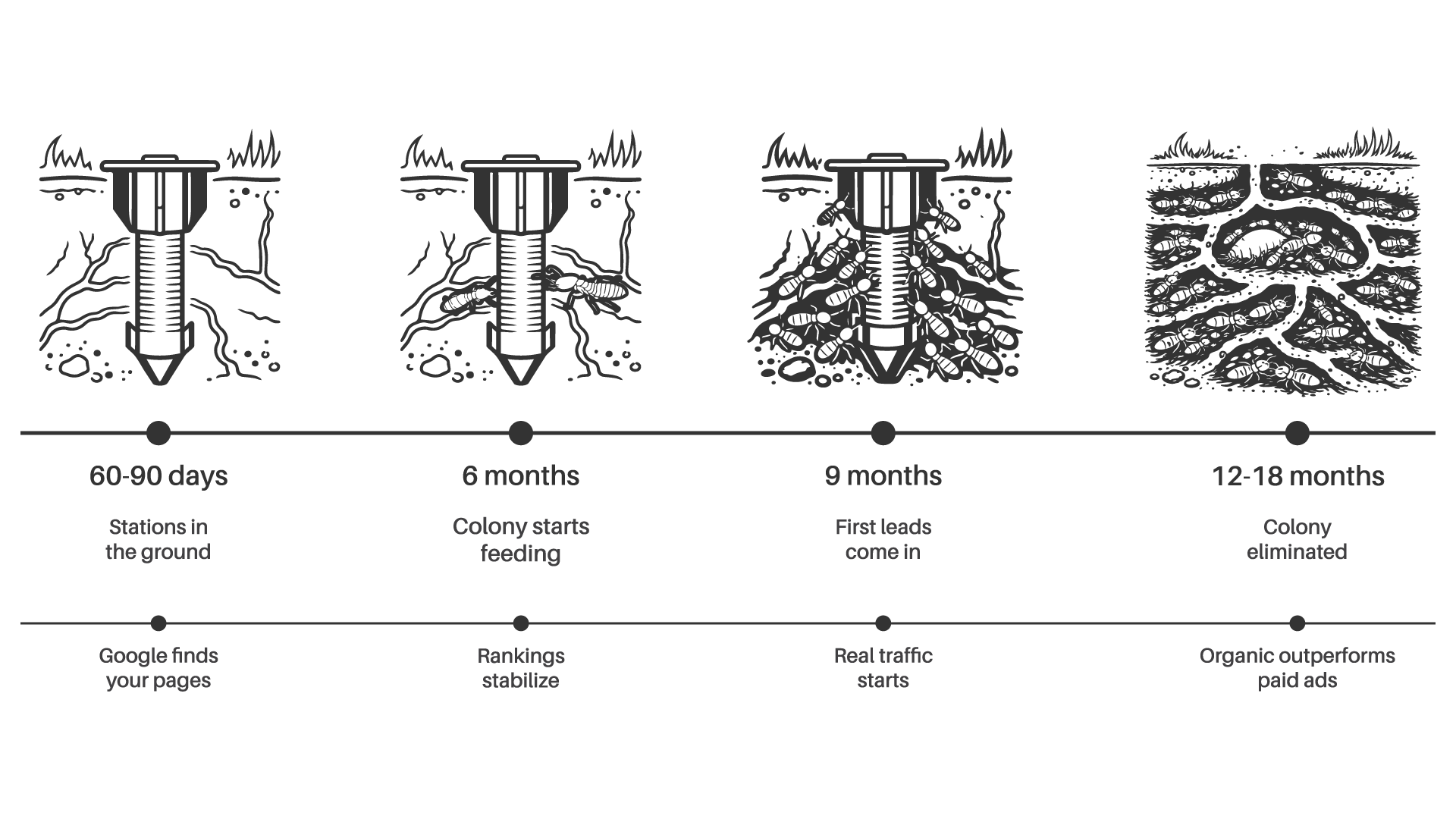
If you've ever explained to a homeowner why termite bait stations take 12 to 18 months to work, you already understand our model. The timeline is almost identical.
| Timeline | Content Marketing | Termite Baiting System |
|---|---|---|
| Month 1 | Content created; site foundation built | Stations in the ground |
| 60 to 90 days | Google finds your pages; indexing begins | Colony starts feeding |
| 6 months | Rankings stabilize; early keyword movement | Evidence of colony reduction |
| 9 months | Real traffic starts; leads increase | Continued colony suppression |
| 12 to 18 months | Organic outperforms paid ad; cost per lead drops | Full colony elimination |
You wouldn't tell a homeowner their termite problem is solved after 30 days of bait stations. The stations need time to attract the colony, the colony needs time to feed, and the active ingredient needs time to spread through the entire network. Pull the stations early, and you've wasted the investment.
Content marketing works the same way. We front-load the heavy foundational work in the first 90 days. Then the content starts compounding. Each piece builds authority. Search engines reward consistency. By month 12, you've built a competitive position that doesn't evaporate the day you stop writing checks.
We require 12 months because that's how long the system needs to produce full results. After that first year, you go month-to-month because by then, the results speak for themselves.
The Questions That Decide This
Strip away the sales talk and the choice comes down to three honest questions.
How Sensitive Are You to Entry Price Versus Content Depth?
If getting started for the lowest possible monthly number is your top priority, WolfPack's $389 entry wins that round. If you care more about how much content you get for your spend, Cube Creative produces materially more at every comparable tier. One of those matters more to you than the other. Be honest with yourself about which.
Do You Want to Assemble the Plan Yourself, or Have It Tailored for You?
Both models can end up with a plan built around your needs. The question is who does the building. With WolfPack, you buy services one at a time and manage each subscription yourself, as of mid-2026. With Cube Creative, you get one plan, one invoice, and one team that customizes it to your company and reallocates any budget that won't help you into work that will. Some owners prefer to run the pieces themselves. Others would rather hand that to a team. Neither is wrong. They're different operating styles.
Do You Want a Specialist or a Capable Generalist?
This is the real dividing line. A generalist that serves 15 verticals can absolutely do competent pest control marketing. A specialist that lives in your industry knows your seasons, your search patterns, and your customers' questions without a ramp-up. If pest-control depth is worth paying for, that points one direction. If you're comfortable with a strong generalist, the other direction is fine.
Choose WolfPack Advising If
- Your top priority is the lowest possible entry price, and you're fine starting with SEO Basic's limits.
- You want to buy services a la carte and control spend line by line.
- You want month-to-month terms with no longer commitment.
- You value a broad service-page matrix across many verticals and cities.
- You don't need deep, pest-specific published proof to feel confident.
Choose Cube Creative Design If
- You want a partner whose deepest vertical is pest control, with five case studies to show for it.
- You want more content per dollar and a library that compounds over time.
- You prefer one plan and one team, customized to what you actually need, over stacking and managing separate subscriptions.
- You want clear ownership of your site, content, and data on a low-maintenance platform.
- You're ready to commit to a 12-month runway because you understand SEO is a long game.
Red Flags to Watch for With Any Agency
This part isn't about WolfPack or us. These are warning signs to watch for no matter who you're evaluating, including agencies I haven't named.
Watch for vanity metrics. Impressions and "rankings improved" mean little if they don't tie to calls, leads, and booked jobs. Ask how the agency connects its work to revenue.
Be wary of guaranteed rankings. Nobody controls Google's algorithm, and a promised number-one spot is a sales tactic, not a plan.
Ask exactly how ad spend is billed. Some agencies have you pay the platform directly and pay them separately for management, which is fine as long as it's disclosed. Others bundle it in ways that hide the real media cost. Either way, get the full monthly number in writing before you sign.
Watch for the disappearing act. Plenty of agencies sell hard, then go quiet after the first month. Ask who your point of contact is and how often you'll actually hear from them.
Finally, read the exit terms. Whether the deal is month-to-month or a longer term, you should know exactly how to leave and what you keep when you do.
Who Shouldn't Choose Either Agency Right Now
Here's the tier nobody likes to say out loud. Some companies aren't ready for an agency at all, and hiring one now would waste money for both of us.
If you're a brand-new one-truck operation with no marketing budget and no cash cushion, hold off. If you expect leads to pour in within 30 days, your expectations don't match how any of this works, and you'll be unhappy with anyone you hire. If you can't commit even a modest monthly amount consistently, an agency retainer will feel like a bill you resent.
What to do instead: claim and fully fill out your Google Business Profile, ask every happy customer for a review, and get your basic website and phone number consistent across the web. Those steps cost little more than time, and they build the foundation that makes an agency worth hiring later. When you've done that, and you're ready to invest in growth, come back and talk to either of us.
Conclusion
Here's the honest summary. WolfPack Advising is a capable generalist with a lower entry price, à la carte flexibility, and a well-built page matrix, and for a budget-first owner who wants to start small, they're a reasonable choice. Cube Creative Design is a pest-control specialist with more content per client, five pest-control case studies, clear ownership, and 20 years of focus, and once you match the full scope of work, our bundled pricing sits in the same range as their stacked subscriptions.
The choice really does come down to specialist versus generalist, and how much content depth is worth to you. If you want a second set of eyes on your current marketing, or you just want help deciding which model fits your company, get in touch, and I'll give you a straight answer, even if that answer is that we're not the right fit.
Frequently Asked Questions
Is WolfPack Advising Cheaper Than Cube Creative Design?
At the entry level, yes. WolfPack's SEO Basic is $389/month as of mid-2026, and Cube's Foundation plan is $1,500/month. But once you match the full scope, SEO plus content plus ads plus social plus a CRM, WolfPack's à la carte total lands around $1,500 to $2,100/month, close to a single bundled Cube plan. The entry-price gap is real; the full-program gap mostly closes.
Does WolfPack Advising Specialize in Pest Control?
No. WolfPack is a generalist serving about 15 home-services verticals. They can do pest control marketing, but their published portfolio shows a single pest control case study among 22 total as of mid-2026 Cube Creative works only in a few niches and treats pest control as its deepest vertical, with five pest-control case studies published.
Why Does Cube Creative Design Require a 12-Month Contract?
Because content and SEO compound, and real results take time. A 12-month initial term matches how long meaningful organic growth actually takes, then converts to month-to-month. It also aligns our incentives with patient, long-term work instead of quick wins that look good on a 30-day report. You own everything we build, with no exit fees.
How Much Content Will I Actually Get?
That's the clearest difference between the two. At comparable tiers, Cube Creative produces roughly two to four times the content per client that WolfPack does, and that volume sits at the heart of our pest control content marketing. WolfPack's paid SEO tiers include one to two blog posts a month, and its Basic tier includes none. If a bigger content library matters to you, compare the monthly content counts, not just the prices.
Are Cube Creative's Plans One-Size-Fits-All?
No. Every package is a starting point we customize to your business, and we don't make you pay for anything you don't need. If a service won't help your company, we redirect that budget into the work that will, at the same published plan price. You get the "only what you want" control of a la carte without having to diagnose which services you need or manage several separate subscriptions yourself.
Which One Should I Choose?
Decide whether you want a specialist or a capable generalist, then match the terms to your comfort. Choose WolfPack if the lowest entry price, buying services one at a time, and month-to-month terms matter most. Choose Cube Creative if pest-control depth, content volume, a plan customized to your needs, and a long-term runway matter most. Both are legitimate choices for different owners.