
In the crowded, hyper-competitive world of modern marketing, standing out is no longer just about catchy slogans or flashy visuals. Consumers are bombarded with thousands of messages each day, and their brains have adapted to filter out noise and prioritize only what emotionally resonates.
Enter neuromarketing—a powerful discipline that applies neuroscience and psychology to better understand how people respond to marketing stimuli. Rather than guessing what works, neuromarketing helps brands tap into the subconscious minds of their customers to refine campaigns, build loyalty, and drive purchasing behavior.
We will explore how neuromarketing works, the science behind it, practical strategies to adopt, and ethical considerations for sustainable use.

The modern-day home service industry has become extremely competitive, which means capturing every potential client is critical. A common problem is that website visitors often don’t book. Luckily, there is a way you can mitigate such issues, and that’s where the power of remarketing comes in.
In IAB Australia’s survey, 74% of marketers reported that remarketing campaigns increased online conversions, and 55% saw an increase in mobile conversions. (Source: IAB Australia) Such figures only go to show how important remarketing strategies can be for your home service business.
In this post, we’ll help you understand the concept of remarketing, explain why it matters for your home service business, introduce some easy-to-apply strategies, and share some effective tips.

Thank you for contributing a guest post to our platform. To ensure your submission is processed quickly and appears correctly, please follow these guidelines carefully:
Search engine optimization (SEO) and content marketing are often discussed as distinct strategies. In fact, they're interdependent—you can't succeed at content marketing without search visibility, and SEO can't work without valuable content. Together, they form the foundation of a successful digital marketing strategy, drive quality traffic to your site, and convert visitors into repeat customers.
In this article, we demystify SEO and content marketing, explain how they complement each other, and highlight their key differences.
Machine learning has changed many industries, from finance to healthcare and transportation to online search. When machine learning algorithms advance, they need careful use and reliable data to work at their best. That’s where web design and digital marketing take machine learning projects to the next level. By making websites easy to use and bringing in users, web designers and marketers give people the chance to work with quality data and applications. We get improved simulations, stronger products, and companies that are smart about taking care of customers.
In this guide, we will explore key ways web design and marketing complement machine learning initiatives. We’ll uncover how these disciplines work synergistically to enhance machine learning projects through:
- User-centric design principles
- Traffic, engagement, and data collection
- Explainability and trust building
- Accessibility and inclusion
- Education and managing expectations
Along the journey, we’ll highlight relevant statistics, examples from industry leaders, and actionable recommendations for organizations exploring how web design and marketing can maximize their machine learning investments. Let’s get started
Crafting Intuitive Interfaces with User-Centric Design
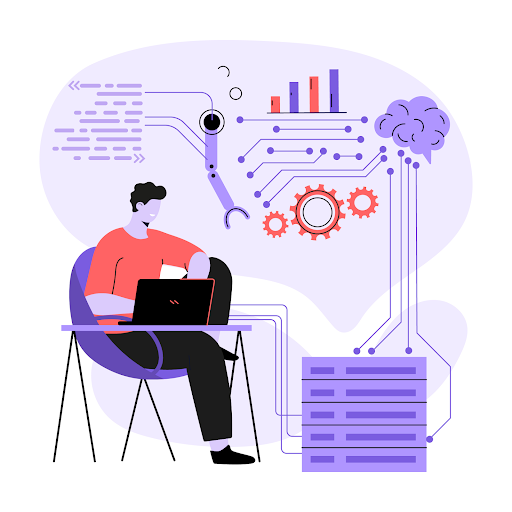
A model is only as accurate as the data used to train it. For many machine learning in healthcare projects, much of this vital data comes from users interacting with web and mobile applications. Thoughtfully designed interfaces that embrace user-centric principles are essential for collecting quality data.
What exactly is user-centric design? The approach is to deeply understand target users and their goals, behaviors, needs, and limitations before designing an interface. As a result, this empathetic orientation results in intuitive digital experiences that seem easy. Useful data is generated when users can easily provide input to the interface, whether browsing content, entering data, rating, or providing feedback.
Let’s look at some user-centric design strategies that elevate the data collection of machine learning:
Simplifying Complex Tasks
The more variables we are dealing with, the better machine learning is at solving complex problems. Humidity, temperature, wind patterns, and others need to be forecasted over locations and time for weather forecasting. This means that document classification must interpret tone, writing style, keywords, and semantics. Breaking down these complex tasks into simpler steps for the users is what user-centric design does. Do users want to label training documents? One last thing to do is design clear categories and provide annotation guidelines. Want to train users to train an image classifier? Help them trace out important areas and objects. User-centered design allows people to build on top of complex machine learning tasks.
Prioritizing Relevant Information
Not all user inputs are created equal. User-centric design research identifies the most useful data needed to solve a problem. This data is then prominently featured in the interface design. For example, an e-commerce site relying on machine learning for product recommendations must understand user preferences. The information architecture explicitly asks users about favorite brands, categories, and prices while allowing seamless browsing and purchasing. Over time, these relevant inputs strengthen recommendations.
Designing for Accessibility
Ensuring accessibility broadens the user pool and generates more diverse training data. User-centric design is about how people with auditory, visual, motor, and cognitive disabilities will interact with an interface. Best practices include writing alt text for images, having good color contrast around form fields, labeling form fields correctly, and allowing navigation via keyboard or voice. By designing for accessibility right from the beginning, we ensure that more users get to make use of an interface and give input.
Overall, embracing user-centric design means machine learning systems are trained on higher quality, more relevant data from a wider population of users. But crafting an intuitive interface is only the first step. We still need users themselves. This is where digital marketing enters the picture.