Running a small business often means you find yourself wearing too many hats. One minute you’re dealing with customers, the next you’re chasing invoices, updating your website, sorting emails, or trying to make sense of marketing reports. While this works in the early days, you’ll find it getting harder as your business grows.
Small business outsourcing provides a practical solution for owners who want to bring in help for specific tasks, without the cost or commitment of hiring a full-time employee.
Definition of Outsourcing (Outsourcing vs Hiring Employees)
Outsourcing is a term that is used when you get someone outside your business to take care of certain tasks. It could mean using a freelancer for a few hours, an agency for ongoing support, or a specialist for work your team can’t handle alone.
Hiring is different. An employee becomes part of the team, with set responsibilities, payroll costs, training, and management time. Outsourcing gives a small business more room to bring in help only where it’s needed.
This matters even more in a digital-first world. DataReportal reported that global internet users reached 6.12 billion in April 2026, showing how many businesses now operate, sell, communicate, and compete online.
Common outsourcing models (freelancers, agencies, virtual assistants, contractors)
Small businesses have several options if they want to outsource some of their tasks. Which one is right depends on the job. Freelancers are a good fit when the job is clear and self-contained, such as a blog post, logo, SEO audit, bookkeeping clean-up, or real estate photo editing.
Agencies tend to make more sense when a project needs several people pulling together, maybe strategy, design, copy, and reporting. A virtual assistant can take the smaller day-to-day jobs off your plate, from inbox sorting to research and scheduling. Contractors usually sit in the middle, offering regular help without becoming a permanent member of staff.
Signs It’s Time to Start Outsourcing
Outsourcing doesn’t always need to happen at a dramatic breaking point. More often, the signs show up in smaller ways, through delays, missed opportunities, tired staff, or routine tasks taking over the weekend.
You’re Spending Too Much Time on Low-Value Tasks
A good warning sign is when your day keeps disappearing into work that has to be done, but doesn’t really need you. Think inbox sorting, appointment reminders, data entry, invoice chasing, formatting documents, or updating the same spreadsheet for the tenth time that week.
These jobs matter, but they can quietly push better work aside. If the admin is stopping you from speaking to customers, improving your offer, or bringing in new business, it may be time to hand some of it over.
Growth Has Started to Slow Down
Sometimes a small business doesn’t stall because demand has dropped. It stalls because everything depends on one or two people having enough hours in the day. Leads sit unanswered.
Marketing becomes patchy. Projects take longer than they should. Follow-ups get forgotten because urgent jobs keep jumping the queue. That’s often the point when outsourcing starts to make sense. A few hours of outside support can remove the blockages and help your business move again.
You Lack Specialized Skills, and Your Team is Overwhelmed
There is also a big difference between learning something useful and forcing your team to muddle through work they’re not trained to do. Payroll, HR, IT security, paid ads, SEO marketing, sales systems, and technical support can all become messy when they’re squeezed into someone’s already full role.
Small business human resources outsourcing or small business IT outsourcing can be useful here, especially when the work needs accuracy, compliance, or specialist know-how. Outsourcing sales for a small business also gives the team breathing room without adding another permanent post.
What Small Businesses Should Outsource First
The best place to start is usually the work that keeps stealing time, causing delays, or sitting half-finished because nobody really owns it.
Administrative Tasks and Accounting
Admin is often the easiest first move. It’s rarely difficult work, but it has a habit of spreading across the whole day. Emails, diary updates, appointment booking, data entry, document tidying, and invoice chasing can all move to a virtual assistant. Accounting is another good one to look at early, especially if receipts and expenses only get sorted when they become a problem.
Digital Marketing and SEO
Marketing tends to be the thing everyone knows they should do, then quietly ignores when client work gets busy. Blog posts, website updates, email campaigns, local SEO, keyword research, and social content all need some kind of rhythm. Outsourcing marketing for a small business can help keep that rhythm going. It also means the owner is not trying to learn SEO at 10 pm after a full day's work.
Customer Service, IT, and Technical Support
Customer service and IT are worth looking at because problems show up quickly. Slow replies annoy customers. Broken logins, missing backups, email problems, or clunky software annoy everyone else. Outsourced support can cover common questions, bookings, follow-ups, software fixes, security checks, and general troubleshooting. Small business IT outsourcing is especially useful when the “tech person” is just whoever happens to be least busy that morning.
Graphic Design and Creative Work
Design is another sensible area to outsource because most small businesses need it in bursts. One month it’s a flyer, next month it’s a presentation, then it’s website graphics or social posts. A freelance designer can keep those materials looking joined-up without the cost of a full-time hire and help turn visitors into customers.
How to Decide What to Delegate
Knowing what to hand over is just as important as deciding to outsource in the first place. The goal isn’t to get rid of work randomly. It’s to free up time, reduce pressure, and make the business run more smoothly without creating new problems elsewhere.
A thoughtful approach to small business outsourcing helps owners stay focused on growth without losing control of daily operations.
Identify Time-Consuming Tasks
A good place to start is with the work that quietly eats up most of the day. These are usually repetitive jobs that need doing, but don’t necessarily need your full attention. Things like admin, scheduling, data entry, customer follow-ups, or updating spreadsheets are common examples.
When these smaller tasks start taking over, they leave less time for bigger priorities like sales, strategy, or improving the business. Handing them off can quickly create more breathing room in the day.
For example, if you're scaling a dropshipping model or learning how to sell other people's products on Shopify, managing inventory and order fulfillment alongside core business tasks becomes unsustainable.
Focus on ROI
Not every task needs to be outsourced immediately. It usually makes more sense to start with the work where outside help creates the biggest impact. If delegating something saves time, improves quality, or helps bring in more revenue, it’s probably worth considering.
Marketing is a good example. Hiring someone with SEO or paid ads experience will often produce better results than trying to learn everything yourself after work hours. Businesses looking to improve efficiency can also benefit from optimizing internal workflows and marketing systems, as discussed in this article about improving internal processes to increase marketing ROI. The aim isn’t just to reduce workload, but to make the business more efficient overall.
Evaluate Complexity and Risk
Some tasks are easier to hand over than others. Before outsourcing something, think about how sensitive, technical, or high-risk it is. Work involving confidential data, finances, or major business decisions may still need closer oversight.
It’s usually better to begin with lower-risk responsibilities that have clear processes and outcomes. As systems improve and trust builds, more important tasks can gradually be delegated without losing control of quality.
The Benefits of Outsourcing for Small Businesses
Source: Agiliway
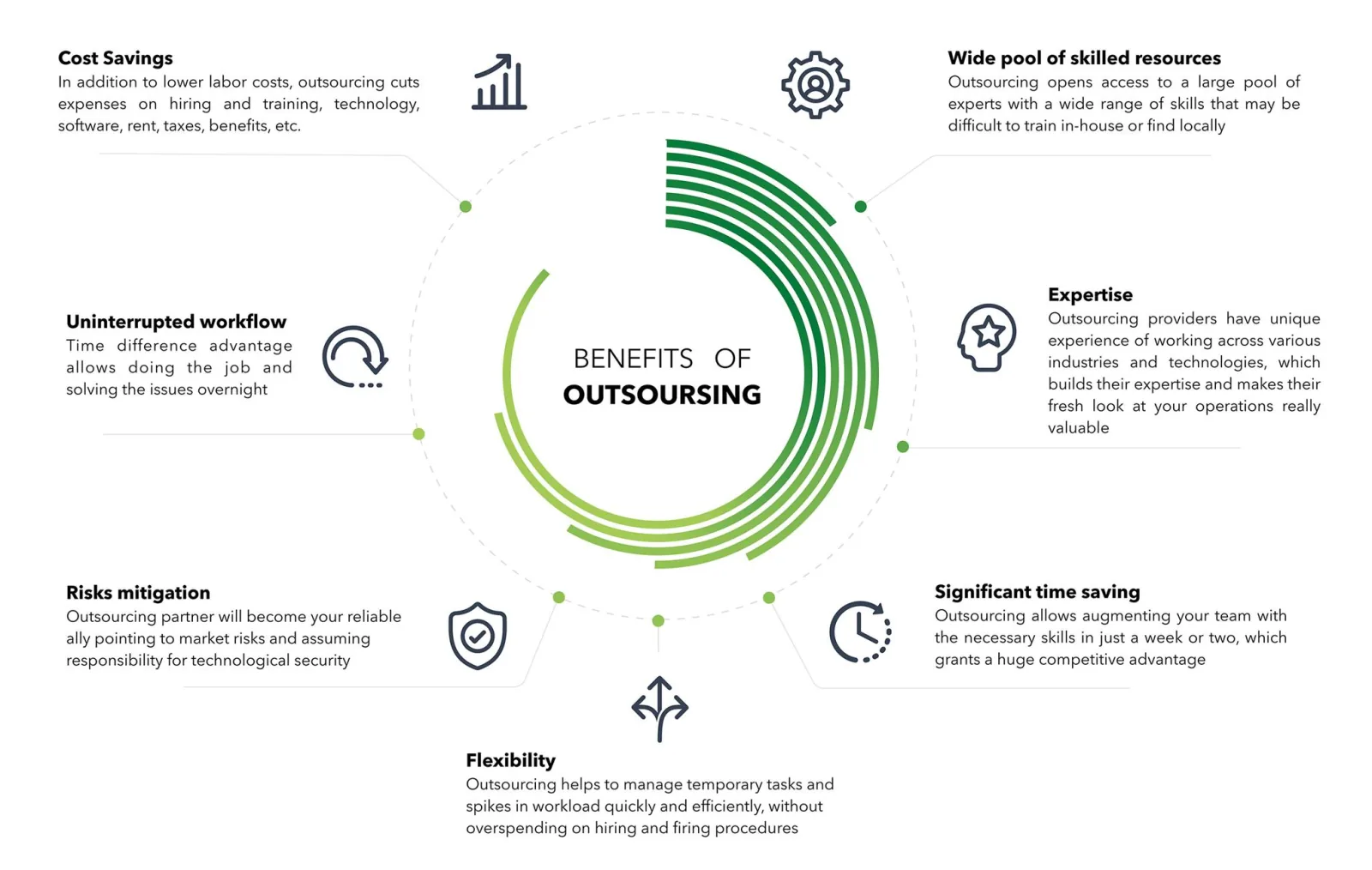
When it’s done properly, outsourcing can take pressure off a small business without making things feel disconnected or overcomplicated. It gives owners access to extra support, specialist skills, and more flexibility without committing to another full-time hire.
For many companies, small business outsourcing becomes a practical way to stay competitive while managing growth more sustainably.
Reduced Operational Costs
One of the biggest reasons small businesses outsource is cost. Hiring employees comes with ongoing expenses like salaries, benefits, training, equipment, and office space. Outsourcing allows businesses to pay only for the help they actually need.
This flexibility is especially useful during busy periods or when budgets are tight. Instead of stretching the team too thin or hiring too early, outside support can fill the gaps more affordably.
Access to Global Talent
Outsourcing also opens the door to a much wider talent pool. Instead of relying only on local hiring, businesses can work with specialists from different countries and industries.
Specialists at Rank Visely said: “Small businesses often see the greatest return from outsourcing specialized services such as SEO, content marketing, and digital strategy. Working with experienced professionals allows business owners to focus on growth while benefiting from expertise that would be expensive to build in-house.”
Whether it’s SEO, design, development, bookkeeping, or customer support, it’s often easier to find someone with the right experience for a specific project. Many businesses also choose to work with a dedicated content marketing specialist to strengthen their long-term digital presence.
Improved Productivity and Faster Business Growth
When repetitive or specialist tasks are handled elsewhere, internal teams have more time to focus on the work that actually drives the business forward. That might mean improving products, speaking with customers, or growing sales.
Outsourcing can also speed things up. Experienced freelancers, agencies, or contractors already know their process, so work often gets completed faster and with fewer delays. For companies focused on sustainable growth, investing in content marketing and SEO services can further improve long-term business performance.
Better Work-Life Balance for Founders
A lot of small business owners try to do everything themselves for as long as possible. Over time, that usually leads to stress, long hours, and burnout.
Outsourcing helps take some of that pressure away. Even handing over a few smaller responsibilities can create more time for planning, decision-making, and life outside the business. In the long run, that balance often helps owners work more effectively, not less.
Wrapping Up
Small business outsourcing works best when it solves a real problem, not when it’s used just because everyone else seems to be doing it. Start with the work that drains time, needs specialist skill, or keeps slowing the team down.
Admin, accounting, marketing, IT, customer support, and design are all sensible places to begin. Done gradually, outsourcing can give a small business more breathing room without turning every task into a permanent hire.