Chances are you have already searched for something on the internet today. Everyone uses Google or other major search engines to find solutions for their problems every single day and businesses cannot forget to optimize their online presence in this day and age. BrightLocal says 46% of searches have a ‘local intent.’ ‘Plumbers near me’ or ‘plumbers in [location]’ are examples of a search with local intent. Even if the user does not include a location, Google uses the location of the searcher to show the most relevant results.
Search engine optimization (SEO) can be intimidating to say the least, but it doesn’t need to be. Today, we will be unpacking what local SEO can do for your company.
Local SEO best serves businesses that have a brick and mortar establishment or serve a specific geographic location. Local SEO consists of customized strategies to best fit your company's needs and goals. With many different price ranges, anywhere from $450 to $3000 per month, there is a solution for every local company.
What Is Local Seo?
Local SEO varies slightly from traditional SEO. The process focuses on getting your business a higher ranking in local search results so your business is seen by more potential customers. The impact of local SEO for a business includes increased visibility, revenue, and customers/clients-- making SEO a wise investment for any company.
WebFX explains that local SEO rankings come down to
- Relevance: Does this business do or sell what the searcher is looking for?
- Proximity: Is the business close to the searcher?
- Prominence: Is the business well-known and reputable?
Local search engine results pages (SERPs) often include a map pack. Google includes the top 3 businesses that are relevant to the search. This allows local businesses to show up twice in a Google search result, once in the organic search results and the second time in the local map pack. A map pack differs from organic results by showcasing the company’s hours, reviews and photos if available. The first step to ensure your presence in a map pack is to claim your Google My Business account.
Google My Business
It is completely free to claim your Google My Business account. In doing so, your business will show up in Google local search results, Google Maps, and Google Search Knowledge Panel. Photos are a great way to allow the customer to get a good feel for what your unique business has to offer.
Automated Local Seo
Automated platforms will constantly update and check that your business name, address, and phone number are correct in local searches. This is the simplest form of SEO but does not provide much lasting value. Typically, this would cost a flat rate ranging from $90-$500 per year. Something to keep in mind, once the payments end, the platform stops performing this service and leaves the company without added assistance.
Smaller Local Seo Campaigns
This is a great option for businesses just starting off or if the business only serves one geographic location. While this service is not the super deluxe package, it will help rank your business higher on local search results and increase the business’ visibility. You can expect to pay $450-$900 per month depending on the agency.
Comprehensive Local Seo Campaigns
This plan is definitely the best long term value. Costs can range from $900-$3000 per month. Typically includes internal website maintenance, backlinks & local citations maintenance, blog & content management, and review management. Let’s break these down a little further:
Internal Website Maintenance
Maintaining your company’s website is a key factor in ranking on search engines. This maintenance entails fixing dead links, creating SEO-friendly URLs, optimizing the website’s title tags and meta descriptions, adding, removing, and editing content. All of these seemingly small changes add up to make a big impact on your company’s website ranking in local search results and ultimately impacts your business’ revenue.
Backlinks & Local Citations Maintenance
Backlinks are created when one website links to another. This is another important factor that Google and other major search engines use to rank your business’s website. Backlinks show the search engines that your website can be trusted and show that your company is the expert in that field.
Local citations are listings of your business’ name, address, phone number, and website URL. Local citations are similar to backlinks in that you want your business consistently listed across all relevant online directories such as Yelp, Angie’s List, Nextdoor, etc. If your business does not appear in many different directories, your competition will have a higher chance to snag your potential customers and the revenue that follows.
Blog & Content Management
Fresh, original content plays a huge role in your SERPs ranking. This shows the search engines that your company is active and relevant to its users. Creating content provides a great opportunity to share your company’s services, products, and specials in more detail. Another benefit is a more personal connection you are able to achieve with potential and returning customers. If writing content for a blog, at least 1,800 words is preferred for optimal exposure.
Review Management
Reviews can say alot about your business. They are real testimonies from other customers that humanize the company. Potential customers feel that they can trust the reviews because they are coming from an unbiased source. With review management, your company is able to send out SMS or email review requests and gain important new reviews. New reviews boosts your ranking on SERPs and positive reviews give your company a leg up on the competition. On the other side, if a negative review comes in, your company will receive a notification, allowing an instant response from your company, ensuring your customer that you are aware of the problem and that you value their feedback.
Why Is Local SEO So Important
Local SEO differs from traditional SEO because Google uses separate algorithms for local rankings and the map pack. As Google continues to improve their algorithms, the way the search results display changes. Marketing Analytics company Moz releases a Local SEO Industry Report annually. The report is a great tool to see which factors influence local search results the most for that year. In 2020, Google My Business elements came in first, followed by Google Reviews, and in 3rd is proximity of the searcher to the place of business. This shows how crucial utilizing your Google My Business account is and how interaction with your customers plays a huge role in gaining new customers and increasing revenue.
Moz tells us that local queries account for almost half of Google’s two trillion searches per year. Moving up in the rankings, even just one spot, can seriously affect how much traffic your company’s website receives.
BrightLocal provides some powerful statistics to take into consideration.
- 96% of PC owners conduct local searches
- 64% of local customers use search engines and directories as their main way to find local businesses
- 50% of local mobile searchers look for business information (company address or phone number)
- A whopping 78% of local mobile searches result in an offline purchase
When someone starts a local search, the number one reason is to find a local business and the second reason is to find a product or service. Many start their search without an individual company in mind, which allows for more potential leads that turn into paying customers.
2020 has been a challenging year for all of us. With the outbreak of COVID-19, less consumers have been visiting brick and mortar establishments. It is pertinent that your company’s website is easily found, user-friendly, and up to date with the correct information. Local SEO is more important than ever because the majority of potential customers will be researching for information online vs in person than ever before.
Budgeting For Local SEO
Certains factors play into how much your company should budget for local SEO services. When your company is in a highly competitive industry, it will require more resources, time, and money to set your brand apart from the pack. Another factor that affects budget is if your company has multiple locations, because each location will have to be optimized for maximum engagement. If your company provides multiple services or products, separate web pages will need to be added to target the individual services or products your company provides.
The Value Of Local SEO
The different services that local SEO provides, prove to be invaluable for your company. The internet is overtaking old school media more and more rapidly by the day. Potential customers turn to Google and other major search engines to find the solutions to their everyday problems. Harnessing the power of local SEO increases traffic, customers, and revenue for your company. Important to note, effective SEO is an ongoing process, it can take anywhere from 4 to 9 months to see results. But trusting the process is well worth the long haul.
Cube Creative is an inbound marketing agency that helps small businesses grow by managing your online presence, including but not limited to your website, website content, social media, online reviews, and online advertising. We are based in Asheville, NC with an additional office in Wilkesboro, NC.
We work with you to create a targeted strategy to use your most profitable keywords and make continuous updates both on and off your website in accordance with Google’s guidelines. No one can guarantee your company the top rankings of any search engine, unless they are talking about paid advertising. Cube Creative uses techniques that are recommended and considered safe for achieving long-term gains, without risk of being penalized or banned by a search engine.
We let your website work for you. Don’t hesitate to reach out with any questions, we are here to help!
Check out our services and connect with us for a custom local SEO plan that works for you.

Written By: Chad J. Treadway | January 26, 2021
Chad is our Chief Smarketing Officer. He will help you survey your small business needs, educating you on your options before suggesting any solution. Chad is passionate about rural marketing in the United States and North Carolina. He also has several certifications through HubSpot to better assist you with your internet and inbound marketing.

Local SEO, what exactly does that even mean? Think about this: four out of five consumers will use local searches to purchase goods, services, and products. If you are a local plumber, electrician, or service provider and your small business does not use local search optimization, you are in trouble. You will be losing out on 80% of potential business because you decided to ignore local search engine optimization (SEO).
Quite frankly, your small business existence depends on utilizing local SEO! By not utilizing local SEO tactics, you will become a statistic in the local small business graveyard. Local SEO provides essential tools to rank your small business website high in local search results. Remember, four out of five people conduct local searches to meet their needs and have their services provided for.
Written By: Chad J. Treadway | January 21, 2021
Chad is our Chief Smarketing Officer. He will help you survey your small business needs, educating you on your options before suggesting any solution. Chad is passionate about rural marketing in the United States and North Carolina. He also has several certifications through HubSpot to better assist you with your internet and inbound marketing.

Imagine for a moment you just started your own party planning business, and you are trying to find customers who would potentially use your services. Still, you don't know anything about marketing, directories, flywheels, and/or funnels. You do a quick Google search and find a company that you can pay to find some leads for you (a lead generating company). They have a plethora of established leads or potential clients, so they say.
This company may have a website that offers free birthday cake recipes and craft wrapping bows ideas as a downloadable pdf. A prospect may enter their email address to access it and have it emailed to them. By entering their email, they agree (usually in the fine print) to have the email address shared with businesses in their area that offer these services. You are then handed (after paying a price) a lead for someone throwing a birthday party. The email and contact information may also be shared with other like-minded businesses who may be potential partners (craft businesses, entertainment, or bakeshops) or even your biggest competitors.
What Is A Lead Generation Company?
A lead generation company is a company that gets paid to give business owners data about people who may be interested in a business, product, or services. Or "Leads," as they are called. Lead generation companies sometimes set up websites or advertisements that offer free things to people to get prospective buyers to give away their info in exchange for something related to what product or service they are trying to generate leads for.
What Kind Of Leads Get Generated By Lead Generation Companies?
There are three kinds of leads that lead generating companies use to advertise and sell.
1. Phone Leads
This type of lead is the least used. These leads can be highly scripted to fit any situation, but even though it has a high potential for conversions, the results are not good and often are rejected before the call is even answered.
2. Inbound
Using social media outlets like Facebook and Instagram, content marketing, search engine optimization (SEO), social media ads, and pay-per-click (PPC). These types of lead generating methods are the least intrusive out of the three forms and an excellent method. This method lets buyers continue through the buying process at their own pace like they would in a store, perusing and wandering, picking and choosing what to look at, and adding to their grocery cart.
3. E-Mail
This method utilizes the most popular method for converting potential buyers, and with good reason too. It has better than average conversion rates. This method can be personalized and tailored to say and show exactly what you want it to. Letting the business put its best foot forward.
The Pros And Cons Of Using Lead Generating companies
Pros
- If you get lucky and manage to go with a genuine lead generating company, they are experienced so that you could benefit.
- You could save time and effort.
- You could avoid human dependency and error altogether.
- They perform analytics at some of the best lead generating companies.
- Build your company faster with genuine leads that actually convert after you bring the sale in.
- Choosing the right program with great strategy and execution does work well for lead contractors.
Cons
- Genuine lead generating companies are going to really cost you huge expenses, so if your a smaller business with a limited budget, you have to really watch the leads that you're getting are worth the expense.
- There is absolutely no guarantee that it will work. Lead generating companies only have to hand you leads, not reel the customer in for you. That is still your job, and if you're not ready to handle the volume, if it does succeed, be careful that you don't find yourself in a bind.
- The cost of a lead is determined by the effort the agency spends on its detection. So if you go cheap, the chances the lead won't pay off are greater.
- So the risk is a massive gamble for businesses just starting out and building a client base.
- Lead generation companies have extensive knowledge of what they are doing but will initially not know as much about your products or services.
- You have to pay for leads, whether they are qualified as genuine or not, and all money is paid upfront.
- Sometimes and sometimes often, you're not going to be able to reach a customer to verify a lead, and when this happens, you still have to pay for the lead.
- If you're a new business and not exactly business savvy yet and well versed in the ways of hooking and reeling your customers in, then you might not know how to properly respond to genuine leads or fail to reach your lead in a timely manner. Remember, those lead generation companies only give you the leads, but it's still up to you to bring the customer through to the finish line.
- The average person receives around 88 emails a day, leaving your messages lost in the clutter and largely ignored if not deleted from so many other lead generating companies targeting your lead.
- If you do manage to land a real lead through email, the average time it takes to woo a person into buying from you? 4-6 months on average. That's a lot of time and energy to invest in a maybe when there are so many other constructive uses for your time.
The Bottom Line
If your business is in the construction field, a service-based business, or something similar, then I would not suggest using a lead generating company to start with. Getting a bad lead with or getting handed oversold leads could break a business before it gets the chance to grow. It has the potential to suck up capital quickly with no guarantee of success.
If you're just starting to grow your company in any specific niche-related field of the market, then learning the right way to organically grow your business might work better until you've grown in capitol to at least a medium-sized business that can better handle low conversion rates that can sometimes dip down on average to below 7%. There are many other ways to build your customer base, often it is much more prudent to invest in SEO practices and tried and true marketing methods or even your own emailing marketing. If you need help gathering leads through your website or help to establish your expertise online then feel free to reach out.
Written By: Chad J. Treadway | January 13, 2021
Chad is our Chief Smarketing Officer. He will help you survey your small business needs, educating you on your options before suggesting any solution. Chad is passionate about rural marketing in the United States and North Carolina. He also has several certifications through HubSpot to better assist you with your internet and inbound marketing.

Google is no respecter of websites. This means every website has the same chance to rank on page 1 of Google, but it takes time, and a website owner must be patient. It takes time and hard work to rank on page 1 of Google. Do not get discouraged if your website does not reach the top page in 30 days. It is practically impossible (if not impossible) to rank on page 1 of Google that quickly.

Written By: Adam Bennett | January 08, 2021
Adam is the president and founder of Cube Creative Design and specializes in private school marketing. Since starting the business in 2005, he has created individual relationships with clients in Western North Carolina and across the United States. He places great value on the needs, expectations, and goals of the client.

Every small business, no matter your industry, seems to struggle at some point. Below are seven tips on how you can help save time and money and ultimately make your business more profitable.
1. Keep a watchful eye over collections and billing
By developing tight controls over billing and collections will go along way in helping you improve profits of your small business. One way you can speed up cash flow is to consider semimonthly billing versus monthly billing. Also, being diligent on sending second notices.
2. Collect on over-due invoices
Of all the small businesses I talk to, there will enviably be some amount of past overdue invoices as we have all ran into those people that survive on other people’s money! Be sure to call those who owe you the most money, and try to resolve the problem on the spot, possibly by charging it to a credit card. What you lose in fees for the quicker payment is far less than dealing with the check is in the mail for two months. If you can't collect the total immediately, negotiate a payment schedule.
3. Wait, did I already pay for that?
The busier you get, the easier it is to let things fall through the cracks, especially if you are often writing and mailing checks. There are many businesses that accidentally will overpay their vendors. Be sure to have a procedure in place to help prevent the issue. If you have an accounts payable person, be sure to have them be diligent in the following accounts payable automation best practices:
- Check the invoice numbers so that you don’t pay twice.
- Don't pay for goods that you return to the supplier or vendor. Be sure to check the invoices that the adjustment has been made.
- If you get a credit memo, be sure to keep track of it and subtract them from the next invoice.
- If a vendor or supplier offers you a discount for early payment, then take them!
- Be diligent in watching for charges that are incorrectly included on the invoice. These include things such as a shipping charge that the vendor had agreed to pay.
4. Payroll
What is one of the largest line items in any business? If you guessed payroll, then you would be correct. There are ways in which you can reduce payroll costs by looking at increasing efficiency. Simply planing a route to avoid traffic could save you 15 minutes. Add that 15 minutes up, and in a week’s time, you may have saved yourself from paying overtime! Also, look at adding temporary employees and subcontractors to help with temporary workloads.
While I am by far not an expert in insurance and employee benefits, I do know that a simple review of your workers' phantom stock taxation and compensation insurance can help reduce costs. Also, look into group insurance programs, leverage the bidding process to find better rates.
Finally, after you have gathered all this information about your employees, find a simple guide on how to run payroll just so you make sure that you are not leaving out any important information when paying wages and calculating of taxes and deductions.
5. Watch your numbers
Use previous financial statements to guide you as you prepare budgets and long-range projections for the coming year. Your actual results will need to be compared to these projections to highlight areas where you need to pay closer attention before significant problems develop.
6. Keep your advisors on speed dial
You will want to keep people like your lawyer, accountant, banker, insurance agent, and marketing agency informed about your business. Keeping these pros informed about your business will help them cut costs and add to your bottom line. Just like you are an expert in your field, so are they. It’s their job to keep up with changes and trends that you may have overlooked or simply don’t know about.
7. Leverage the power of online marketing
While your marketing budget may be seen as an expense, it can actually help add to your profit margins. Online marketing is one of the cheapest and most effective ways to get your business name out in the world. By merely having an updated Google My Business profile listing can go along way into increasing your leads and new sales.
Written By: Chad J. Treadway | January 04, 2021
Chad is our Chief Smarketing Officer. He will help you survey your small business needs, educating you on your options before suggesting any solution. Chad is passionate about rural marketing in the United States and North Carolina. He also has several certifications through HubSpot to better assist you with your internet and inbound marketing.
If I were to ask you the difference between search engine optimization (SEO) and search engine marketing (SEM), you may or may not be able to tell me. Unfortunately, they are far too often used interchangeably. However, they are very different strategies! The similarity between the two makes it difficult for most small business owners to determine a better fit. Should you invest in one or the other, or maybe both? Let's look at what's the difference and which one you need for business.
SEO and SEM, What are they, and what's, are the differences between the two?
Both of these industry terms get used abundantly, and they definitely work hand-in-hand. When used together, your website may benefit. However, they are not the same thing.
One way to think about the two is to think about fishing. SEM is like taking a single fishing pole and going over to the honey hole where you know the fish are biting and dropping your line. Now an SEO would be like taking a fishing net and stretching it across the same spot. Both catch fish but only by using the net are you going to stay fed for a while or feed your family. Unfortunately, it takes time to weave the net together, so the fishing pole is a good option while you get started perfecting your macrame.
SEO = Search Engine Optimization
SEO is a marketing strategy, using keywords people use when using a/an search engine like google and linking the keywords to their site or business. Hence, they appear as close to the top of the first search engine results page (SERP) as possible, To gain exposure for their site or business, which leads to higher traffic and sales. But it's not as simple as one might think. A lot has to go into a site to optimize its potential
SEM = Search Engine Marketing
SEM is also a marketing strategy, but one that uses paid advertisement to link the name of their site or business to a list of keywords that customers might use in their search engine for services. The ad will either appear above the organic sites at the top of the SERP or listed at the bottom. Which is why, if you've ever searched for anything using Google, then you know the first three or four things listed in your search results are all ads and marked as such. Those are all what is known as SEM's, and they go by a CPC (cost per click) or a PPC (pay per click).
What is the difference between SEO and SEM?
Well, the obvious answer would be money. An SEM is paid for, and an SEO is not.
More than the apparent financial difference, SEM is mostly used in the short term to announce a sale or to gain better exposure for a highly competitive keyword, which is extremely difficult to be seen and rank for otherwise. For example, if you are a plumber and you are competing against Roto-Rooter or Benjamin Franklin Plumbing. As you can imagine, these companies have money to burn and gladly buy ads, running up the ad prices. Ads for competitive keywords can become very costly and can add up fast!. SEM's are best when used in the short term, so if you use one, remember you can set a daily budget or the max amount you're willing to pay per day.
SEM's are better used as boosters to gain traffic to your site or business and typically are not economically feasible in the long term. SEM should always be used in conjunction with an SEO site for optimal benefit.
SEO or organic search brings more traffic in the long run. Organic search is a search that cannot be affected by paid advertising and is listed by its relevance to a search. Now, if you can't afford any SEM kind of advertising, there are many ways that you can optimize your site to get it to appear high in the SERP by using SEO techniques and content marketing.
Tips And Tricks You Should Know
The White Hat Technique Will Raise Your Search Ranking Based On How Search Engines Rank Sites
1.) On-Page SEO
This SEO helps search engines understand a page's content. Therefore, giving it a higher ranking in the search by optimizing each individual page of a website to target a specific keyword makes your site more appealing to the search engine.
Keyword Research: Research the most commonly used keywords in searches that have been used for your site's topic or business by going to websites like ubersuggests.com and registering for free. If your site uses the most common keywords people are asking about, its relevance will be raised automatically in the search engine.
Creative Content Writing: Your site can't be like any others; if you want traffic and to get noticed, you can't just use the keywords. You need to find a new angle on them and make people want to click on them, giving readers what the other sites are NOT. Or, in other words, answer people's questions! Exactly what an AI SEO agency helps you do by combining creativity with data-driven keyword insights.
2) Technical SEO
This SEO will optimize non-content elements of the site and the overall site itself, improving its foundation.
Site Speeds: Use lower resolution or more transparent media on the landing page for faster site speed.
Indexing: Make everything organized and clean looking while also making info easy to find
Crawlability: Make words and buttons bigger for easy navigating.
Site Architecture: Make sure there are several ways to reach, contact, or talk to someone on the landing page, and everything is clearly marked and visible.
Mobile Friendliness: Make your site or business mobile-friendly. Search engines are used almost more on mobile phones than on computers anymore, and search engines know the difference and rate higher for sights that cater to both.
Security: Security is vital if you want to build trust and return traffic.
3.) Off-Page SEO
When other reputable website sites link to your site, it shows the search engine that the brand is trustworthy. This type of SEO builds up a website's reputation and authority. This is usually accomplished by connecting it to other high-quality websites by including:
- Local listings
- Directory profiles
4) Local SEO
Local SEO comprises a variety of tactics. Most will include a geographic landing page. As the name implies will consist of a geographical location and services or products relevant to the area. They are designed for local search or when a user is searching for the keyword or keyword phrase in combination with the "near me," "city," or zip code determined by Google. Other things will include
- Google My Business Listing and Management
- Reputation/Testimonials
- Maintaining Name, Address, and Phone consistency
Why Good Businesses Use Either An SEO or SEM Or Both
Everybody wants their site or business to appear at the top when someone searches. Obviously, it's a highly coveted position that's extremely competitive. Most people who use search engines like Google, Bing, Yahoo for their search only look at the first page of search results. Why? Because we want everything fast. Having to click through pages of search results is work. Typically people use searches for three reasons:
- for businesses and services
- for researching topics to become better educated about something
- for finding info on people, places, or things
Ask yourself this, when you do a Google search, do you click to the second page of your search results? How about the third page? If they don't see what they want to on the first page, most people will type in a whole new search by altering their wording or "keywords" next, rather than click to a second or third search result. Being listed on the second page of search results is still better than five or ten, but it still gives you less than a 50% chance that a searcher will reach your site or business through their search engine results.
Knowing this, I'm sure you can imagine with both SEO strategy and SEM strategy, the goal is to be seen in order to gain the most traffic. The more traffic to your site or your business, the higher the chance someone will contact you or will share your content with others. There's a lot that goes into each SEO and SEM strategy also both on and off-page. However, the one thing they have in common is keywords. Both strategies are intent-based. Meaning someone is purposefully searching for what you're offering or something closely related.
Target Marketing
It's important to know who and what you're marketing to. Some demographics are broad range like sports or medicine, but even both of those topics are umbrella terms for a much greater list that could attach itself to those words alone. Sometimes being broad helps, and using an umbrella term can sometimes definitely help. But so are a million other businesses that got there first years ago and have established themselves on the internet—making your business page 30 in the search engine. So to optimize using an SEO or SEM needs to be far more specific if not closely related to your actual target audience.
For example, let's say I'm an ice cream fanatic blogger. Now the words ice cream have been taken by Baskin-Robbins and rap songs for at least three search pages. Let's say mint-chocolate chip and a couple of other flavors are taken up also. But maybe through my research, ice cream scooper is wide open or ice cream as one word because sometimes people don't care how it goes into the search bar is also a better chance for you to get on that first SERP as #1.
Which Is Better for Your Business, SEO, or SEM?
With the similarities and differences between SEO and SEM laid out, unfortunately, there isn't a clear winner for most small businesses. Just as you and your business are unique, so should the choices you make. For some, SEM might be just the ticket to break through a ceiling, while it might be cost-prohibitive for others.
If you need help choosing, I would suggest reaching out for a free consultation. We will be glad to help you decide if one is better than the other or if both might be a better fit for you and your business.
Written By: Adam Bennett | January 01, 2021
Adam is the president and founder of Cube Creative Design and specializes in private school marketing. Since starting the business in 2005, he has created individual relationships with clients in Western North Carolina and across the United States. He places great value on the needs, expectations, and goals of the client.

Controlling overhead costs is critical for all small businesses, but those in the construction and trades it is even more critical. With increased competition, increased material cost, and slim profit margins, it has forced many businesses to take a good hard look at overhead cost management.
Budgeting and variance analysis
Technology has made budgeting systems, control strategies, and planning available to contractors, both large and small. Budgeting allows you to evaluate and assess current operations, future costs, and provide a proactive approach to controlling overhead. Tools like Coast’s AP automation for construction can also help contractors track invoices, manage approvals, and keep project expenses under control.
Your overhead will be either variable or fixed. Owners and managers can use these price relationships along with historical developments to potentially forecast costs. Keeping a flexible budget can then be used to evaluate significant variances between actual costs incurred and projected amounts. This will also help you in highlighting weaknesses and potential problems in your organizational structure.
Merely setting a budget, you will help you and can act as an action plan. It can help you change employee behavior and assist you in the decision-making processes. By prompting managers to emphasize cost control and extend planning, employees and staff will often adopt your values. They will also develop a cost-conscious attitude that will start to permeate the company.
Partnering
The global pandemic has thrust the adoption of technology and online communication faster than anyone could have predicted. These advances have also increased the availability of access to the internet wither in the office or in the field. This, in turn, has allowed contractors to join meet with owners, architects, financiers, and subcontractors faster and work through all aspects of a project. Cooperation has the potential to virtually eliminate several of the problems that previously plagued a project.
Job planning and management
Software is now available that helps builders manage and plan jobs more efficiently. For example, contractors can accurately plan crew sizes, production schedules, manage material deliveries, and schedule subcontractors with the help of technology. These programs allow you to make better decisions, ensuring that your jobs are completed with fewer problems and within budget.
Technology saves time and money
While technology has helped many people, it does come at a cost. You must weigh the benefits of the cost and your time. Ultimately, you must decide if this is going to help or hurt you? Often, the initial sting of technology costs hurt, but the rewards of time gained back is worth every penny.
Just like your website should help answer searchers’ questions so that you or your staff doesn’t have to take time out of their day to answer it. This isn’t to say you should always direct them to your website for an answer, but it does help to have the most common questions answered there as if one person is asking it, chances are there are more with a similar question.
If you are a contractor who needs help with making your website work harder, then reach out to us. We specialize in helping contractors and small businesses grow by simply making their website answer people’s questions, which increases leads and sales.

The 30 Lead Generation Tips, Tricks & Ideas For Trades
Free Resource
Are you looking for help with lead generation for your construction business?
Written By: Chad J. Treadway | December 02, 2020
Chad is our Chief Smarketing Officer. He will help you survey your small business needs, educating you on your options before suggesting any solution. Chad is passionate about rural marketing in the United States and North Carolina. He also has several certifications through HubSpot to better assist you with your internet and inbound marketing.

Jobsite theft can be a hefty burden for contractors of any size. According to the Associated General Contractors of America, it can almost a billion dollars annually.
Here are a few tips and tricks that you can do to help secure your job site:
Install A Fence
Merely installing a fence around the entire work area can help limit the lazy thief. Fencing such as a chain-link fence is easy to install. If the site you are working in allows you can also add barbed wire to the top to discourage the more ambitious thief from climbing over it. If you are looking for a good fence installer in the WNC area, be sure to reach out to Asheville Fence and tell them we sent you!
Hey, you can’t park in here
By having your employees park outside the main job site will help prevent smaller tools from growing legs and walking off to the trunk of a car or bed of a truck.
Light it up
Having a bright light area can help deter both vandalism and theft. It allows police and neighbors to keep a watchful eye out for any unusual activity.
Alarm systems
By simpling putting up an alarm that detects motion and activates additional lighting may be all that’s required. If you want to go a step further, then adding security cameras might be another option. If you need a good alarm system or looking for a consultation, talk to Integrity Security, and be sure to tell them we sent you!
Mark equipment with ID numbers.
By marking equipment with an ID number will help not only deter theft but help you in inventory and depreciation management. Use something like a Google Sheet to help you keep track of everything. Be sure to have one that is visible and one that is hidden, such as an access panel that is rarely removed or hard to remove.
Getting a delivery, be sure to sign for it
It is helpful to have one person you really trust in charge of materials coming to the job site. Have them keep a log of what is there and what isn’t. Expensive and critical materials should only here there just in time.
Inform the proper authorities
It’s always wise to inform the proper authorities such as fire and police before starting a project. Simply reaching out to them and showing them some goodwill will help in protecting your job site. To help oversee the site effectively, police often use inventory tracking software for agencies to monitor equipment, materials, and on-site activities, ensuring everything is accounted for and reducing potential risks.. Be sure to make sure you give them an estimated completion date and typical work hours, don’t forget to update them if it changes either! Also, try to provide a list of key personnel and their mobile phone numbers for emergencies.
Hopefully, with these tips, you can help ensure your job site is safe and secure. While we at Cube Creative Design can’t help you with securing your job site, we can help you with securing your website and making sure you have a full pipeline of leads. Contact us today to see how we can help your business grow!
Written By: Chad J. Treadway | November 02, 2020
Chad is our Chief Smarketing Officer. He will help you survey your small business needs, educating you on your options before suggesting any solution. Chad is passionate about rural marketing in the United States and North Carolina. He also has several certifications through HubSpot to better assist you with your internet and inbound marketing.
The primary purpose of your small business website is to attract the right customers and motivate them to take action. The call to action might be to contact you, find out more about you and your offerings, or referring others to the business. A mere entertaining site is simply noise and is no real value, ahem social media sites. Your website needs to work just as hard for you as you do; consider the following suggestions:
Define your buyer persona
A buyer persona is just a semi-fictional representation of your ideal customer base. This is based on your market research and real data about your existing customers. This will help you in not only identifying the target audience for your website, ads, or social media, but it can also help identify who are ideal people for your sales team to go after.
Make your content skimmable
News flash, searchers will not read all your copy. Crazy, I know! I bet you are skimming this right now, which just proves my point. You need to make it easy for people to scan or skim your content. Numbered and bulleted lists will help people digest your content. Add a few well-placed headlines, and you are well on your way to building a great page.
Be clear and succinct
You need to make it crystal clear what you do and even what you don’t do. A little transparency can go along way in actually building your credibility. Make sure you also describe the characteristics, parameters, or capabilities of what you can do.
I don’t want to use a GPS on your site
Your website should be easy to navigate and find the information people need. Nothing is worse than coming to a site and not finding the information you are looking for. Unless it is a landing page where you only want them to focus on the one call to action, make sure your navigation is prominent. I often tell clients that you won’t want to switch the gas and the brake on your car, what would you want to change where your navigation is?
Social Proof
Searchers want and need reviews and/or references in the form of social proof. It comes in many forms.
Here are a few impressive statistics about social proof:
- According to Voices.com, placing the logos of business customers on a company website can increase conversions by as much as 400%. I also refer to this as the NASCAR section.
- The average consumer reads ten online reviews before making a purchase decision.
- 57% of consumers will only buy or use a business service if it has at least a 4-star rating.
- 88% of consumers trust user reviews as much as personal recommendations.
Don’t Ghost Your Prospects
While ghosts may be ok at Haloween or a graveyard, the bottom line is they have no business being around your website. Just as they shouldn’t be around your website, you shouldn’t ghost a prospect. Be sure to promptly answer all inquiries and/or respond immediately with automated e-mails stating when you will follow up.
Keep The Vegas Strip In Vegas
The goal of your site is to attract prospects. If you have too much flash, sound, and fury, then you will alienate them before you even have a chance to convert them. While it might be nice to win a design award, that might not mean you win over visitors. Often less is more.
Too much detail
I will admit, I am passionate about what I do, and I tend to over-explain things. I have realized that, just like the design, less is often more. The 3,000-word blog post with 50 images may say what you need to say, but what will your prospect say about it? Will they wait for all the images to load? Can they find what they are looking for? Or would it be better to trim the fat and the number of images to better convey the message? Hint, its the latter!
It’s Not Hide And Seek
In other words, don’t hide the essential information from searchers. Make sure you present information in order of its importance. Make things clear and concise.
Your small business website can be your single best sales tool if you let it. You simply have to give it the attention it deserves.
Written By: Adam Bennett | October 09, 2020
Adam is the president and founder of Cube Creative Design and specializes in private school marketing. Since starting the business in 2005, he has created individual relationships with clients in Western North Carolina and across the United States. He places great value on the needs, expectations, and goals of the client.
I have a couple of confessions to make; I used to hate reading! I would often read the Cliff Notes versions if one was available. In college, I would do my best to skim what I had to read and fake my way through the discussion. In hindsight, not the best decision, but I passed, right? However, as I have gotten older, I have forced myself to read more. My thoughts are I already have a master’s degree, reading sales and marketing books is cheaper than an MBA, less time-consuming, and I don’t have to do accounting classes! I am happy to report as of writing this, I have read 14 books just this year.
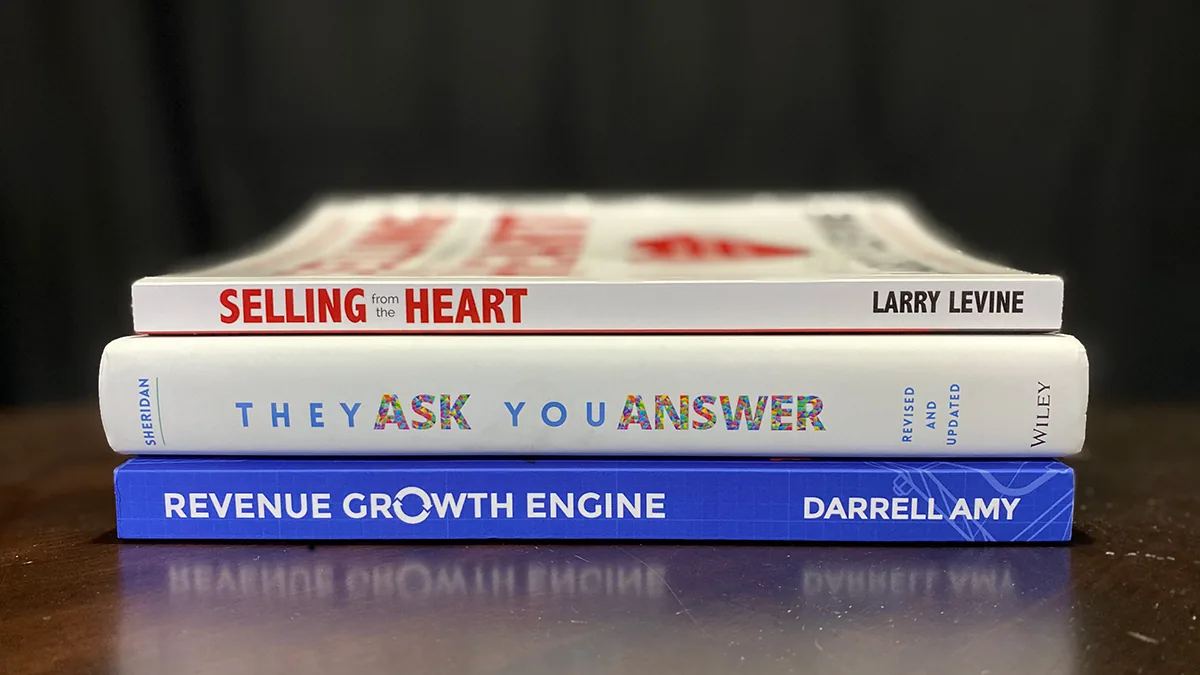
Some have been short, some have been longer. Some I struggled to get through, a few I could take or leave, while others really spoke to me. Of all that I have read in the past few years, there are three maybe four that I think every entrepreneur and small business owner needs to read. I call it the sales and marketing trifecta. Without further ado, here is the order I think you should read them.
1. Selling From The Heart by Larry Levine
If you are unfamiliar with Larry, he was a copier salesman in LA and really built strong relationships with his clients. I first learned about him through a couple of podcasts and started following him on LinkedIn. When he started up his podcast, I started listening to it, and I still listen to it weekly. When I heard the “Selling From The Heart: How Your Authentic Self Sells You!” came out, I ordered a copy and put it in the reading queue.
Larry exudes what a good salesperson should be. He often says, don’t be “an empty suit.” What that means is you need to be authentic and genuine, don’t walk in with the sole purpose of making a sale, or as he says, “having commission breath.” Ultimately you want to come to a place where you want to help clients, or in other words, “sell from the heart.” To do this, you have to build relationships with clients, be it in person, over video, or on social. Larry says you have to build relationships before you can sell someone. Your clients need to make sure that they know who you are, and you know who they are.
You don’t want to be the person who walks through the door once a year at renewal or just at the holidays who is dropping off the tin of cookies. Even worst, they think that you are there just there to sell them something.
What I took away and what I try to do with my clients is that I want to know you by name. I want to know about your family. If you see me in the grocery store, I want you to come up and speak to me, and I want to feel like I can do the same thing. Not like, "Oh God, there's that Chad guy. He's going to try to sell me something here in the middle of Walmart."

2. They Ask, You Answer by Marcus Sheridan
“They Ask, You Answer: A Revolutionary Approach to Inbound Sales, Content Marketing, and Today's Digital Consumer” (TAYA) has to be one of the books that changed my thought process and outlook on what I do. If you have been around me longer than 10 minutes and the subject of content marketing or what I do, you will probably hear me reference it.
To me, the book is one of the best marketing books out! If you do any kind of research or a poll on social, you might see Seth Godin’s “Purple Cow” pop up as a must-read. I have read both TAYA and “Purple Cow.” However, having read TAYA, I would read a passage and be like, ok, this is the TAYA concept. I am thankful that I had checked the book out from the local library while it was on order. Needless to say, I shipped the book back because I didn’t care for it. Now I don’t mean to discount “Purple Cow.” What Seth Godin says may resonate with you. However, I have deep blue-collar roots. While Marcus has risen to be an influential figure in the sales and marketing world, he is still a pool guy, so he says!
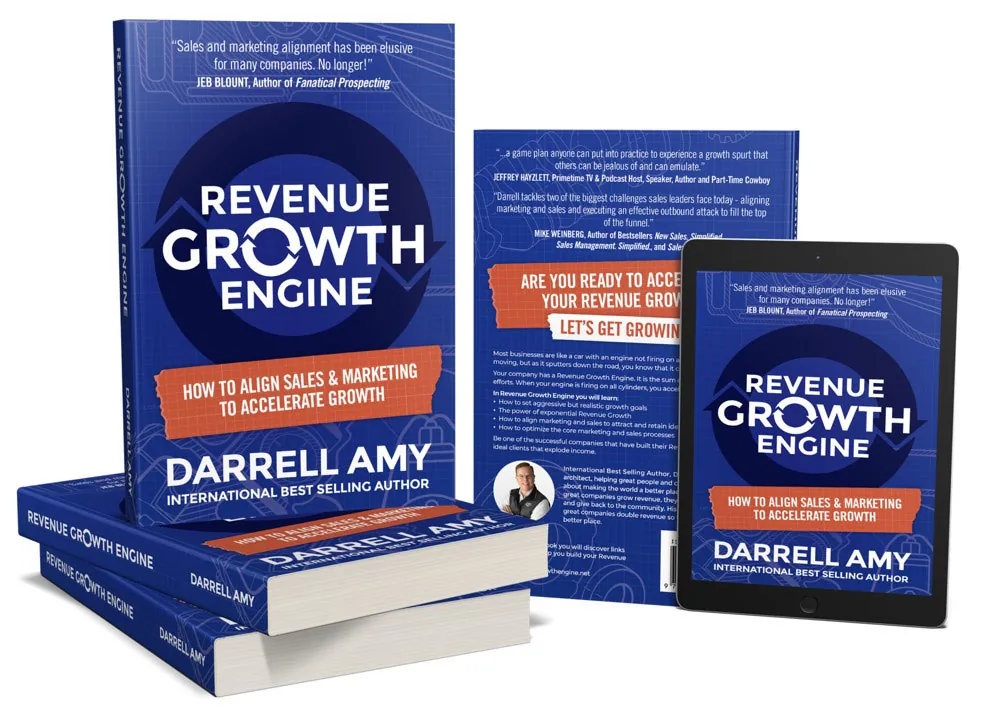
3. Revenue Growth Engine by Darrell Amy
The third book in my trifecta is “Revenue Growth Engine: How To Align Sales & Marketing To Accelerate Growth.” Darrell co-hosts with Larry on the Selling From The Heart Podcast. I like Darrell’s book because it is a culmination of the two previous books I mentioned.
The bottom line is that “Revenue Growth Engine” gives you a good summary and consolidation of “Selling From The Heart,” and “They Ask, You Answer” with a healthy dose of how to bring it all together to really get a good return on your investment which will help a business grow.
Bonus: Start With Why by Simon Sinek
“Start with Why: How Great Leaders Inspire Everyone to Take Action” by Simon Sinek has completely changed my mindset on how I approach a prospect. I have always felt like I had a “givers gain” or pay it forward mindset because I don't want to just sell anybody my services. The book helped me clarify my mission and it has helped Cube Creative solidify the company as a whole. I can proudly now say that I help small businesses grow by helping them to build and manage their online presence. I even start conversations with prospects by asking if they want to grow their business, why they exist, and why they do what they do.
Essentially if you're starting a business or thinking about starting a business, you need to read “Start With Why” so so that you can ultimately decern and know why you want to do what you do. If you're struggling in your career or in a company where you feel like you're struggling, you should also give it a read.
Final Thoughts
Depending on your role or background I would recommend starting with “Selling From The Heart,” then “They Ask, You Answer.” If you are short on time, then you should read “Revenue Growth Engine.” However, I think you will get more out of it by reading it last as it will help tie in the key aspects and topics that you may not realize when you read the others.
Written By: Chad J. Treadway | September 22, 2020
Chad is our Chief Smarketing Officer. He will help you survey your small business needs, educating you on your options before suggesting any solution. Chad is passionate about rural marketing in the United States and North Carolina. He also has several certifications through HubSpot to better assist you with your internet and inbound marketing.

On the surface, Google My Business (GMB) is a FREE tool from Google that helps businesses manage their online presence on the search engine results page and maps. It is the vessel that allows the local search to be more accurate. The only stipulation is that you must meet people in person. In other words, you can’t operate 100% online.
For example, if you chartered Nautilus trips, you could have a Google My Business listing, however, if you just sell seashells online, it's a no go.
Before we dive too much into GMB, let's look at how people search.
Written By: Chad J. Treadway | July 28, 2020
Chad is our Chief Smarketing Officer. He will help you survey your small business needs, educating you on your options before suggesting any solution. Chad is passionate about rural marketing in the United States and North Carolina. He also has several certifications through HubSpot to better assist you with your internet and inbound marketing.

It’s a competitive market for today’s small business owners. You aren’t only competing against other small business owners but depending on your area you might also be competing with larger companies and franchise operations. But there is good news, much like a David and Goliath, being smaller and also help make you more nimble allowing you to act quicker. If you know how and what information to monitor, your business can be as successful as any.
Here are seven tips for helping your small business save time and money and making your business more profitable.
1. To sell right, you have to buy right
One way small businesses can compete is by being competitive with your prices of physical products. The best way to do that is to buy competitively. Try to buy factory direct where possible, attend wholesale auctions, and consider establishing a buying co-op with other small but noncompeting businesses.
2. Cost: It’s everyone's concern
Make every attempt to help motivate your staff to be mindful of costs and the net profit. The goal being they are as concerned with controlling costs as with generating sales. One way you could encourage participation would be to implement a bonus program based on a percentage of costs saved.
3. Treat your customers right and they'll keep coming back.
Ben Franklin is credited with saying that “The bitterness of poor quality remains long after the sweetness of low price is forgotten.” This goes along with your customer service. While watching the cost is a factor, you don’t want to sacrifice your quality or customer service to do it.
4. Build a network and be mentored
Finding a good mentor be it someone local, regional, or thousands of miles away, will help you navigate the journey of business ownership. Build out a network of professionals in your industry you will find out what others are doing to manage problems with inventory, receivables, personnel, fixed assets, technology, marketing, etc.
5. Change isn’t a bad thing
Legend has it that Henry Ford said, “If I had asked people what they wanted, they would have said faster horses.” Think about that, if it had not been for creative ideas and innovation we wouldn’t have the mobility we do today. See change isn’t a bad thing! Just because its the way its always been down doesn’t mean there isn’t a better way.
6. Ask your employees and your customer service reps
Businesses shouldn’t be afraid to ask the staff and customer service reps for suggestions. These are the folks that are directly involved with both your product and your customers. They are in the perfect position to suggest improvements and give you an insight into what is working and what’s not working.
7. Examine your current marketing strategy
For smaller companies a yearly marketing plan may be efficient, for larger ones, it may be better to look at doing something quarterly or monthly. If you are focusing on content and digital marketing its much easier to pivot and make changes.
Conclusion
Hopefully, these seven tips will help you set up your small business for success! If you are interested in a free review of your current website or would like a consultation on what we can do to help you with your website, content marketing, and digital marketing needs, please be sure to reach out!
Written By: Chad J. Treadway | July 07, 2020
Chad is our Chief Smarketing Officer. He will help you survey your small business needs, educating you on your options before suggesting any solution. Chad is passionate about rural marketing in the United States and North Carolina. He also has several certifications through HubSpot to better assist you with your internet and inbound marketing.