
The academic arena in the 21st century is extremely competitive. The costs of running and maintaining a school have risen drastically, and each year, it’s becoming harder to convince parents that choosing a private over a public school is still a sound investment given its rising cost. That’s why schools need to have a solid marketing plan to combat the challenges that they currently face.
Private school marketing campaigns aim to entice prospective students to come to your school and enroll. It is important to have a consistent strategy in place to keep your school's academic identity meaningful to your demographic in the long term.
Keeping up to date on the new school marketing strategies and applying them regularly is critical if you like the school to excel. Luckily, companies like Cube Creative exist to support you. Cube Creative will be a dependable collaborator for the school's digital marketing demands, thanks to its wide range of sophisticated services.
This article examines three big challenges to keep your eye on when it comes to marketing the school and ensuring its long-term success and how your school can work around them. We will go into who your target demographics are, how you can successfully communicate to them, and how you can keep their commitment to your educational brand through a strong online presence and advertising strategy.

Written By: Adam Bennett | May 17, 2021
Adam is the president and founder of Cube Creative Design and specializes in private school marketing. Since starting the business in 2005, he has created individual relationships with clients in Western North Carolina and across the United States. He places great value on the needs, expectations, and goals of the client.
As a small business owner venturing into search engine optimization (SEO) can be an intimidating endeavor. While it seems like every competitor from the 800lb gorillas to “Chuck with a truck” has an online presence. The question becomes, how do you compete online? The answer is simple. You use digital marketing or, more specifically, SEO and the content marketing pieces to better compete.
SEO and content marketing go hand in hand, like peanut butter and jelly. While SEO tactics were a thing by themselves several years ago, you can't talk about one without the other.
Here are the top ten reasons why SEO and content marketing is so critical for small businesses:

Written By: Chad J. Treadway | May 17, 2021
Chad is our Chief Smarketing Officer. He will help you survey your small business needs, educating you on your options before suggesting any solution. Chad is passionate about rural marketing in the United States and North Carolina. He also has several certifications through HubSpot to better assist you with your internet and inbound marketing.

In the old days, private schools bragged about dedicated faculty, excellent student-to-teacher ratios, and strategies in educating the whole child, which was the focus of marketing a school.
Nowadays, employing only this approach may fail to attract students to enroll in these institutions. In addition to this strategy, one also needs to use other marketing approaches.
Social media engagement is one such strategy. Facebook, Twitter, Instagram, and more are available platforms you can use. Increase your branding and improve your parent engagement by choosing the most suitable social media platform.
One of the best private school marketing strategies when using social media is to reach out to just a few people. Do not adopt a cluttered approach that reaches out to the highest number possible. Instead, target a few ones who already have an interest in your school.
Then create a wildfire of interest that you can grow from there and proceed using other effective methods that work for word-of-mouth strategies, SEO strategies that work for most types of business and organization, and competitor analysis.
Written By: Adam Bennett | May 13, 2021
Adam is the president and founder of Cube Creative Design and specializes in private school marketing. Since starting the business in 2005, he has created individual relationships with clients in Western North Carolina and across the United States. He places great value on the needs, expectations, and goals of the client.

Local search engine optimization, or local SEO, is the act of optimizing a website for local search using specific terms and key phrases targeting searchers that your business caters to in your specific geographical location. Local SEO is very similar to traditional SEO in that it also is a process involving the placement of your site or a page in the search engine results pages (SERPs) of these search engines, often called "natural" or "organic" results. Ultimately what you are looking for are those searchers looking for something near them or in your area, in other words, "near me" type results.
Written By: Chad J. Treadway | May 11, 2021
Chad is our Chief Smarketing Officer. He will help you survey your small business needs, educating you on your options before suggesting any solution. Chad is passionate about rural marketing in the United States and North Carolina. He also has several certifications through HubSpot to better assist you with your internet and inbound marketing.

Let’s face it, we live in a world where the internet isn’t a luxury anymore but, dare I say, a necessity (ask my son, and he will tell you it is a necessity) in the same sense that electricity is. We, as internet users, will consume on average 6 hours and 30 minutes each day (Bond Cap, 2019).
No one would think that a business owner would put having a website or at least “creating a website” at the top of their to-do list. Depending on the study and survey, on average less than 50% of small businesses actually have one (CNBC 2017). Many small business owners try to use substitutes for a website, such as the Yellow Pages online, a Facebook page, or some other form of “free” social media.
Looking at the same CNBC/SurveyMonkey, they found that:
- 55 percent of small-business owners say they have a business website
- 50 percent say they have a business Facebook page
- 21 percent say they have a business Twitter account
While these statistics might be shocking to some, we see them every day. A website will give your small business more visibility and credibility it needs to thrive.
Before I move on and address the five reasons you need an online presence, let me address those business owners who only have a social media page as “their website.” Your social media page isn’t your website, not even close! While it is a common misconception, you must think about it like this. Social media platforms are simply rented spaces.
Written By: Chad J. Treadway | May 07, 2021
Chad is our Chief Smarketing Officer. He will help you survey your small business needs, educating you on your options before suggesting any solution. Chad is passionate about rural marketing in the United States and North Carolina. He also has several certifications through HubSpot to better assist you with your internet and inbound marketing.

At Cube Creative, the staff and I work with small businesses, many of which are family-owned and operated. To be a successful family business, you need to be vigilant when looking at the present and the future. Here are five crucial questions that you and your family need to address:
1. What is your "Why"
When I speak with prospects, I may sound like a child with all my "why" questions. Most of them are geared to digging in and getting the root of things. As part of the barrage of questions I often ask, I will also ask the most important question, which is, "Why do you do you do what you do," or "why do you want to do this venture or idea." Their answer will determine if I want to even work with them. While there isn't a magical answer or a right or wrong answer, I really want to know that they have a passion for what they do. If they don't have a passion for what they do, then what I do won't matter.
2. Do you have a business plan?
While you wouldn't build a house without some sort of plan, you shouldn't run your business without one either. At best, you are just wing' in it, which, let's be honest, isn't the greatest idea. Of all the small businesses I have worked over the years, those who have succeeded and grown have had a plan or a vision. Now, your business plan doesn't need to be complicated. It should include both short and long-range goals. If you can include specific goals such as growth, profit, and market-share targets, then that's all the better. Also, you should have a plan in place for the transition. Being a family-owned business, there is bound to be conflict. I have experienced it first hand both with my own family's business, and I have seen it with clients, its best to have a plan for those.
3. Who's managing the day today?
Who is helping to manage the day to to day operations? Do you have a family member or a key employee, or a fresh hire with experience? As the old saying goes, when you have too many cooks in the kitchen, it ruins the soup. The same could be said for family businesses. When several family members all work within the company, you need to have roles clearly defined. This will help both you and your staff and should help to alleviate family conflicts.
4. What business entity should my business fall under?
Whether you're a first-time entrepreneur wanting to build something for your family and the generations to come, or if you are taking over the multi-generational business, there are many options before you. Speaking with a good lawyer should be able to help advise and guide you on the correct path.
5. What does my future hold?
While many family-owned business owners never seem to retire, there may be a point that you either want to retire, have to step away, hand the business off, or sell out. Statistics show that only 30 percent will survive the second generation and only 13 percent to the third. Ensuring you have a plan for your future and benefits for yourself and everyone else involved is critical. While there are many plans available depending on your business, having and speaking with a qualified accountant, financial advisor, and a lawyer will help.
At Cube Creative, we don't have a crystal ball or a DeLorean to see the future. We know that to be successful, you need to look at where you have been, where you are, and where you want to be. Having strategic partners along the way will help you in growing your business. If you are looking for a partner to help you manage your online presence, we at Cube Creative can help you. Feel free to contact us for a free consultation on how we can help your business grow!
Written By: Chad J. Treadway | May 03, 2021
Chad is our Chief Smarketing Officer. He will help you survey your small business needs, educating you on your options before suggesting any solution. Chad is passionate about rural marketing in the United States and North Carolina. He also has several certifications through HubSpot to better assist you with your internet and inbound marketing.
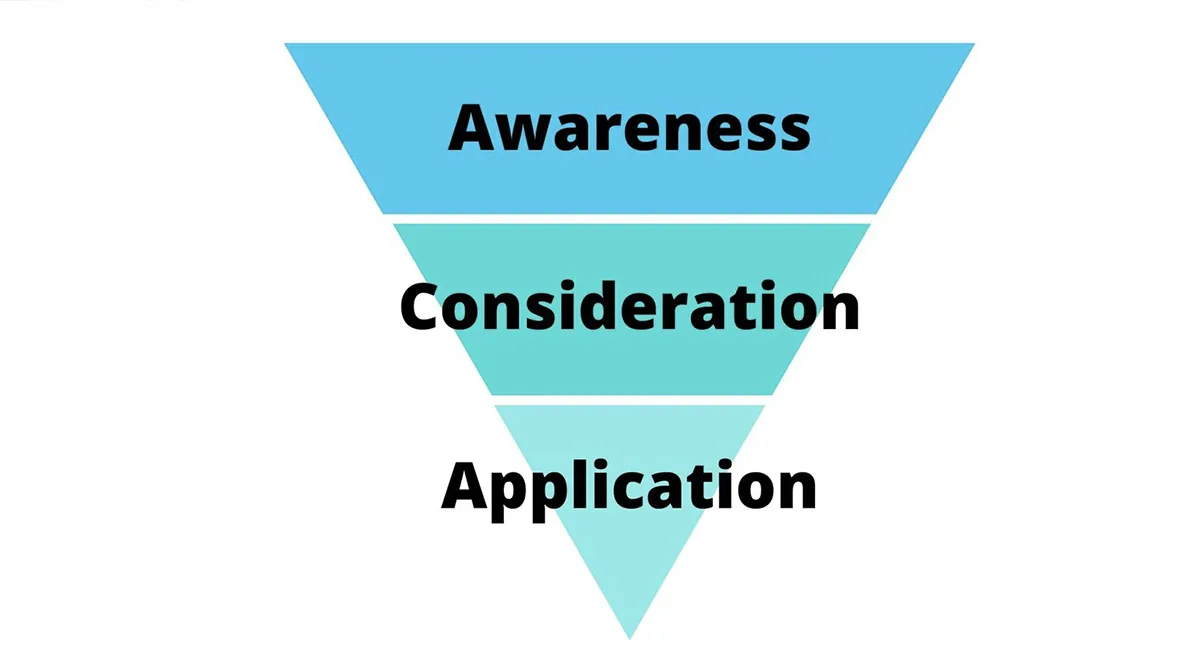
The journey that starts from accessing your target market to invoking your target market to procure your service or product is quite frankly long and arduous. In the case of private schools, you have a very specific niche. Your market is wide and profitable but tapping into the market is easier said than done.
However, that should not discourage you from fully optimizing the resources at your disposal. The journey is long, but the results are outstanding. Your first and quite ready resource at your disposal is your enrollment funnel. Just like any industry funnel, it is made to improve your process and possibly maximize on profits.
The only difference is that different industries have different issues they want to solve through their funnel. In terms of the private school industry, here is your specialized enrollment funnel. Its main aim is to actualize admissions and increase your student body.
But first, lets start with the basics—the introductory part of the marketing textbook.
Written By: Adam Bennett | April 29, 2021
Adam is the president and founder of Cube Creative Design and specializes in private school marketing. Since starting the business in 2005, he has created individual relationships with clients in Western North Carolina and across the United States. He places great value on the needs, expectations, and goals of the client.
Far too often, entrepreneurs leave money on the table, prospects, and clients in the dark by failing to drive traffic to their business. They think that having a social media page or just a website is good enough to make the phone ring or bring business through the door.
If you want to get an edge as a small business owner, you should be formulating and utilizing a creative content plan that focuses on local search engine optimization. This includes:
Written By: Chad J. Treadway | April 23, 2021
Chad is our Chief Smarketing Officer. He will help you survey your small business needs, educating you on your options before suggesting any solution. Chad is passionate about rural marketing in the United States and North Carolina. He also has several certifications through HubSpot to better assist you with your internet and inbound marketing.

There are stars in the southern sky Google Business Profile (formerly Google My Business) listing, and if you decide to go after them, you will be rewarded like the taste of thyme sweetened honey. Let’s go down the seven bridges reasons why they matter and how you can boost your Google reviews count.
Written By: Chad J. Treadway | April 20, 2021
Chad is our Chief Smarketing Officer. He will help you survey your small business needs, educating you on your options before suggesting any solution. Chad is passionate about rural marketing in the United States and North Carolina. He also has several certifications through HubSpot to better assist you with your internet and inbound marketing.

Even if a school is doing everything right, it does not always follow that people have heard about them or the things they are doing. Worse, the surrounding communities and families they want to target the most may not be aware of their existence.
In such a scenario, and if there is a consensus within your school organization that a more robust and effective marketing plan must be implemented to attract more applicants, then one of the strategies you ought to consider to include is inbound marketing – along with other strategies for that matter.
Here is how inbound marketing goes.
Written By: Adam Bennett | April 13, 2021
Adam is the president and founder of Cube Creative Design and specializes in private school marketing. Since starting the business in 2005, he has created individual relationships with clients in Western North Carolina and across the United States. He places great value on the needs, expectations, and goals of the client.

Do you wonder why old pages tend to show up at the top in some search results even though they are relatively old? Aren’t we told that we should keep our content fresh to stay on top of search engine results? These results are what we in the digital marketing industry refers to as evergreen content.
Written By: Chad J. Treadway | April 12, 2021
Chad is our Chief Smarketing Officer. He will help you survey your small business needs, educating you on your options before suggesting any solution. Chad is passionate about rural marketing in the United States and North Carolina. He also has several certifications through HubSpot to better assist you with your internet and inbound marketing.
Local search engine optimization (local SEO), also called local link building, refers to optimizing your websites or web pages for better local exposure in the search engines. Local SEO is like organic SEO in that it also is a method affecting the visible presence of a site or a page in the search results of a particular search engine, often called the "organic" or "unpaid" results. Organic search results are those that are generated by the engines based on natural user searches for a given keyword/phrase. These natural searches are what your organic optimization efforts are aimed at.
Written By: Chad J. Treadway | April 10, 2021
Chad is our Chief Smarketing Officer. He will help you survey your small business needs, educating you on your options before suggesting any solution. Chad is passionate about rural marketing in the United States and North Carolina. He also has several certifications through HubSpot to better assist you with your internet and inbound marketing.