 use Joomla\CMS\Uri\Uri;
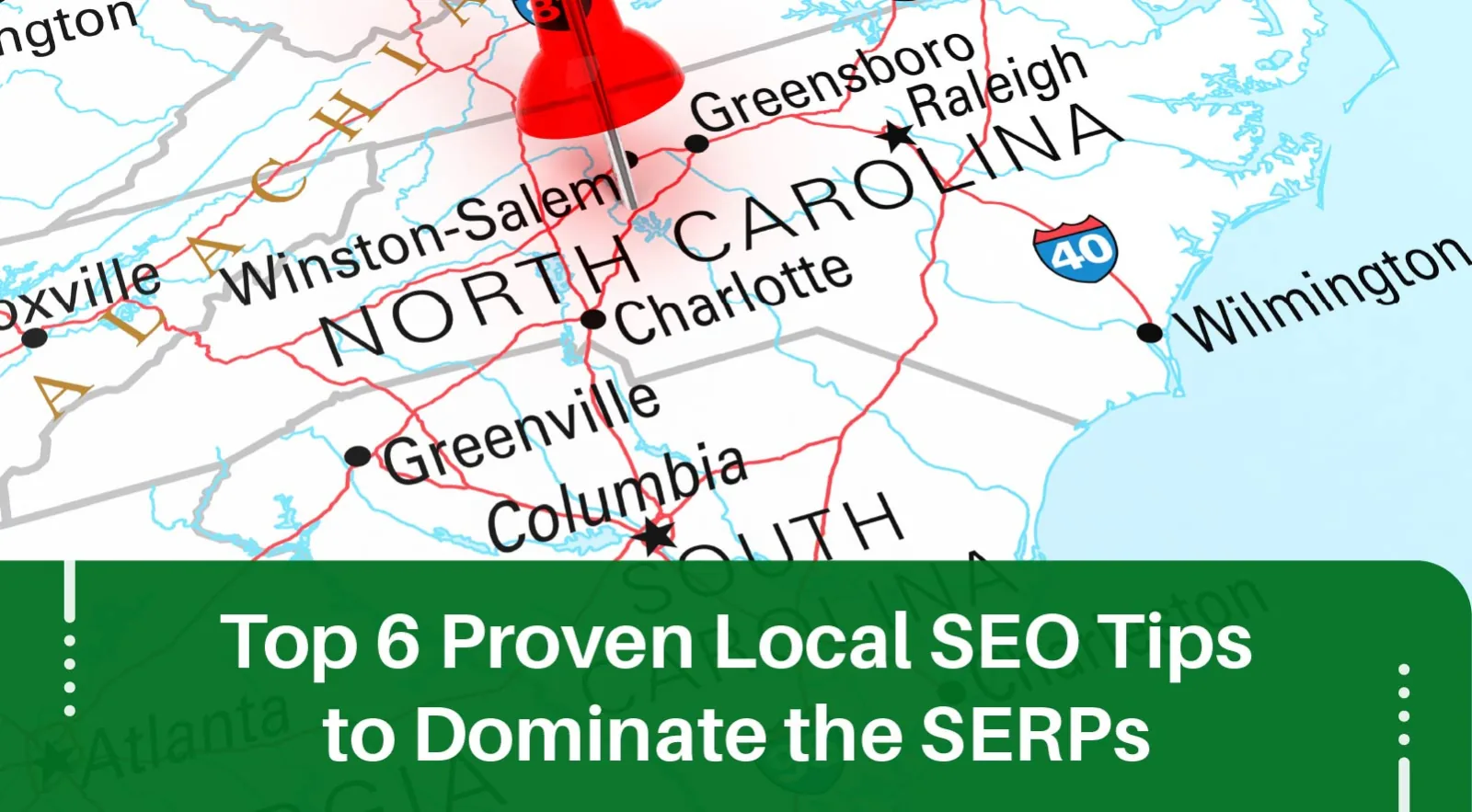
As a local small business, you will do almost anything to get in front of potential clients. You can use the power of the internet and internet marketing to ensure you’re in front of local searchers when they are looking for your services.
The problem is that many local small businesses’ websites aren’t optimized for search engines, let alone local search. The bottom line is that you are throwing away a huge opportunity to reach potential clients in your service area and drive additional traffic, incremental revenue, and more sales.

Written By: Chad J. Treadway | January 25, 2023
Chad is our Chief Smarketing Officer. He will help you survey your small business needs, educating you on your options before suggesting any solution. Chad is passionate about rural marketing in the United States and North Carolina. He also has several certifications through HubSpot to better assist you with your internet and inbound marketing.

In this digital world, your website will likely be one of the first and best impressions you can make on potential clients. Web “people” go by various names: web designer, webmaster, web developer, digital marketer, SEO guy, SEO agency, content marketing agency, etc. Because of their technical prowess, they have an uncanny ability to speak a different language.
Before you dedicate your time, energy, and hard-earned dollars toward the perfect website, here are ten questions you need to ask and potential answers for them:
Written By: Chad J. Treadway | January 23, 2023
Chad is our Chief Smarketing Officer. He will help you survey your small business needs, educating you on your options before suggesting any solution. Chad is passionate about rural marketing in the United States and North Carolina. He also has several certifications through HubSpot to better assist you with your internet and inbound marketing.

Ah, the humble email has come a long since Ray Tomlinson sent the first one in 1971. While it may have started as a side project for him, it has become one of the most used communications methods.
According to recent research by Statista, it was estimated that 333.2 Billion emails would be sent and received daily. Think of it like this that is 41 emails per person per day, or nearly 15,000 a year!
While an email may seem like an afterthought to your overall digital marketing strategy, I am here to tell you it should be considered one of the first things you think about once you have enough content (blogs and landing pages) in place.
Therefore in this post, I will cover ten reasons and stats why you need to think about email marketing as part of your digital marketing strategy and email newsletters asset sizes!
Written By: Chad J. Treadway | January 18, 2023
Chad is our Chief Smarketing Officer. He will help you survey your small business needs, educating you on your options before suggesting any solution. Chad is passionate about rural marketing in the United States and North Carolina. He also has several certifications through HubSpot to better assist you with your internet and inbound marketing.

According to Statistica, In 2022, global content marketing industry revenue was estimated at roughly 76 billion dollars, projected to increase to over 88 billion in 2023. Suffice it to say the worldwide content marketing sector has snowballed in recent years. Therefore, content marketing will remain essential to your private schools’ marketing mix.
Private schools like yours must use many different types of content outlets for marketing your school effectively; these include but aren’t limited to:
- Blogs
- Infographics
- E-books
- Email Newsletters
- Print Newsletters
- Social Media Posts
- Videos
- Podcasts
- Testimonials and Reviews
- Paid advertising (PPC and Social Media Ads)
Private school marketers and administrators that can anticipate content marketing trends and changes in audience behavior will be able to alter their marketing strategies and make the best investment in resources and time. To increase growth, private school marketers must be aware of the ever-changing world of content marketing.
When done correctly, digital and content marketing attract new parents and caregivers to your site and increase searches and questions. So how can you market your school the right way with content? Here are the top seven content marketing trends that private school marketers should be aware of.

Written By: Adam Bennett | January 16, 2023
Adam is the president and founder of Cube Creative Design and specializes in private school marketing. Since starting the business in 2005, he has created individual relationships with clients in Western North Carolina and across the United States. He places great value on the needs, expectations, and goals of the client.
It has happened to me countless times, private school marketers and administrators obsess over the school’s home page. While this is somewhat justifiable, you must realize that most searchers are unlikely to see your private school’s homepage. The reason is that the search engines will serve the page most likely to match the searcher’s intent. Therefore, you need to consider your website and each page of it as more like the books, chapters, and pages of the Bible. When you pick up the Bible to read, you typically don’t start in Genesis and read it straight through to Revelation. You jump in and around, and your website is no different. This is where landing pages come into play.
In this post, I will give you a basic understanding of what a landing page is, the different types, and how they can be used for your private school digital marketing campaigns.
Written By: Chad J. Treadway | January 11, 2023
Chad is our Chief Smarketing Officer. He will help you survey your small business needs, educating you on your options before suggesting any solution. Chad is passionate about rural marketing in the United States and North Carolina. He also has several certifications through HubSpot to better assist you with your internet and inbound marketing.
Any private school marketing message aims to get prospective students’ parents to commit to a tour, so you can show them how good your school is. But what happens when you get them to your school’s website? How do you get them to engage more and ultimately raise their hand for a tour? To do this, you need effective call-to-action items.
Written By: Adam Bennett | January 09, 2023
Adam is the president and founder of Cube Creative Design and specializes in private school marketing. Since starting the business in 2005, he has created individual relationships with clients in Western North Carolina and across the United States. He places great value on the needs, expectations, and goals of the client.

When it comes to running a private school, allocating your marketing budget might mean the difference between being profitable and being in the red. Are you inaccurately measuring the value of your marketing channels? What if you’re overspending on student acquisition? What if you’re losing money because of outmoded thinking and incorrect assumptions?
What would additional market share be worth to your private school?
Written By: Chad J. Treadway | January 04, 2023
Chad is our Chief Smarketing Officer. He will help you survey your small business needs, educating you on your options before suggesting any solution. Chad is passionate about rural marketing in the United States and North Carolina. He also has several certifications through HubSpot to better assist you with your internet and inbound marketing.

In August 2018, Google revealed a new algorithm upgrade dubbed the Medic Update, which focused a lot on E-A-T (Expertise, Authority, and Trustworthiness). E-A-T is one of Google's top five ranking indicators to evaluate page content, according to their Search Quality Rater Guidelines (QRG). E-A-T is so significant that it is cited over 185 times in the QRG.
Google has stated that the focus for websites should be on creating unique content and providing an excellent overall user experience. Google has previously said that relevant content, good E-A-T, mobile friendliness, and a fast page load time (less than 2 seconds) are required for websites to obtain better ranks.
Google’s algorithm is updated on a nearly daily basis. They also provide Core Updates numerous times a year. Thanks to AI and machine learning, Google can now rank material based on its quality requirements.
To rank your private school’s website content in Google, you have to focus on getting into the minds of your target audience (parents), thinking about the questions they want to be addressed and the intent behind their search.
Here are seven strategies to demonstrate E-A-T and increase the visibility of your school's content in Google searches.
Written By: Adam Bennett | January 02, 2023
Adam is the president and founder of Cube Creative Design and specializes in private school marketing. Since starting the business in 2005, he has created individual relationships with clients in Western North Carolina and across the United States. He places great value on the needs, expectations, and goals of the client.

If you are a small business owner, you have probably heard that you need a local marketing strategy.
Did you know that “88% of people who conduct a local search on their smartphone visit a related store within a week.” (Source: Think With Google) Therefore having a local marketing strategy is more critical than ever.
Written By: Chad J. Treadway | December 28, 2022
Chad is our Chief Smarketing Officer. He will help you survey your small business needs, educating you on your options before suggesting any solution. Chad is passionate about rural marketing in the United States and North Carolina. He also has several certifications through HubSpot to better assist you with your internet and inbound marketing.
No matter how great your school is, you will receive negative comments at some point. It's sometimes more about the person having a terrible day or being unhappy about something unrelated to your school than anything that happened at your private school. Whatever the source, the person's annoyance manifests as a bad review or comment on Facebook or another social channel.
For better or worse, we live in a world where people have a voice that can be easily expressed on social media. Parents and students can take pictures and videos, interact with others and create a positive or negative buzz about their experiences with your school as they perceive them. Unfortunately, their perceptions aren't always accurate.
I understand how annoying that may be, especially because social media is essential to any modern private school marketing plan. As a result, client support on social media necessitates a distinct technique. Effective social media management is required, especially when dealing with unfavorable comments. Handling negative comments on social media is critical for your school's brand image, and a well-thought-out plan can help minimize the damage.
Here are some strategies for dealing with negative social media comments or reviews:
Written By: Adam Bennett | December 26, 2022
Adam is the president and founder of Cube Creative Design and specializes in private school marketing. Since starting the business in 2005, he has created individual relationships with clients in Western North Carolina and across the United States. He places great value on the needs, expectations, and goals of the client.
Having precise, consistent information across the internet is crucial to being discovered online. Here is where local SEO citations come in handy.
Since local search marketing is somewhat of our specialty, I have let you in on some of our industry’s best-kept secrets by sharing my most effective citation-building strategies.
Written By: Chad J. Treadway | December 21, 2022
Chad is our Chief Smarketing Officer. He will help you survey your small business needs, educating you on your options before suggesting any solution. Chad is passionate about rural marketing in the United States and North Carolina. He also has several certifications through HubSpot to better assist you with your internet and inbound marketing.

Errors are all too prevalent when employing employees for a small firm. While costly HR procedures can be used. Small firms are especially susceptible to a few typical mistakes. There are a few HR pitfalls that small businesses should avoid, according to Eddy.com.
