
Your best customer just told three neighbors how good your service is. You don't know who any of those neighbors are. You didn't follow up. You didn't offer your customer anything for the recommendation. You have no idea if any of those three turned into a contract. That referral existed, and you had nothing to do with it.
That's the gap most independent pest control companies live in. Word of mouth already works. Your trucks, techs, and quarterly visits are generating goodwill on every route. But goodwill that isn't captured is goodwill you can't bill against. A real pest control referral program strategy turns that goodwill into a system, or it stays an accident. For most operators in the $1 million to $2.5 million revenue range, it's still an accident.
This is not a post about begging customers for a Google review. That's a different conversation. This is about engineering a referral engine the way you'd engineer a service route: the right incentive structure, where the ask lives in your technician workflow, how to track results without enterprise software, and the legal guardrails to know before you start writing checks. By the end, you should have a working blueprint for turning your existing customer base into your most reliable lead source.

Written By: Chad J. Treadway | June 16, 2026
Chad is a Partner and our Chief Smarketing Officer. He will help you survey your small business needs, educating you on your options before suggesting any solution. Chad is passionate about rural marketing in the United States and North Carolina. He also has several certifications through HubSpot to better assist you with your internet and inbound marketing.
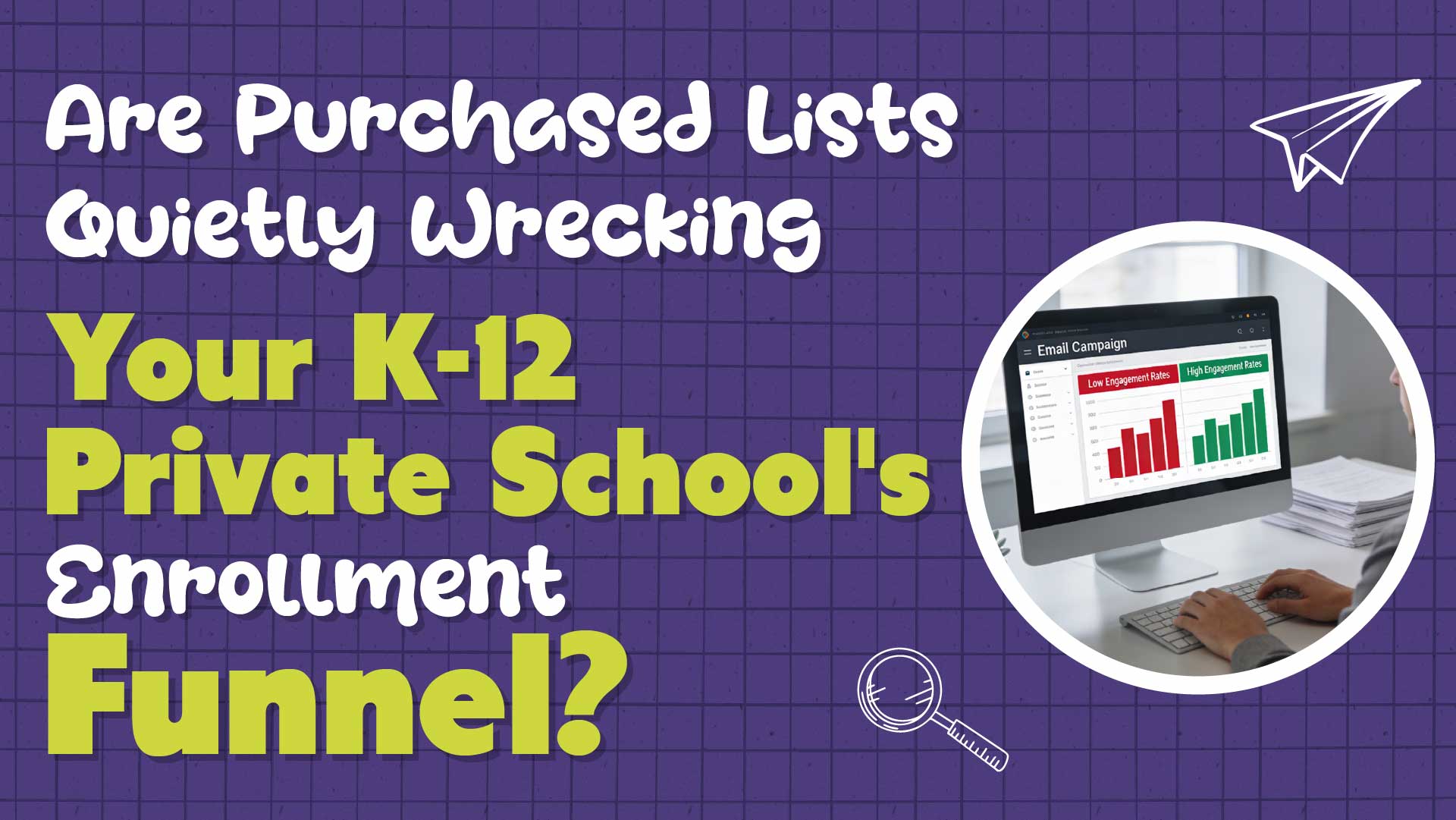
There is a particular kind of disaster that admissions directors never see coming until the symptoms show up in the wrong place. The marketing email campaign is performing badly. Unsubscribes are climbing. Then a parent calls because she did not get the re-enrollment reminder. Then another. Then the head of school mentions she missed the snow-day alert. Then the IT director pulls the deliverability report, and the picture sharpens fast: someone bought a list, the domain reputation tanked, and now every email the school sends is clawing its way out of spam folders.
That is what a purchased mailing list does to a school. It does not just fail to enroll students; it quietly burns the email infrastructure that every other school function runs on. For private and independent schools where digital outreach is the entire enrollment pipeline, the damage is the difference between an inconvenience and an emergency. First-party data school marketing is what works now, and for a virtual academy with national reach, it is the only model that survives the next 18 months of tightening privacy law, stricter deliverability rules, and shrinking demographics.
This piece is for school administrators, marketing directors, and admissions teams who have either been pitched a purchased list, are still using one, or are quietly wondering whether the agency they hired is using one on their behalf. The argument is simple. Buying lists is no longer a shortcut. It is a slow-motion liability, made worse by a demographic squeeze and a privacy regime that has tightened materially in the last 18 months. The first-party alternative is more work up front and dramatically more durable. By 2026, it will also be the only approach that actually produces enrolled students.

Written By: Adam Bennett | June 15, 2026
Adam is the president and founder of Cube Creative Design and specializes in private school marketing. Since starting the business in 2005, he has created individual relationships with clients in Western North Carolina and across the United States. He places great value on the needs, expectations, and goals of the client.
Every pest control owner I talk to wants more leads. Almost none of them want to talk about what happens after the phone rings, which is funny, because that's where every dollar of marketing spend either turns into a customer or evaporates. You can run the prettiest Google Ads campaign in the county, but if your office manager is on hold with a parts supplier when a panicked homeowner calls about carpenter ants, you just paid for a competitor's appointment.
This is the last-mile problem of pest control marketing. Independent operators in the 11-to-30-employee range are the ones most exposed to it. You've got a real budget, real lead flow, and a real office manager, but that office manager is also scheduling routes, fielding billing questions, and handling complaints from the technician whose truck just blew a tire on I-40. The sales workflow is whatever happens in the cracks. That's where the leaks live.
I work with independent pest control companies every week, and the pattern is almost always the same: marketing generates the calls, then a tired CSR with no playbook converts about a third of what should have been a much bigger number. Below is the complete phone-to-close workflow — speed, script, buyer type, pricing frame, commercial bidding, call tracking, CRM pipeline, conversion benchmarks, and the one industry credential that sells for you before you've even pitched. Treat it like a checklist. Most companies leak in three or four spots and don't realize it.
Written By: Chad J. Treadway | June 15, 2026
Chad is a Partner and our Chief Smarketing Officer. He will help you survey your small business needs, educating you on your options before suggesting any solution. Chad is passionate about rural marketing in the United States and North Carolina. He also has several certifications through HubSpot to better assist you with your internet and inbound marketing.
Your school's website gets traffic every single day. Families browse your academic programs, check tuition rates, scroll through photo galleries, and read about your mission. Then they leave. No form filled out. No inquiry submitted. No name, no email, no phone number. Just another anonymous session in your Google Analytics dashboard.
Here is the uncomfortable truth that most private school leaders don't want to hear: somewhere between 96% and 98% of website visitors never fill out a form. That is not a typo. For every 100 families who visit your site this month, you might hear from two or three of them. The other 97 vanish without a trace.
Family visitor identification changes that equation entirely.
Written By: Adam Bennett | June 12, 2026
Adam is the president and founder of Cube Creative Design and specializes in private school marketing. Since starting the business in 2005, he has created individual relationships with clients in Western North Carolina and across the United States. He places great value on the needs, expectations, and goals of the client.