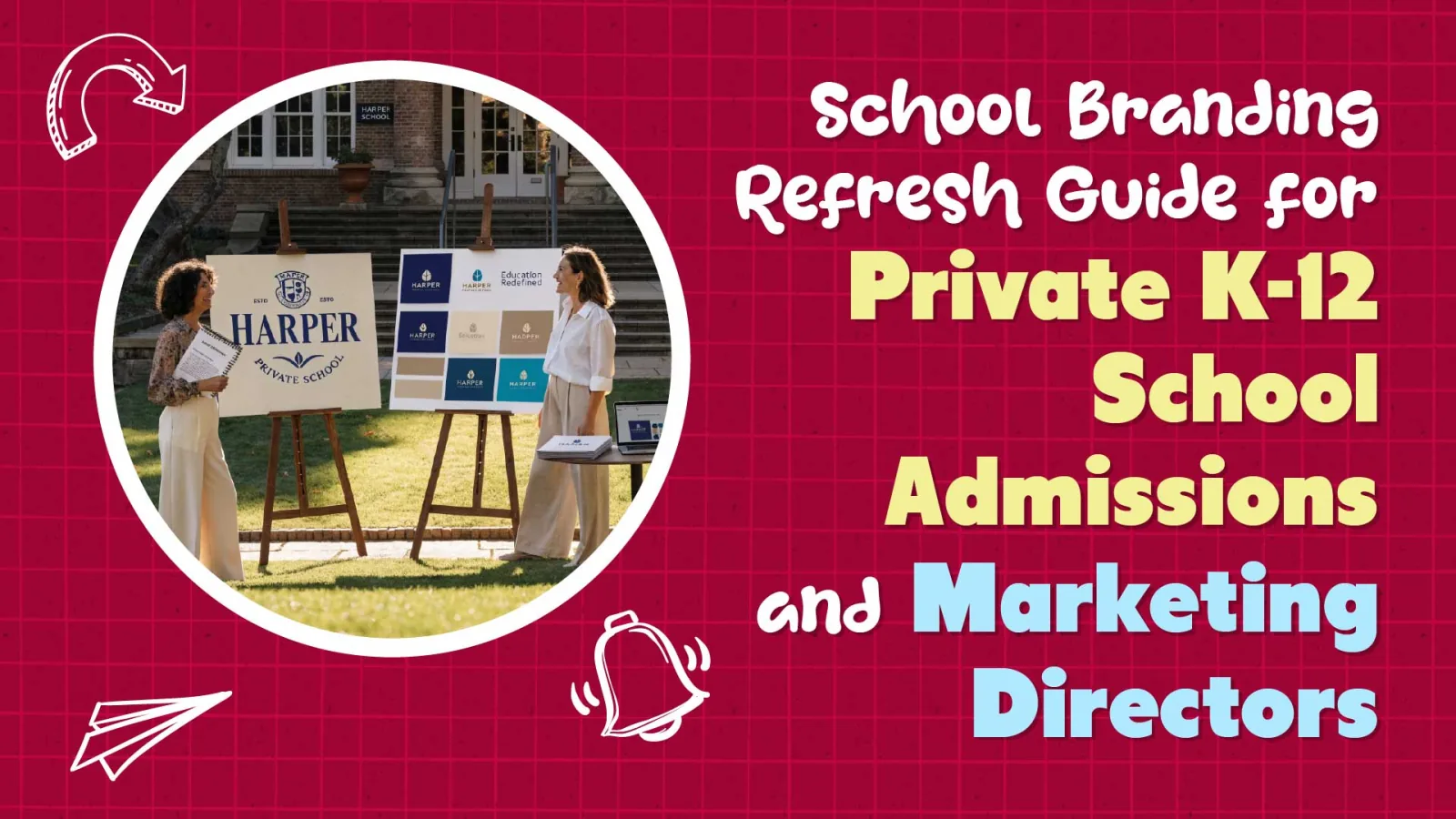
Every five to seven years, a private school looks at its logo, realizes the serifs are doing nothing for it on Instagram, and quietly starts the rumor of a brand refresh. Three months later, that rumor has turned into a forty-person committee, two dozen competing color palettes, and a Head of School who never again wants to hear the word "discovery session." The brand projects that actually ship on time at independent schools share a different trait: tight governance, a clear scope, and a leader who can say "no, we're not doing that right now."
This guide is the playbook for a Director of Admissions and Marketing at a 400-800 student college-prep school with tuition between $18,000 and $35,000 and a marketing budget of $50,000-$250,000. It covers the decision criteria for refresh versus full rebrand versus rename, the full brand stack that needs to align, the phased timeline for a summer project, stakeholder governance, realistic budget tiers, named case studies of schools that did this well, current K-12 visual identity trends, messaging principles, how to measure ROI, and the pitfalls that kill most school brand projects. It is written to get you the project you want without sacrificing the community trust you already have.
What's the Difference Between a Brand Refresh, a Rebrand, and a Rename?
A brand refresh is an evolutionary modernization. A full rebrand is a strategic repositioning. A rename is a complete identity reset. Choose based on the trigger, not the aesthetic itch.
When a Refresh Is the Right Call
A refresh fits when the school's mission and core values are still accurate, but the visual and verbal expression has drifted. Typical triggers include a logo that doesn't scale cleanly on mobile, three different shades of navy blue used across departments, a tagline nobody remembers, or a drift from the school's original voice. A refresh preserves the existing brand equity while modernizing the presentation.
When a Full Rebrand Is Warranted
A full rebrand makes sense when the external perception of the school no longer matches the internal reality. Triggers are more severe: sustained enrollment decline, a new Head of School with a materially different vision, a pedagogical pivot (for example, from traditional to experiential learning), a merger, or a meaningful reputation repair project after a crisis. A full rebrand signals "new chapter" internally and externally.
When a Rename Is the Answer
Renaming is rare and reserved for existential cases. Mergers that create a new entity, schools with a name that no longer reflects their program (a "preparatory academy" that now serves K-12), or institutions recovering from reputational damage tied to the name itself. The cost and risk are highest.
Equity Audit First
Before choosing a path, run a formal brand audit. Survey current families, prospective families who toured and did not apply, alumni from the last 10 years, and faculty. Recent NAIS sector research tracks admission, retention, and financial aid trends that underscore how much enrollment stability rides on a school's standing with its community if families choose your school primarily because of legacy recognition. A rebrand risks alienating the exact audience that keeps the school full. If families choose your school primarily because of legacy recognition, a rebrand risks alienating the exact audience that keeps the school full.
What's in a Modern Private School Brand Stack?
The brand stack has six layers, top to bottom: mission, values, brand promise, positioning, personality and voice, and visual identity. Each layer should align with the ones above it.
Mission and Values
Mission describes why the school exists. Values describe what the school holds non-negotiable. For a refresh, these rarely change; they get sharpened language. For a full rebrand, they are often rewritten. Either way, the mission and values drive every downstream decision.
Brand Promise
The brand promise is different from the mission. Mission is what the school does; promise is what a family can count on. A strong promise is specific and accountable: "Our graduates enter college with the writing and reasoning skills to thrive in seminar-style learning" is a promise. "Educating tomorrow's leaders" is not.
Positioning Statement
The positioning statement clarifies the school's place in the competitive market. It names the target audience, the category, the distinction, and the proof point. A usable template: "For [families seeking X], [School Name] is the [category] that [distinction], because [proof]."
Personality and Voice
Personality is how the brand would feel if it walked into a room. Voice is how it talks when it sits down. For a college-prep school, the common personality pairing is "scholarly and rigorous" with "warm and human." Voice consistency is one of the hardest brand disciplines; the fastest fix is a written voice guide with do/don't examples for specific scenarios (admissions emails, Instagram captions, Head of School letters, tuition pages).
Visual Identity
Visual identity is the most immediate expression of the brand. The components include the primary logo and wordmark, a core color palette, typography, photography style, iconography or pattern system, and touchpoint application standards. Visual identity does a lot of work at first impression, but the foundation underneath matters more over time than any single design choice.
What Does a Phased Summer Brand Refresh Timeline Look Like?
A realistic summer brand refresh runs 16-24 weeks from kickoff to full rollout. Compressing below 16 weeks produces a brand that does not survive its first fall season.
Phase 1: Discovery (Weeks 1-4, April)
Conduct stakeholder interviews with 8-12 people spanning the Head of School, board chair, advancement, admissions, faculty, students, alumni, and parents. Run the brand audit, the competitive audit, and a review of current assets. Commission any family or alumni survey work. Synthesize findings into an insights report.
Phase 2: Strategy (Weeks 5-7, May)
Develop or refine the mission and values language. Write the brand promise, positioning statement, and personality profile. Present strategic recommendations to the Head of School and board for sign-off. Do not move to design until the strategy is approved in writing.
Phase 3: Visual Design (Weeks 8-12, June-early July)
Develop logo explorations, color palette options, typography pairings, photography direction, and iconography. Present three to four concept directions. Refine to one chosen direction. Build out the full visual system: primary and secondary marks, horizontal and stacked logo lockups, one-color and two-color options, brand colors with hex, RGB, CMYK, and Pantone values, and a typography system.
Phase 4: Guidelines (Weeks 13-15, mid-July)
Create a brand guidelines document covering logo usage, color, typography, photography, iconography, voice, and application examples for the most common touchpoints (business cards, letterhead, email signature, social templates, yard signs, uniforms, website header).
Phase 5: Rollout Planning (Weeks 16-20, late-July to August)
Plan the internal launch (faculty return, convocation), the external launch (website refresh, press announcement, community event), and the asset rollout schedule. Prioritize high-visibility assets: website, admissions materials, social channels, signage at the entrance. Deprioritize low-visibility legacy assets.
Phase 6: Launch and Stabilization (Weeks 21-24, August-September)
Execute the launch in a planned sequence. Internal launch first, then external. Monitor community reception through the first 30-60 days. Adjust rollout pace based on feedback. Retire old assets systematically rather than all at once.
Who Should Be Involved, and Who Should Just Be Informed?
Stakeholder governance is where most school brand projects go sideways. "Design by committee," where too many voices hold veto power and the final design becomes a risk-averse compromise that resembles every other school in the market, is the single most common failure mode in school brand projects.
The Decision-Maker Matrix
Name exactly three decision-makers: the Head of School, the board chair (for major strategic decisions), and the Director of Admissions and Marketing. Everyone else is a stakeholder whose input matters but whose veto does not.
Stakeholder Roles
| Group | Role in Brand Refresh |
|---|---|
| Head of School | Vision approver, tie-breaker, internal champion |
| Board chair | Strategic approver, budget sponsor, community liaison |
| Admissions and marketing director | Project lead, daily decision-maker, vendor manager |
| Advancement | Input on donor-facing implications; veto power only on major messaging |
| Faculty | Input on values and voice; feedback in the final stages |
| Alumni (sample) | Feedback through a structured survey, not a committee |
| Current parents (sample) | Feedback through a structured survey |
| Students (sample) | Feedback at age-appropriate detail |
| Agency or designer | Strategic and creative lead; recommends, does not decide |
Write Down the Decision Rights
A one-page decision rights document at kickoff prevents 90% of downstream conflict. It specifies who approves the strategy, who approves the creative, who provides input, and who is informed. Distribute it, get it signed, and refer to it often.
What Does a Private School Brand Refresh Cost?
Three realistic budget tiers in 2026:
| Tier | Typical Scope | Budget Range |
|---|---|---|
| DIY / in-house | Logo refinement, color tuning, voice guide, template work | $5,000-$15,000 |
| Regional agency | Full strategy, visual system, guidelines, rollout support | $25,000-$75,000 |
| National brand firm | Full strategy, research, creative, rollout, and post-launch support | $75,000-$200,000+ |
What You Get at Each Tier
DIY works when the core strategy is already clear, and the project is primarily a visual tune-up. It typically involves an in-house team or a single freelance designer. Timeline runs 4-10 weeks.
Regional agencies handle the full brand stack and are the most common fit for mid-sized college-prep schools. Expect a 16-24 week project with a dedicated creative director, strategist, and project manager.
National brand firms bring deeper strategic research, executive-level creative leadership, and the ability to run simultaneous internal and external launches. Fit for schools with large capital campaigns, major mergers, or national-profile ambitions.
Cost Per Enrollment as the ROI Lens
The better way to frame the budget is enrollment impact over time. NAIS's 2024-2025 State of Independent School Marketing report found that growing enrollment and strengthening the school's brand are the top two marketing goals for a majority of independent schools, and most schools now treat marketing as a dedicated function rather than a side project. The math is the reason. For a 550-student school at $26,000 tuition, a 10% enrollment lift is roughly 55 students and $1.43 million in first-year tuition revenue. A $50,000 brand refresh that contributes materially to that lift is a rounding error on the return.
Which Current Visual Trends Matter for K-12 Schools?
2024-2026 K-12 branding has a few consistent threads worth paying attention to.
Logos as Systems, Not Just Marks
Modern logos are designed to work across contexts: primary mark, horizontal lockup, stacked lockup, monogram, favicon, and iconographic simplification. The idea is flexibility across the many places a school brand lives (athletics uniforms, emails, social avatars, entrance signage, pet tags at homecoming).
Color Palettes Move to Deep and Warm
Deep navy blues (replacing flat black), warm neutrals (off-whites, taupes, cream), and one to two confident accent colors. Blue still dominates the education category, but the palette has shifted from flat primary tones to deeper, more premium-feeling variants.
Typography: Editorial Serifs Paired With Clean Sans
A popular 2026 pairing is an editorial-feeling serif for headlines (Tiempos, Canela, Recoleta, or a custom cut) and a humanist sans-serif for body copy (Inter, Söhne, Whitney). Avoid overly trendy display faces; a school brand should age for 7-10 years.
Pattern Systems and Secondary Graphics
A modern school brand often includes a secondary graphic system: a repeatable pattern, a set of linear illustrations, or a photography treatment. These give the brand a signature texture beyond the logo.
Photography Style
Authentic candid photography with natural light, consistent color grading, and a documentary feel has replaced the staged studio style of the 2010s. This shift is one of the single biggest brand lifts available to most schools.
What Messaging Trends Shape School Brand Voice in 2026?
Messaging has moved in three directions worth understanding.
From Tradition-Only to Mission-Forward
Schools that leaned heavily on "since 1898" are adding "for what comes next." The tradition still matters; it is now framed as the foundation for a forward-looking mission rather than the whole pitch.
Inclusivity Without Flatness
Language around inclusivity has matured past generic "welcoming all" statements into specific, concrete commitments. The strongest school brand voices name their community explicitly and describe the experience they want every family to have.
Concrete Over Abstract
"Graduates who can write with clarity and think critically about complex problems" beats "preparing students for the challenges of tomorrow." Specific outcomes and the evidence behind them carry more weight than generic aspiration.
Avoid the Cliché Phrases
Every school website has the same phrases. Avoid: "nurturing environment," "well-rounded education," "lifelong learners," "unique opportunities," "personalized attention." If you could paste the phrase onto a competitor's website without anyone noticing, the phrase is not doing brand work.
How Do You Measure School Branding ROI?
The metrics that matter for a brand refresh fall into three categories: leading indicators, mid-funnel metrics, and enrollment outcomes.
Leading Indicators (30-90 days post-launch)
- Website traffic and session duration on the refreshed homepage
- Social media engagement rate and follower growth
- Brand recall survey results among prospective families
- Net Promoter Score among current families
- Direct feedback from faculty and alumni
Mid-Funnel (3-12 months)
- Inquiry volume year-over-year
- Inquiry-to-tour conversion rate
- Tour-to-application conversion rate
- Application yield (applicants who enroll)
Enrollment Outcomes (12-36 months)
- Total enrollment growth or retention
- Market share in your local metro
- Donor giving growth, particularly from alumni
- Cost per enrollment (CPE) decreases
The NAIS State of the Independent School Sector research provides benchmarks against which to measure. The short version: brand work should move real enrollment metrics within 12-24 months, and if it doesn't, the execution or the underlying strategy has a problem worth solving.
What Are the Biggest Brand Refresh Pitfalls?
Five traps swallow most school brand projects.
Design by Committee
When too many people have veto power, the final design is a risk-averse compromise that resembles every other school in the market. Fix it by writing down decision rights at kickoff.
Losing Legacy Equity
A school with strong recognition can refresh itself into irrelevance by over-correcting. The fix is to identify which brand elements carry emotional weight with alumni and current families, and to modernize them rather than replace them.
Weak Research Foundation
A brand refresh without real audience research is guesswork. The minimum: 8-12 stakeholder interviews, a survey of 200+ current parents and alumni, and a structured competitive audit.
Bad Rollout
Even the best brand fails if the rollout is chaotic. Common errors include launching externally before the faculty has seen the new identity, rolling out piecemeal across 18 months so nothing feels current, or launching the new website with the old tagline still in the footer.
Inconsistent Execution Post-Launch
Brand discipline needs governance. Without a named brand owner, clear standards, and regular spot-checks, a brand decays within 24 months of launch. Establish a quarterly brand review as part of normal marketing operations.
Practical Application: A 600-Student College-Prep Brand Refresh
Consider a non-denominational college-prep school with 620 students K-12, tuition at $28,000, a marketing budget of $180,000, and a 30-year-old logo that no longer scales cleanly on mobile. Enrollment is stable, but inquiries from the target demographic have softened over three consecutive years. The Head of School, new to the role two years ago, sees a branding refresh as a way to signal a new chapter without disrupting core identity.
The director kicks off the project in early April with an 18-week timeline and a regional agency at a fully scoped $62,000. The discovery phase includes stakeholder interviews, a 240-response parent survey, and a 145-response alumni survey. The strategy phase sharpens the mission language, articulates a new brand promise focused on "deep preparation for seminar-style college learning," and lands on a refined personality of "serious scholarship with human warmth."
The visual phase modernizes the primary mark (retaining the historical crest as a secondary heritage mark), introduces a deep-navy palette with a warm accent, pairs an editorial serif with a humanist sans, and delivers a photography direction rooted in candid classroom moments. The internal launch happens at the August faculty return meeting with a full assets kit, a brand voice guide, and templates for the most common communications. The external launch coincides with the new website going live on September 5, a press announcement, and a community preview event the following Saturday.
Six months after launch, website traffic is up 34%, inquiry volume is up 19% year-over-year, and first-round application yield has held steady despite the broader market softness. The new alumni giving pattern shows stronger engagement among graduates of the last 10 years, a segment the school had been quietly losing. The total brand refresh cost has been recouped by the end of the first enrollment cycle.
Execute a Brand Refresh That Strengthens What Already Works
A well-run private school brand refresh is one of the highest-leverage marketing moves available. Done poorly, it burns community trust and wastes six figures. Done well, it modernizes the school's presentation, sharpens the value proposition, and compounds enrollment gains across the next three to five admissions cycles. The difference between those outcomes is scope discipline, governance, and an honest willingness to name what is actually broken.
If you are considering a brand refresh this summer and want a second set of eyes on scope, stakeholder dynamics, agency shortlists, or a budget estimate before you sign, schedule a conversation. An hour of analysis in April can save a year of cleanup in September.
Frequently Asked Questions
How Long Does a School Branding Refresh Take?
Plan for 16-24 weeks from discovery to full rollout for a proper refresh with strategy, visual design, guidelines, and launch planning. Compressing below 16 weeks produces a brand that will not hold up through the first fall season. DIY visual tune-ups can run 4-10 weeks if the strategy is already settled.
What Should a Private School Brand Refresh Cost?
Budget tiers are: $5,000-$15,000 for DIY or in-house, $25,000-$75,000 for a regional agency engagement, and $75,000-$200,000+ for a national brand firm. Most mid-sized college-prep schools land in the regional-agency range.
How Is a Brand Refresh Different From a Full Rebrand?
A refresh preserves the existing mission and modernizes the expression (logo, color, typography, voice). A full rebrand repositions the school itself in the market, often following a new head's arrival, a significant enrollment decline, or a pedagogical pivot. A rename goes further still and is rare.
What Are the Biggest Brand Refresh Mistakes?
Design by committee, losing legacy equity by over-correcting, weak or absent audience research, a chaotic rollout, and no post-launch governance. Each of these can be headed off with clear decision rights and a disciplined project plan.
How Do I Measure Whether the Brand Refresh Is Working?
Track leading indicators (web traffic, social engagement, brand recall surveys, NPS) in the first 90 days, mid-funnel metrics (inquiry volume, inquiry-to-tour, tour-to-application) over 3-12 months, and enrollment outcomes (total enrollment, market share, donor giving) over 12-36 months. If you want help setting up a tracking framework, reach out.