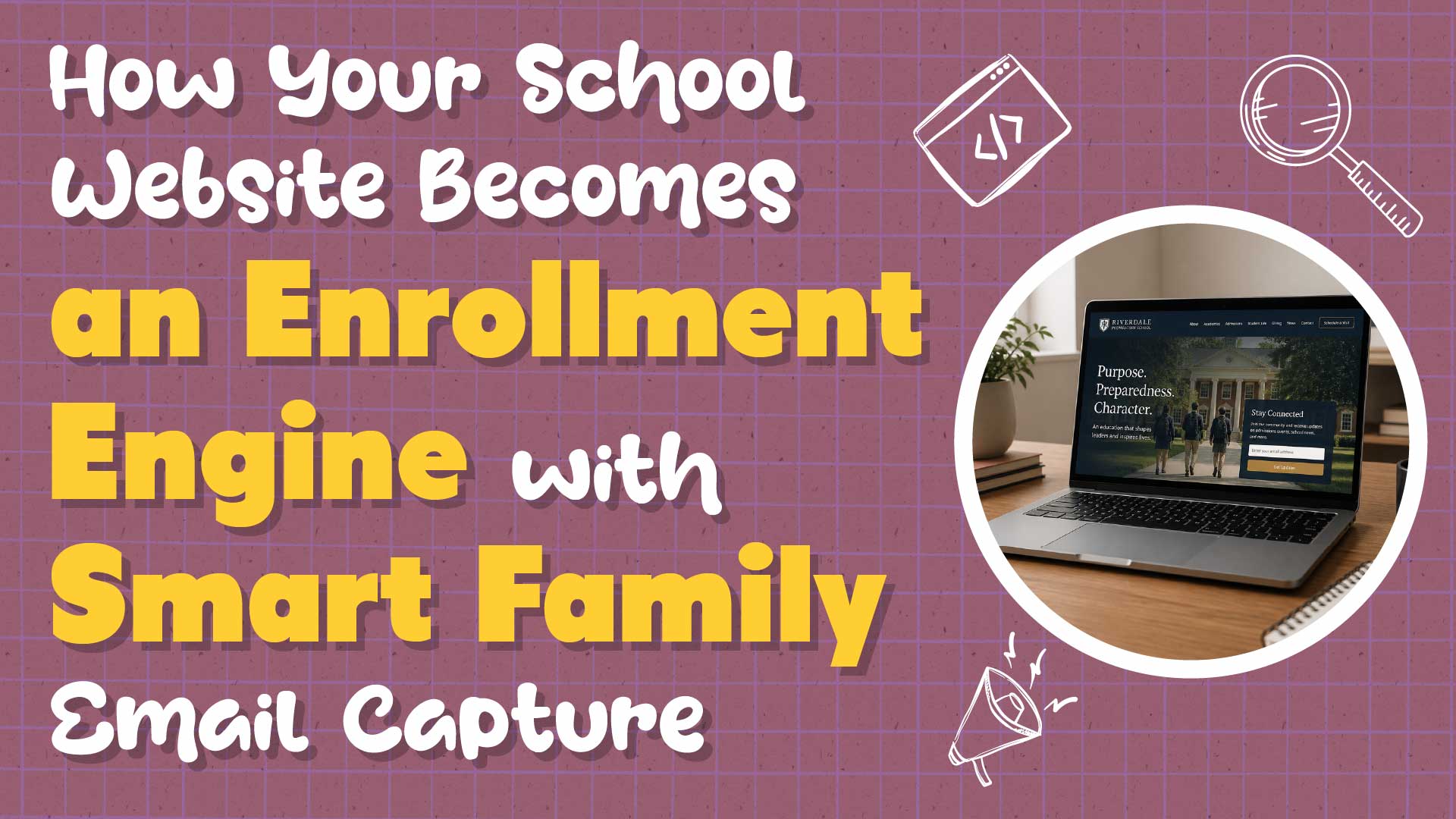
Your school website probably collects email addresses the way most websites do: a footer form that nobody notices, maybe a modal pop-up that appears at an awkward moment, and that's it. Then you wonder why your prospective family list grows at a crawl, and the families you do capture seem uninterested.
Here's the uncomfortable truth: you're not missing families. Your website is simply treating email capture as an afterthought instead of designing it as a system. When you build your website to actively identify high-intent visitors and invite them in with relevant offers, everything changes. You stop waiting for families to stumble onto your contact form and start turning qualified traffic into subscribers your admissions team can actually use.
you visit? Email
This isn't about bombardment or being pushy. It's about recognizing that private schools often leave massive opportunity on the table; families are already on your site, already interested, already telling you through their behavior exactly what matters to them. You just need to ask for the relationship at the right moment.

Written By: Adam Bennett | June 18, 2026
Adam is the president and founder of Cube Creative Design and specializes in private school marketing. Since starting the business in 2005, he has created individual relationships with clients in Western North Carolina and across the United States. He places great value on the needs, expectations, and goals of the client.
Here's where most marketing advice falls apart for growing pest control companies: it's written like every business is the same size. A blog post tells you to "spend 10% on marketing" without ever asking whether you're a one-truck operator or running 18 routes across three counties. That advice will steer you wrong in both directions.
What works at $500K actively hurts you at $2M. What works at $2M would bankrupt you at $500K. And the middle, the $1M and $1.5M zone where most independent pest control companies get stuck, is its own animal. The numbers shift, the channels shift, the staffing shifts, and the technology you absolutely need at one stage becomes overkill or insufficient at the next.
The good news: the milestones are predictable. The traps repeat. And once you can see them clearly, you stop guessing about whether to hire that office manager, switch CRMs, or pour more money into Google. You start making moves that fit the stage you're at.
This post maps the marketing decisions that matter at four specific revenue stops: $500K, $1M, $1.5M, and $2M. Spend percentages, channel mix, CRM stage, staffing, and the one number that tells you whether to keep your foot on the gas. It's grounded in real industry benchmarks, not vague "best practices," so you can hold it up against your own P&L and figure out where you actually stand.

Written By: Chad J. Treadway | June 17, 2026
Chad is a Partner and our Chief Smarketing Officer. He will help you survey your small business needs, educating you on your options before suggesting any solution. Chad is passionate about rural marketing in the United States and North Carolina. He also has several certifications through HubSpot to better assist you with your internet and inbound marketing.
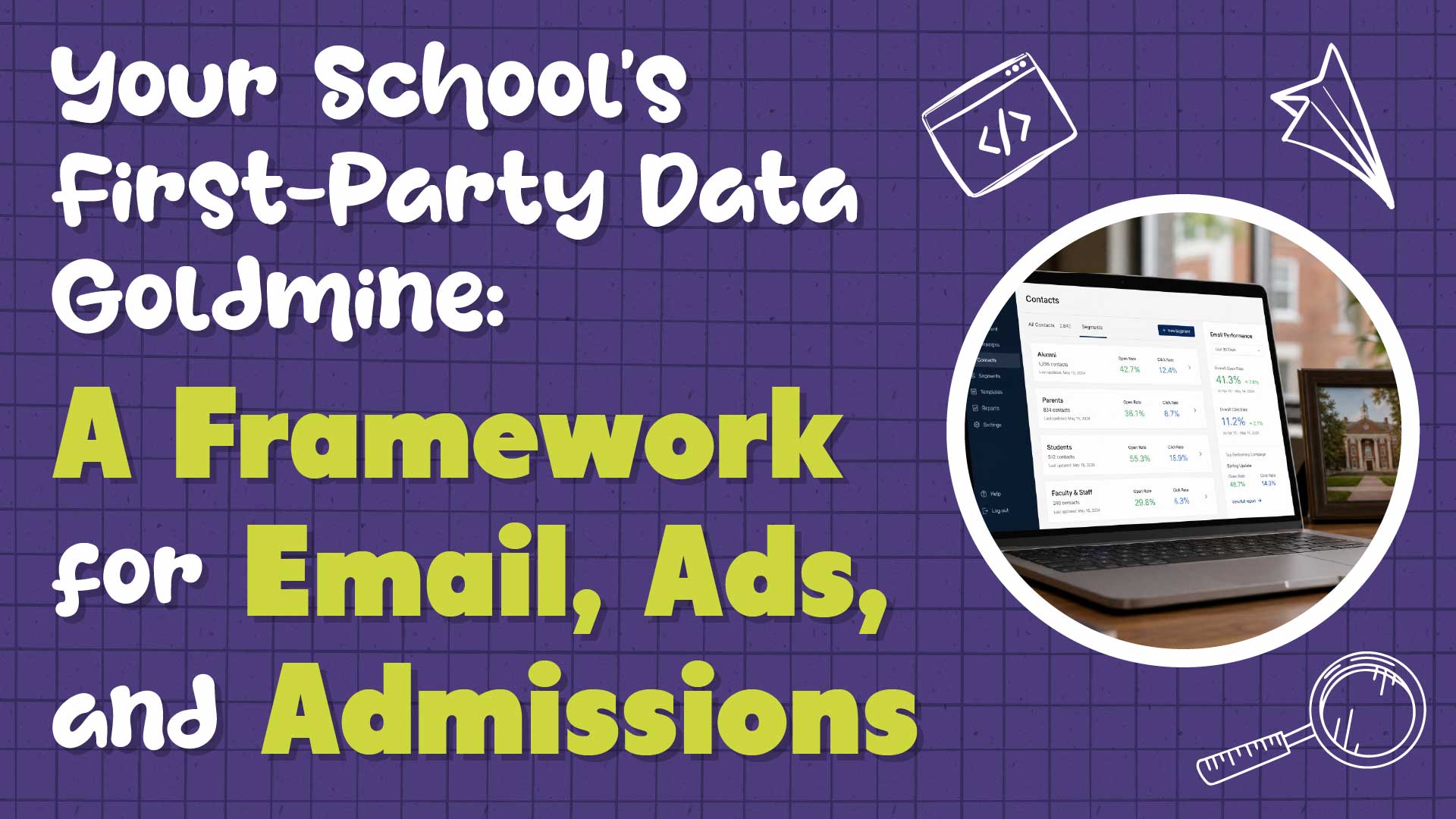
Your school is sitting on a goldmine of family insight; you probably don't even know it. Every time a parent visits your tuition page, clicks through an email, attends a webinar, or sits for an admissions interview, your school collects data. The problem is that most schools treat email as email, ads as ads, and outreach as outreach. These channels operate in silos, making decisions independently, missing the obvious patterns that sit right in front of them.
Here's the real opportunity: You don't need to buy another list to grow enrollment. You need to coordinate the data you already have. When your email team knows what pages families are visiting, when your paid ads team understands which segments your outreach team is focusing on, and when your admissions team gets real-time alerts based on family website behavior, something clicks. Campaigns stop feeling random. Families feel understood.
This is exactly where we help K-12 private schools unlock growth. We transform scattered engagement data into clear signals your team can act on. This guide walks you through that framework. what data matters, how to turn it into signals, and how to coordinate it across email, ads, and admissions outreach.
Written By: Adam Bennett | June 17, 2026
Adam is the president and founder of Cube Creative Design and specializes in private school marketing. Since starting the business in 2005, he has created individual relationships with clients in Western North Carolina and across the United States. He places great value on the needs, expectations, and goals of the client.
Your website is like the front door to your business. Except right now, that front door has no welcome mat, no doorbell, and a sign that just says "We do stuff. Call us." That is not a marketing strategy. That is a missed opportunity.
Most home service companies build a website, put their phone number on it, and call it done. Maybe they add a "Services" page and an "About Us" section. Then they wonder why nobody calls. The reason is simple: your website is competing with thousands of other pages for the same search results, and a five-page brochure site does not give Google anything to work with.
Content marketing fixes this. It is the practice of creating useful, relevant content that attracts the people you want as customers and gives them a reason to trust your company before they ever pick up the phone. And it is not just theory. DemandSage's content marketing research shows that content marketing costs 62% less than outbound marketing while generating more than three times as many leads as traditional outbound approaches.
Written By: Chad J. Treadway | June 16, 2026
Chad is a Partner and our Chief Smarketing Officer. He will help you survey your small business needs, educating you on your options before suggesting any solution. Chad is passionate about rural marketing in the United States and North Carolina. He also has several certifications through HubSpot to better assist you with your internet and inbound marketing.