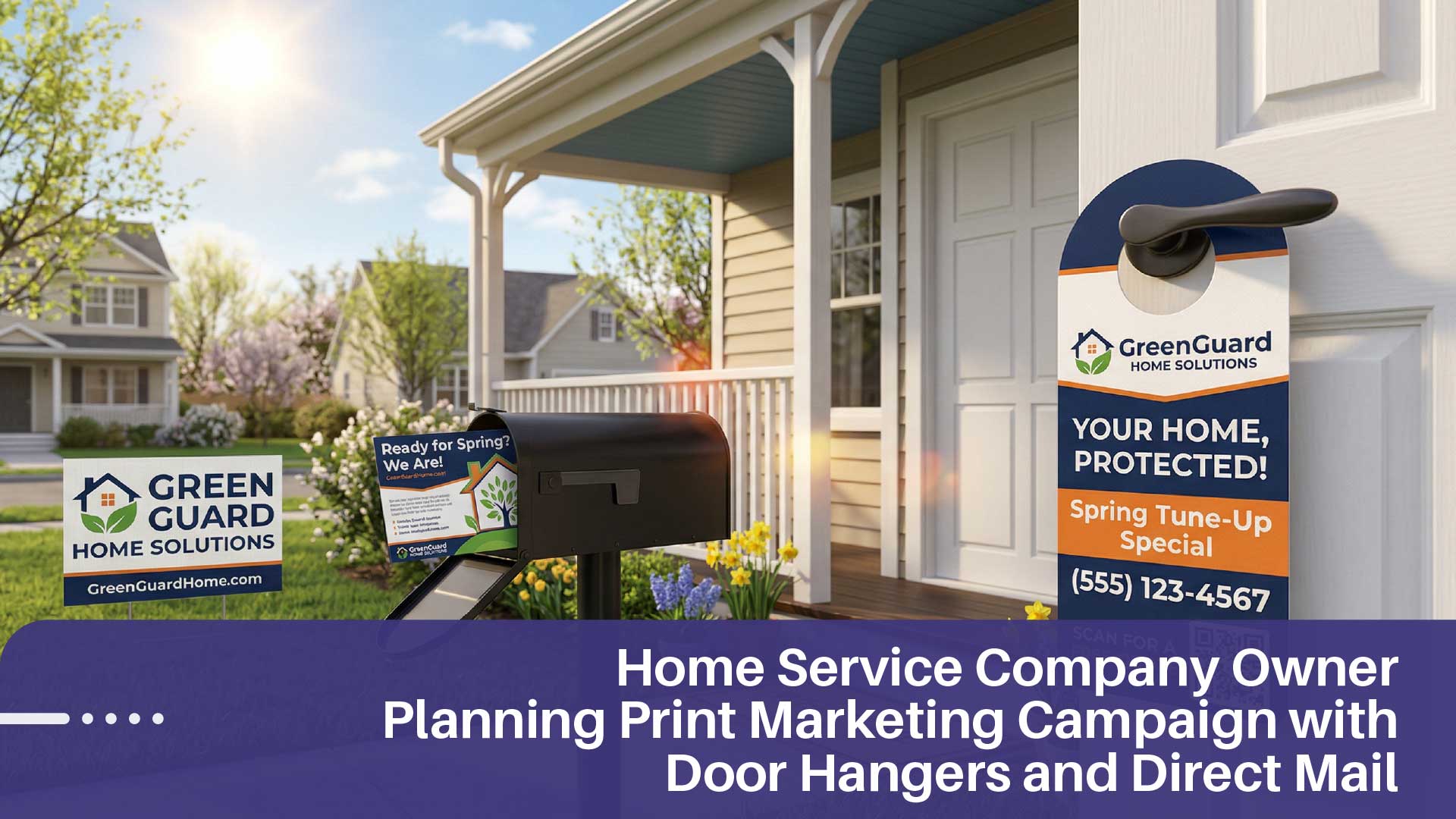
Here's something counterintuitive: in 2024, when everyone talks about digital marketing, print is making a comeback. And for home service companies, it's not nostalgia—it's ROI.
Your market is saturated with digital ads. Homeowners scroll past Google Ads, Facebook campaigns, and sponsored listings every day. But a well-designed door hanger on their doorknob or a personalized mailer in their mailbox? That's different. That's tangible. That's something they notice.
In this post, we'll cover why print marketing works for home service businesses like yours, which specific tactics (door hangers, yard signs, direct mail) deliver the best response rates, and how to integrate print with your digital strategy for 400% better results.
Why Is Print Marketing Effective for Home Service Companies?
Print marketing cuts through digital noise in ways paid ads can't. When you're competing against dozens of service companies online, print gives you a physical presence in a homeowner's world. It sits on their counter. It stays in their car. It isn't lost in an overstuffed inbox.
Data from the ANA Response Rate Report reveals that direct mail achieved a 161% average return on investment, significantly outpacing email (44%), digital display (23%), and paid social media (21%). For home service companies specifically, this matters because your customers (homeowners) are often in decision-making mode only when they need you—a burst pipe, a furnace failure, a roof leak. Direct mail gets your name in front of them right when they're searching for a solution.
Beyond ROI, there's psychology at work. Research compiled by PostcardMania shows that 86% of consumers say they genuinely like receiving direct mail (Lob, 2025), and 70% say mail gives them a better impression of the company than email (MarketReach, 2020). Even more telling, 39% of consumers have tried a business for the first time because of direct mail, according to the Data & Marketing Association.
How Door Hangers Drive Response Rates for Service Companies
Door hangers are the workhorse of print marketing for local service businesses. They're affordable, targeted, and impossible to ignore because they're literally hanging on someone's door. A homeowner can't accidentally delete a door hanger like an email. They either throw it away or keep it, and many keep it for weeks in a drawer or on the fridge.
Typical door hanger response rates for home service companies range from 1-3%, with best-in-class campaigns reaching 3-5% or higher. To put that in perspective, direct mail to house lists (your existing customers or people in your target area) achieves a 9% response rate, while email campaigns often hover around 5% or lower. Door hangers work because they're physical, local, and timely.
Research from ThinkFlyers shows that door hanger effectiveness increases dramatically with personalization. Industry data from Adzze found that personalized door hanger ads can drive up to 135% higher response rates compared with generic versions. That means a campaign pulling a typical 1.8% response could jump above 4% simply by addressing homeowners by name rather than using generic "Dear Neighbor" copy.
The best door hangers for home services include: a clear problem statement ("Is Your AC Running This Summer?"), a specific offer (discount, free inspection), a phone number that's easy to call, and a QR code linking to your website or appointment booking page. Design matters; a professionally printed door hanger works better than something that looks DIY.
Direct Mail Strategy for Service Area Expansion
Direct mail (postcard mailers and multi-page letters) works differently from door hangers. While door hangers hit a neighborhood in a few hours, direct mail reaches carefully selected lists of homeowners over days. This makes it ideal if you're expanding into a new service area or trying to reach homeowners in specific zip codes.
According to PostcardMania, direct mail response rates vary based on audience:
- House lists (existing customers or opted-in prospects): 5-9% response rate
- Cold prospect lists (demographics-matched homeowners): 4-5% response rate
Research from Postalytics confirms that adding a recipient's name to direct mail can increase response rates by up to 135%. Meanwhile, 88% of marketers say personalized direct mail significantly improves response rates (Lob, 2025).
For a growing service company like yours, these data points point to a strategy: start with your house list (past customers, people who called but didn't book). A personalized postcard offering a maintenance special or seasonal discount will pull a 6-9% response. Then expand to targeted purchased lists (age 45+, homeowners in your expansion zip codes) with a different offer to test the market.
Think of it like this: you wouldn't send the same estimate to every homeowner in your service area. You personalize the price, the service offered, and the timeline. Direct mail works the same way. The more you segment your list and customize your message, the better the response.
Yard Signs: Low-Cost Visibility for New Service Areas
Yard signs are often overlooked, but they're one of the most cost-effective ways to build visibility in new neighborhoods. A homeowner places a sign after a successful service (a new roof, a new AC system, a finished landscaping job), and that sign sits in their yard for weeks or months. Every neighbor sees it. Multiple times.
Yard signs work best in combination with other marketing. A homeowner gets a door hanger, you complete the job, they agree to display a sign, and now their neighbors associate your brand with quality work. It's a virtuous cycle that costs very little to maintain because the homeowner is your marketing asset.
The downside: you can't control where signs appear, and response rates are harder to track. But for brand building and increasing your company's visibility in a new area, yard signs are remarkably effective—especially when you ask customers to display them and incentivize them with a small discount or referral bonus.
Combining Print and Digital for 400% Better Results
Here's where print marketing gets really powerful: alone, it works. Combined with digital, it dominates.
Postalytics reports that campaigns combining print and digital marketing are 400% more effective than either channel alone. That means if you send a direct mailer to 1,000 homeowners in your expansion area, adding a digital remarketing campaign (Facebook ads, Google Ads to the same audience will more than quadruple your response.
Here's the practical application for your business: You drop 5,000 door hangers in a neighborhood. You design a Facebook ad targeting homeowners in that same zip code who fit your ideal customer profile. You run the Facebook campaign for 30-45 days, which overlaps with when homeowners find the door hanger. When they Google "plumbing near me" or "HVAC repair," they see your Google Ad. When they're on Facebook, they see your remarketing ad. That repeated exposure creates familiarity, which drives calls.
PostcardMania data shows that 57% of consumers visited the brand's website after receiving direct mail, especially when the mailer includes a URL or QR code. That website visit is your chance to show them your portfolio, read reviews, and book an appointment. If you're not running digital ads during that same window, you're leaving conversions on the table.
Additionally, Postalytics data shows that 82% of businesses increased their direct mail spending in 2024, suggesting that even in an increasingly digital world, savvy companies recognize print's unique role in a complete marketing strategy.
How to Implement a Print Marketing Campaign
Start small and test. Order 500-1,000 door hangers for one neighborhood. Include a trackable phone number or a unique QR code so you can measure response. Track which calls come from the door hanger campaign versus other sources. If the response meets or beats your expectations, expand to more neighborhoods.
For direct mail, consider starting with a postcard to your house list (past customers). A simple message—"We Saved You Money Last Time. Let's Do It Again."—with a seasonal offer, can generate quick wins. Measure the response, calculate your cost per lead, and decide if it justifies expanding to purchased lists.
Yard signs should be a longer-term play. Don't expect immediate ROI. Instead, ask customers to display signs and track how it affects your brand visibility and word-of-mouth referrals over 6-12 months.
For all three tactics, timing matters. Spring is the ideal window—homeowners are thinking about maintenance, repair, and upgrades as the season heats up. Door hangers, mailers, and yard signs placed in March-April hit homeowners right when they're evaluating options. That's why 82% of businesses are increasing direct mail spend—they're capitalizing on seasonal demand.
Should Your Service Company Use Print Marketing?
The data says yes. Print works especially well if you're a growing service company with a specific service area, a local or county-wide reach, and a customer base of homeowners (not commercial clients). If your competitors aren't using door hangers or direct mail, you have an advantage. If they are, you need to match their strategy and combine it with digital to stand out.
The key insight: print isn't meant to replace digital. It's meant to complement it. When a homeowner sees your door hanger, visits your Google Business Profile after searching online, sees your Facebook ad, and finally calls your number, that's three touchpoints in one integrated campaign. That's what 400% more effective means in real terms.
If you're ready to stop guessing and start seeing results, let's talk about building a print and digital strategy that fits your budget and your service area.
Frequently Asked Questions
{{FAQ}}
What's the Average Cost of a Direct Mail Campaign for Home Service Companies?
Direct mail costs depend on volume, design complexity, and list quality. Postcards typically run $0.50-$1.50 per piece all-in (design, printing, postage). A 5,000-piece campaign costs roughly $2,500-$7,500. Door hangers run $0.15-$0.50 per piece, including design and printing (you distribute them yourself), so 1,000 door hangers might cost $150-$500. Start with a small test to validate response rates before committing to larger volumes.
How Do I Measure the ROI of a Print Marketing Campaign?
Assign a unique phone number or QR code to each campaign, so calls and website visits are trackable. Use a simple formula: (Revenue from Campaign - Campaign Cost) / Campaign Cost = ROI %. For example, a $3,000 door hanger campaign that generates 20 jobs at $500 average value = $10,000 revenue minus $3,000 cost = $7,000 profit, or 233% ROI. Track for 60-90 days after distribution to capture delayed responses.
Should I Design My Own Direct Mail or Hire a Professional?
Professional design is worth the investment if you're spending more than $2,000 on a campaign. DIY designs often look cheap, which undercuts your brand positioning. For door hangers and postcards, a designer typically charges $300-$1,000, depending on revision rounds. That's 5-10% of your total campaign cost and significantly improves response rates. Your designer should research competitor materials in your area to position your piece to stand out.
Can I Target a Specific Neighborhood with Door Hangers?
Yes. Door hanger distribution is hyperlocal—you can target specific zip codes, neighborhoods, or even blocks. This makes them ideal for test campaigns or service area expansion. Work with a printing company that offers neighborhood maps or use a marketing service that handles distribution. The cost is low enough to test multiple neighborhoods simultaneously and identify which ones convert best.
When Is the Best Time to Launch a Print Marketing Campaign?
Spring (March-May) is peak season for home service marketing because homeowners are preparing for summer and addressing maintenance issues. Fall (September-October) works well for HVAC and heating companies. Avoid December-January when mailboxes are jammed with holiday promotions. Time your campaign to align with seasonal demand in your trade.
{{endFAQ}}

Written By: Chad J. Treadway | April 21, 2026
Chad is a Partner and our Chief Smarketing Officer. He will help you survey your small business needs, educating you on your options before suggesting any solution. Chad is passionate about rural marketing in the United States and North Carolina. He also has several certifications through HubSpot to better assist you with your internet and inbound marketing.
Getting a negative Google review stings. You've worked hard to build your service business, and suddenly someone's bad experience is sitting right there where potential customers see it first. The worst part? You can't delete it. But here's what you can do: respond strategically.
The numbers are sobering. Research compiled by BrightLocal shows that 94% of people say reviews have made them avoid a business (originally reported by ReviewTrackers). BrightLocal's own 2026 consumer survey found that negative reviews deter 77% of consumers.
The good news? You have more control than you think. Your response to negative reviews sends a message to everyone reading those comments—including future customers. This guide shows you exactly how to handle negative reviews in a way that protects your reputation and can actually win back trust.
If you're running a home service company and want to build a strong brand, managing your online reputation is non-negotiable. Let's walk through how to do it right.
Written By: Chad J. Treadway | April 14, 2026
Chad is a Partner and our Chief Smarketing Officer. He will help you survey your small business needs, educating you on your options before suggesting any solution. Chad is passionate about rural marketing in the United States and North Carolina. He also has several certifications through HubSpot to better assist you with your internet and inbound marketing.
You started your home service company because you're good at what you do. Maybe you're the best HVAC tech in the county or the plumber everybody recommends at the hardware store. But somewhere between hiring your third employee and fielding your hundredth call, you realize something: people aren't just choosing you for your skills anymore. They're choosing between you and five other companies that all claim to be "reliable" and "professional."
That's where branding comes in. And no, I don't just mean your logo.
At Cube Creative Design, we work with home service companies every day, and the ones that stand out in their markets aren't always the biggest or the cheapest. They're the ones with a brand that feels like something. Something real, something consistent, something that makes a homeowner think, "Yeah, these are my people."
If you've been running your business for a few years and you're ready to stop being "just another service company," this post is for you. Let's talk about what branding actually means for a service business and how to build one that works as hard as you do.
Written By: Chad J. Treadway | April 07, 2026
Chad is a Partner and our Chief Smarketing Officer. He will help you survey your small business needs, educating you on your options before suggesting any solution. Chad is passionate about rural marketing in the United States and North Carolina. He also has several certifications through HubSpot to better assist you with your internet and inbound marketing.
Pull up Google and search for any home service in your area. Look at the results. Every company says the same thing: "reliable," "professional," "family-owned," "serving [city] since [year]." If everyone is saying the same thing, nobody stands out. And if nobody stands out, homeowners pick whoever shows up first or whoever has the most reviews.
That's the challenge for home service companies trying to grow in a competitive local market. Doing good work isn't enough to differentiate you online. You need to be intentionally different in ways that homeowners can see, feel, and remember.
Here are five strategies that actually work for service area businesses that want to stand out online, without big-brand budgets or corporate marketing teams.
1. Niche Down on Your Service Areas
Most home service companies try to be everything to everyone across the broadest possible territory. That's a recipe for blending in. The companies that stand out locally are the ones that own specific geographies in Google's search results.
Instead of one generic "Services" page, build city-specific service pages for every community you serve. A page for "AC Repair in Marion, NC" and another for "AC Repair in Morganton, NC" tells Google exactly where you work. It also tells the homeowner in Marion that you're not some company three counties away hoping to pick up a job.
Research from SeoProfy shows that businesses appearing in Google's local 3-pack get 126% more traffic and 93% more actions than those ranked 4th through 10th. City-specific pages are how you earn those top spots for the places you actually serve, rather than competing for broad terms against companies with bigger budgets.
Think of it like yard signs after a job. You don't put a yard sign in a neighborhood 50 miles away. You put it where your next customer lives. City-specific web pages are the digital version of that strategy.
2. Own Your Google Presence
Your Google Business Profile is the most visible piece of your online presence, and most home service companies treat it like an afterthought. They claimed it three years ago, added a phone number and address, and haven't touched it since.
The companies that stand out are the ones that treat their GBP like a storefront. They post updates weekly. They upload new project photos regularly. They respond to every review within 24 hours. They add seasonal service descriptions and keep their hours accurate.
BrightLocal's 2026 survey found that 97% of consumers use online platforms to evaluate local businesses. Your Google Business Profile is often the very first thing they see. If yours looks neglected while your competitor's has fresh photos, recent reviews, and weekly posts, the homeowner's decision is already made before they visit either website.
Add photos of your team, your trucks, and your completed work. Post a quick update every week, even if it's just "Spring AC tune-ups are filling up. Call now to get on the schedule." These small actions signal to both Google and homeowners that your business is active, engaged, and trustworthy.
3. Build a Brand Voice That Sounds Like a Real Person
Here's what most home service company websites sound like: "We are committed to providing exceptional service and customer satisfaction. Our team of experienced professionals is dedicated to delivering quality workmanship." That could be any company, in any trade, in any city. It says nothing. It sounds like it was written by a committee.
The home service companies that stand out online have a voice. They sound like real people. They have personality. Whether it's a dry sense of humor, a straight-shooting tone, or a friendly neighborhood vibe, their content reads like someone you'd actually want to let into your house.
Your brand voice should be consistent across your website, social media, and review responses. If your owner is the kind of person who cracks jokes with customers on the job site, your website should reflect that personality. If your team prides itself on being no-nonsense and efficient, your copy should be direct and to the point.
The goal isn't to be clever. It's to be recognizable. When someone reads your social media post, and it sounds exactly like the person who showed up at their door, that's brand consistency. And that builds trust faster than any stock-photo-filled website ever could.
4. Showcase Your Team and Your Work
Homeowners hire people, not logos. One of the easiest ways to differentiate your home service company online is to show the actual humans behind the business.
Post photos of your team on your website and social media. Not posed corporate headshots; real photos of your crew in the field, doing the work, with branded uniforms and trucks visible. Introduce your technicians by name. Share a quick bio or a fun fact. Let homeowners see who's going to knock on their door.
Before-and-after project photos are equally powerful. A 30-second video of a messy ductwork installation turned clean and professional tells a story that no amount of written copy can match. Research from TrueFuture Media notes that 63% of social media users prefer authentic, relatable videos over polished productions. That's great news for a plumber filming a quick clip on their phone from a job site.
The more real and specific you are about your team and your work, the harder it is for a competitor to replicate what makes your company different. Anyone can copy your service list. Nobody can copy your people.
5. Get Involved in Your Community (and Talk About It)
Community involvement is one of the most underrated differentiation strategies for home service companies. When your company sponsors a Little League team, donates to the local food bank, or volunteers at a community event, you're not just being a good neighbor. You're building brand recognition in a way that no Google Ad can replicate.
The key is to talk about it online. Post photos from the event on Facebook. Mention it in your Google Business Profile updates. Add a "Community" section to your website. Most home service companies do some community work, but never tell anyone about it. That's like donating to charity and burning the receipt. The gesture still matters, but you're missing the marketing value.
Community involvement also builds the kind of word-of-mouth referrals that close at higher rates and cost nothing. When the Little League parents need a plumber, they're calling the company whose name is on the back of their kid's jersey. When the chamber of commerce member needs HVAC work, they're calling the business owner who shows up at meetings.
This strategy works especially well for growing companies that serve county-wide areas. You're not just another contractor. You're part of the community fabric. And that's a competitive advantage that's almost impossible to buy.
Differentiation Isn't About Being Louder. It's About Being Clearer.
Standing out online as a home service company doesn't require a massive marketing budget or flashy campaigns. It requires intentional decisions about how you present your business, who you show up as, and where you focus your energy.
Niche down on your service areas. Own your Google presence. Build a voice that sounds human. Show your team and your work. And get involved locally. These five strategies cost more in consistency than they do in dollars, and that's exactly why they work.
If you're ready to build an online presence that actually sets your company apart, send me a message and let's figure out where to start.
Frequently Asked Questions
How Long Does It Take to See Results From These Differentiation Strategies?
Some strategies produce results quickly. Updating your Google Business Profile with fresh photos and posts can improve visibility within a few weeks. City-specific service pages take longer to rank in Google; expect two to six months, depending on competition. Brand voice consistency and community involvement are long-game strategies that build compound returns over time. The common thread is consistency: the companies that stick with these strategies for six to twelve months see the strongest results.
Do I Need to Hire a Marketing Agency to Stand Out Online?
Not necessarily. Many of these strategies can be executed by the business owner or office manager. Posting project photos on social media, responding to reviews, and attending community events don't require an agency. Where professional help adds value is in building city-specific service pages, developing a cohesive brand voice across your website, and implementing a local SEO strategy that ties everything together.
What's the Single Most Impactful Strategy for a Small Home Service Company?
If you had to pick one, own your Google Business Profile. It's free, it's visible to every homeowner searching for your services, and most of your competitors are neglecting it. A fully optimized GBP with regular posts, strong reviews, and up-to-date photos gives you an immediate competitive edge in local search results.
How Do I Develop a Brand Voice for My Home Service Company?
Start by thinking about how you talk to customers on the job. Are you friendly and casual? Direct and efficient? Funny? Whatever your natural communication style is, bring that to your website, social media, and review responses. Write the way you talk. If your website copy sounds nothing like the person who answers the phone, there's a disconnect that homeowners will notice.
Is Community Involvement Really a Marketing Strategy?
Absolutely. Community involvement creates brand recognition, generates word-of-mouth referrals, and builds trust in ways that paid advertising cannot. The key is consistency (show up regularly, not just once) and visibility (share your involvement online). A company that sponsors local events, volunteers regularly, and talks about it on social media becomes part of the community's identity, not just another service provider.
Written By: Chad J. Treadway | March 26, 2026
Chad is a Partner and our Chief Smarketing Officer. He will help you survey your small business needs, educating you on your options before suggesting any solution. Chad is passionate about rural marketing in the United States and North Carolina. He also has several certifications through HubSpot to better assist you with your internet and inbound marketing.