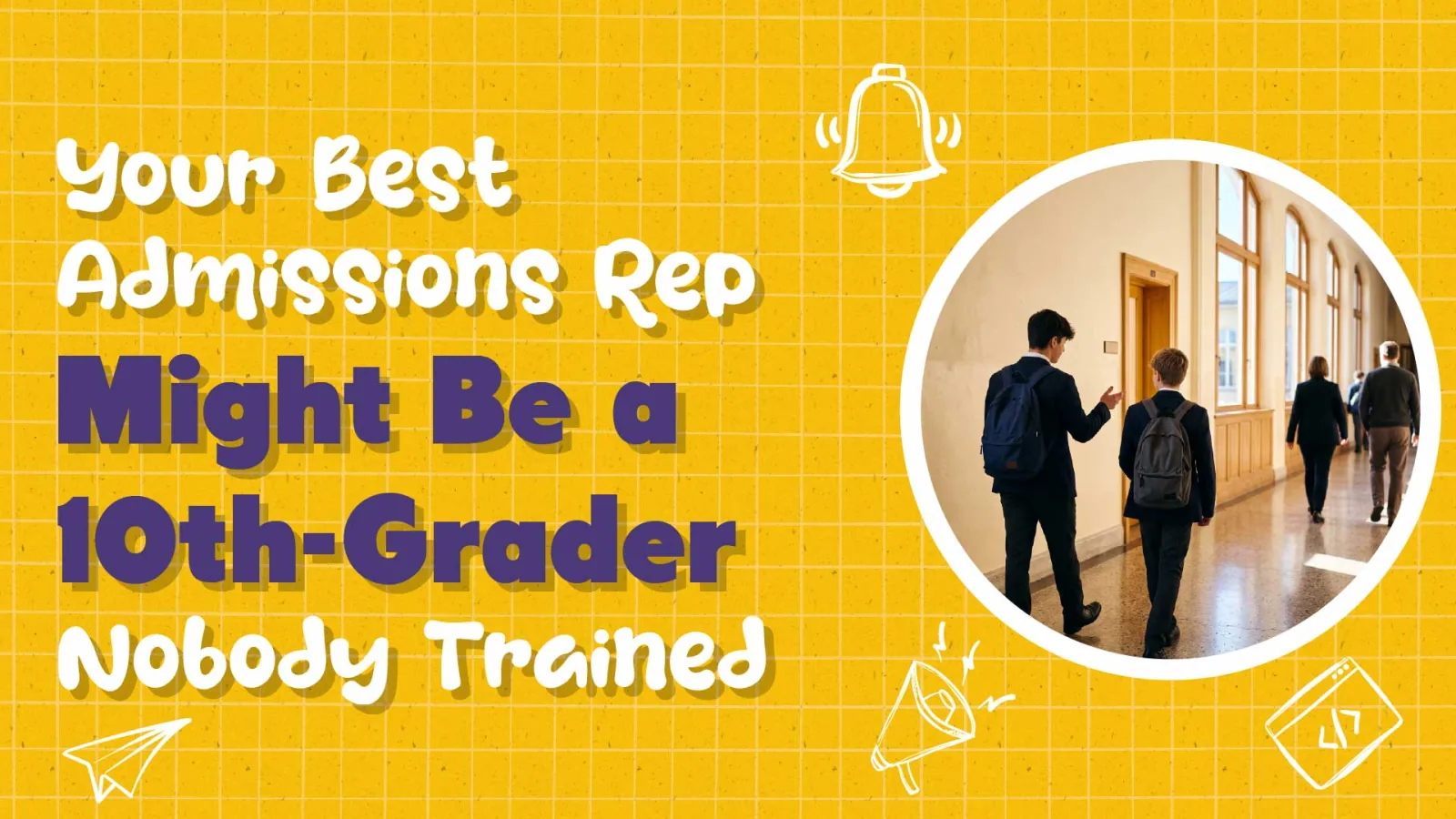
Your most persuasive admissions officer may be a 10th-grader who has never opened your viewbook. That is the uncomfortable premise behind every student ambassador program worth running. Prospective students and their parents believe a current student in a way they will never believe an adult with a title and a lanyard. Most schools already know this. Most schools also staff the program by pulling three cooperative kids out of study hall 20 minutes before a tour and hoping for the best.
We work with school admissions teams who have genuinely great ambassadors and no program behind them. The students are not the problem. The structure is missing. This post covers the operational build. How to select ambassadors. What to teach them before they meet a family. Where the message boundaries sit. How to schedule without wrecking anyone's academic day, how to keep the roster alive past October, and how to prove the program moves visit-to-application conversion.
What Is a Student Ambassador Program, and Why Does It Work?
A student ambassador program is a managed corps of current students, trained to represent the school to prospective families through campus tours, shadow day hosting, and open house panels. It works because a peer is believed in a way your own marketing never is, and because the one-on-one visit is where families decide.
The data on that last point is unambiguous. In a survey conducted by NAIS and Metric Marketing, independent school marketers rated individual tours as their most effective admissions touchpoint at 89%, ahead of group open houses at 63% and small-group tours at 46%. The same NAIS and Metric Marketing report documents that word of mouth is the most widely used traditional channel, with 92% of schools relying on it, and that in-person events were named the most effective traditional channel by 69% of respondents.
Read those together, and the case makes itself. Your highest-converting touchpoint is a one-on-one campus visit, and your most-used channel is people talking to people. The ambassador program sits right where those two meet. That is a strange spot to wing it.
Research from higher education points the same way, and it comes with a caveat worth stating up front. A higher-education study of peer-to-peer conversations by Intead and Unibuddy found that "more than half (57%) of surveyed students said that online conversations with student ambassadors were the most helpful resource for them when they were considering which university to apply to, compared with 47% who said friends and family were the most helpful." (Source: ICEF Monitor) That is a university finding, not a K-12 one. It shows the mechanism works. It is not your benchmark.
One boundary before we go further. This post is about students hosting visiting families. Adult advocacy runs on a different playbook with different training and different liability, and we cover it separately in our guide to parent ambassador programs.
How Do You Select Student Ambassadors?
Pick for honesty, plain speech, and follow-through, not for grades or popularity. Build a roster that spans grades, interests, sports, arts, and family backgrounds, so most visiting families meet someone they recognize. Use a short written form plus faculty picks, and accept that some strong students are a poor fit.
Drafting your student council is the obvious move, and it is usually the wrong one. Student government tends to yield polished kids who sound like the website. The family already read the website. What moves them is a student who can say "the first two weeks were rough and here is what helped," because that answer is unrehearsed enough to be believed.
Vermont Academy publishes how its own program works, and it reported that 40 of its 216 students serve as tour guides. The model is worth copying. Students can raise a hand with the admissions office, and faculty can put names forward, which turns up the quiet, steady kid nobody would have guessed. New guides train with an Orange Key Society member, shadow tours, then lead one alongside an admissions officer before they take a family alone. Madison Paydos, the school's assistant director of admissions, explained the payoff plainly. "It is extremely beneficial to our team to have student tour guides because the best way to get to know Vermont Academy is through the eyes of our students," she said.
Build your criteria around four things, in this order:
- Reliability. Will this student show up at 8:30 on a Tuesday, twice a month, in March? That matters more than charisma.
- Candid communication. Can the student answer a hard question honestly without turning it into a complaint about a teacher?
- Mission fit. Does the student's own story of the school match what your materials promise? A gap there is worth knowing either way.
- Roster coverage. Fill gaps on purpose. Grade level, new-in-ninth versus lifer, arts versus athletics, and families who are new to private school all matter to the parent in your lobby.
Set a term, too. A one-year run with a renewal chat gives you a clean way to end a poor fit, without a hard meeting mid-season.
What Should Student Ambassador Training Cover?
Cover the tour route, the questions kids really ask, your mission in plain words, and the handoff script for topics that belong to staff. Run at least one mock tour with real feedback before a student meets a real family. Plan on 90 minutes for the first session, plus a short refresher each term.
The role runs wider than the tour itself. In a piece built on guidance from ISM consultant Penny Rogers, Independent School Management stated, "Student ambassadors can assist Admission Office staff members during tours or act as one-on-one hosts for new applicants. They can also be greeters, program attendants, ushers, or panelists during open houses and other admission events." The onboarding advice in the same piece is refreshingly plain. "Hold a lunch or after-school event to review the guidelines and clearly define expectations."
Feed them the questions in advance. Ambassadors get asked the same nine or 10 things all year, and each one has a good, honest answer and a bad, improvised one. Is the homework a lot? Are the teachers strict? Where do you sit at lunch if you know nobody? Write the honest answers down, workshop them together, and let students put the words in their own mouths rather than memorizing yours.
Train the observation half of the job too. ISM noted that on any tour, "the visit is a two-way street." Guides, the article added, should watch for "potential red flags to report to the Admission Office for further consideration—or for unforeseen positives, too!" Give ambassadors a two-question debrief form. What did the student seem most excited about, and what worried the parent? That answer is worth more to your follow-up email than anything else you collect that day.
Our post on school tour best practices covers the mechanics of the tour itself, including how to pair a visiting child with an ambassador of similar age and interests. Use it as the curriculum for that portion of training rather than rebuilding the material here.
What Can a Student Ambassador Say, and What Belongs to Staff?
A student ambassador can speak to their own life here: classes taken, teams joined, teachers liked, and what the first month felt like. Tuition, aid, odds of getting in, discipline, learning support, and anything about another student belong to staff. Teach the line as a script, not a rule list.
This is not an abstract concern. NAIS puts responsibility for volunteer conduct squarely on school leadership. Its Principles of Good Practice hold admissions professionals and the head of school responsible "for communicating and upholding these principles of good practice to all professional staff and volunteers (including parents, alumni/ae, tour guides, coaches, faculty, and board members) who represent the institution." (Source: National Association of Independent Schools) The same document commits member schools to respecting "the confidentiality of students, families, and documents in the admission process." An untrained 16-year-old on your tour route is still your school speaking.
The exposure runs both directions, which most schools miss. Writing for NBOA, attorneys Grace H. Lee and Ashley Sykes of Venable LLP noted that "the ADA Technical Assistance Manual states that schools may not make unnecessary inquiries into the existence of a disability in the admissions process." An ambassador who asks a friendly question about a visiting student's individualized education plan has created a problem nobody intended. Tell them plainly: never ask about grades, testing, health, or why the family is leaving their current school.
Give them one sentence for everything outside the line. "That is a great question for our admissions director, and I will make sure she gets it before you leave." Then build the handoff so it happens. An ambassador who parks a question on a note card and hands it to staff at the end of the visit has done the job perfectly.
Three more boundaries belong in the written guidelines:
- No comparisons to other schools by name. Ambassadors talk about what they like here, never about the school down the road.
- No promises. Not about acceptance, not about a spot on a team, not about a specific teacher next year.
- Honest is allowed; venting is not. "The math workload is real" builds trust. "The math department is a mess" does not.
How Do You Schedule Student Ambassadors Around Class Time?
Book ambassador shifts against free blocks, lunch, and study hall, never a core class. Keep a roster tagged by each student's open periods, so the office can match a tour request to a free guide in one step. Cap each ambassador at two or three tours a month so the ask stays fair.
The friction here is real, and one boarding school's student newspaper documented it honestly. The Willistonian reported that Williston Northampton School fields 288 tour guides, and that the recurring problem is getting students to accept tours scheduled between 8:30 and 10:30 a.m. during their morning free blocks. Guides described accepting those requests with a sigh. If a school with 288 guides still struggles to fill an 8:30 slot, a program with nine volunteers will not survive its first busy October.
Depth is the answer, not pressure. Aim for a roster three to four times the shifts you need in a peak week, spread across enough different free-block schedules that any weekday morning has at least four eligible guides. Then send assignments as an invitation with a named backup, so a declined request routes automatically instead of landing back on your desk.
A few scheduling rules that hold up:
- Publish the visit calendar two weeks out so ambassadors can plan around tests and games.
- Never assign a tour during a lab, a studio block, or an assessment. One missed quiz turns a parent into an opponent of the program.
- Ask advisers to flag academic trouble. A student on probation comes off the active roster without drama and returns when grades recover.
- Keep a two-person standby list each morning, and rotate it so the same reliable senior is not covering every gap.
Virtual academies run this model with one adjustment. The ambassador joins a scheduled video visit for the last 10 minutes, answers a prospective student's questions without a parent narrating, and never handles the enrollment conversation.
How Do You Keep Student Ambassadors Engaged All Year?
Recognition keeps the program alive, and it needs no budget line. Add a senior tier above the main roster, count hours toward service credit, write real reference letters for the steady ones, and thank students by name. Then ask the students themselves what would make the role worth keeping.
Vermont Academy's tiers are a clean example of status doing the work of pay. Above the general tour guide roster sits the Orange Key Society, seven highly trained guides who welcome campus visitors, alumni, and honored guests. To get in, a student needs a record of service as a guide, strong citizenship, good grades, poise with adults, and leadership outside class. That gives a sophomore a reason to keep showing up, and it gives you a trained bench for the visits that matter most.
Offices that take the thank-you question seriously say so out loud. Christa Talbot Syfu, an admissions officer at Williston Northampton School, told The Willistonian, "We are continuing to discuss ways to show our gratitude to students who give up their free time, especially sleep-ins, to support the admissions process." When the paper asked guides what would help, one suggested an award system. Students will tell you what they want if you ask.
Low-cost recognition that works over a full year:
- A named role and a visible credential: a lanyard, a pin, or a listing on the admissions page.
- Service hours or a co-curricular credit that appears on the transcript.
- A specific written recommendation from the admissions director for college applications.
- One end-of-year event, and one named thank-you in front of the whole school.
- First access to something students want anyway, such as priority seating or an early sign-up for a popular trip.
How Do You Measure Whether Your Student Ambassador Program Works?
Tag ambassador-hosted visits and staff-only visits as two groups in your CRM, then compare how many in each group apply across a full cycle. A happiness survey tells you families liked the tour. Group-by-group conversion tells you whether the program earns its keep.
Start by knowing where the visit sits in your inquiry-to-application funnel. Niche reported that at established independent schools, "the inquiry-to-application rate is typically between 20% and 35%," with the inquiry-to-tour rate somewhat higher and a step down between tours and applications. That range is funnel context, not an ambassador benchmark. It shows how much room sits between a visit and a submitted application, which is the gap an ambassador exists to close.
Be honest about what does not exist. No published K-12 study measures ambassador-hosted visits against staff-only visits at scale. Anyone quoting you a lift percentage for ambassador programs is quoting a higher-education study or an estimate. Your own first cycle produces the only benchmark that will ever apply to your school, which argues for instrumenting it properly from day one.
Four fields in your CRM get you most of the way, alongside the enrollment metrics most schools already track:
- Visit type, with ambassador-hosted flagged separately from staff-only.
- Ambassador assigned, so you can see whether specific guides correlate with stronger follow-through.
- Grade applied for, because a strong middle school bench and a weak upper school one average into a meaningless number.
- Application submitted, with date, so you can measure elapsed time from visit to application by cohort.
Watch program health apart from conversion. Tour acceptance rate, no-show rate, active guides as a share of the trained roster, and average tours per guide will warn you the program is failing weeks before conversion data does. A roster where six students carry 70% of the tours is one graduation away from collapse.
A Realistic Build: Formalizing Ambassadors at a 550-Student College Prep
Picture a K-12 college prep with 550 students, tuition around $26,000, roughly 45 inquiries a month, and a two-person admissions and marketing office. Ambassadors already exist informally: six seniors, all recruited by the same adviser, all from the same friend group, all scheduled by text the morning of a visit.
The rebuild takes a summer and no new money. The office opens a one-page application in May and adds faculty nominations. It seats 22 ambassadors across grades 7 through 12: athletes, arts kids, students who arrived in ninth grade, and students who have been there since kindergarten. Training runs 90 minutes in August: the route, the 10 standard questions, the handoff script, the message boundaries, then a mock tour with feedback. Four seniors become team leads for high-stakes visits. The roster gets tagged by free block, and the CRM gets two new fields.
The first cycle does not produce a headline. It produces a clean baseline: roughly 180 ambassador-hosted visits with conversion measured against the staff-only ones, fewer morning scrambles, and a follow-up email that names what the visiting student was excited about. A few percentage points of movement on visit-to-application is a good year-one outcome at that volume, and it compounds, because year two starts with trained juniors instead of a blank roster. Any vendor promising that school a doubled application count in one cycle is selling something.
Conclusion: Train Ambassadors Like Staff, Not Like Borrowed Kids
A prospective family will believe your student ambassadors without reservation. No other part of your admissions operation gets that benefit, which makes running the program on improvisation an odd choice. Select for reliability and candor over polish. Train before the first tour, and train the boundaries as hard as the talking points. Schedule against free blocks with a bench deep enough to absorb a bad week. Recognize the work in ways that cost time rather than money. Then instrument the program so you know what it is worth instead of assuming.
None of it is complicated. It is just program design, and program design is the part that tends to get skipped when two people are running admissions, marketing, and the open house at the same time. If you want a second set of eyes on how your ambassador program connects to your enrollment funnel and your reporting, send me a message, and we will map it out together.
Frequently Asked Questions
How Many Student Ambassadors Does a Private School Need?
Size the roster to about three to four times the number of visit slots you need to fill in a peak week, then spread it across different free-block schedules. A school running 12 tours in a busy October week wants 36 to 48 trained ambassadors, not 12. Depth is what keeps a single busy week from breaking the program.
What Grade Levels Should Student Ambassadors Come From?
Recruit across every division you enroll into, not just the oldest grades. A visiting fifth-grader wants to talk to a current fifth or sixth-grader, and a parent touring for middle school entry is not reassured by a senior. Older students handle open house panels and long parent conversations better, so use them there. Our school tour best practices guide covers how to pair a visiting child with an ambassador of similar age and interests.
Should Student Ambassadors Be Paid or Earn Service Hours?
Service hours, co-curricular credit, and named recognition work better than payment for most K-12 programs, and they avoid the wage, tax, and equity questions that paid student roles create. Check your state's student employment rules before considering any stipend, and talk with your business office first.
Can a Virtual Academy Run a Student Ambassador Program?
Yes, with a narrower format. Have an ambassador join the last 10 minutes of a scheduled video visit to answer a prospective student's questions directly, ideally without a parent narrating. The same selection criteria, training, and message boundaries apply, and the scheduling problem largely disappears.
What Should You Do If a Student Ambassador Says the Wrong Thing?
Treat it as a training gap, not a discipline matter, unless confidentiality was breached. Debrief privately, correct the specific answer, and add it to your standard question list so every ambassador gets the right version. If confidential information was shared, follow your school's existing privacy reporting process and notify your head of school.