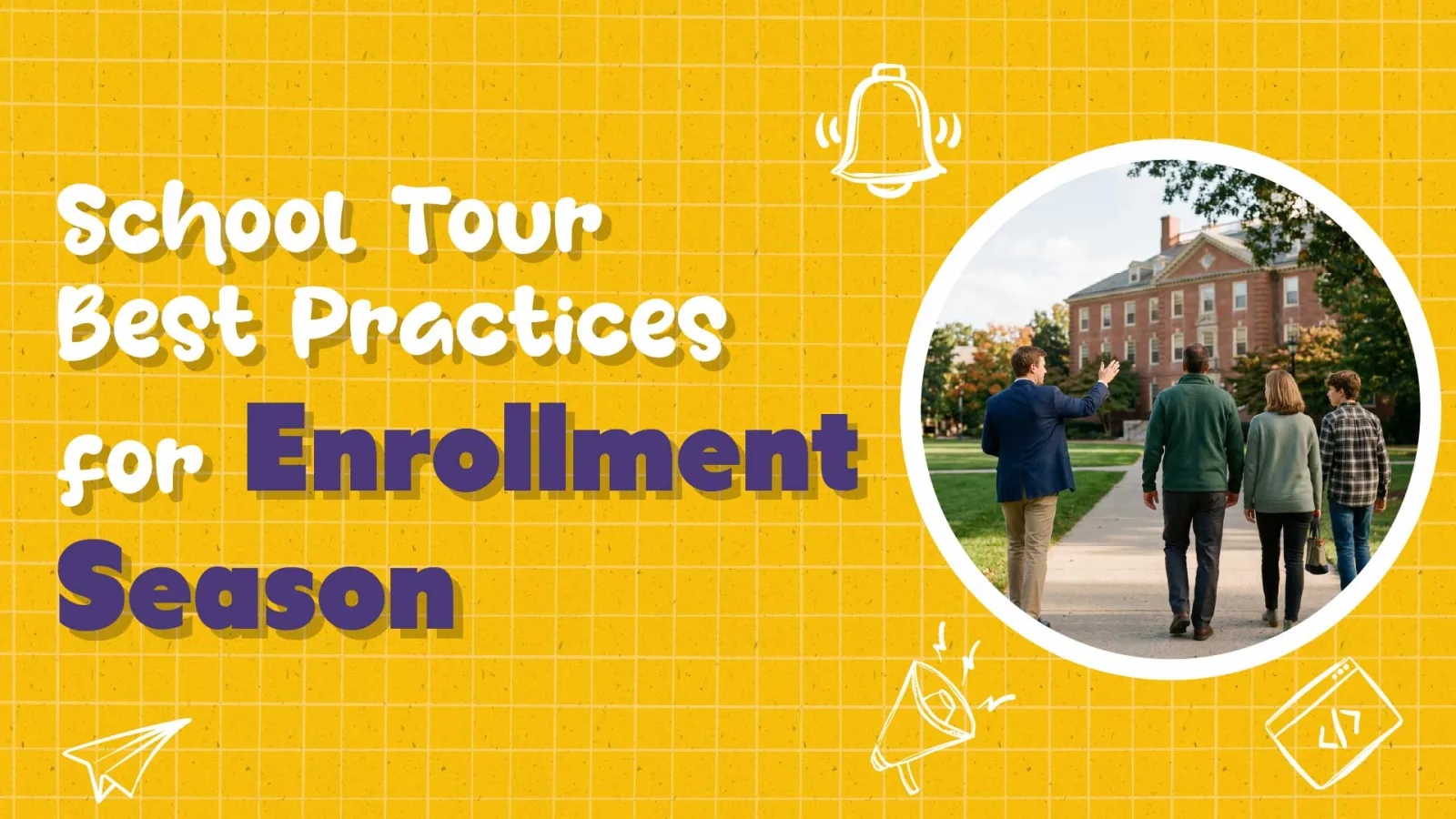
Ask most admissions directors where their enrollment dollars go, and you'll hear about the fall open house, the viewbook, and the paid social campaign. Ask them how they run an individual campus tour, and you'll often get a shrug and whichever parent volunteer happened to be free that morning. That gap is where enrollment quietly leaks. School tour best practices are not a nice-to-have add-on to your event calendar; the private and independent schools that treat the one-on-one visit as their highest-impact admissions moment tend to convert more of the families who walk through the front door.
The data backs this up, and it isn't close. The individual tour is the single most effective thing you can do to move a family toward an application. Yet it's often the least scripted, least staffed, and least measured part of the funnel. This guide is the operational companion to your open house planning: a working checklist for scheduling, guide selection and training, student ambassadors, personalizing the visit, virtual-versus-in-person tradeoffs, follow-up, and the tracking that tells you whether any of it worked.
Why Are Individual School Tours the Most Effective Admissions Touchpoint?
Individual tours are the highest-converting admissions activity a private school runs. In a survey conducted by NAIS and Metric Marketing, independent schools rated one-on-one tours the most effective admissions touchpoint at 89%, ahead of group open houses at 63% and small-group tours at 46%. Self-guided tours ranked dead last at 3%.
That ranking should reshape how you spend your time. A group open house is a wonderful top-of-funnel event, but it is a broadcast. The individual tour is a conversation, and conversations convert. The same NAIS research collected responses from 344 marketing professionals over 17 days in August 2024, with 261 answering the specific touchpoint question, so this isn't one school's hunch.
Families feel the same way. Niche data shows that 56% of parents said visiting a school influenced their enrollment choice, behind only the school website at 60%, and 55% of parents said the visit played the biggest role of any channel in shaping their child's final decision. When the parent writing the tuition check ranks the visit that high, that moment deserves a checklist, not a shrug.
There's academic support for the pattern, too, with one caveat worth stating plainly. Research published in AERA Open found that middle schoolers randomly assigned to visit a university campus showed gains in college knowledge and college efficacy and were more likely to enroll in advanced coursework the next year. That study is about college-access interventions, not families touring a K-8, so read it as adjacent evidence: campus visits change behavior in ways an informational packet does not.
How Should You Schedule and Set Up Campus Tours?
Schedule tours during authentic, active school hours and control every logistical detail a family notices before they meet a single teacher. That means offering flexible individual time slots rather than herding everyone into one Saturday, confirming appointments in writing, and making sure parking, signage, and the front-desk greeting are handled. The visit begins in your parking lot, not your lobby.
Here's a starting checklist for the operational layer most schools underinvest in:
- Offer individual, bookable time slots across multiple days, including at least one before- or after-work option for working parents.
- Send a confirmation with directions, parking instructions, what to bring, and who to ask for on arrival.
- Walk the route yourself the day before. Clear clutter, fix the flickering hallway light, and post clear wayfinding signs.
- Brief the front desk by name. The first face a family sees should be expecting them and glad they came.
- Build in a weather contingency: covered walkways, umbrellas by the door, and an indoor alternate route.
That last point sounds trivial until you see the evidence. A working paper from the National Bureau of Economic Research found that prospective students were about 10% less likely to apply after touring on a hot day and about 8% less likely after a rainy one. It's higher-education data, so treat the exact figures as directional for K-12 rather than gospel. The lesson still lands: the subjective feel of a visit, not just its content, shapes whether a family moves forward. Sweat the small stuff, because families do.
If your tour scheduling still runs through a back-and-forth email chain, a simple online booking page fixes most of the friction, and it's one of the features every admissions website needs. This is one place a Joomla-based site earns its keep: your admissions coordinator can build and update a tour-request form or scheduling widget without filing a developer ticket every time the calendar changes.
How Do You Select and Train School Tour Guides?
Always use a trained guide, and never let a tour run self-guided. A prepared guide controls the narrative, highlights what matters, anticipates the questions families are afraid to ask, and creates the human connection a printed map never will. Guides should also come equipped with a short set of scripted questions so every family hears a consistent version of your mission.
The guide is doing more than pointing at the science lab. As Independent School Management put it, "the visit is a two-way street. Just as you and your school are evaluated by the family, so are you evaluating the family as a prospective member of your academic community." A good guide watches for red flags and unexpected positives alike and reports both back to the admissions office. That's intelligence a self-guided iPad tour will never hand you.
Scripting is not about turning warm people into robots. It's about consistency. ISM's guidance on admission conversations notes that "having a handful of scripted questions ready to ask prospective families demonstrates an interest in learning about them," and recommends using a common question list "to prepare responses that reinforce your school's mission." Different guides, different families, same core story.
Build your guide program around a few non-negotiables:
- Train every guide, whether staff, faculty, or student. No walk-on volunteers running a tour cold.
- Give each guide three to five open-ended questions to ask families, tied directly to your mission and differentiators.
- Rehearse the awkward questions: tuition assistance, college outcomes, how you handle a struggling student. Confident, honest answers build trust.
- Debrief after each tour. What did the family react to? What did they worry about? Feed it back into the process.
A trained guide is your brand with a pulse. Send in an untrained one, and you've spent your best admissions asset on a coin flip.
Should Student Ambassadors Be Part of the Tour?
Yes, and they may be your most persuasive people. Students hold real influence over the final school choice, so pairing a visiting child with a current student ambassador does work no adult can replicate. A prospective seventh-grader believes a current seventh-grader in a way they will never believe a brochure or a head of school.
The research community has been saying this for years. As highlighted by Independent School Management, "students have an important influence in selecting their school," which is why the visit should attend to "each detail—from how they are greeted on arrival to their lunchroom experience—because students assess your school from the moment they step on campus."
So plan the kid-facing moments as deliberately as the parent conversation. Pair the visiting student with an ambassador of similar age and interests. Let them peel off for part of the tour so the child can ask the questions they'd never ask in front of a parent. Build in a real lunchroom stop, or a few minutes in a class the student would actually take. Those unscripted minutes often decide the enrollment.
How Do You Personalize a School Tour for Each Family?
Tailor the route and the talking points to what that specific family cares about, and lead with the three things parents weigh most heavily. Data collected by the National Center for Education Statistics indicates that among parents who considered multiple schools, quality of teachers and staff (79%), safety (71%), and curriculum focus (59%) were the factors most often rated "very important."
Those numbers climb for the private-school segment specifically. The same NCES analysis found that among families choosing private nonreligious schools, 92% rated teacher and staff quality very important and 74% said the same about curriculum focus. A generic campus walk that drifts past these three priorities is a missed opportunity. Introduce a standout teacher by name. Show, don't just mention, your safety protocols. Walk the family through the specific program that fits their child.
Personalization starts with a two-minute intake before the tour. Ask why they're looking, what their child loves, and what worried them about their current school. Then route accordingly. A family fleeing a chaotic environment needs to see calm, structured classrooms and hear your safety story. A family chasing academic rigor needs time in your strongest program, not a full lap of the athletic facilities.
This is also where treating families as sharp, active evaluators pays off. Private school families today compare notes with other parents, cross-reference tuition and outcomes data, and often walk in having already ruled out a competing school. Translation for your admissions team: the parent across from you has done homework, compared you to three other schools, and will notice if the tour is a canned script. Meet them as the informed decision-makers they are.
Are Virtual School Tours as Effective as In-Person Visits?
No. Virtual tours are a valuable supplement, not a substitute for a guided in-person visit. The same NAIS survey that rated individual in-person tours most effective at 89% rated virtual tours with admissions staff effective by only 10% of schools. That's not a rounding difference; it's a chasm.
Virtual tours still earn a place in your funnel, especially for out-of-area or early-stage families who aren't ready to travel. Research by Niche reveals that in its 2024 pulse survey, 98% of parents said school visits would influence their choice for the coming fall, and 74% said virtual tours and events were influential. The takeaway isn't "skip virtual." It's "sequence it right": use a live virtual walkthrough to qualify and warm up distant families, then convert them with an in-person visit whenever geography allows. If you want the full playbook for that virtual layer, see our guide to running an effective virtual tour.
For virtual academies, this ranking flips from a caution to a core competency. If your school has no physical campus to walk, your "tour" is a live, guided video session with a real person, and every best practice above still applies: a trained guide, a scripted-but-warm conversation, a student ambassador on the call, and personalization to the family's priorities. The medium changes; the fundamentals don't.
What Should Happen After the School Tour?
Follow up fast, follow up personally, and record everything. This is the most neglected stage of the entire process. In a study by NAIS and Metric Marketing, three in four schools reported having a formal method to follow up with prospective families, yet only 39% used a CRM to automate it. Good intentions, manual execution, dropped balls.
ISM's guidance is refreshingly specific on timing, even though it's written for open house day rather than the individual tour. According to Independent School Management, "the Admission Office must follow up by phone with each open house attendee within a week of the event" — the same one-week cadence holds up just as well for a tour. ISM also recommends creative touches on top: student ambassadors writing thank-you notes, or the head of school sending personal thank-you cards. Those small human gestures separate the schools families remember from the ones they forget by the weekend.
A workable post-tour sequence looks like this:
- Log the visit in your CRM the same day, with notes on the child's interests and the family's stated priorities.
- Send a personalized thank-you within 24 hours that references something specific from the visit.
- Place a phone call within one week, ideally from the person who gave the tour.
- Add a genuine human touch: an ambassador note or a card from the head of school.
- Set the next concrete step, whether that's an application deadline reminder, a shadow day, or a follow-up question answered.
That fourth-and-fifth step is where a strong tour turns into a serious prospect. For families who are clearly engaged, the natural next move is a deeper experience like a student shadow day, and your follow-up should tee it up rather than leave the family wondering what comes next.
How Do You Measure Whether Your School Tours Are Working?
Track two conversion rates: tour-to-application and tour-to-enrollment. Without them, you're guessing which of your changes helped and which just felt productive. Your CRM should tie every tour to an outcome, so you can see whether the families who visit actually apply and, ultimately, enroll. Those two rates are also the backbone of the broader private school enrollment funnel you're building beyond the tour itself.
The tooling matters less than the discipline, but it helps to know the field. As reported by NAIS and Metric Marketing, the most common admissions software among independent schools was Blackbaud at 32%, followed by Ravenna and School-Admin at 19% each. Any of them, used consistently, beats a spreadsheet that only one person understands and nobody updates after October.
Start with a handful of metrics and hold them season over season:
- Tour-to-application rate: of families who tour, what share submit an application?
- Tour-to-enrollment rate: of families who tour, what share ultimately enroll?
- Follow-up speed: how many hours between the tour and the first personal contact?
- Guide performance: do certain guides consistently convert better? Learn why and spread it.
Measure first, then improve. A school that knows its tour-to-application rate can test a change and see if it moved. A school that doesn't is just redecorating.
A Realistic Look: Tightening the Tour Process at a Mid-Sized College Prep
Picture a college preparatory school with 550 students, a two-person admissions team, and a healthy 45 inquiries a month. Their tours weren't bad, exactly. They were just loose: whichever staffer was free walked the family around, the route rarely changed, and follow-up depended on someone remembering. Roughly one in three tour families went on to apply.
Over one admissions season, the team applied the checklist in this guide. They trained a small bench of guides and gave them five mission-aligned questions to ask. They paired every visiting student with an ambassador and built in a real lunchroom stop. They added a two-minute intake so the route matched each family's priorities, and they committed to a phone call within a week of every tour, logged in their CRM.
The gains were modest and real, which is the point. Tour-to-application conversion moved from about a third of families to closer to four in 10, and the team could finally see which guides and which follow-up habits drove the difference. No tripled enrollment, no miracle. Just a highest-impact moment finally treated like one.
Conclusion: Treat the Tour Like the Asset It Is
The individual school tour outperforms every other admissions touchpoint you have, and yet it's usually the least planned. That's not a problem; it's an opening. Train your guides, put students in front of students, personalize the route to what parents actually weigh, use virtual tours as a warm-up rather than a stand-in, and follow up within a week with every family. Then measure the conversion so you know what's working.
None of this requires a bigger budget. It requires treating the visit as the deciding moment it already is. If you want a second set of eyes on how your school runs its tours and follows up with families, let's talk. No pitch, just a straight conversation about where your enrollment funnel is leaking and how to plug it.
Frequently Asked Questions
How Long Should a Private School Tour Last?
Plan for 45 to 60 minutes for an individual family tour. That's enough time to walk key spaces, sit for a real conversation, and let the visiting student experience a class or the lunchroom, without exhausting a young child. Build in a few unscheduled minutes so the visit never feels rushed.
Who Should Give School Tours: Staff, Students, or Parents?
Use trained guides, and pair them with student ambassadors. Adult guides, whether admissions staff or faculty, control the narrative and answer the hard questions, while a current student gives the visiting child a peer they'll actually believe. Avoid untrained walk-on volunteers, who tend to wander off-message and miss chances to reinforce your mission.
How Soon Should You Follow Up After a Campus Tour?
Make personal contact within one week, and ideally send a thank-you within 24 hours. Independent School Management recommends a phone call within a week of a visit, plus creative touches like an ambassador thank-you note. Speed signals that your school is organized and genuinely wants the family, which is exactly the impression you want to leave.
Are Virtual School Tours Worth Offering?
Yes, as a supplement rather than a replacement. Virtual tours help qualify and warm up out-of-area or early-stage families who aren't ready to travel, but in-person visits convert far better. For fully virtual academies, a live, guided video walkthrough with a real person and a student ambassador becomes the primary tour and should follow the same fundamentals.
How Do You Measure Whether School Tours Are Working?
Track tour-to-application and tour-to-enrollment conversion in your CRM. Tie every tour to an outcome so you can see whether visitors actually apply and enroll, then watch those rates season over season. Only 39% of schools automate follow-up in a CRM, so simply tracking consistently already puts you ahead of most. If connecting that tour data to the rest of your private school marketing is the piece you're missing, that's a fixable gap.