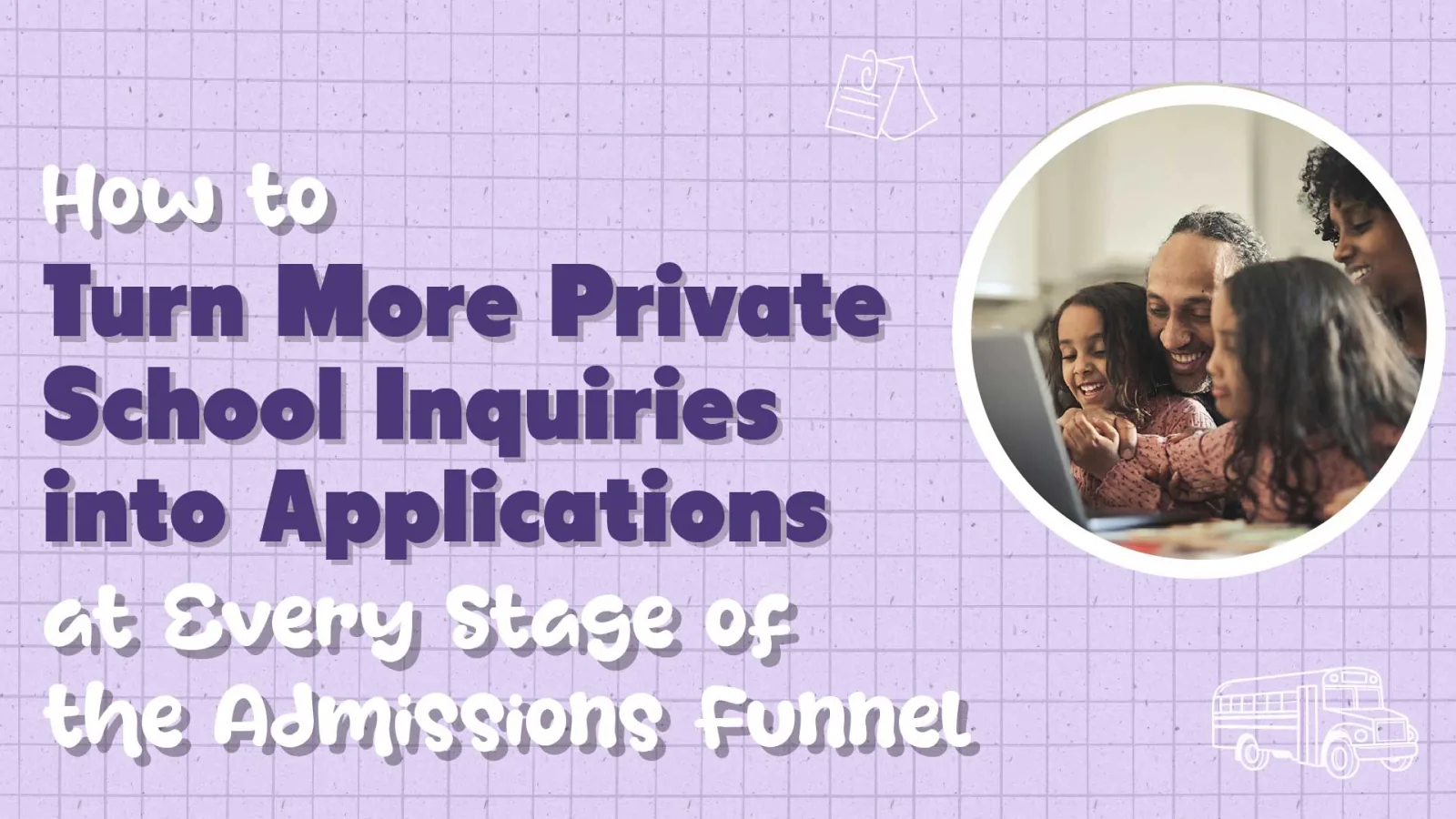
Out of every 100 families that submit an inquiry to a private school, roughly 70 will never submit an application. Not because they weren't interested. Not because they couldn't afford it. In many cases, the school's follow-up was too slow, too generic, or too infrequent to keep them engaged through the decision process.
That's not a marketing problem. That's a pipeline problem. And it's one that private school admissions teams can fix without spending another dollar on advertising.
The admissions funnel from first inquiry to submitted application is where most schools lose the most families and where most schools have the most room for improvement. This post maps each stage of that funnel, identifies the benchmarks you should measure against, and provides the specific follow-up strategies that move families from "just looking" to "where do I sign?"
What Does a Healthy Admissions Funnel Look Like?
Before you can fix a funnel, you need to know what a functioning one looks like. The admissions funnel has four primary stages, each with its own conversion benchmark:
| Funnel Stage | Target Conversion Rate | What It Measures |
|---|---|---|
| Inquiry to Tour | 40-50% | How many inquiring families visit the campus |
| Tour to Application | 60-70% | How many visiting families start an application |
| Application to Acceptance | 80-90% | How many completed applications result in offers |
| Acceptance to Enrollment | 75-85% | How many accepted families enroll (yield rate) |
Niche research on K-12 admissions indicates that established independent schools see inquiry-to-application rates between 20-35%. NAIS data shows the acceptance-to-enrollment rate (yield) averages 71.4% across member schools.
The full-funnel conversion rate from first inquiry to enrolled student typically falls between 3-5%. If your school is below that range at any stage, that stage is where the optimization effort belongs.
Stage 1: How Fast Are You Responding to Inquiries?
The inquiry stage is almost entirely about speed. A family submits a form, sends an email, or calls your office. From that moment, the clock is running, and so is the family's attention.
The 2025 Niche Parent Pulse Survey found a 29-point satisfaction gap between the communication speed of chosen schools versus schools that families rejected. Specifically, 66% of parents rated the responsiveness of the school they enrolled in as "high" or "very high," compared to just 37% for schools they passed on. Speed isn't a nice-to-have; it's a selection criterion.
Yet LeadSquared research found that 40% of schools have no pre-defined contact cadence, and 58% of schools report that fewer than 30% of inquiries result in a scheduled appointment. That gap between what families expect and what schools deliver represents the biggest conversion opportunity in the entire funnel.
What to Fix
Automate the first response. Set up an automated email or text that fires within minutes of any inquiry. This isn't the personal follow-up; it's the confirmation that the school received the inquiry and someone will be in touch. Include next steps, a link to schedule a tour, and a direct contact for the admissions team.
Make personal contact within one business day. Research cited by Niche shows that only one in four families is satisfied with a response that takes longer than a day. A phone call or personalized email from an admissions counselor within 24 hours dramatically increases the chance of moving the family to the next stage.
Segment inquiries by quality. A family that filled out a detailed form with grade-level and program questions is a higher-quality lead than a generic "tell me more" submission. Route high-quality inquiries to your most experienced counselor. Use the information they provided to personalize the initial contact.
Track response time as a KPI. If you're not measuring how long it takes to respond to inquiries, you're flying blind. Set a target (same-day automated, next-business-day personal) and hold the team accountable. (For a broader look at the marketing KPIs that predict enrollment health, we covered that separately.)
Stage 2: Are Inquiring Families Actually Visiting Campus?
Getting a family from inquiry to campus visit is the first major conversion hurdle. The benchmark is 40-50% of inquiries resulting in a scheduled visit, but many schools fall well below that.
Why Families Don't Visit
The most common reasons are logistical, not emotional. The family couldn't find a convenient tour time. The scheduling process required a phone call during school hours. They weren't sure what to expect from the visit. Or they simply didn't hear from the school quickly enough and moved on to another option.
What to Fix
Offer online self-scheduling. If booking a tour requires a phone call, you're excluding every parent who researches schools at 9 PM. Use Calendly, your CRM's built-in scheduler, or a similar tool to let families book tours, virtual visits, and shadow days online, at any time.
Provide multiple visit options. In-person tours, virtual tours, student shadow days, and parent coffee events all serve different family situations. A working parent who can't take a Tuesday morning off might jump at a Saturday open house or a 20-minute virtual tour during lunch.
Send a pre-visit communication package. Once a tour is scheduled, send details about what the family will see, who they'll meet, where to park, and what questions other families commonly ask. This reduces anxiety and increases the likelihood they actually show up. LeadSquared data shows that targeted drip emails generate 18x more revenue than non-targeted campaigns, with a 119% increase in click-through rates. Sending a welcome email immediately after inquiry captures peak engagement and keeps your school top of mind.
Follow up on no-shows immediately. If a family misses a tour, call them the same day. Don't assume disinterest; assume a scheduling conflict and offer to rebook. A no-show isn't a no; it's a not-yet.
Stage 3: What Happens Between the Tour and the Application?
This is the stage where most schools lose the most families, and it's the stage where follow-up quality matters most. The campus visit is often the deciding moment for prospective families — many parents make their enrollment decision during or immediately after the tour. If a family tours and doesn't apply, something about the experience or the follow-up missed the mark.
Why Families Don't Apply After Touring
The tour felt generic instead of tailored to their child's interests. The follow-up after the visit was slow or nonexistent. The application looked long and complicated. They had unanswered questions about tuition and financial aid. They're comparing your school to two or three others, and nothing made yours stand out.
What to Fix
Follow up within 48 hours of every tour. Send a personalized email referencing something specific from the visit. "It was great meeting you and Aiden. I know he was excited about the robotics lab; here's a video from our last competition." This signals that your school pays attention to individual students.
Address tuition anxiety proactively. If a family hasn't asked about financial aid, they may still be worried about cost. Tuition is consistently the top concern families cite during the application process. Include financial aid information in your post-tour follow-up, even if the family didn't ask.
Reduce application friction. Count the steps between "I want to apply" and "I submitted my application." If the application requires more than 30 minutes to complete, requires documents families don't have readily available, or doesn't save progress, simplify it.
Create urgency without pressure. Share application deadlines clearly, communicate available seats by grade level, and let families know the timeline for financial aid decisions. Urgency based on real information is helpful; manufactured scarcity is not.
Stage 4: How Do You Prevent Application Abandonment?
A significant number of families who start a school application never finish it. The families who started your application have already demonstrated significant intent. Losing them at this stage is the most expensive kind of funnel leakage.
Why Families Abandon Applications
The application required a document they didn't have (transcripts, recommendation letters from a current teacher). The portal was confusing or didn't work on their phone. They got distracted and intended to come back, but never did. They hit a section they didn't expect (essay questions, detailed family information) and stalled.
What to Fix
Send completion reminders. If a family started an application but hasn't submitted it within seven days, send a helpful (not pushy) reminder: "We noticed you started your application for Maya. Is there anything we can help with? Our admissions team is happy to walk through any part of the process."
Allow documents to follow the application. Don't require transcripts, recommendation letters, or test scores before a family can submit the application. Let them submit what they have and provide supporting documents separately. Every third-party dependency (requesting records from a current school, asking a teacher for a letter) is a potential abandonment point.
Make the application mobile-friendly. If the application portal doesn't work on a phone or tablet, it doesn't work for a significant portion of your applicant pool. Test the entire application process on mobile devices.
Communicate the estimated completion time. At the top of the application, tell families: "This application takes approximately 20 minutes to complete. You can save your progress and return at any time." Setting expectations reduces abandonment.
How Do You Build an Admissions Nurture Sequence?
A nurture sequence is a planned series of communications that guides a family from inquiry to application. EducationDynamics found that schools with a structured nurture program achieve 35-40% inquiry-to-enrollment conversion rates, compared to 25-30% for schools without one. That 10-percentage-point difference translates directly into enrolled students.
The Touchpoint Framework
Traditional sales research indicates that 7-13 touchpoints are needed to convert a prospect, according to SchoolMint data. For school admissions, those touchpoints should span multiple channels:
Email (primary channel): LeadSquared data shows that welcome emails achieve a 58.7% open rate compared to 14.6% for regular emails, and if sent immediately after inquiry, open rates reach 88.3%. Use email as the backbone of your nurture sequence, but don't rely on it exclusively. (For specific sequence templates, see our guide to email marketing campaigns that drive school enrollment.)
Phone calls (high-impact, personal): A phone call from an admissions counselor carries more weight than any email. Use calls strategically at key moments: after the initial inquiry, after a tour, and before the application deadline.
Text messages (for logistics): Tour reminders, deadline notifications, and quick check-ins work well via text. Keep them brief and helpful.
Mail (for differentiation): A handwritten note from the admissions director or a printed welcome packet stands out in a family's mailbox in a way that email doesn't.
Sample 30-Day Nurture Timeline
| Day | Action | Channel |
|---|---|---|
| Day 0 | Automated inquiry confirmation with tour scheduling link | |
| Day 1 | Personal call or email from an admissions counselor | Phone/Email |
| Day 3 | "What to expect from your visit" pre-tour guide | |
| Day 7 | Tour follow-up with a personalized note | Email/Mail |
| Day 10 | Financial aid information and FAQ resource | |
| Day 14 | Invitation to the upcoming campus event or shadow day | |
| Day 18 | Current parent testimonial or student spotlight | |
| Day 21 | Application reminder with direct link and support offer | |
| Day 25 | Phone call check-in from admissions counselor | Phone |
| Day 30 | Deadline reminder with remaining steps | Email/Text |
This cadence of approximately one touchpoint every three days supplements a core email cadence of one email every 7-14 days, with phone calls and other channels filling in between email sends.
What Should Your Spring Funnel Strategy Look Like?
March is the conversion month for admissions funnels. The families in your pipeline have been researching since the fall. They've narrowed their options. They're ready to decide, and they're looking for reasons to commit or reasons to walk away.
Week 1 (Early March): Audit your pipeline. Pull every family from your CRM who has inquired but not applied. (While you're at it, make sure your admissions landing pages aren't leaking families before they even inquire.) Segment them by: inquiry date, last touchpoint, visit status (toured vs. didn't tour), and grade level. This gives you a prioritized re-engagement list.
Week 2: Re-engage cold leads. For families who inquired but never visited, send a personalized email inviting them to a spring event or offering a private tour. For families who toured but didn't apply, a phone call from the admissions counselor is more effective than another email. Reference something from their visit.
Week 3: Simplify the application. Review your application form. Can you remove any fields that aren't essential for an admissions decision? Can you offer a "fast track" option for late-cycle families that collects only the essentials? Can supporting documents follow the initial submission?
Week 4 (Late March): Push to close. For families with completed applications, accelerate acceptance and financial aid decisions. For families with incomplete applications, send a direct, helpful outreach: "We'd love to have your family join us next year. Your application is almost complete. Can we help you finish?"
What a Funnel Improvement Looks Like in Practice
A mid-sized college prep with 500 students generates 600 inquiries between September and March. Their current funnel converts at these rates:
| Stage | Current Rate | Families Remaining |
|---|---|---|
| Inquiries | — | 600 |
| Inquiry to Tour | 30% | 180 tours |
| Tour to Application | 50% | 90 applications |
| Application to Acceptance | 85% | 77 accepted |
| Acceptance to Enrollment | 75% | 58 enrolled |
The admissions director implemented three changes: a same-day automated response with a tour scheduling link, a 30-day nurture sequence with 10 touchpoints, and a simplified application that reduced fields from 14 to 7.
After one enrollment cycle, the funnel shifts:
| Stage | Improved Rate | Families Remaining |
|---|---|---|
| Inquiries | — | 600 |
| Inquiry to Tour | 42% | 252 tours |
| Tour to Application | 62% | 156 applications |
| Application to Acceptance | 88% | 137 accepted |
| Acceptance to Enrollment | 78% | 107 enrolled |
That's 49 additional enrolled students from the same 600 inquiries. At a $25,000 average net tuition, that's $1.225 million in first-year revenue without spending a dollar on new advertising. The cost of the improvements (a CRM scheduling tool, an email sequence, and a simplified application form) is a fraction of what it would cost to generate 49 new enrollments through additional marketing.
Conclusion: Fix the Middle of the Funnel
Most schools respond to enrollment shortfalls by adding more inquiries at the top. More open houses. More ad spend. More content marketing. And those strategies have their place. But if your funnel is losing 70% of families between inquiry and application, adding more families at the top just means more families to lose in the middle.
Fix the follow-up speed. Build the nurture sequence. Simplify the application. Personalize the tour and every communication after it. Then, once the middle of the funnel is tight, invest in driving more volume through a pipeline that actually converts.
If you need help building an admissions funnel that converts more inquiries into applications, or if you want a second set of eyes on your follow-up process, contact me, and let's find the families you're leaving on the table.
Frequently Asked Questions
What Is a Good Inquiry-to-Application Rate for a Private School?
Established independent schools typically see inquiry-to-application rates between 20-35%, with strong programs reaching 30-50%, according to Niche research on K-12 admissions. If your rate falls below 20%, the issue is almost always in follow-up speed, personalization, or the number of touchpoints between inquiry and application deadline. The full-funnel conversion from first inquiry to enrolled student typically falls between 3-5%.
How Many Touchpoints Does It Take to Convert an Inquiry to an Application?
Traditional sales and education marketing research suggests 7-13 touchpoints across multiple channels (email, phone, in-person events, and mail) are needed to convert a prospective family. Schools with a structured nurture sequence of at least seven interactions achieve 35-40% inquiry-to-enrollment conversion rates, compared to 25-30% for schools without one. Space touchpoints every 3-5 days during the first 30 days after inquiry.
How Quickly Should Schools Respond to Admissions Inquiries?
A 2025 Niche parent survey found a 29-point satisfaction gap between the responsiveness of chosen schools (66% rated "high") versus rejected schools (37%). Only one in four families is satisfied with a response taking longer than a day. Best practice: send an automated confirmation within minutes and follow up with a personal call or email from an admissions counselor within one business day.
What Causes Families to Abandon School Applications?
The most common reasons are cost concerns, followed by application complexity, missing required documents (transcripts, recommendations), non-mobile-friendly portals, and unexpected application components like essays or detailed family questionnaires. Simplifying the application and proactively addressing tuition anxiety reduces abandonment significantly.
How Can Schools Improve Their Admissions Funnel During Spring?
Start by auditing your pipeline: segment every inquiry by status, last touchpoint, and visit history. Re-engage cold leads with personalized outreach (phone calls for toured families, event invitations for non-toured). Simplify your application by removing non-essential fields and allowing documents to follow the initial submission. Accelerate financial aid decisions for completed applications, and set clear enrollment deadlines with personal follow-up one week before.