Running a pest control business in North Carolina comes with its own unique set of challenges. From dealing with persistent palmetto bugs in Wilmington to managing mountain-dwelling pests and wildlife in Asheville, setting the right price for your services can feel as tricky as handling a yellow jacket nest.
If you're like many North Carolina pest control operators, you might be wondering:
- "How should I adjust my pricing between urban markets like Charlotte and rural areas?"
- "What should I charge for seasonal services, especially during our humid summers?"
- "How can I stay competitive while dealing with our state's specific operational costs?"
- "Should my pricing change between coastal, piedmont, and mountain regions?"
The good news? You're about to get clarity on all of these questions and more. This comprehensive guide will walk you through everything you need to know about effectively pricing your pest control services in the North Carolina market. No more second-guessing or leaving profits behind.

Written By: Adam Bennett | January 13, 2025
Adam is the president and founder of Cube Creative Design and specializes in private school marketing. Since starting the business in 2005, he has created individual relationships with clients in Western North Carolina and across the United States. He places great value on the needs, expectations, and goals of the client.
In the pest control industry, operational efficiency is the difference between thriving and merely surviving. According to The Business Research Company, the sector has witnessed robust growth, increasing from $22.91 billion in 2023 to $24.94 billion in 2024, reflecting a CAGR of 8.8%. Looking forward to 2028, the market is expected to continue its strong growth, reaching $34.53 billion with a CAGR of 8.5%. What's more, research from Sharp Sheets indicates that pest control businesses show remarkable profitability, with an average operating profit margin of 45% (EBITDA) after accounting for operating costs like salaries and supplies.
As pest control businesses face increasing demands for faster response times, better service quality, and competitive pricing, the ability to streamline operations has become more critical than ever.
"In the future, I really see it continuing to be strong, even through all the downturns we've had in the economy. As long as you do it the right way and be a leader in the industry, you're always going to grow." - Brad Pitts, Consumer Services Consultant, FieldRoutes' Field Famous podcast.
The modern pest control landscape presents unique challenges: coordinating multiple technicians across various locations, managing inventory of regulated substances, ensuring compliance with ever-changing regulations, and meeting rising customer expectations. However, these challenges also present opportunities for businesses that can master their operational workflows and leverage technology effectively.
This detailed playbook will walk you through every aspect of pest control business operations, from route optimization to technology integration, providing you with actionable strategies to enhance efficiency and drive growth.

Written By: Chad J. Treadway | January 08, 2025
Chad is our Chief Smarketing Officer. He will help you survey your small business needs, educating you on your options before suggesting any solution. Chad is passionate about rural marketing in the United States and North Carolina. He also has several certifications through HubSpot to better assist you with your internet and inbound marketing.
The pest control industry stands at a crossroads. Digital tools, consumer expectations, and green values are changing the rules. For pest control businesses, the time to act with digital marketing strategies is now. Those who adopt these trends won't just survive. They'll thrive in a market that keeps getting more crowded. Think of this guide as your map through these changes. It gives you the strategies and ideas you need to run a tighter shop, expand your reach, and build a strong future in pest control.
Written By: Chad J. Treadway | January 06, 2025
Chad is our Chief Smarketing Officer. He will help you survey your small business needs, educating you on your options before suggesting any solution. Chad is passionate about rural marketing in the United States and North Carolina. He also has several certifications through HubSpot to better assist you with your internet and inbound marketing.
In the competitive world of pest control management (PCM), effective digital marketing can make all the difference. At Cube Creative Design, we've developed a unique approach that delivers exceptional results for our PCM clients. Our contract-based model is a key component of this success, and here's why it's essential for achieving the best outcomes for your pest control business.
Written By: Adam Bennett | December 30, 2024
Adam is the president and founder of Cube Creative Design and specializes in private school marketing. Since starting the business in 2005, he has created individual relationships with clients in Western North Carolina and across the United States. He places great value on the needs, expectations, and goals of the client.
"If I just run some Google ads, the customers will come crawling in!"
Sound familiar? Many pest control business owners have fallen into this trap, only to watch their marketing budget scatter like roaches when the lights come on. While display ads can certainly attract attention, relying solely on them is like trying to catch a mouse with cheese but no trap – you might get some interest, but you're missing the bigger picture.
In today's digital landscape, where every pest control company is vying for attention, simply throwing money at pretty ads isn't enough to make your phone ring. Your potential customers are being bombarded with marketing messages faster than ants at a picnic, and standing out requires more than just a flashy banner ad or a clever tagline.
Think about it: when was the last time you saw a display ad and immediately made a purchase? Just like how a comprehensive pest treatment plan requires more than just spraying chemicals, an effective marketing approach needs a well-thought-out strategy behind it.
In this post, we'll explore why developing a marketing strategy is crucial for your pest control business's success and how it complements your advertising efforts. We'll uncover the secret ingredients that make some pest control companies thrive while others struggle to survive in today's competitive market. Whether you're a small local operation or a growing regional business, you'll learn how to build a marketing framework that attracts and retains customers, even when facing tough competition and rising costs.
Let's dig deeper into why strategy matters and how you can build one that works as effectively as your best treatment plan.
Written By: Chad J. Treadway | December 24, 2024
Chad is our Chief Smarketing Officer. He will help you survey your small business needs, educating you on your options before suggesting any solution. Chad is passionate about rural marketing in the United States and North Carolina. He also has several certifications through HubSpot to better assist you with your internet and inbound marketing.
Ever feel like you're caught in a web of digital marketing chaos while trying to run your pest control business? You're not alone. While you're out there eliminating unwanted visitors from homes and businesses, your website might be collecting digital cobwebs, and your social media presence could be as empty as an abandoned nest.
Let's face it: between managing technicians, scheduling appointments, handling customer calls, and actually performing pest control services, finding time to master the ever-changing world of digital marketing feels about as possible as teaching a termite to tap dance. And when you do try to tackle it yourself, it often feels like you're spraying and praying – hoping something will stick without really knowing what works.
But here's the thing: just as you wouldn't recommend DIY pest control for a serious infestation, trying to handle all your digital marketing in-house might be doing more harm than good. The digital landscape for pest control companies has become increasingly competitive, with everyone vying for those coveted top spots in local search results.
That's where hiring a pest control industry-specific digital marketing expert specialized in pest control SEO comes into play. Think of it as bringing in a specialized exterminator – but instead of eliminating pests, they're eliminating the barriers between your business and potential customers.
In this comprehensive guide, we'll explore why partnering with an industry-specific digital marketing expert isn't just another expense – it's an investment that can help your pest control business:
Written By: Chad J. Treadway | December 23, 2024
Chad is our Chief Smarketing Officer. He will help you survey your small business needs, educating you on your options before suggesting any solution. Chad is passionate about rural marketing in the United States and North Carolina. He also has several certifications through HubSpot to better assist you with your internet and inbound marketing.
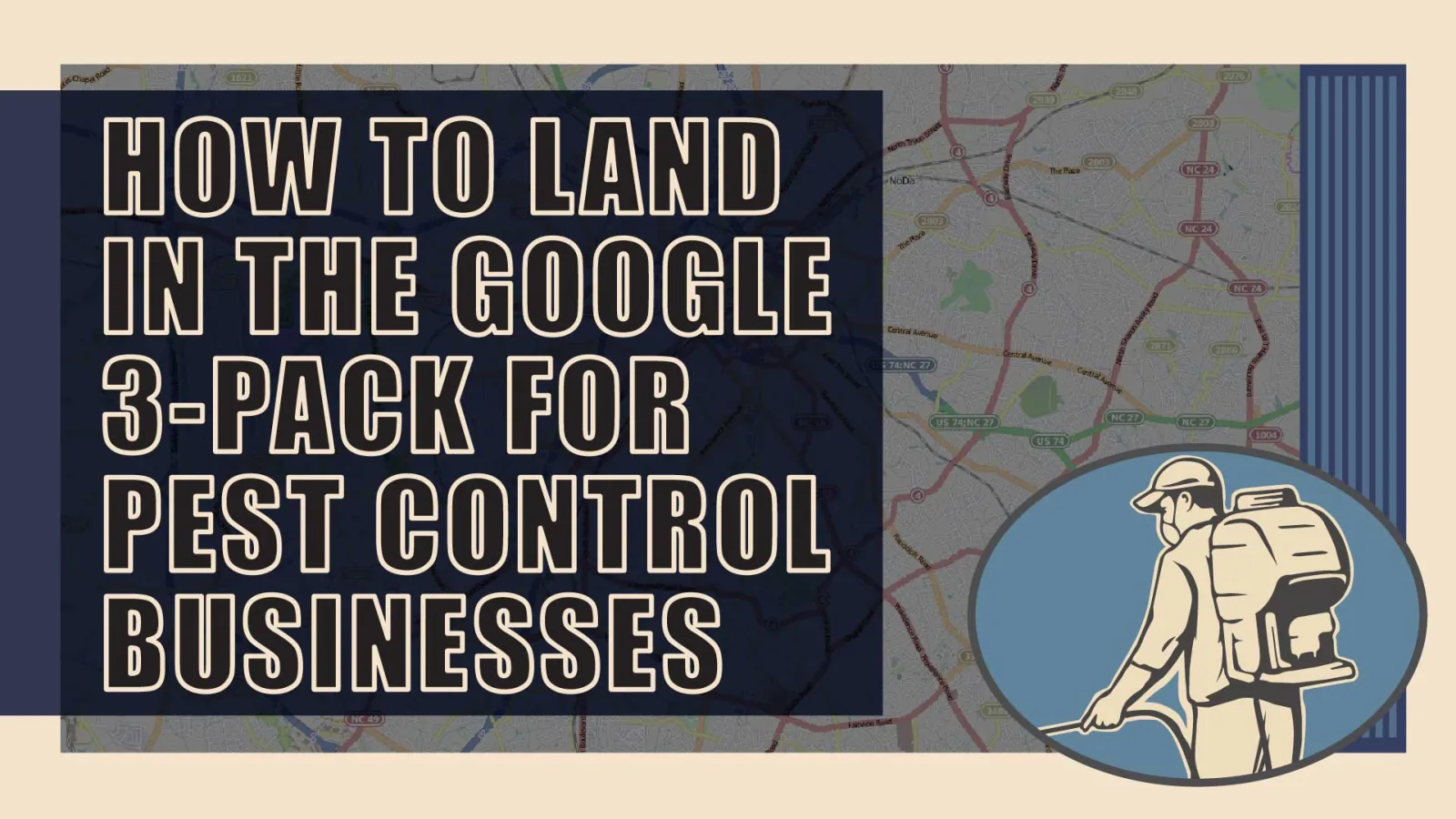
A homeowner discovers signs of bugs coming out of their hardwood floors (termite infestation) late at night. Panicked, they grab their phone and search for "pest control near me" or “exterminator near me.” Will your business be one of the first three results they see? If you're not in Google's Local SEO 3-Pack, chances are you're missing out on these urgent service calls.
Let's face it – the pest control industry is crawling with competition (pun intended). While you're busy helping customers deal with unwanted visitors, your competitors might be climbing the local search rankings, capturing those valuable emergency calls and routine pest control inquiries. But here's the good news: with the right strategy, you can secure your spot in the coveted Local SEO 3-Pack and ensure your business stands out when it matters most.
In this comprehensive guide, we'll exterminate the confusion around Local SEO 3-Pack rankings and provide you with actionable strategies to boost your local visibility. Whether you're dealing with seasonal surge searches for "mosquito control" or year-round queries for "bed bug treatment," we'll show you how to position your pest control business right where your potential customers are looking.
Written By: Chad J. Treadway | December 18, 2024
Chad is our Chief Smarketing Officer. He will help you survey your small business needs, educating you on your options before suggesting any solution. Chad is passionate about rural marketing in the United States and North Carolina. He also has several certifications through HubSpot to better assist you with your internet and inbound marketing.
It's peak season, your phone should be ringing off the hook, but instead, you're watching your Google Ads budget drain away with minimal returns. This is the reality for many pest control companies attempting to manage their own Google Ads campaigns. While it's technically possible to run your own campaigns, the real question isn't "Can you?" but rather "Should you?"
A comprehensive study of over 2,000 Google Ads accounts by Disruptive Advertising revealed a stark reality: on average, 61% of ad spend is wasted, with the median account wasting more than 75% of their budget. For pest control companies, the stakes are even higher, with some businesses reporting costs of $40-90 per click, according to Service Autopilot. These challenges are particularly daunting for pest control businesses:
Written By: Adam Bennett | December 16, 2024
Adam is the president and founder of Cube Creative Design and specializes in private school marketing. Since starting the business in 2005, he has created individual relationships with clients in Western North Carolina and across the United States. He places great value on the needs, expectations, and goals of the client.
Are you tired of watching your competitors crawl up the search rankings while your phone stays quieter than a mouse in a cat convention? In the pest control industry, timing is everything. When someone discovers unwanted guests doing the conga line across their kitchen floor at 2 AM, they're not scrolling to page two of Google—they're clicking on the first solution they see.
Pay-per-click advertising is your digital mouse trap, putting your pest control business front and center when frantic homeowners and desperate business owners need your services most. But like using the wrong bait in the wrong place, poorly managed PPC campaigns can quickly eat through your budget faster than termites through a lumber yard.
Whether you're dealing with seasonal surge searches for "mosquito control" in summer, emergency calls for "wasp nest removal," or year-round demands for "monthly pest control services"—mastering PPC is crucial for capturing these high-intent leads. In this comprehensive guide, we'll exterminate the confusion around PPC management and show you exactly how to:
Written By: Adam Bennett | December 16, 2024
Adam is the president and founder of Cube Creative Design and specializes in private school marketing. Since starting the business in 2005, he has created individual relationships with clients in Western North Carolina and across the United States. He places great value on the needs, expectations, and goals of the client.

Wendy, the founder of Bug Off Pest Control in Charlotte, thought she had it all figured out. "My customers love us, and they're telling their friends. That's all the marketing we need, right?" Wrong. Six months later, while scrolling through her phone, she discovered her competitors dominating local search results, building impressive social media followings, and expanding into neighboring territories. Meanwhile, her phone wasn't ringing as often as it should have been.
Sound familiar?
Here's the hard truth: Word-of-mouth marketing is powerful. It's like having an army of trusted neighbors vouching for your pest control expertise. But in today's digital world, relying solely on word-of-mouth is like trying to catch a swarm of termites with a butterfly net – you might catch a few, but most will slip right through.
Consider this: While Gary at Dream Weaver Pest Control in Hickory was waiting for word-of-mouth to grow his business, Eden from Green Pest Elimination in Asheville partnered with a marketing agency and saw her eco-friendly pest control business triple its service area in just 18 months. The difference? She understood that modern pest control marketing requires a strategic blend of traditional word-of-mouth and professional digital marketing expertise.
In this post, we'll explore why word-of-mouth alone isn't enough in today's competitive pest control market and how partnering with a professional marketing agency can help your business thrive. We'll dig into real challenges faced by pest control companies, share practical solutions, and help you make an informed decision about your marketing strategy.
Whether you're a startup like Bug Off Pest Control or an established player like Guardian Pest Services in Raleigh, you'll discover:
- Why word-of-mouth marketing still matters (but isn't enough)
- When and how traditional marketing falls short
- What value does a professional marketing agency bring to your pest control business
- How to choose the right agency for your needs
- What kind of investment to expect, and the returns you should anticipate
Ready to stop letting business opportunities scatter like roaches when the lights come on? Let's dive in.
Written By: Chad J. Treadway | December 12, 2024
Chad is our Chief Smarketing Officer. He will help you survey your small business needs, educating you on your options before suggesting any solution. Chad is passionate about rural marketing in the United States and North Carolina. He also has several certifications through HubSpot to better assist you with your internet and inbound marketing.
In today's digital-first world, your potential customers aren't flipping through the Yellow Pages anymore – they're reaching for their smartphones. According to recent industry data, More than 9 out of 10 online experiences begin with a search engine, with most deciding within the first hour of their search. For pest control professionals, this means one thing: if you're not visible in search results, you're losing business to competitors who are.
With increasing competition in the pest control industry, visibility across multiple platforms is crucial. Your potential customers aren't just using Google – they're searching across Facebook, Instagram, and other social platforms for pest control solutions. This multi-platform presence, anchored by strong SEO, helps you stand out in a crowded market.
Written By: Chad J. Treadway | December 09, 2024
Chad is our Chief Smarketing Officer. He will help you survey your small business needs, educating you on your options before suggesting any solution. Chad is passionate about rural marketing in the United States and North Carolina. He also has several certifications through HubSpot to better assist you with your internet and inbound marketing.
You know the ins and outs of pest control like the back of your hand. After years of serving customers and building your expertise, you're ready to strike out on your own. While you're confident in your ability to deliver exceptional pest control services, marketing your new business might feel like uncharted territory.
Take Wendy from Bug Off Pest Control in Charlotte. After spending eight years as a lead technician for a major pest control company, she knew it was time to build her own business. She had the certifications, understood the local pest challenges, and had built strong relationships with suppliers. Her expertise in handling everything from routine pest prevention to complex termite treatments was solid. But like many skilled technicians making the leap to a business owner, she faced a new set of challenges: building a customer base from scratch, creating a marketing strategy, and managing a business while still being the primary technician.
Written By: Chad J. Treadway | December 09, 2024
Chad is our Chief Smarketing Officer. He will help you survey your small business needs, educating you on your options before suggesting any solution. Chad is passionate about rural marketing in the United States and North Carolina. He also has several certifications through HubSpot to better assist you with your internet and inbound marketing.