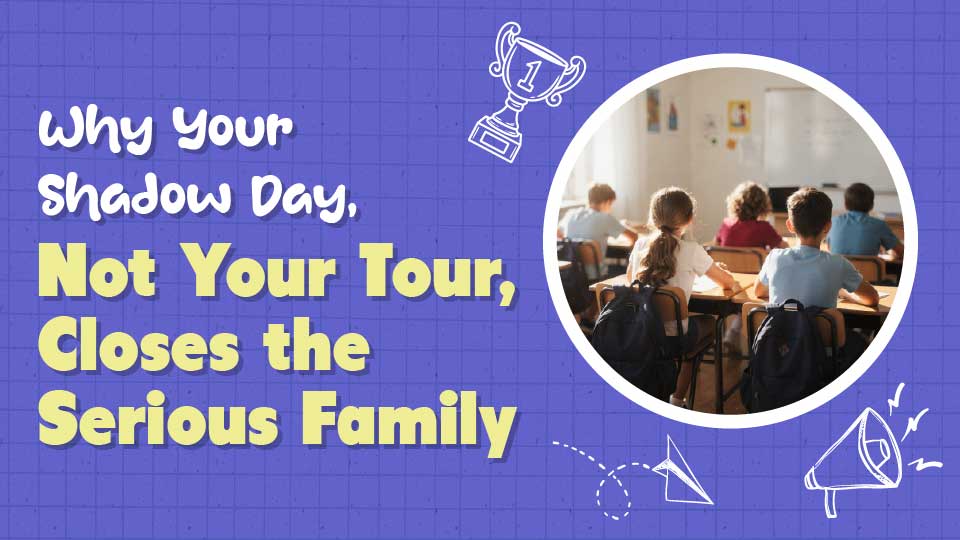
By the time a family agrees to a shadow day, they have usually toured your campus, sat through your pitch, and quietly compared you to two or three other schools. They are not browsing anymore. They are deciding. And the person doing most of that deciding is the 12-year-old who has to walk into an unfamiliar building on Monday morning and picture spending the next six years there. A private school admissions team that treats the shadow day as an afterthought to the tour is leaving its most serious prospects to make that call with no help at all.
That is the whole case for taking shadow day marketing seriously. It sits at the bottom of the campus-visit funnel, after the open house draws the crowd and the individual tour warms the family up. It is the test drive that closes the gap between "we're interested" and "we're applying." This guide covers what a shadow day actually is, where it belongs in your funnel, how to select and train host students, how to handle logistics and capacity without burning out your staff, how to follow up, and how to measure whether any of it is working.

Written By: Adam Bennett | August 21, 2026
Adam is the president and founder of Cube Creative Design and specializes in private school marketing. Since starting the business in 2005, he has created individual relationships with clients in Western North Carolina and across the United States. He places great value on the needs, expectations, and goals of the client.
By the time a prospective family fills out your inquiry form, they have probably already read your tuition page, watched two of your videos, checked your reviews, and compared you against three other schools. They did all of it without telling you. If your marketing only kicks in after the inquiry, you are showing up to a conversation that started months ago. A fall enrollment timeline fixes that by putting your school in front of families during the long, quiet stretch when they are actually making up their minds.
This is the working calendar behind a healthy admissions year. It maps the full cycle, from August awareness campaigns through spring deposits and into summer re-enrollment. Your team knows what to launch, when to spend, and where to follow up. Cube Creative Design builds this kind of plan for private and independent schools, and the pattern below is the one we use to keep a full year from turning into a spring scramble.
Think of this as your master calendar. The three open-house pieces in this cluster cover the tactics of a single event. This piece sits one level up and shows how that event fits into the whole year. Let's walk the cycle month by month.
Written By: Adam Bennett | August 19, 2026
Adam is the president and founder of Cube Creative Design and specializes in private school marketing. Since starting the business in 2005, he has created individual relationships with clients in Western North Carolina and across the United States. He places great value on the needs, expectations, and goals of the client.
Three concrete shifts reshaped private school marketing between 2025 and 2027, and most happened in places a busy Head of School would never think to look. A tax law rewrote who can afford your tuition. Google quietly deleted a review channel schools spent a decade building. Families started asking chatbots where to send their kids. If your enrollment plan still reads like it was written in 2023, this is the year to fix that. This guide is built for the person who has to defend a marketing budget to a board of trustees, not the person deciding which Facebook post to promote this week. If you lead one of the private and independent schools trying to make sense of all this, here is what actually matters heading into the 2027 school year, and what you can safely ignore.
Written By: Adam Bennett | August 17, 2026
Adam is the president and founder of Cube Creative Design and specializes in private school marketing. Since starting the business in 2005, he has created individual relationships with clients in Western North Carolina and across the United States. He places great value on the needs, expectations, and goals of the client.
The open house is over. The cookies are gone, the parking lot is empty, and your admissions team is running on fumes. Here is the uncomfortable part: the event you spent six weeks planning did not decide who enrolls. What happens in the next 24 hours does. Open house follow-up is where enrollment is actually won or lost, and most schools treat it like an afterthought — a thank-you email sent whenever someone finally gets around to it.
That afterthought is expensive. The stretch between "attended your event" and "submitted an application" is exactly where a warm family either builds momentum or quietly cools off and picks the school down the road. If you own the follow-up process at your school, this is your highest-impact window, and it is the same problem we help school admissions teams solve every fall. This post picks up the moment your event ends and walks through the nurture strategy that converts attendees into applicants: how fast to respond, what to send, how to segment your list, and where technology helps versus where it just gets in the way.
Written By: Adam Bennett | August 14, 2026
Adam is the president and founder of Cube Creative Design and specializes in private school marketing. Since starting the business in 2005, he has created individual relationships with clients in Western North Carolina and across the United States. He places great value on the needs, expectations, and goals of the client.