No one hands you a syllabus for this. You decide your child might do better somewhere else, you read four school websites, and you get four versions of the same soft promise: apply this winter, we will be in touch. Then you learn that a private school application has six or seven separate parts, and that other people have to finish half of them for you.
I work at Cube Creative Design, where we build websites and enrollment marketing for private school administrators. I read admissions pages for a living. Most of them are written by people who already know the process, for people who do not. The information is technically there. The sequence almost never is.
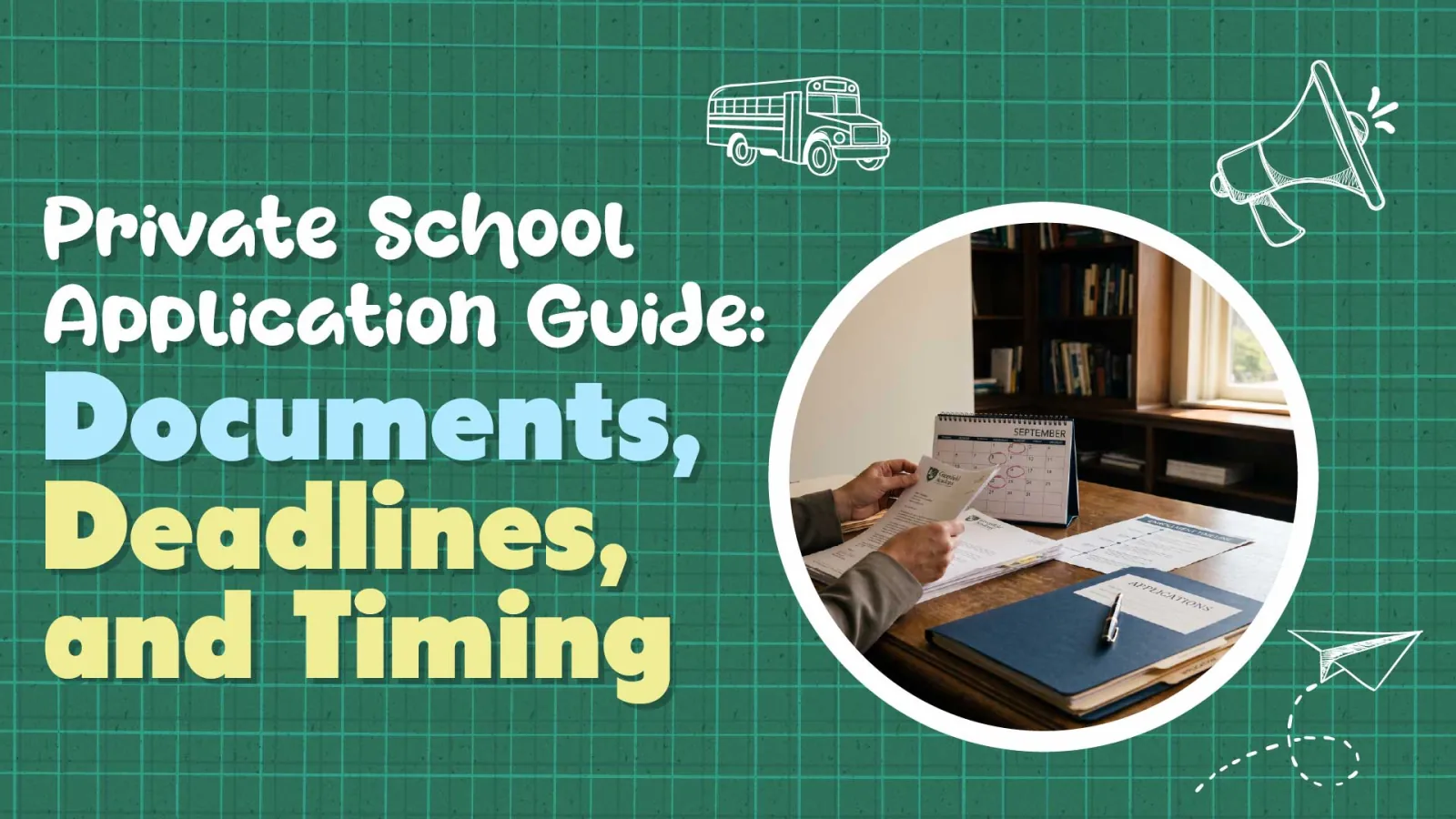
This guide lays out what the application actually requires, when each piece comes due, how financial aid changes the schedule, and where families lose the most time. Individual deadlines vary by school, and you should confirm every one of them. The shape of the year does not vary much at all.
What Is the Private School Application Process?
A private school application is a package of materials you send to each school on that school's schedule. Expect an application form, a student essay, a parent statement, transcripts, teacher recommendations, an interview, and in most grades an admission test. Financial aid, if you need it, is a separate application with its own deadline.
The hard part is not any single item. It is that you are the project manager for work other people perform. Your child's current registrar sends the transcript. Two teachers write recommendations. A testing organization schedules the exam and releases scores. Your accountant, or your patience with tax software, controls the aid file.
Families applying to several schools can cut the duplicate work. The Enrollment Management Association reported that its Standard Application Online covers more than 400 participating schools. You fill it out once and send it to any of them. Schools that do not take it will want their own forms, so ask early which camp each school is in.
One more thing worth saying out loud: admissions offices are not trying to hide the ball. Most of them are small teams running a complicated season. The families who do well are simply the ones who treat the process like a project instead of a form.
When Should You Start a Private School Application?
Start the summer before the year you plan to apply, and get serious by early fall. The admission timeline published by the Enrollment Management Association puts school research in August through October. Visits and application forms follow in October through December, and deadlines land between November and January.
The Fall Window Does the Heavy Lifting
Almost everything that determines a private school application outcome happens between September and January. Open house visits, interviews, testing, recommendations, and aid forms all stack into that window, and they stack in a specific order because each one depends on the last. Build your own admissions timeline around that order, not around the deadline alone.
Deadlines cluster hard. EMA reported that the application deadline for most schools on a traditional timeline falls between mid-December and mid-February, with Jan. 15 as the most common date. Canadian schools often run much earlier, with Oct. 31 or early November deadlines.
After the deadline, the pace changes and you lose control of the clock. Candidate review runs through February into early March at traditional-timeline schools, according to EMA, and the most common week for decision letters is the week of March 10.
Then the ball is back in your court, briefly. Schools typically require enrollment decisions and deposits in early to mid-April, which gives families somewhere between two weeks and a month to compare acceptances, waitlists, and aid awards. That is not a lot of time to make a five-figure decision, so do your comparing in the fall.
A Typical Admissions Timeline, Month by Month
The table below maps a traditional-timeline application year, from summer research to a signed April contract. Schools running this same calendar from the other side face their own enrollment timeline pressures, which is worth knowing if you are reading this as the admissions office rather than the applicant.
| Month | What Happens | What You Should Be Doing |
|---|---|---|
| August to October | Research and school lists | Narrow to three to five schools, submit inquiry forms |
| October to December | Open houses, tours, interviews | Visit, meet admissions staff, ask each school for its deadline list |
| October to November | Application forms open | Start forms, begin the student essay and parent statement |
| Early to mid-November | Recommendation season | Request transcripts and teacher recommendations |
| October to January | Testing | Register for and take the admission test; leave room to retest |
| December to January | Deadlines | Submit applications and financial aid forms |
| February to March | Review and decisions | Wait, respond fast to any request for missing items |
| March to April | Revisits and contracts | Revisit finalists, compare aid awards, sign and deposit |
What Documents Does a Private School Application Require?
Most private schools ask for the same core set. You submit an application form with a student essay, a parent statement, an official transcript, two or more teacher recommendations, and an admission test score for grades three and up. Add an interview, plus tax returns if you apply for aid. Details vary by grade.
What Your Family Submits
The application form collects the basics, along with your child's essay and, at most schools, a parent statement. The parent statement is not a formality. It is the one place you explain, in your own words, what your child needs and why this school is on your list.
Completing the form usually opens the school's admission portal, which is where the school's real requirements and dates live. EMA noted that this portal is where you learn the specific application requirements and deadlines for that school. Read it the day you get access, not the week before the deadline.
What Your Current School Submits
Transcripts and teacher recommendations come from your child's current school, which means those dates are not yours to control. Check whether each target school has its own recommendation forms before you ask anyone for anything.
What schools ask for shifts by grade. Research by EMA shows elementary applicants usually need a parent statement and one general recommendation, which can come from a principal, counselor, or teacher. Most middle and upper school applications ask for letters from current English and math teachers, plus personal or special-interest references.
Timing matters more here than anywhere else. In its guidance for families, EMA recommended making transcript and recommendation requests in early to mid-November, based on common marking periods. That window is late enough that teachers know your child and early enough to beat the rush.
What Your Child Completes
EMA's timeline guidance reports that students applying to grade three and higher are commonly asked to take a standardized admission test, such as the ISEE or the SSAT. Lower elementary applicants may sit for an academic assessment with a school official instead, and international students often add an English proficiency exam.
Register early enough to test twice if you want the option. The interview belongs to your child too, and it usually happens between October and December alongside open houses and campus tours.
Showing up counts for more than families assume. EMA found that visiting a school sends a strong signal about your family's interest, and that the signal carries weight when the admissions committee makes its harder calls. Attend the open house even at the school you are least sure about.
How Does Financial Aid Change the Application Timeline?
Financial aid adds a second set of deadlines, and they often land first. EMA reported that schools with fixed deadlines start taking aid applications on Oct. 1. Per that same aid timeline, applications are usually due between Dec. 15 and Jan. 31, with awards arriving between Feb. 1 and March 31.
Schools ask for more paperwork than most families expect. As reported by EMA, private schools typically request the documents below. Treat it as your required-documents checklist:
- The school's online financial aid application
- Tax returns: 1040s with all schedules, plus 1099 and K-1 forms
- Bank statements for every savings and checking account
- Mortgage or rent details
- Investment details, including 529, 401(k), and 403(b) accounts
- Unusual costs, such as funeral bills or flood repairs
Also check what the sticker price leaves out. EMA noted that published tuition may not cover the full cost of attendance. Uniforms, books, meals, transportation, and after-school care get added on top. EMA's example is a $40,000 tuition that ends up costing $43,000. Ask for the all-in number before you compare awards.
The Tax Deadline Problem
The aid calendar and the tax calendar do not line up, and everybody knows it. EMA's aid timeline tells families to file income taxes as soon as they can after Jan. 1, so the return can go with the aid form. That is a polite way of saying your December deadline arrives before your paperwork does.
Families say the same thing when researchers ask them. In its 2024 report on how parents pay school costs, the National Association of Independent Schools found that parent satisfaction with the aid process had slipped. Ratings fell for instructions, explanations, and the paperwork schools ask for. Parents wanted simpler forms, tax deadlines that match application deadlines, and more openness about how awards get set.
The stress is real, and it is rising. NAIS reported that 55% of surveyed parents now feel stressed about paying for private school, up from 47% in 2018. That NAIS survey drew on 1,961 parents who were actively seeking aid. If this part feels heavy, you are in the majority.
Two practical moves take most of the pain out of it. Gather last year's return, recent bank statements, and mortgage details in October, before anyone asks. Then file this year's taxes as early as you can, and tell the aid office your filing date so nobody assumes you went quiet.
How Do Rolling Admissions Change the Application Process?
Rolling admissions means a school reviews applications continuously instead of after one fixed deadline. The requirements do not get lighter, and the review does not get faster. What changes is scarcity: open seats and available aid dollars both shrink as the year moves along, so applying early matters more, not less.
The paperwork stays the same. EMA reported that the usual criteria still apply at most rolling admissions schools: the application form, interview, essay, standardized test, and recommendation letters. A committee still reviews every file.
Space is the real constraint. One director of enrollment management told EMA that late applicants often assume a rolling process always has openings. In fact, seats in certain grades become very limited by May or June. Openings also vary grade by grade, which gets complicated fast if you are placing two children.
Aid runs out before seats do. EMA noted that a rolling process tends to award aid first-come, first-served. The same article quotes an enrollment director who sees families surprised each year that no aid is left in late summer. Rolling schools also keep firm deadlines for specific scholarships.
Rolling schools also open a door that fixed-deadline schools usually keep shut. EMA data shows that many of them offer mid-year enrollment alongside the standard fall start, which matters if a placement stops working in October. If you are considering a mid-year move, ask both schools how partial credits and grades will transfer before anyone signs anything.
Treat rolling admissions as an opportunity with an expiration date. It is genuinely useful when your family decides late, or when a school year goes sideways in November. It is not a reason to wait.
Where Do Families Lose the Most Time?
Families lose the most time in three places: staying anonymous while they research, requesting transcripts and recommendations too late, and treating financial aid as a step that follows an acceptance. Each one is easy to fix, and each one costs weeks that the winter calendar does not give back.
Most families who reach out never finish an application. Niche reported that at established independent schools, the inquiry-to-application rate is typically between 20% and 35%. Treat that as an industry range rather than a fixed benchmark, because the underlying member data is not public. The takeaway holds either way: the process outruns most people who start it.
Staying Invisible Too Long
Parents research quietly now, and schools know it. Niche survey results show that 87% of parents surveyed used school search and review platforms before contacting or visiting the school they ultimately chose.
Admissions professionals have a name for this. Kate Auger-Campbell, with Independent School Management, said families can find what they need online and cut their list without ever speaking to an admissions office. Many of these "stealth candidates," she said, reach the application phase before the school knows they exist.
Staying invisible costs you, not them. Submitting an inquiry form early gives you more time to build a relationship with the admissions team, and it puts you on the list for open houses, deadline reminders, and any change in seat availability.
Use those first exchanges as a test. Niche's 2025 Parent Pulse Survey found that 66% of parents rated the speed of communication from the school they eventually enrolled in as high or very high, compared with 37% for schools they did not choose. How fast a school answers you in September tells you something about how it will treat you in March.
Requesting Recommendations Late
Teachers write recommendations for multiple students in the same two-week stretch, on top of their actual jobs. A November request gets a thoughtful letter. A January request gets a rushed one, if it arrives at all.
Send requests in early to mid-November, give each teacher the school's own form, and include a short list of deadlines. Then check the school's portal to confirm each item was received, because a missing recommendation is your problem to solve, not the teacher's.
Treating Financial Aid as Step Two
Waiting for an acceptance before applying for aid is the single most expensive habit in the private school application process. EMA advised families not to wait on admission decisions before applying for financial aid, and to submit aid applications in the same window as admission applications.
At schools with fixed deadlines, a late aid file can miss the award cycle entirely. At rolling schools, it can arrive after the money is gone. Either way, the answer is the same: file both applications together.
How Competitive Is Private School Admission Right Now?
Competition varies by school and grade, but demand has been strong. In its 2025 report on a national survey of private schools, the Cato Institute found that 42% reported an increase in application submissions, while 39% of respondents received more applications than they had available seats.
Read those numbers carefully. Cato drew its sample from 22,411 private schools and got 883 responses, a roughly 4% response rate with a margin of error of plus or minus 3.3 points. The survey ran in late 2024. It tells you the direction of demand nationally. It cannot tell you whether the K-8 down the road has room in fourth grade.
Only the school can tell you that, so ask. Two questions get you most of the way: how many seats do you expect in my child's grade, and how many applications did you receive for that grade last year? Admissions offices answer this more often than parents expect.
Grade matters more than school reputation here. Entry points such as kindergarten, sixth grade, and ninth grade usually have the most seats, while a mid-year transfer into an established grade may be competing for a single opening created by one family's move.
What a Realistic Application Season Looks Like for One Family
Picture a hypothetical family with two children, ages 8 and 11, applying for the older child's entry into sixth grade. Their list has four schools: two faith-based K-8 programs, one larger college prep campus, and one smaller school with rolling admissions. Nothing about their season is heroic. It is just early.
In August, they narrow the list and submit inquiry forms at all four schools. In September and October they attend two open houses and schedule interviews, and they ask each admissions office for a single written list of deadlines, including the aid deadline. Two of the four lists turn out to differ from what the websites say.
In early November, they request transcripts and teacher recommendations, with the deadline list attached. Their child takes the admission test in November, which leaves room for a December retest if the scores come back weak. They start the aid application the week it opens and submit it in early January, then file taxes in late January and forward the return.
Decisions arrive in March. They get two acceptances, one waitlist, and one denial, plus aid awards that make exactly one of the acceptances workable. They revisit both accepted schools in late March, ask the aid office to confirm the all-in cost with fees, and sign the contract in the second week of April. The advantage they had was never money. It was six weeks of lead time.
The Bottom Line on the Private School Application
The private school application rewards sequence more than polish. Inquire early so you are visible and informed, ask each school for its own deadline list in writing, request transcripts and recommendations in early November, and file the aid application alongside the admission application rather than after it. Confirm every date directly with each school, because the calendar in this guide describes the typical cycle, not yours.
If you run a school instead of applying to one, reread the friction points above from the family's side. Parents research you for weeks before you ever hear from them; they measure you by how fast you answer, and they drop out when your requirements live in five places, and your aid deadline arrives before their tax documents do. A clear application page, one written deadline list, and a fast reply do more for enrollment than another brochure ever will.
If you want an outside read on what your admissions pages ask of families, get in touch. I will tell you where your application process loses people.
Frequently Asked Questions
How Long Does the Private School Application Process Take?
Plan on about a year from first research to a signed enrollment contract. The Enrollment Management Association describes a cycle that begins a full year before the enrolling school year, with research in late summer, applications due between November and January, and enrollment decisions in the spring. The active work is concentrated in roughly four months.
Can You Still Apply to a Private School After the Deadline?
Often, yes. Many schools accept late applications if space remains, and more schools now use rolling admissions year-round. EMA reported that some schools revert to rolling admissions after a traditional deadline passes, so it is always worth asking about availability. Late applicants face fewer seats and, usually, less financial aid.
How Many Private Schools Should a Family Apply To?
For most families, three to five is a workable range. Fewer than three leaves you exposed if a waitlist or a thin aid award takes an option away. More than five multiplies interviews, recommendation requests, and aid files past what one fall can absorb. Include at least one school with a realistic chance of a strong aid offer.
What Happens If Your Child Is Waitlisted?
Waitlists move, but slowly. EMA noted that schools typically begin making offers to waitlisted students in late spring and early summer, once commitments from accepted and returning students are processed, and that an offer can arrive even after school has started. Keep another acceptance in hand while you wait.
When Do Private Schools Send Admission Decisions?
EMA data shows that most U.S. private schools send decisions in March, with the week of March 10 the most common. Some notices arrive as early as late February and others as late as April. Schools generally release financial aid awards at the same time so families can compare full costs before contracts come due.