By the time a prospective family fills out your inquiry form, they have probably already read your tuition page, watched two of your videos, checked your reviews, and compared you against three other schools. They did all of it without telling you. If your marketing only kicks in after the inquiry, you are showing up to a conversation that started months ago. A fall enrollment timeline fixes that by putting your school in front of families during the long, quiet stretch when they are actually making up their minds.
This is the working calendar behind a healthy admissions year. It maps the full cycle, from August awareness campaigns through spring deposits and into summer re-enrollment. Your team knows what to launch, when to spend, and where to follow up. Cube Creative Design builds this kind of plan for private and independent schools, and the pattern below is the one we use to keep a full year from turning into a spring scramble.
Think of this as your master calendar. The three open-house pieces in this cluster cover the tactics of a single event. This piece sits one level up and shows how that event fits into the whole year. Let's walk the cycle month by month.
Why Does a Fall Enrollment Timeline Matter More Now?
A fall enrollment timeline matters more now because demand is real but no longer automatic. Post-pandemic growth has slowed, families research longer and more on their own, and good timing is what sets apart schools that fill their class from schools that just hope to. The calendar turns interest into applications on a schedule you control.
The demand is easy to miss. In its 2024 Schooling in America survey, EdChoice found that 36% of K-12 parents say they would most like to send their child to a private school, roughly four times the 9% who actually do. That gap is your market to win. It does not close on its own. Timing and follow-through are what capture it.
The easy years are over, too. The Cato Institute reported that among 883 private schools surveyed, 40% saw enrollment rise between 2023-24 and 2024-25, while 32% saw it fall and 28% held flat. That is a clear slowdown from the pandemic-era peak, when 53% reported growth. When a rising tide lifted every boat, weak marketing could hide. It cannot hide now.
Then there is the quiet researcher. Kate Auger-Campbell, ISM's executive director of sales and marketing, put the shift plainly: "Prospects these days can easily find all the information they need about independent schools online and narrow down options without ever speaking to an admission department. Many of these 'stealth candidates' make it to the application phase without admission professionals even knowing they exist." A timeline is how your marketing reaches those families before they raise their hand. Mapping that behavior end to end is the focus of our parent journey mapping guide.
What Is a Fall Enrollment Marketing Timeline?
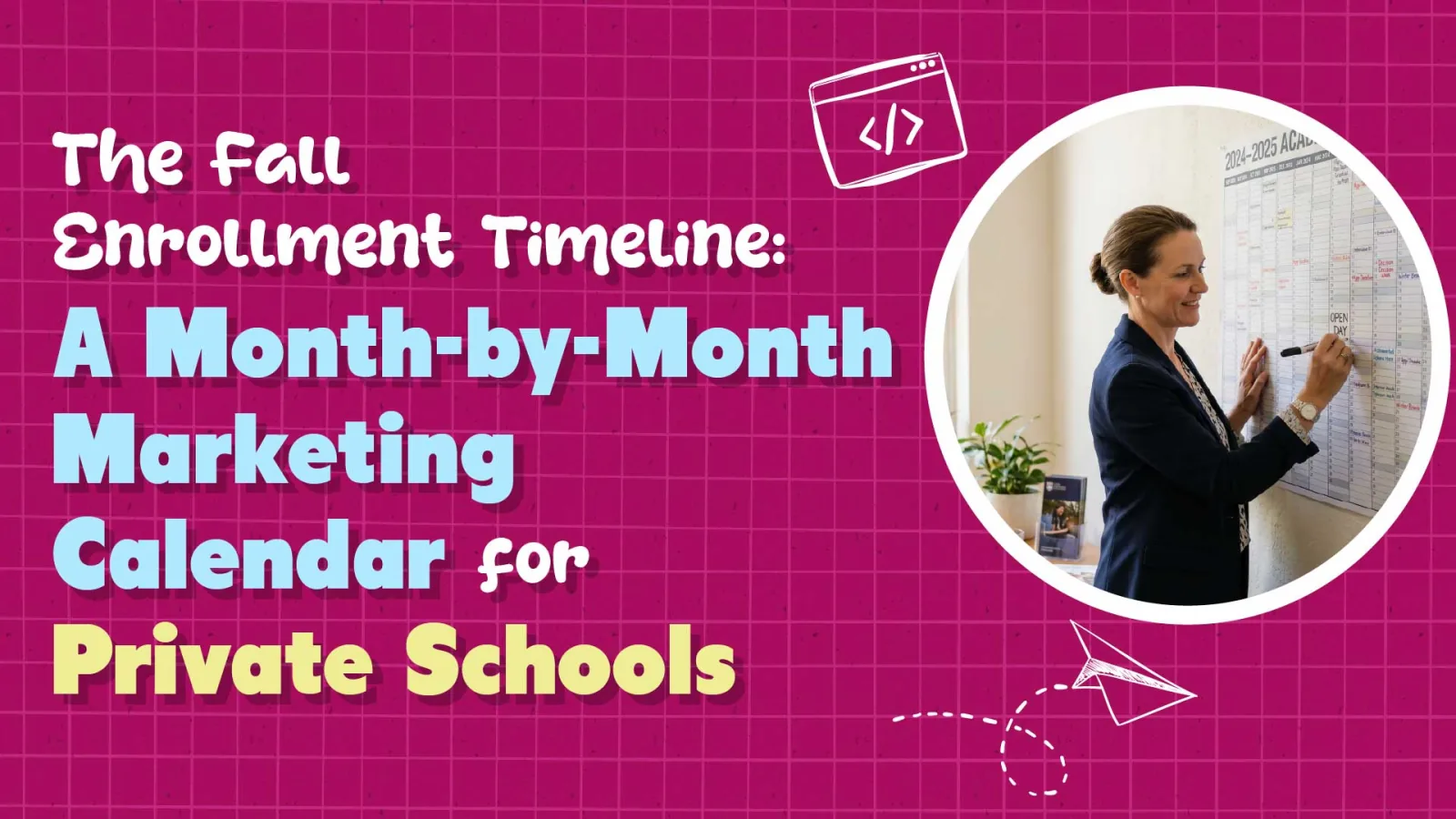
A fall enrollment marketing timeline is a month-by-month calendar that lines up your marketing with the real admissions cycle. It runs from awareness campaigns in late summer through application deadlines, decision letters, and deposits the next spring. Each channel gets a job and a window, so promotion, spending, and follow-up happen on purpose.
A fixed calendar works because the family side of the cycle looks the same from school to school. NAIS lays out the general sequence in its guidance on affording an independent school education: families begin their search in September and October of the year before enrollment, start financial aid applications in November and December, submit admission applications in January or early February, and get decisions in late February or early March, with financial aid awards in March and April.
Your marketing timeline mirrors that family timeline. When families are searching, you are running awareness campaigns. When they are applying, you are cutting friction and reminding them of deadlines. When they are deciding, you are making your case one last time. The rest of this guide walks that mirror month by month.
The Month-by-Month Fall Enrollment Timeline
This is the core of the admissions marketing timeline: what to run in each window and why. Treat it as the overview. It gives you the shape of the year and the top priority for each phase, which is enough to plan your budget and staffing around. The detailed, week-by-week version lives in the downloadable calendar described further down.
August to September: Launch Awareness and Lead Generation
Early fall is when the search begins, so this is your awareness and lead-generation window. Launch your top-of-funnel campaigns, refresh your website's admissions pages, publish seasonal social content, and post open house events to your Google Business Profile so they show up in local search. The goal is simple: be visible while families are quietly building their shortlists.
This is also when you open your open house promotion window. Fall is the busy season for these events for a reason. NAIS says so directly in its parent guidance: "The majority of open houses occur in the fall, although some schools schedule one just after the first of the year." (Source: NAIS) Promoting early gives your campaigns time to fill seats, instead of begging for RSVPs the week before.
Practical moves for August and September:
- Turn on awareness ads (search and social) aimed at families researching schools in your area.
- Publish first-day-of-school and campus-life content while enthusiasm is high.
- Open registration for your fall open house and start promoting it across email, social, and your Google Business Profile.
- Audit your inquiry form and admissions pages so a stealth researcher can find answers without calling.
Getting this early window right is the heart of a solid early enrollment strategy, since the schools that move first capture families before a competitor even shows up on their radar.
October to November: Open Houses and the Financial Aid Window
Mid-fall is peak event season and the start of financial aid, so this window carries two jobs at once: run your open houses and get families into the aid pipeline. Increase ad spend here to drive event attendance. Your messaging should also start pointing families toward the application and aid deadlines that are now in view.
Financial aid timing is not a footnote. It is a deadline that shapes the whole spring. The Enrollment Management Association's admissions resource notes that schools generally begin accepting financial aid applications on Oct. 1, with applications usually due between Dec. 15 and Jan. 31 and awards made from Feb. 1 through March 31. Families who miss the aid window often drop out on their own, so getting this date in front of them in October is a retention play as much as a marketing one.
This is the month to lean on the open-house cluster. For the tactical detail of running the event itself, see the companion guides on fall open house planning and school tour best practices. Your timeline's job is to make sure those events are promoted and staffed on schedule, not to re-run their playbooks.
December to January: Application Deadlines and Nurture Peak
Winter is deadline season, so your nurture sequences should peak here. Application deadlines cluster in January and early February, and financial aid applications typically close by Jan. 31. Every family who toured in the fall but has not applied needs a reason and a reminder to finish the job. This is where a well-built email cadence earns its keep. If that stall turns into full silence, our guide on re-engaging families who toured but never enrolled has the playbook.
Send several reminders rather than one announcement. Research on admissions timing is a useful caution here. In a study of a public school-choice lottery, Fong and Faude (2018) found that nearly half of Black kindergarten applicants missed the first registration deadline, almost three times the rate of their white peers. Strict deadlines can punish families who have less time and less paperwork know-how. A fair timeline sends several reminders through several channels, not one email and a shrug.
Priorities for December and January:
- Peak your inquiry-to-application nurture emails; segment by the family's stage and interest.
- Send layered deadline reminders for both admission and financial aid applications.
- Keep a warm hand on families who attended fall events but have not converted.
- Prepare decision-release messaging so it is ready before February arrives.
February to March: Decision Releases and Accepted-Family Messaging
Late winter is decision season, so your marketing shifts from recruiting to welcoming. NAIS's general calendar places admission decisions in late February and early March, with financial aid awards in March and April. Write, design, and schedule your accepted-family emails before the letters go out. The window between acceptance and deposit is short, and other schools are courting the same families.
This is a separate messaging job, not more of the recruitment campaign. Accepted families are weighing your offer against other acceptances and, often, against the aid package that came with each. Time your financial aid awards to land with your enrollment contracts, so a family sees the full picture at once. A warm, well-run welcome sequence in this window does more for yield than another round of top-of-funnel ads.
April to May: Yield, Deposits, and Wait-List
Spring is the close, so the calendar shifts fully to yield and deposits. This is where the year's work either pays off or slips away. Deposit deadlines, wait-list movement, and enrollment contract follow-up all land in this window. The schools that treat it as a real campaign, not a passive wait, are the ones that fill their class.
Run this phase like a sales close, because it is one. Personal outreach beats mass email here. A call or a note from an admissions officer to an accepted-but-undecided family often tips the decision. Getting that automation-versus-personal-touch balance right across the whole process is covered in our guide on balancing automation and personal touch in admissions. Keep your wait-list families warm with honest, specific updates, so that when a seat opens, you can fill it fast. Track your deposit numbers each week against your capacity target, so you always know where you stand.
June to July: Re-Enrollment and Planning the Next Cycle
Summer is for retention and planning, so the calendar circles back to your current families and next year's plan. Start re-enrollment campaigns for existing families now, because keeping a family costs far less than winning a new one. This is also when you review the cycle that just ended and start building the timeline for the fall ahead.
Retention is not an afterthought. It is the base that next year's numbers sit on. Use the quiet summer months to ask what worked, where inquiries stalled, which channels produced enrolled students rather than just clicks, and what you will change. Then set your next calendar. The best time to plan August's campaign is in July, not in August.
Download the Full Week-by-Week Calendar
The timeline above is the planning-level overview. The full version breaks each phase into weekly tasks, owners, and channel-by-channel checklists. You can print it, share it with your team, or hand it to your head of school to back up your budget and staffing timing. If a save-and-print calendar template would help your team run the year without missing a beat, our 90-day enrollment marketing plan template is built to be downloaded and worked from directly.
Which Admissions Touchpoints Deserve the Most Calendar Weight?
In-person touchpoints deserve the most weight, which is why the calendar front-loads fall event promotion. Individual tours and group open houses are the most effective admissions touchpoints by a wide margin, while virtual-only options trail badly. If you are deciding where to spend limited time and budget, spend it on getting families onto campus.
The numbers make the case. In its 2024-2025 State of Independent School Marketing report, NAIS found that schools rated individual tours (89%), group open houses (63%), and small-group tours (46%) as their most effective admissions touchpoints. Virtual tours with staff (10%) and self-guided virtual tours (3%) ranked lowest. Individual tours worked best for smaller schools; group and small-group formats did more for larger ones.
The planning takeaway is simple. Weight your fall calendar toward promoting and staffing in-person events. Treat virtual touchpoints as a backup for far-away or busy families, not the main event. Once a family is on campus, the open house follow-up strategies that turn a visit into an application become the next job on your timeline.
How Does Email Fit Across the Whole Enrollment Cycle?
Email is the thread that runs through the whole cycle, carrying families from first inquiry through deposit and into re-enrollment. It is the one channel that touches every phase of the timeline, which makes a steady nurture rhythm worth more than any single campaign. When a family goes quiet, a well-timed email is usually what brings them back.
Schools tend to punch above their weight in the inbox. Campaign Monitor's analysis of email performance put the education sector at a 28.5% average open rate and a 4.4% click-through rate, the highest of the 18 industries it tracked. Treat those figures as a rough guide, not a current-year number, since the data is a few years old. The point still holds: families open and read email from schools they are weighing.
The use across the timeline looks like this. Awareness emails in late summer, event invites in the fall, deadline reminders in winter, welcome emails for accepted families in early spring, and re-enrollment notes in summer. Sort families by where they sit in the funnel, so the message matches the moment. Do that, and the channel will pull more than its cost suggests.
How Do You Scale the Timeline for a Smaller Budget or a Virtual Academy?
You scale the timeline by keeping the calendar skeleton and swapping the tactics to fit your budget. The order of phases does not change. What changes is whether a step runs on paid media or on organic and community effort. A $10,000 budget and a $150,000 budget can follow the same calendar with very different line items.
Take a well-funded college prep school: a K-12 program of about 550 students with a marketing budget near $144,000 a year. The timeline runs as written. Paid search and social ads step up in the fall, nurture emails run in a CRM, and a staffed event calendar anchors the October to November window. The goal for a school like this is often a steady 15% to 20% yearly rise in applications, and the calendar is what makes that repeatable rather than lucky.
A faith-based or lower-cost school with a $5,000 to $15,000 yearly budget follows the same phases with free and low-cost swaps. Community events, church and parent networks, referral pushes, and organic social take the place of most paid media, and the principal often runs the calendar in person. The value of the timeline here is focus. A small budget spent in the right week beats the same budget spread thin all year. Schools working this budget band can see how we help faith-based schools increase enrollment with the same approach.
A virtual academy keeps every digital step and drops the campus-only ones. Webinars and virtual open houses stand in for in-person tours. Ad pacing and email cadence run just as described, and the search-to-decision sequence holds. What does not apply is day-of-event logistics and in-person tour promotion, so a virtual academy shifts that energy into stronger digital touchpoints and follow-up. So much of this rides on seasonal landing pages and event sign-up forms. Your team should be able to build and edit those pages without a developer on call for every date change. That is one reason we build on Joomla: a marketing director can own the seasonal page updates directly.
Putting the Timeline to Work
A fall enrollment timeline does not add work to your year. It takes the work you already do and puts it in the right order. Awareness in late summer, events and financial aid in the fall, deadlines and nurture in winter, decisions and welcomes in late winter, yield in spring, and retention and planning in summer. Map it once, give each phase an owner, and the panic that usually shows up in April tends not to arrive.
The families are out there. Far more parents want a private school than currently choose one, and many are actively looking to switch. What they need from you is to show up on their timeline, not yours, and to make each next step clear. If you want to see what a steady calendar could mean for your own application and enrollment numbers, or you would like a second set of eyes on the plan you already have, schedule a conversation, and we'll build the year out together.
Frequently Asked Questions
When Should a Private School Start Its Fall Enrollment Marketing?
Start in August, before families begin their search in earnest. NAIS's general-case cycle has families beginning their school search in September and October of the year before enrollment, so awareness campaigns and open house promotion need to be live by late summer to reach them at the top of the funnel rather than after they have already built a shortlist.
What Are the Most Important Dates on the Enrollment Calendar?
The anchor dates are financial aid opening around Oct. 1, applications and aid closing in January (aid typically by Jan. 31), decisions releasing in late February and early March, financial aid awards in March and April, and deposits closing out in May. Build your marketing around these fixed points, since the family side of the cycle rarely moves.
How Is a Fall Enrollment Timeline Different From an Open House Plan?
An open house plan covers a single event end to end; a fall enrollment timeline covers the entire admissions marketing year, of which the open house is one milestone. The timeline handles campaign launch, ad pacing, financial aid and application deadlines, decision messaging, yield, and re-enrollment. Use the fall open house planning guide for event tactics and the timeline for the calendar around them.
Can a Small School With a Tight Budget Use This Timeline?
Yes. The calendar skeleton is the same at any budget; only the tactics change. A school working with $5,000 to $15,000 a year swaps paid media for organic social, community events, and word-of-mouth referral pushes, while keeping the same phase sequence. The timeline's value for a small school is focus, spending limited dollars in the weeks that matter most.
How Much of the Budget Should Go to In-Person Events Versus Digital?
Weight the calendar toward in-person events, because they convert best. NAIS's marketing research rated individual tours and group open houses as the most effective admissions touchpoints, far ahead of virtual-only options. Digital channels do the awareness and nurture work that fills those events, so fund digital to drive attendance and fund events to close, rather than treating them as competing line items.