
Most pest control budgets move a month after the phones do.
If you're an owner running eight trucks, or an office manager keeping the marketing alive between dispatch and billing, you've lived this. The first termite swarm hits. The phone lights up. That's when someone raises the ad budget, and by the time the new money buys clicks, the busiest two weeks are gone.
A monthly pest control marketing plan fixes the timing. Pest pressure is one of the most predictable things in this business. Carpenter bees show up in the Southeast in March. Mice move into Northeast attics in October. You can see the curve a year out, so there's no reason to wait for it to hit you.
I build marketing for pest control business owners, and spend that chases demand instead of meeting it is the most common timing problem I see. Your goals, budget, and channel weights belong in the 8-step annual marketing plan. This post is the calendar underneath it, one month at a time.
One honest limit up front: this plan times what you already run. It won't fix a slow website or a profile with nine reviews, and it asks for a short planning session at the start of every month. Skip that session, and the plan turns back into a reaction.
Below you'll find all 12 months, each built on the same five lines, plus three patterns that repeat across the year and a first-quarter example for a nine-truck company.
How Do You Read This Monthly Pest Control Marketing Plan?
Read each month as five short lines: the pests rising in your region, the one or two levers to pull, when to shift spend, one number to measure, and one thing to skip. Find your region in the tables below. Then act on the month before the curve turns, not the month it peaks.
Think of it as a pest control marketing calendar with the reasons written in. The pest timing comes from Cube's planning data, a region-by-region file of peak, shoulder, and off-season months for the pests our clients treat. It covers eight U.S. regions. Peak is a region-wide signal, though. A coastal county and a mountain county in the same state won't match, so check your own call log before you commit.
Rhythm matters more than size here. Cube's 2026 Pest Control Website Audit of over 300 companies found that the typical Google Business Profile posted a handful of times a year, often in a cluster around one campaign, and then went quiet. A plan that names one task per month is how you avoid the burst-and-forget pattern.
Doesn't Google Already Handle the Seasons for You?
Google handles some of it, and only inside the limits you set. Google's seasonality adjustments guide states, "Use seasonality adjustments only if you expect major changes to conversion rates, because Smart Bidding already manages seasonal events."
Smart Bidding sets bids inside the budget you give it. It won't raise a daily budget you set back in January. It can't publish a termite page, and it can't ask a customer for a review. Those jobs stay on your calendar.
This plan also stays out of the question of which channels get the money. That question has its own answer in the guide to where to invest your marketing dollars. Here, the only spend question is when.
Pest Pressure by Month and Region
The two tables count how many pests in Cube's planning data are at peak in each region, in each month. Regions list different numbers of pests, so compare months inside one region. Don't compare one region against another.
| Month | Southeast | South Central | Southwest | California |
|---|---|---|---|---|
| Jan | 6 | 6 | 3 | 4 |
| Feb | 4 | 4 | 1 | 2 |
| Mar | 5 | 7 | 3 | 5 |
| Apr | 8 | 11 | 3 | 5 |
| May | 13 | 15 | 4 | 7 |
| Jun | 17 | 18 | 7 | 12 |
| Jul | 15 | 14 | 8 | 12 |
| Aug | 20 | 20 | 12 | 16 |
| Sep | 18 | 17 | 8 | 14 |
| Oct | 14 | 13 | 5 | 12 |
| Nov | 9 | 8 | 5 | 10 |
| Dec | 6 | 6 | 3 | 4 |
| Month | Northeast | Midwest | Pacific NW | Mountain West |
|---|---|---|---|---|
| Jan | 9 | 7 | 7 | 4 |
| Feb | 7 | 5 | 5 | 2 |
| Mar | 5 | 5 | 5 | 3 |
| Apr | 4 | 3 | 2 | 1 |
| May | 7 | 8 | 5 | 3 |
| Jun | 13 | 14 | 9 | 7 |
| Jul | 14 | 15 | 8 | 6 |
| Aug | 17 | 20 | 14 | 9 |
| Sep | 12 | 14 | 10 | 5 |
| Oct | 11 | 10 | 7 | 3 |
| Nov | 9 | 7 | 7 | 4 |
| Dec | 9 | 7 | 7 | 4 |
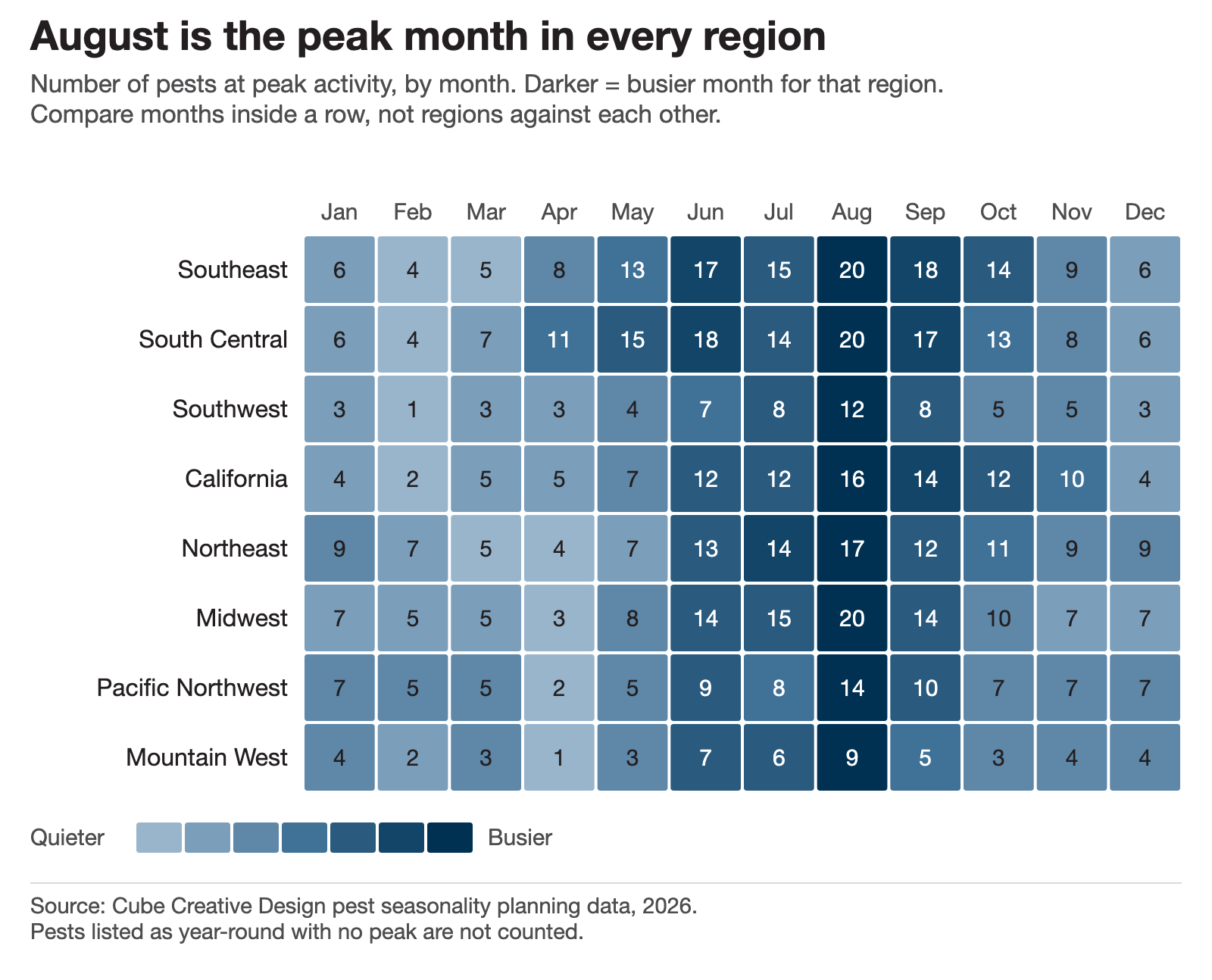
August is the peak month in every region. Source: Cube Creative Design pest seasonality planning data, 2026.
Two things jump out. August is the top month in all eight regions. And the low point isn't midwinter everywhere: April is the quietest month in the Northeast, Midwest, Pacific Northwest, and Mountain West, while February is the quietest across the South and California. In the North, mice and overwintering bugs keep January busier than April.
How Do You Check This Plan Against Your Own Call Log?
Check the plan by pulling last year's calls and finding two dates for each service: the week calls first doubled and the week they peaked. The regional tables give you the shape of the year. Your call log gives you the dates, and the dates are what you schedule against.
Pull the calls from your phone system or field software and sort them by week and by pest. Then count back from the first date for each lever. Ads go two to three weeks earlier. Email goes about a month earlier. Content goes two to three months earlier.
Here's how that plays out. If mouse calls doubled the week of Oct. 6 last year, your rodent ad raise lands in mid-September, the rodent email goes out in early September, and the exclusion page goes up in July.
If you don't have clean call data, start with the regional tables and keep a simple tally this year: date, pest, and how the caller found you. A three-column spreadsheet beats a memory of "it got busy sometime in spring." By next November, you'll have your own curve.
Companies with branches in two regions should run the count for each branch. A Southeast curve and a Northeast curve can sit a month or more apart, and one blended budget ends up early for one branch and late for the other.
Winter Build Months Set Up Your Spring Calls
January and February are the cheapest months to fix what spring will test, and the guide to year-round planning for steadier profits covers how to keep cash flowing through them.
January Is for Fixing the Profile Before Anyone Calls
Pests rising: Almost nothing enters peak in January. The Northeast and Midwest still carry winter work, with mice, Norway rats, stink bugs, and boxelder bugs sheltering indoors. In the Southeast and South Central regions, roof rats and mice keep the phone from going silent.
Run: Clean up your Google Business Profile, starting with categories, service areas, and hours. In a survey conducted by Whitespark, local search experts ranked "Business is Open at Time of Search" fifth of 187 local pack factors in 2026. A profile that says you're closed when you're open is a profile that gets passed over. While you're in there, reply to every review left over the holidays and add photos from last season. Cube's audit turned up photo libraries that hadn't been touched in 18 months or more. Real photos of your techs and trucks do more for a shopper than a stock picture of a cockroach.
Shift spend: Hold paid budgets at your floor. Move your planning hours instead, and draft the termite and spring ant pages you'll publish next month.
Measure: Calls from your Google Business Profile, compared with last January. That number is your baseline for the year.
Skip: Big ad pushes in the Mountain West and Southwest, where pest pressure sits near its yearly low. Spending hard into an empty month is like fogging an empty garage.
February Puts Termite Pages Live Before the Swarm
Pests rising: Termites sit in their shoulder season in the Southeast, where Cube's planning data puts the eastern subterranean termite peak in March through May. Mice still lead in the North. Fire ants start to stir in South Central, where February is a shoulder month.
Run: Publish or refresh your termite service page and your swarm-season blog post, then send the termite email. Northeast companies run the same play about a month later: the planning data puts their termite pages in January and February and their termite email in March. Google's own guidance backs the timing. Google Search Central advises site owners to "plan ahead to have high quality content available on your site a little before people are searching for it, so that when they do, your content is ready for them."
Shift spend: Not yet. Write the ad copy and pick your landing pages now, so the March raise takes two minutes instead of two hours.
Measure: Whether your termite page shows as indexed in Search Console before March 1. If Google hasn't found it, the swarm won't either.
Skip: Launching a brand-new service line. February is for sharpening the pages that pay in spring.
Spring Ramp Months Decide How Your Summer Goes
March through May is when the curve turns in the South and the bulk of the year's lead time gets spent, and the spring peak season guide covers the peak itself.
March Brings Early Termite Swarms to the South
Pests rising: In the Southeast, carpenter bees, eastern subterranean termites, fleas, and odorous house ants enter peak. South Central adds fire ants and lone star ticks. In the Southwest and California, black widows, carpenter ants, and fire ants wake up.
Run: Your pay-per-lead ads (Google Local Services Ads) and the termite content you published in February.
Shift spend: Raise your Local Services Ads budget two to three weeks before your usual first swarm call, not the day after. The account itself is changing. Google is moving Local Services Ads into Google Ads as Performance Max campaigns with pay-per-lead goals. Select pest control advertisers began moving in August 2026, and service-area businesses without a storefront follow in late 2026. Google's migration notes explain, "Your historical average weekly budget is automatically divided by 7 to determine your daily average budget." Monthly spend stays capped at the daily average times 30.4, so a $100 daily average caps out at $3,040 for the month. If your account hasn't moved yet, the math matches. (Source: Local Services Help, which puts the monthly max at average weekly budget times 30.4 divided by seven.)
Measure: The number of days between your budget raise and your first swarm call. You want the raise to come first.
Skip: Termite ads in the Northeast. The planning data puts the swarm peak there in April and May.
April Wakes Up Ants and Spiders Across the South
Pests rising: South Central jumps from seven pests at peak in March to 11 in April, with American and smokybrown roaches, brown recluse spiders, black widows, and carpenter ants. The Southeast adds brown recluse spiders, carpenter ants, fire ants, and black widows. In the Northeast and Midwest, eastern subterranean termites and carpenter bees enter peak.
Run: A mosquito program pre-sale, pushed through email marketing and your Google Search ads, with a firm sign-up deadline.
Shift spend: Use a seasonal budget adjustment for the pre-sale window. Google built the tool "for a limited time event, such as a promotion or a sale," per Google's seasonal budget guide. The raise can start today or any day ahead, and it lasts 3 to 14 days before the budget returns to its old level on its own. It works on Search and Shopping campaigns only. Campaigns on a shared budget don't qualify, and neither do the ones Google calls dayparting campaigns. A second raise on the same campaign waits seven days after the first one ends.
Measure: Mosquito program sign-ups during the window, compared with the two weeks before it.
Skip: Using the adjustment for the whole season. Fourteen days is the limit, and Google treats the market's normal seasons as something it already knows.
May Starts the Mosquito and Roach Rush
Pests rising: The Southeast climbs to 13 pests at peak, led by American and smokybrown roaches, Formosan termites, earwigs, and house flies. South Central reaches 15, adding Formosan termites, mosquitoes, and scorpions. In the Northeast and Pacific Northwest, carpenter ants and odorous house ants take over.
Run: Review requests and the mosquito last-call email. Fresh reviews matter more than they did a year ago. BrightLocal's 2026 Local Consumer Review Survey found that 32% of consumers look for reviews written in the last two weeks, up from 20% in 2025. Ask within a day or two of the service visit, while the tech's name is still fresh. For the email, the planning data puts the Southeast mosquito send in May, a month before the June peak. Give it a real deadline, such as the date your first spray route fills, so the last call means something.
Shift spend: Raise Search budgets on mosquito terms now. In the Southeast, the planning data puts the mosquito peak in June through September, so May is your two-to-four-week runway.
Measure: New Google reviews per week. Write the number on the whiteboard where the techs can see it.
Skip: Brand awareness video. A homeowner in May wants someone who can come out Thursday.
Summer Peak Months Test Your Budget Cap
June through August is when demand runs ahead of your trucks, and the guide to mosquito and tick seasonal revenue covers the add-on programs that ride this wave.
The chart below shows the idea in one picture. The demand line is California's real monthly workload, built from state pesticide-use filings. The spend line is modeled: the same curve moved three weeks earlier. That gap is the whole plan.

California treatment reports by month (January = 100) and a modeled spend line three weeks earlier. Source: The Pest Control Brief, California Pesticide Use Reports 2022-2023.
June Nearly Doubles the Peak List in the North
Pests rising: The Northeast goes from seven pests at peak in May to 13 in June. Bed bugs from summer travel, German roaches, fleas, house flies, and silverfish all enter peak there and in the Midwest. In the Southwest, scorpions and drywood termites take center stage.
Run: Your pay-per-lead campaign and how fast you answer it. In the Local Services Ads ranking factors from Whitespark, the top four in 2026 are budget and bidding, reviews, service selection, and response times. If your office can't pick up, those leads can still cost you, a problem covered in the post on missed calls you still pay for.
Shift spend: Watch your monthly cap. Local Services Help warns, "Once you have hit your monthly max, your ad will no longer appear for the remainder of the month unless you adjust your budget." Check your spend on the 15th. If you're past half the cap, raise the budget before the last week of June goes dark.
Measure: The date you hit your monthly cap, if you hit it at all. Write it down. You'll want it in November.
Skip: New channel tests. June is for running what already works.
July Is the Midseason Budget Check
Pests rising: Mosquitoes enter peak across the North and in the Southwest. Earwigs join them in the Northeast and Midwest. Tawny crazy ants show up in the Southeast and South Central, while the overall count there dips from its June high.
Run: Write the fall pages now. Cube's planning data puts mouse and stink bug content in June through August, months before those calls arrive. The guide to year-round content strategies covers how to keep that publishing steady.
Shift spend: Look back, not forward. Find the months that never reached their cap and the months that ran dry, and note where next year's money should move. Keep Google's seasonality adjustments for short bursts. Google's guide to seasonality adjustments notes, "They may not work as well if you use them for extended periods (more than 14 days at a time)."
Measure: Which month ran out of budget first. That month gets its raise two weeks earlier next year.
Skip: Spring termite ads in the South. Swarm season is over, and the clicks you buy now come from curious homeowners, not panicked ones.
August Is the Busiest Month in Every Region
Pests rising: August tops the chart in all eight regions. Wasps, hornets, and yellow jackets enter peak, along with back-to-school bed bugs, house spiders, and fungus beetles. In the Midwest, stink bugs and boxelder bugs start their move toward the house.
Run: Call handling and your wasp and bed bug landing pages. Demand outruns staff in August. The Pest Control Brief's analysis of California Department of Pesticide Regulation filings found about 30% more treatment reports in August than in January in both 2022 and 2023. Employment at the same firms rose only 3.6% to 6.6% over the same stretch.
A wasp call is usually a same-day call, so check that your wasp page shows the phone number at the top of a phone screen. In the Northeast, late August is also when the planning data sends the stink bug email, a few weeks before the bugs start looking for a way in.
Shift spend: Start the fall shift. In the North, put mouse and stink bug budgets in place by the last week of August, ahead of the September entry.
Measure: Your missed-call rate: unanswered calls divided by total calls. If it climbs in August, more ad spend only makes it worse.
Skip: Pushing for more volume when your schedule is booked two weeks out. Buying calls you can't run is like ordering a second truck with no one to drive it.
Fall Turn Months Flip the Curve Toward Rodents
September through December is when the work moves indoors, and the fall slow season playbook and the rodent control marketing guide go deeper on both halves of it.
September Brings Stink Bugs and a Rising Share of Pest Calls
Pests rising: In the Northeast, stink bugs, cluster flies, and boxelder bugs start pushing into homes. The Midwest adds cluster flies and crickets. In the Mountain West, mice and boxelder bugs arrive early, and in the Southeast, fire ants come back for a second round.
Run: Review requests and the rodent email. Data collected by Lead Smart Inc indicates that pest control's share of 163,748 home-service calls on its network climbed from 17.1% in July 2026 to 21.9% in August and 27.3% in September. That's one company's call data for one quarter, not an industry census.
Shift spend: Move exclusion and rodent budgets live before the first cold night in your area. Cube's planning data puts the mouse email in September for the Northeast and Midwest. In the Southeast, September is the roof rat email month, with the roof rat page published over the summer, ahead of an October through February peak.
Measure: The share of your calls that are rodent or overwintering pest calls. Watch for the week it crosses summer pests.
Skip: New mosquito sign-ups in the North, where the planning data ends the mosquito peak in August.
October Moves the Work Indoors With Mice and Rats
Pests rising: Mice, Norway rats, and Asian lady beetles enter peak in both the Northeast and the Midwest, and blacklegged ticks join them in the Northeast. In the Southeast and South Central, roof rats and stink bugs take over. Mice and western subterranean termites lead in the Pacific Northwest, which makes October a termite month there while the rest of the country thinks of termites as a spring job.
Run: Rodent exclusion pages and Google Business Profile posts about sealing entry points. Rodent work runs on a different clock than bug work. The Pest Control Brief reported, "The rodenticides are the only group whose busiest months fall in autumn and winter."
Shift spend: Raise budgets on rodent and exclusion search terms. In the Northeast, add tick content for fall hunters and hikers. In the Pacific Northwest, keep a termite campaign running through the fall instead of shutting it off after spring.
Measure: Rodent calls booked as exclusion jobs, compared with one-time trap visits.
Skip: Summer service promotions. A homeowner hearing scratching in the attic doesn't care about your mosquito special.
November Is When You Build Next Year's Calendar
Pests rising: Mice enter peak in the Southeast, South Central, Southwest, and California. Holiday-travel bed bugs and pantry pests enter peak in all eight regions. Asian lady beetles reach the Southeast a month after the North.
Run: The 2027 calendar. Use this plan's tables, your call log, and the dates you wrote down in June and July. List the 12 months down one side of a page. Next to each one, write the first-call date for each service from your log, the lever that starts that month, and the person who owns it. Then write first-quarter content and Google Business Profile posts, including a holiday-travel bed bug inspection offer for the weeks after Thanksgiving. Give each post a date range when you can: per Google Business Profile Help, "Posts older than 6 months are archived unless a date range is set."
Shift spend: Trim warm-weather campaigns. Keep rodent and bed bug campaigns running.
Measure: The number of 2027 months with a named lever, a named owner, and a start date. The target is 12.
Skip: A holiday discount on general pest. Mice don't need a coupon to move in.
December Is the Cheapest Month to Fix Your Website
Pests rising: Few pests are new this month. The Northeast holds at nine pests at peak and the Midwest at seven, almost all of them rodents and overwintering bugs. The South and California head toward their February lows.
Run: Website fixes and review replies. Build one page for each service you sell. Whitespark's 2026 survey ranks "Dedicated Page for Each Service" as the top local organic ranking factor, according to Whitespark. Send a year-end thank-you email to current customers that asks for a referral, since a happy recurring customer is usually the cheapest lead you'll get all year. Reply fast to reviews, too: BrightLocal reported that 19% of consumers expect a same-day reply to their review in 2026, and 32% expect one by the next day.
Shift spend: Hold pay-per-lead budgets near your floor in the South. Keep northern rodent spend steady through the holidays.
Measure: Service pages live compared with services sold. If you sell eight services and have three pages, you know your January project.
Skip: Chasing year-end general pest clicks in the South. Save that money for the March raise.
What Patterns Repeat Across All 12 Months?
Three patterns repeat. Lead time shrinks from content to email to ads, so each lever runs on its own clock. Reviews earned in the fall still count with winter shoppers. And the North's winter rodent and invader work flips the curve in November and December, right when you're planning the next year.
Lead Time Shrinks From Content to Email to Ads
Each lever needs a different head start before a pest peak. Cube's planning data shows the gap clearly. For a Southeast termite season that peaks March through May, blog pages go up in December and January and the email goes out in February. For a Northeast mosquito peak in July and August, content goes up in March and April and the email goes out in June. The planning data doesn't set an ad window. Cube's guidance is the shortest runway of the three, about two to three weeks, because an ad budget changes in minutes.
The industry has said the same thing for years. Jim Fredericks, then executive director of PPMA, wrote in NPMA's PestWorld magazine in 2023, "To maximize your budget and increase your marketing efficiencies, concentrate your efforts in the weeks leading up to and including your busiest time."
The longer runway for content is the reason a calendar beats good intentions. You can raise an ad budget in a day. You can't write, publish, and get a page indexed in a day.
A September Review Ask Protects the October Call
Reviews have a shelf life, and the fall review ask is the one that covers you through winter. BrightLocal's 2026 survey found that 74% of consumers only care about reviews written in the last three months. A review left on Sept. 15 still counts with a homeowner who hears mice in the walls on Dec. 10.
Google rewards a steady pace, too. Whitespark's 2026 survey puts "Sustained Influx of Reviews Over Time (rather than bursts)" among the top 15 local pack factors, according to Whitespark's ranking factors study. A few reviews every week beats 40 in one weekend and then nothing.
Rodents and Holiday Bed Bugs Flip the Curve in Winter
The North's slow season isn't winter. In Cube's planning data, the Northeast has nine pests at peak in December and only four in April, and the Midwest has seven in December against three in April. Mice, rats, stink bugs, and lady beetles keep winter phones ringing up there.
November also brings holiday-travel bed bugs and pantry pests to all eight regions. That makes November and December real service months, not dead ones. If you run a northern company, don't let your profile and pay-per-lead campaign go dark at Thanksgiving. Your true quiet month is April, and that's the month to plan around.
How Would a Nine-Truck Company Run Its First Quarter?
A nine-truck company in the Southeast would spend January fixing its profile and hours, February publishing termite pages and sending the termite email, and late February raising its pay-per-lead budget. Every step lands before the March swarm calls do, and the budget raise comes about two to three weeks ahead.
Picture an office manager who also handles scheduling and billing. On the first Monday of each month, they spend one planning session with this calendar and the company's call log from last year. In January, that session covers the profile hours, the holiday review replies, and a draft of the termite page.
In February, the termite page goes live and the email goes out to current customers. The office manager checks Search Console to confirm Google has indexed the page. They also look up last year's first swarm call. Say it came on March 9. That sets the budget raise for about Feb. 20.
The raise itself is simple math. If the pay-per-lead campaign runs at a $100 daily average, the monthly cap is $3,040. Moving to a $140 daily average lifts the cap for a full month, March in this case, to $4,256. The office manager writes down the raise date and the first swarm call date. Next year, that gap tells them whether to move earlier.
A 20-technician company covering two regions runs the same steps twice. It follows two columns of the table and staggers the raise by region, so the Southeast branch moves in late February and the Northeast branch waits until late March.
Put the 2027 Calendar on the Wall Before December
The busy months aren't a surprise. They're on the calendar, and they show up in the same order every year. Month-by-month pest control marketing comes down to when you act: content two or three months ahead, email a month ahead, ads two to three weeks ahead, and review asks all season long.
Build the 2027 version in November, while the rodent calls are still steady and spring is far enough away to plan for. If you want the bigger picture behind the month-level work, the complete year-round marketing guide ties it together.
If you'd like a second set of eyes on your 2027 calendar, let's talk. It's a 30-minute call. I'll mark the months where your spend runs late, and there is no contract attached.
Frequently Asked Questions
What Should a Monthly Pest Control Marketing Plan Include?
A monthly pest control marketing plan should cover five lines: the pests rising in your region, the one or two marketing levers to pull, when to shift spend, one number to measure, and one task to skip. Keep the same five lines every month so the plan stays quick to read. Then act on each month before its curve turns, not the month it peaks.
How Far Ahead Should Pest Control Companies Raise Ad Budgets?
Raise paid ad budgets about two to three weeks before your usual first call for a pest, not after the calls arrive. In a seasonal pest control marketing plan, content needs a longer runway of two to three months, and seasonal emails work best about a month ahead. Use last year's call log to find your own first-call dates.
Doesn't Google Ads Adjust for Pest Season on Its Own?
Only partly. Google says Smart Bidding already manages seasonal events, but it only sets bids inside the budget you choose. It won't raise your daily budget, publish your seasonal pages, or ask customers for reviews, so those steps still need a person and a date on the calendar. Google's own short-term tools, seasonality adjustments and seasonal budget adjustments, are meant for bursts of 14 days or less.
What Is the Slowest Month for Pest Control Marketing?
It depends on your region. In Cube's planning data, April has the fewest pests at peak in the Northeast, Midwest, Pacific Northwest, and Mountain West. February is the low point in the Southeast, South Central, Southwest, and California. Northern winters stay busy with rodents and overwintering bugs, so don't let a northern campaign go dark at Thanksgiving.
How Did the Move to Google Ads Change Local Services Ads Budgets?
Google is moving Local Services Ads into Google Ads as Performance Max campaigns with pay-per-lead goals. Select pest control advertisers began moving in August 2026, and service-area businesses without a storefront follow in late 2026. Your weekly budget becomes a daily average, the weekly number divided by seven, and the monthly cap stays at the daily average times 30.4. A $100 daily average caps out at $3,040 for the month.