The best SERP tracking tools for enterprise teams solve a data-engineering problem, not a dashboard problem. When you're monitoring 100k+ keywords across regions, languages, and devices, the constraints that decide the outcome are data accuracy and crawl-location fidelity. They also cover whether the numbers land in your own pipeline in a shape your BI layer can query. A tracker that samples the wrong locale, or only exposes rankings through an export button, fails silently at that volume, and you find out weeks later when a regional report doesn't reconcile. The surface keeps expanding: Google's AI Mode already had over 100 million monthly active users in the U.S. and India during rollout (Alphabet Q2 2025, blog.google), so it's a distinct SERP surface to track, not a footnote to organic position.
What’s the Best SERP Tracking Tool for Enterprise SEO Teams in 2026?
For most enterprise and technical teams, SE Ranking is the strongest all-round fit. It runs independent crawlers and calculates its own search volume rather than reselling an upstream feed, so the numbers hold up at scale. Its API and official MCP server ship in every plan, so you can pull position tracking data straight into your own pipeline instead of scraping a UI, and its AI Results Tracker covers AI Overviews and AI Mode across 188 countries. One honest caveat: if your hard requirement is raw SERP data piped into your own warehouse, seoClarity, AccuRanker (Enterprise), or AWR go deeper on that single axis.
Who Needs Enterprise-Grade SERP Tracking (And Who’s Overpaying for It)
Enterprise-grade tracking earns its cost when your setup crosses specific thresholds: you track 100k+ keywords, where per-keyword pricing and refresh cadence become throughput constraints; you run a multi-region, multi-language footprint where one mistracked locale silently corrupts reporting; you have in-house developers plus a BI or data-warehouse pipeline, so ranking data needs an API, not a CSV export; and your reports are consumed by non-SEO stakeholders (product, revenue, regional leads) who join the data against their own tables.
If none of that describes you, you're overpaying. A single-region site tracking a few thousand keywords, reported inside one team, gets what it needs from a mid-tier plan.
The Enterprise Serp-Tracking Stack: What Has to Hold at Scale
An enterprise SERP-tracking pipeline is an engineering system, not a dashboard. Five requirements decide whether it holds at 100k+ keywords.
- Data accuracy: independent crawl and raw SERP truth. A tracker reselling one upstream feed inherits its gaps; an independent crawler removes that single point of failure. Google runs ~90.8% of global search across all devices (Statista, Dec 2025).
- Geo, device, and language granularity. AI Overviews now run in 200+ countries and 40+ languages (Google, May 2025), so require city/ZIP/coordinate targeting and separate desktop/mobile results, not a blended average.
- SERP features, AI Overviews, and AI Mode as distinct surfaces. AI Overviews are driving over 10% more queries globally for the query types that show them (Alphabet, Q2 2025), and AI Mode expanded to 40+ new countries and 35+ new languages, reaching 200+ countries and territories total in October 2025 (Google). At scale, google ai overviews serp tracking has to record feature-level presence and citations, not just position 1–10.
- API and data-warehouse delivery. A serp tracking api, scheduled exports, or raw SERP HTML into BigQuery, S3, or Looker is the differentiator; a UI-only tool breaks the pipeline.
- Scale and cadence. Daily baseline, hourly for volatile terms, without the per-keyword-per-check unit math exploding the bill.
We judged the field on these five; SE Ranking anchors the list.
Enterprise Requirements, Side by Side
The columns are the ones an enterprise stack queries against: cadence, geo/device precision, AI surfaces, raw HTML plus warehouse delivery, API tier, and scale ceiling.
| Tool | Check cadence | Geo/device granularity | AI surfaces (AIO / AI Mode / LLM) | Raw SERP HTML + warehouse delivery | API tier | Practical scale ceiling |
| SE Ranking | Daily on all plans (Core + Growth) | 188 countries; any country/city/region/ZIP; desktop + mobile tracked separately | AIO, AI Mode, and LLM (ChatGPT, Gemini, Perplexity) via AI Results Tracker | No raw HTML, but API + official MCP (160+ tools) on every plan; Looker/Data Studio connector | API included on every plan (Data API + Project API + MCP, one key) | Plan keyword caps: 2,000/day (Core), 5,000/day (Growth); Enterprise custom |
| seoClarity | Weekly, daily, hourly, and on-demand | Any geolocation, incl. local from any point; desktop + mobile | AI Overviews tracking (broader AI search is the separate Clarity ArcAI add-on) | Raw feed via Rank Tracking API + warehouse delivery to BigQuery, RedShift, S3 (FTP/SFTP extracts) | API on the enterprise arrangement | Quote-only, 2,000-keyword minimum; no self-serve tier |
| AccuRanker | ~2-hour full-domain refresh; on-demand per keyword | Local or country level; desktop + mobile | Google AI Overview presence; LLM tracking is the separate AccuLLM product | Raw SERP HTML + BigQuery on the Enterprise tier only | API included | Enterprise tier for 25,000+ keywords (quote-only) |
| Advanced Web Ranking (AWR) | Scheduled daily/weekly (1-hour on-demand from Agency up) | Country, city, or GPS coordinate; desktop, mobile, Local Pack | AIO, AI Mode, and LLM (ChatGPT, Perplexity, Gemini, Claude) natively | Raw SERP HTML source; no native warehouse connector | API on Agency plan and above | Keyword-unit model (daily/multi-region/multi-device multiplies units fast); 50,000 kw then quote-only |
| Nightwatch | Daily automated + real-time on-demand, every plan | 107,000+ locations across 190+ countries, any language; mobile | AIO, AI Mode, and LLM citations (ChatGPT, Claude, Gemini, Perplexity) on every plan | No raw HTML, no native BigQuery delivery | API + Looker Studio from the Professional tier | Enterprise (20,000+ kw) quote-only |
| Semrush | Daily | Down to ZIP/postal code; mobile, tablet, desktop | AIO in Position Tracking; AI Mode / ChatGPT Search via AI Visibility Toolkit add-on | No raw HTML, no native BigQuery delivery | API lives in separate Semrush products/add-ons | ~5,000 keywords on the top self-serve (Advanced) tier |
| Serpstat | Daily on all plans | 230 regions by country, state, or city; desktop + mobile | Google AI Overview tracking; no AI Mode / LLM | None documented | API + bulk datasets are a separate quote-only Enterprise arrangement | Capped by monthly position checks (500,000 on Agency), not true keyword scale |
For an enterprise buyer, the tie-breakers are the last three columns: raw SERP HTML plus warehouse delivery, API tier, and the scale ceiling before pricing turns into a sales call.
The 7 Best SERP Tracking Tools for Technical Teams
Ranked by what an enterprise data pipeline demands: crawl independence, geo and device granularity, and API access, not feature count.
In order: 1. SE Ranking (best all-round), 2. seoClarity, 3. AccuRanker, 4. Advanced Web Ranking, 5. Nightwatch, 6. Semrush, 7. Serpstat.
1. SE Ranking — the all-round SERP tracker for technical teams
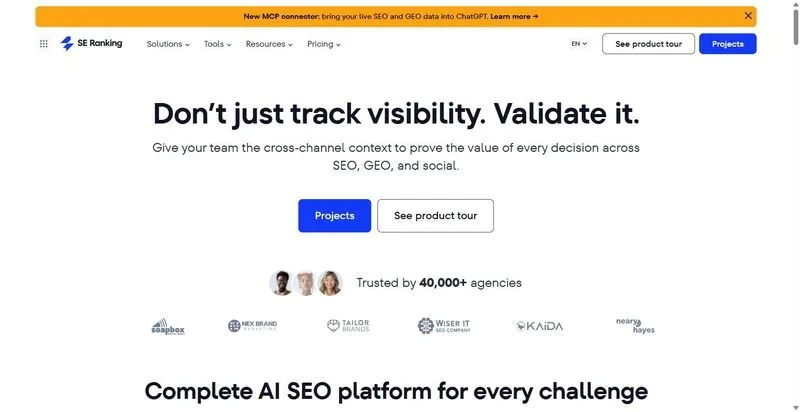
SE Ranking runs its own independent crawlers and calculates search volume in-house rather than reselling one upstream feed, so the numbers hold up when SE Ranking's position tracker runs across 100,000+ keywords. Top-100 refreshes daily on every plan, desktop and mobile track separately, any of 188 countries pins to city/region/ZIP, and it reports 35+ SERP features. The AI Results Tracker covers AI Overviews, AI Mode, ChatGPT, Gemini, and Perplexity as distinct surfaces, and one API key covers the Data API, Project API, and official MCP server on every plan, with native connectors for n8n, Make, Zapier, Looker Studio, GA4, GSC, and Matomo.
Why it works for technical teams: You pull ranking and SERP-feature data straight into an existing pipeline through one API key and the MCP server: no separate API contract, no middleware. The connectors land the data where your dashboards already read.
Pricing: Core $129/mo ($103.20/mo billed annually), Growth $279/mo ($223.20/mo annually), Enterprise custom; 14-day free trial.
Cons, stated plainly: no raw-SERP-HTML export and no native BigQuery or warehouse delivery. Access runs on the API-credit model, so teams needing to parse raw SERP HTML in-house will weigh that. AI-prompt tracking at scale needs the paid AI Search add-on. Deleting a search engine or region permanently wipes its history.
The data says: for a technical team wanting trustworthy data and pipeline access without a separate API contract, this is the default. Reach for a warehouse-native tool only when raw SERP HTML is non-negotiable.
2. seoClarity — enterprise rank data straight into your warehouse
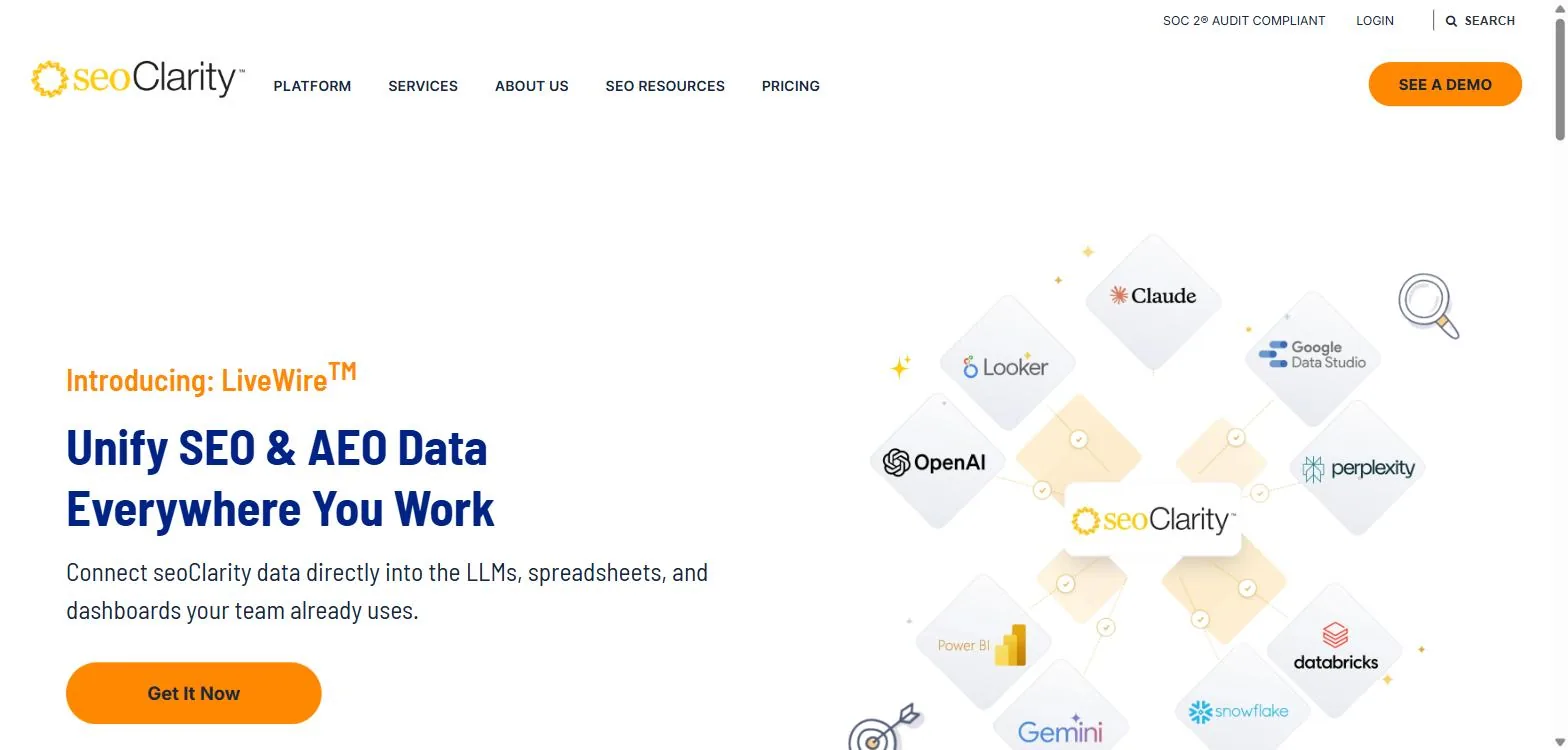
Inside seoClarity's enterprise suite, the rank-tracking module (branded Rank Intelligence) is what matters here. Checks run weekly, daily, hourly, or on-demand, against any engine and country, with local results from any geolocation and AI Overviews tracking. The technical draw is the delivery layer: a Rank Tracking API plus warehouse delivery into BigQuery, RedShift, and Amazon S3 (FTP/SFTP extracts), so position data feeds your own BI, not a vendor dashboard. Pricing is quote-only, 2,000-keyword minimum, from ~$2,500/mo; enterprise-only, no self-serve, and you sign a contract.
Why it works for technical teams: SERP data lands as tables in a warehouse you already query, so rank checks join your other datasets without an export step and run on the pipeline's alerting schedule.
Where it fits: teams already running BigQuery or RedShift who want rank data as another table, not another login.
3. AccuRanker — fastest refresh, raw SERP HTML on Enterprise
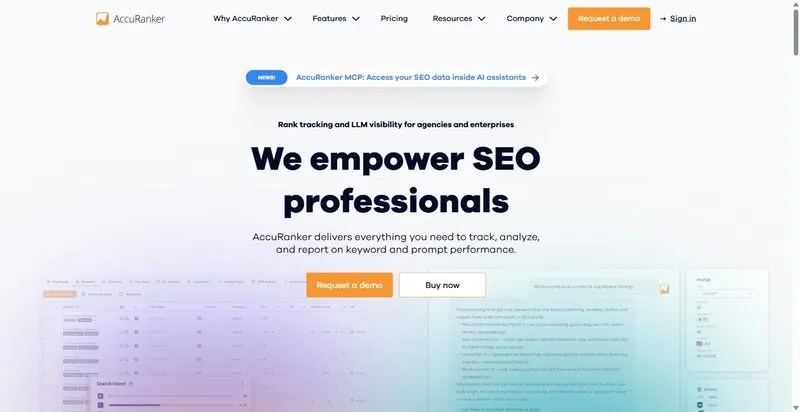
With no audit or backlink suite attached, AccuRanker lives or dies on refresh cadence, and its ~2-hour full-domain refresh plus on-demand per-keyword re-checks is the tightest in this group. The technical draw sits on one tier: Enterprise adds raw SERP HTML for parse-your-own accuracy and BigQuery delivery. Professional runs $224/mo for 2,000 keywords; Enterprise is quote-only above 25,000. It tracks Google AI Overview presence, but broader LLM tracking is the separate AccuLLM product.
Why it works for technical teams: Raw SERP HTML lets you run your own parser against Google's markup instead of trusting vendor extraction, and the ~2-hour cadence keeps a 100k-keyword footprint close to real time.
In practice: budget for Enterprise from the start. The raw-HTML and BigQuery hooks that justify AccuRanker never appear on Professional.
4. Advanced Web Ranking (AWR) — GPS-level SERP data with raw HTML
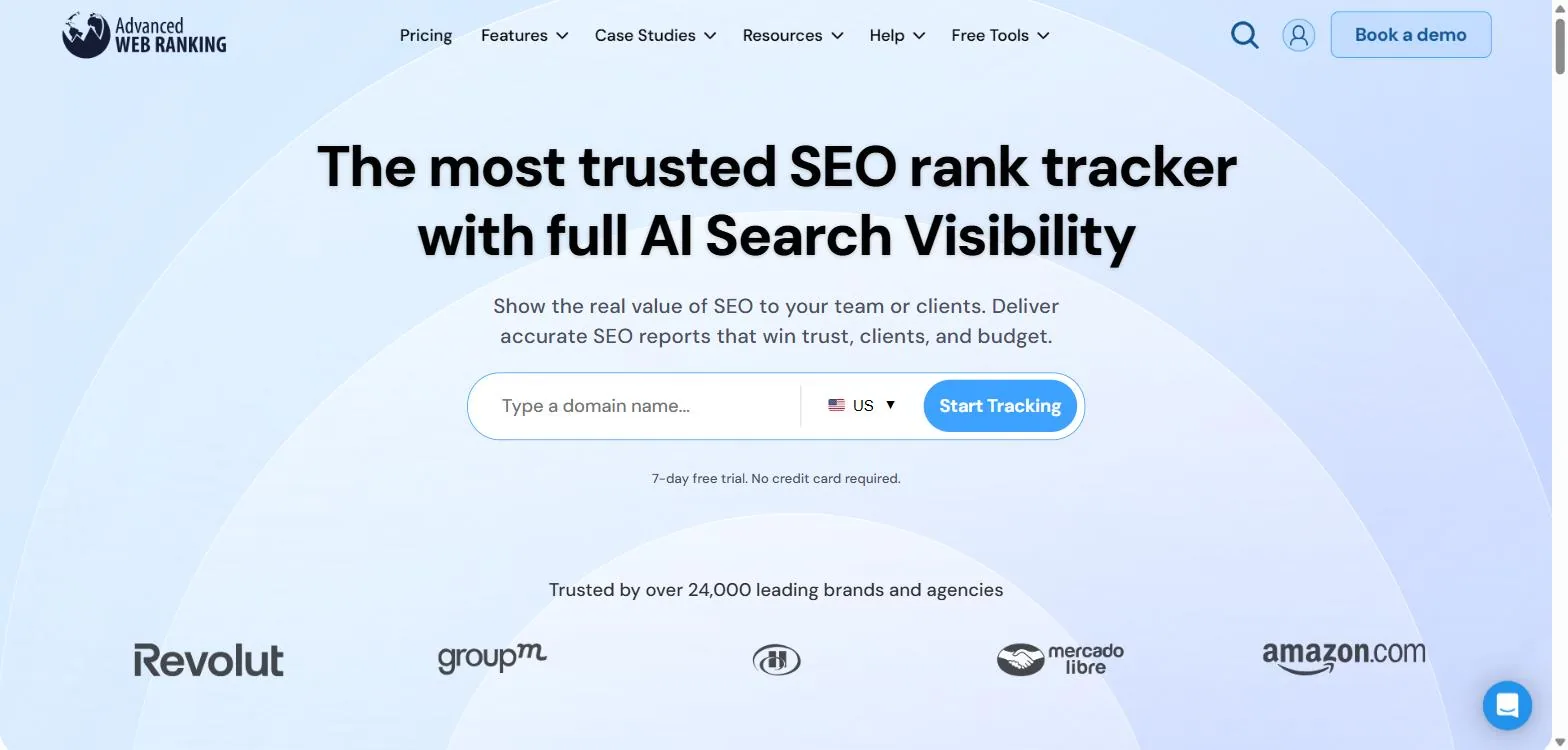
AWR has tracked SERPs for two decades, and granularity is why it belongs here: geo targeting goes down to a GPS coordinate, and every result carries pixel position and above-the-fold state. It exposes raw SERP HTML source, and AI tracking is native across AI Mode, AI Overviews, ChatGPT, Perplexity, Gemini, and Claude. Pro is $139/mo for 7,000 keyword "units"; the API and white-label sit on Agency ($279/mo) and above. The catch is the unit model: 1 unit = 1 keyword × weekly × one engine × one device, so daily is 7× the units and every extra device, engine, or location multiplies again.
Why it works for technical teams: GPS-coordinate targeting plus raw SERP HTML pins position data to an exact point and hands you the markup to verify it, which is what multi-region accuracy audits depend on.
Net-net: model your unit consumption first; daily multi-region tracking scales the count fast.
5. Nightwatch — widest geo granularity, AI tracking on every plan
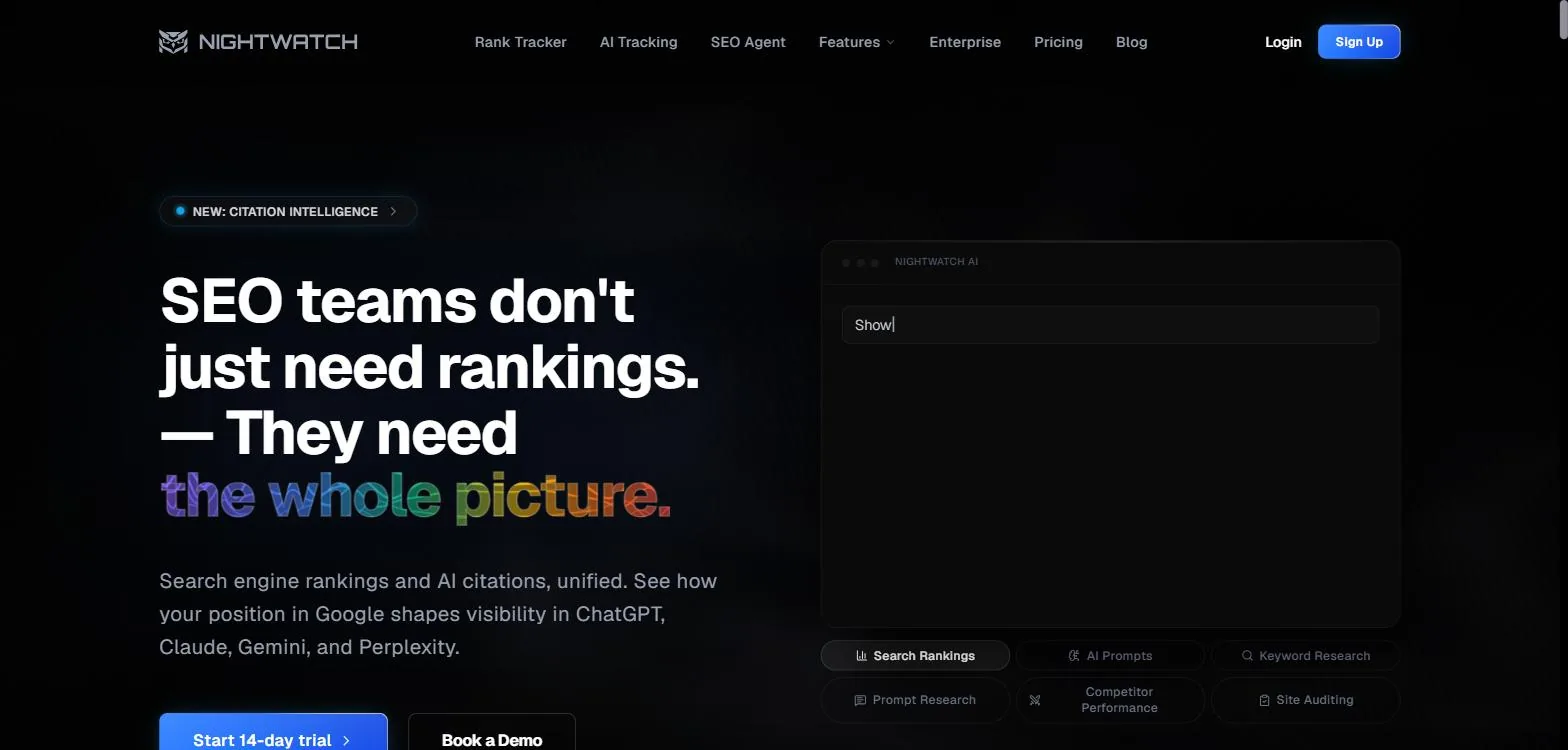
Nightwatch organizes itself around AI visibility rather than bolting it on. Geo granularity is the widest here, 107,000+ locations across 190+ countries in any language, and AI Mode plus AI-platform citation tracking (ChatGPT, Claude, Gemini, Perplexity) ship on every plan via Citation Intelligence, with unlimited seats. API and Looker Studio start at Professional (€159/mo). Bottleneck: no raw SERP HTML or native BigQuery connector, and enterprise volume (20,000+ keywords) is quote-only.
Why it works for technical teams: Widest geo precision in the group, plus per-plan AI Mode and LLM citation tracking that reaches your BI through the API and Looker Studio from €159/mo, with no separate AI SKU to license.
The test: can you work without raw HTML and BigQuery? If yes, the geo coverage is hard to match.
6. Semrush — Position Tracking for teams already on the platform
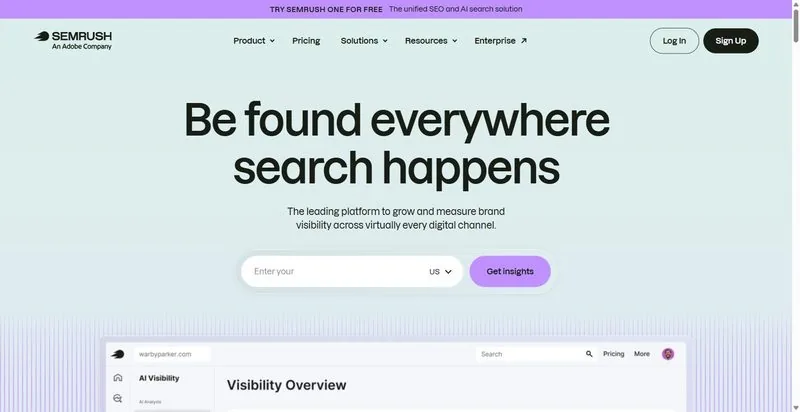
Position Tracking sits inside Semrush's wider toolkit, so its value tracks whether the platform is already your research backbone. It reaches postal/ZIP level across desktop, mobile, and tablet, identifies AI Overviews (filter keywords where your domain is an AIO source), and tracks Google AI Mode and ChatGPT Search, though those prompts require the AI Visibility Toolkit or Semrush One. The SEO plan runs $139.95/mo ($117.33 annually): 500 keywords, 5 sites. Failure mode at scale: no raw SERP HTML or BigQuery in the standard product, API and volume in separate products, ~5,000-keyword self-serve ceiling.
Why it works for technical teams: It fits teams already standardized on Semrush for keyword and competitive research. Position Tracking layers ZIP-level, multi-device rank data and AIO source detection onto a dataset they already query daily.
My read: correctly placed at #6: capable inside its own UI, thin once you need warehouse delivery or six-figure keyword scale.
7. Serpstat — mixed research + tracking, lighter on pipeline
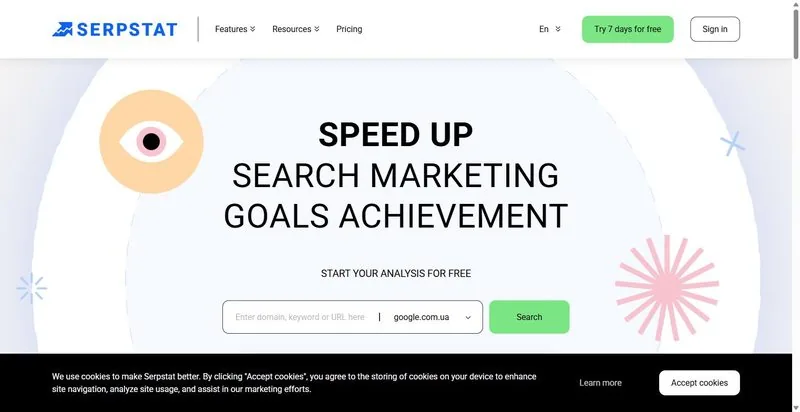
Rank tracking is one module inside Serpstat's research suite (keyword research, backlinks, site audit), so it mixes research and tracking rather than specializing. It covers top-100 across 230 regions by country, state, or city, with explicit Google AI Overview tracking. Plans span $50/mo (Individual), $100/mo (Team), and $410/mo (Agency). The constraint at scale is the accounting unit: rank data is capped by monthly position checks (500,000 on Agency), not true keyword scale, so a 100k-keyword daily run drains the allowance fast. API and bulk datasets are a separate quote-only Enterprise arrangement; no raw SERP HTML or warehouse delivery documented.
Why it works for technical teams: City-level geo and AIO tracking sit in one research-plus-rank interface, but the position-check cap and the missing warehouse feed make it the lightest fit for feeding a large data pipeline.
Bottom line: workable as a mixed research-and-tracking tool; the weakest option here for feeding a real data pipeline.
Matching a Tracker to Your Technical Setup
The best SERP tracking tools all cover the fundamentals; match the constraint that binds your setup (data destination, scale, geo precision, AI surface), not the longest feature list.
- Land raw SERP data in your own warehouse (BigQuery/S3): seoClarity (raw ranking feed via its Rank Tracking API into BigQuery/RedShift/S3) or AccuRanker Enterprise (raw SERP HTML plus BigQuery). SE Ranking's API and MCP cover most pipelines without the quote-only enterprise contract those two require.
- Track 100k+ keywords across regions with data you can trust: SE Ranking, for its independent crawlers, 188 countries, and API + MCP on every plan.
- Need a local serp tracker for GPS-precise or hyper-local coverage: AWR (targeting down to GPS coordinates) or Nightwatch (107,000+ locations across 190+ countries).
- AI Mode, AI Overviews, and LLM citations as first-class surfaces: SE Ranking or Nightwatch bundle them on every plan; AWR tracks them natively.
- Already standardized on Semrush for research: keep it there, but move high-volume rank and SERP tracking to SE Ranking. Global serp tracking tools priced by keyword count hit Semrush's ~5,000-keyword ceiling fast at enterprise scale.
Frequently Asked Questions
How do enterprise SERP trackers get position data into a data warehouse?
Three delivery mechanisms. A serp tracking api (pull-based JSON) ships in SE Ranking on every plan, and in Nightwatch and AWR from their mid-tiers. Raw SERP HTML for self-parsing comes from AccuRanker Enterprise and AWR. Direct warehouse feeds (BigQuery, Redshift, S3) come from seoClarity's Rank Tracking API and AccuRanker Enterprise.
Should you track AI Mode separately from AI Overviews?
Yes. They are distinct surfaces: AI Overviews is an answer block above organic results, while AI Mode is an end-to-end conversational surface that passed 100 million monthly active users in the U.S. and India (Alphabet, Q2 2025). SE Ranking, Nightwatch, AWR, and Semrush report each as its own dimension.
Why does position data diverge between trackers on a large multi-region site?
Four variables diverge: crawl location, device profile, personalization signals, and check timestamp. A result pulled from a Frankfurt IP on mobile at 08:00 differs from a US desktop check at 14:00. Independent crawlers with pinned location and device settings reduce this drift across large keyword sets.
What check frequency do large sites need?
Daily is the baseline for most enterprise keyword sets. Reserve hourly checks for volatile or high-value terms: launches, price-sensitive queries, contested SERP features. Cadence drives cost, since unit-based trackers multiply consumption by frequency, device, location, and engine, so hourly tracking of a full 100k set is rarely justified.
Can you track SERPs at the language and country level across regions?
Yes. Enterprise trackers target by country, region, city, and language per engine: SE Ranking covers 188 countries, Nightwatch 107,000+ locations. Every locale carries its own AI surface to monitor, since AI Overviews and AI Mode now span 200+ countries and territories and 40+ languages (Google, 2025).