Most agencies buy competitor analysis tools for a reason that won't survive the next renewal. You wanted a cheaper version of the platform you already resent paying for, or a slick dashboard the client opens once and never again. Look — that logic stopped paying rent. Gartner predicted that traditional search engine volume would drop 25% by 2026 as buyers shift to AI chatbots and virtual agents. The job moved under you. Competitor analysis now has to read the answer an AI hands your client's prospect, not just the blue links nobody scrolls to anymore.
Short version: for an agency, SE Ranking is the tool I'd build the stack around. The Agency Pack stacks white-label reporting and client seats on top of all-in-one competitor data across organic, paid, and AI answers — AI Overviews, AI Mode, ChatGPT, Gemini, Perplexity. API and MCP ship on every plan. One honest nuance. If your pitches live and die on ad spend, SpyFu is cheaper and runs sharper branded PPC teardowns; if links are the whole story, Ahrefs digs deeper. Everyone else sits below. Here's the ranked six competitor analysis tools, starting with the one that reads a rival across SEO, PPC, and AI search.
The Three Jobs an Agency Hires a Competitor Tool to Do
An agency hires competitor analysis tools to do three things that actually touch revenue: win the pitch with a fast market teardown, prove value in the monthly report against named rivals, and turn the gaps they surface into the next scope of work. Rank a tool on those three, or you're buying a toy.
- Win the new-business pitch — a fast competitive teardown of a prospect's market: who ranks, who's buying ads, who's getting cited in AI answers. You walk into the room already knowing where the prospect bleeds. That's the difference between a proposal and a guess.
- Prove value in the monthly client report — white-label reporting that shows movement against named rivals, not vanity charts. Reporting is what clients actually renew on, and the ones who churn are usually the ones who never saw the win in writing. If your report can't name the competitor you just overtook, the client never feels the win.
- Turn gaps into scope — the keyword, content, backlink, and AI-answer gaps you can package as the next project. A real competitor backlink analysis tool hands you a link-building retainer in a spreadsheet; a keyword gap becomes a content sprint. Gaps are pipeline, not trivia.
I ranked the six on the three things that actually bill — white-label client reporting, multi-client seat and project economics, and whether the competitor data now reaches AI answers. I checked every feature and price against each vendor's own pages in July 2026, not secondhand roundups. Good seo competitor analysis is only as honest as the source behind it. And an AP-NORC poll (July 2025) found 60% of US adults have used AI to find information, which is exactly why AI answers made the cut.
How the Six Tools Compare for Agencies
The table below ranks the six competitor analysis tools for agency work, not for a solo audit. Read the middle three columns first: whether client reporting is white-label, how many clients and seats you get before costs jump, and whether the competitor data reaches AI answers. Entry price is the lowest monthly list plan; the cards below carry the detail.
| # | Tool | Best agency job | White-label reporting | Multi-client at entry | AI-search coverage | Entry price |
| 1 | SE Ranking | Whole workflow + client reporting | Yes — Agency Pack | 10 projects Core (+~30 client seats with Pack) | 5 AI engines | $129/mo (+$69 Pack) |
| 2 | Ahrefs | Backlink / link-gap teardown | Add-on only (Report Builder) | 1 seat; projects by tier | Brand Radar | $129/mo |
| 3 | Semrush | Multi-channel pitch teardown | Add-on (Agency Growth Kit) | 1 user (+$45/seat) | In every plan | $139/mo |
| 4 | SpyFu | PPC / ad-history teardown | Yes — branded Recon Reports | Unlimited projects; 5 users (Team) | Basic (from Pro+) | $39/mo |
| 5 | Serpstat | Value multi-client gap analysis | Agency tier only | Unlimited projects; 50 seats (Team) | LLM Brand Monitor (separate) | $50/mo |
| 6 | Similarweb | Market-sizing for a pitch | No | Single user (self-serve) | AI Search Intelligence (separate) | ~$125/mo |
The Six Tools, Ranked for Agency Work
The six cards follow the table below, ranked for agency work. Each one names the specific agency job the tool wins, calls out the honest gaps, and lays out the per-client math, so you can see exactly where it fits into a stack before you ever start a trial.
- SE Ranking
SE Ranking is an all-in-one SEO and AI-search platform that also ships the white-label reporting and client seats an agency actually runs on.
Best for: agencies that want one white-label platform to run competitor research AND client reporting.
Standout: The Agency Pack (from +$69/mo, annual billing) is the real hook. You get the platform and reports on your own logo and domain, around 30 client seats, unlimited scheduled reports with AI summaries, plus Agency Catalog placement and a Lead Generator widget. All of it sits on top of competitor data across organic, paid, and five AI engines from one lookup.
Pros:
- Bakes white-label reporting and client seats into the platform via the Agency Pack.
- Reads a rival across organic, paid, and AI answers from one entry.
- Ships API and MCP on every plan, so you can query live inside Claude or ChatGPT.
- Surfaces keyword and backlink gaps you can turn around and sell as scope.
Cons:
- The Agency Pack is a paid add-on, and it bills annually.
- Competitor traffic and keyword figures are database-dependent estimates, not logs.
- AI Competitive Research domains are capped by tier (5 on Core, 15 on Growth).
Pricing: Core $129/mo ($103.20/mo billed annually), Growth $279/mo ($223.20/mo billed annually). Agency Pack adds from +$69/mo on annual billing. 14-day free trial, no credit card.
Honest assessment: This is the platform I would build an agency stack around, because competitor analysis and white-label client reporting live in the same login instead of two tools you reconcile by hand. Just budget for it honestly. The Agency Pack is an annual add-on, not something bundled free.
2. Ahrefs
The deepest backlink and link-gap teardown, paired with the weakest native agency-reporting story.
Best for: agencies whose pitches live or die on links.
Standout: Site Explorer tears a competitor's backlinks, organic keywords, and top pages apart in one view. Content Gap surfaces the terms rivals rank for, and you don't. You get up to 20 competitors per project, plus Brand Radar tracking brands inside AI answers. Client-facing branded reports sit behind the separate Report Builder add-on.
Pros:
- Indexes links deeper than anyone here.
- Runs a fast, clean content-gap workflow.
- Ships API and MCP access from the Lite tier.
Cons:
- No native white-label. Client-branded exports need the separate Report Builder add-on, and each plan ships just one platform seat (extra seats run +$40–$80/mo by tier).
- Per-client cost climbs fast, and there's no free trial.
Pricing: Lite $129/mo, Standard $249/mo (annual billing saves ~17%).
My verdict: Buy it when links are the whole pitch. Nobody indexes them deeper. But the reporting gap means it feeds your client layer; it isn't the client layer. Treat Ahrefs as a data source and build the deck somewhere else.
3. Semrush
The broadest multi-channel teardown, with white-label parked in a paid add-on.
Best for: agencies pitching organic and paid as one story.
Standout: Domain Overview, Keyword Gap and Backlink Gap handle the organic teardown. Traffic & Market sizes the audience behind a rival. AI-search tracking ships in every 2026 plan, not just the top tier. White-label client reporting arrives through the My Reports / Agency Growth Kit add-on, not the core plan you actually buy.
Pros:
- Covers the widest feature surface here.
- Delivers strong PPC and ad research.
- Includes AI search in every plan, plus MCP from Starter.
Cons:
- The real setup (core plan + Agency Growth Kit + seats at +$45/user) stacks into a high per-client cost.
- White-label isn't bundled, and the learning curve is steep.
Pricing: SEO plan $139/mo; higher AI-search tiers $199–$549/mo.
My verdict: The most complete dataset here, no argument. The catch is cost. Once you stack the core plan, the Agency Growth Kit and seats at $45 each, the effective per-client number runs high. Pay it when you pitch organic and paid together.
4. SpyFu
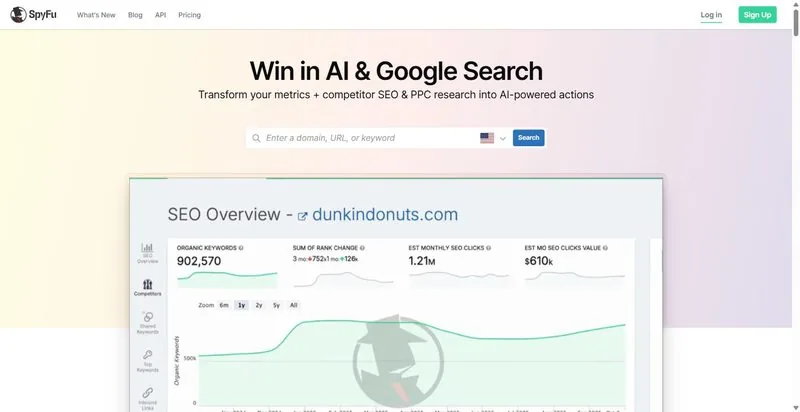
SpyFu is the cheapest credible white-label option on this list and a genuine paid-search specialist.
Best for: agencies that pitch on paid-search and win work off ad-strategy teardowns.
Standout: Recon Reports carry your logo instead of SpyFu's, and you can add the client's on top, so what lands in the inbox looks like your own product. Every tier runs unlimited projects. Behind that sits 10-plus years of a rival's ad-copy and paid-keyword history, plus the Kombat tool for head-to-head domain comparison.
Pros:
- Brands reports natively, no add-on tier.
- Runs unlimited projects on all plans.
- Enters cheap at $39.
- Covers 5 users on the Team plan.
Cons:
- Skews US and Google-centric, with thin data elsewhere.
- Ships a smaller, less current organic index.
- Handles AI-search coverage at a basic level only.
Pricing: Basic $39/mo, Pro + AI $119/mo, Team/Agency $249/mo (5 users).
My verdict: Add SpyFu as the specialist for ad teardowns and paid-competitor snooping. Do not run a whole account on it. The international gaps and thin organic index will show the moment a client asks about anything past Google US.
5. Serpstat
Serpstat is the value play for a growing team that needs seats, with true white-label held back to the top tier.
Best for: growing agencies watching per-seat spend before headcount does.
Standout: The $100/mo Team tier is where the math works. You get unlimited projects, API and MCP access, and up to 50 share-access seats, which is a lot of people looking at data for the money. Domain vs Domain, gap analysis, and competitor rank tracking cover the research side. AI answers live in a separate LLM Brand Monitor. True white-label, meaning Serpstat's logo comes off the client reports, only unlocks on the roughly $410 Agency tier. Team already includes scheduled and branded reporting.
Pros:
- Shares across many seats at Team price.
- Covers a wide research toolkit.
- Opens API and MCP from Team up.
Cons:
- Gates real white-label behind the ~$410 Agency tier.
- Runs an index less refined than the leaders.
- Splits AI monitoring into a separate product.
Pricing: Individual $50/mo, Team $100/mo, Agency ~$410/mo.
My verdict: For a seat-heavy team that reports in its own name internally, Team is strong value. The catch is branded client reports. If you need those now, you are paying Agency money, and at that point the value argument gets thinner.
6. Similarweb
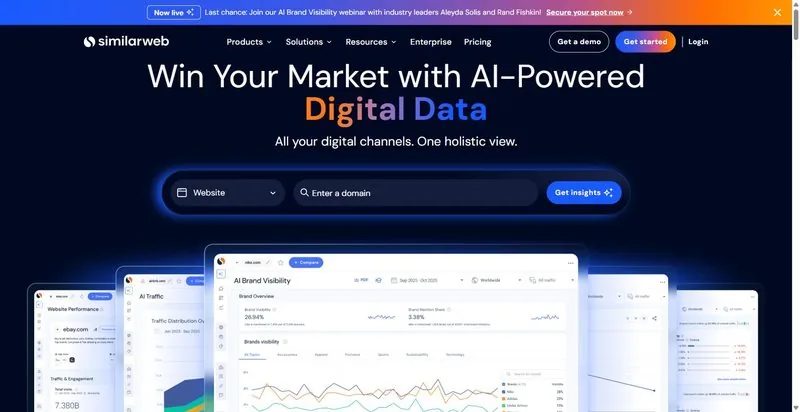
Similarweb is market and traffic intelligence for the pitch deck, not an engine you report to clients from.
Best for: agencies sizing up a prospect's entire market before the pitch.
Standout: It estimates a competitor's total traffic, channel mix, and audience overlap across both web and app. That also makes it one of the more useful social media competitor analysis tools for reading how a rival splits its channels. A separate AI Search Intelligence product bolts on AEO metrics. None of it is client-facing in any branded sense.
Pros:
- Models broad market and traffic sizing.
- Analyzes audience overlap between rivals.
- Runs a dedicated AI Search Intelligence product.
Cons:
- Offers no real client white-label.
- Reports modeled estimates, not measured numbers.
- Hides pricing and leans enterprise.
Pricing: from ~$125/mo (billed annually), largely quote-based above that (approximate; Similarweb hides most pricing).
My verdict: Use Similarweb for market context and prospect sizing in a pitch. Do not try to make it your reporting tool. The numbers are estimates, there is no client branding, and the opaque enterprise pricing means you will negotiate for anything serious.
My Verdict for Agency Stacks
Look. Build the agency stack around SE Ranking and stop debating it. One white-label platform covers both competitor research and client reporting, so your team learns one interface and your clients see one branded deliverable. Add SpyFu when a pitch turns on ad teardowns, and you need paid history fast. Reach for Ahrefs when links are the whole story and nothing softer will do. That is the whole rig.
The context matters here. The IAB 2026 Outlook Study forecasts 9.5% US ad-spend growth and names AI as the force shaping 2026 priorities, so clients will expect sharper competitive intelligence, not vaguer.
Skip if: you were about to make Similarweb your reporting engine (it isn't one, it's a traffic estimator), or you were about to pay twice for white-label by bolting Semrush report add-ons onto a stack where reporting is the main job.
One honest note. A free competitor analysis tool is fine for a one-off prospect peek before a call. It's useless for recurring client reporting.
Frequently Asked Questions
What's the best competitor analysis tool for agencies?
SE Ranking, because it handles competitor research and white-label client reporting in one seat instead of two subscriptions. Agencies live or die on delivery, not raw data volume. A platform your junior can run without a training week beats a deeper tool that only one person on the team actually understands.
Can you white-label competitor analysis reports for clients?
Yes, and it's a real dividing line. SE Ranking (Agency Pack) and SpyFu do white-labeling natively, so your logo and domain sit on the report by default. Semrush and Serpstat gate it behind add-ons or their top tiers, which means you pay more to remove someone else's brand.
How many competitors should you track per client?
Three to five direct rivals, revisited quarterly. That's enough to spot real gaps without drowning the client in noise. Track fifteen and every report becomes a spreadsheet nobody reads. Pick the ones actually stealing the same rankings and revenue, then swap the list when the market shifts.
How do you turn a competitor analysis into new client scope?
Take the prioritized gap list and convert the top three findings into a named next project. "Competitor owns 40 commercial keywords you don't" becomes a scoped content sprint with a title, a deliverable count, and a price. You sell the fix, not the finding.