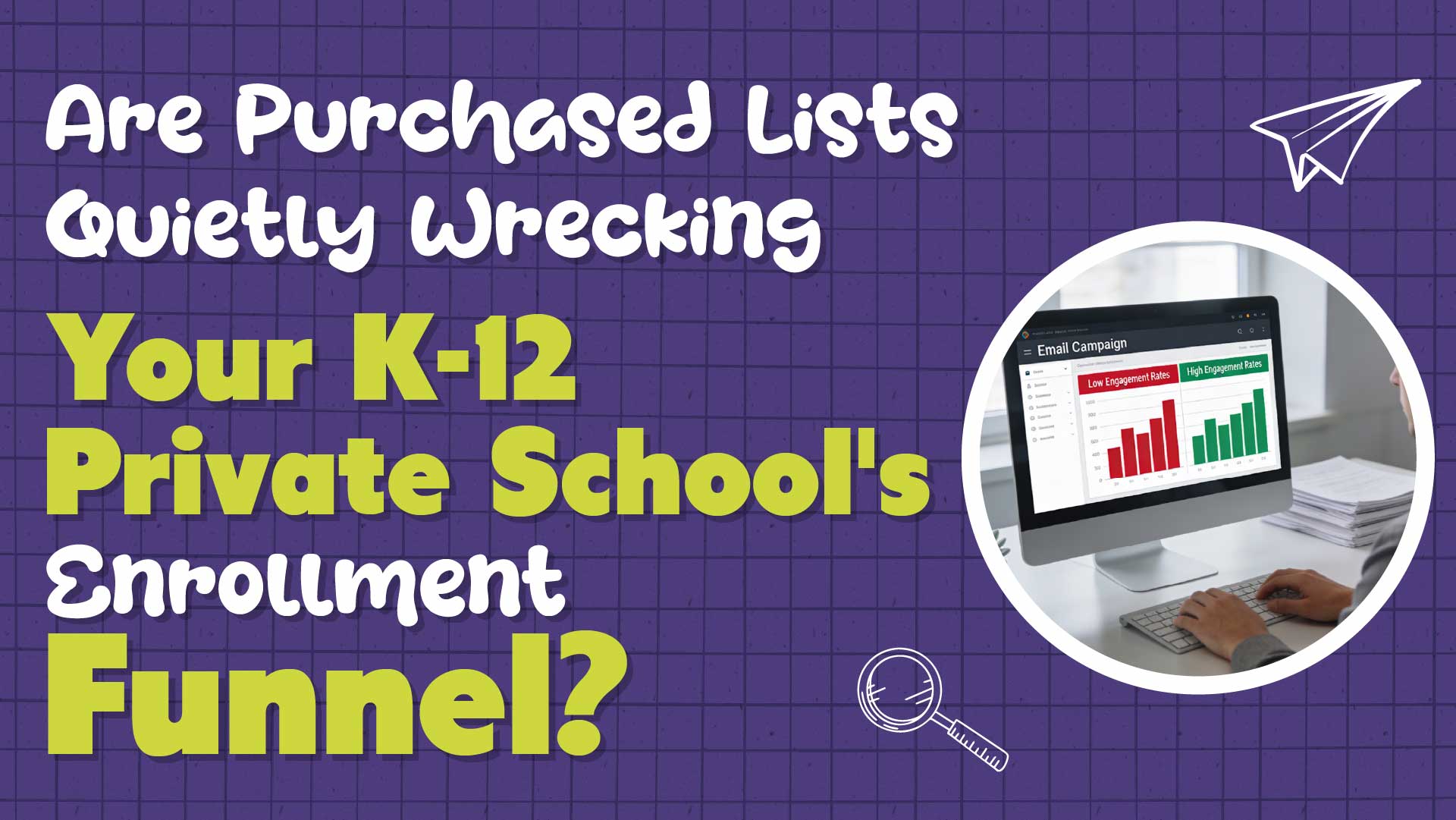
There is a particular kind of disaster that admissions directors never see coming until the symptoms show up in the wrong place. The marketing email campaign is performing badly. Unsubscribes are climbing. Then a parent calls because she did not get the re-enrollment reminder. Then another. Then the head of school mentions she missed the snow-day alert. Then the IT director pulls the deliverability report, and the picture sharpens fast: someone bought a list, the domain reputation tanked, and now every email the school sends is clawing its way out of spam folders.
That is what a purchased mailing list does to a school. It does not just fail to enroll students; it quietly burns the email infrastructure that every other school function runs on. For private and independent schools where digital outreach is the entire enrollment pipeline, the damage is the difference between an inconvenience and an emergency. First-party data school marketing is what works now, and for a virtual academy with national reach, it is the only model that survives the next 18 months of tightening privacy law, stricter deliverability rules, and shrinking demographics.
This piece is for school administrators, marketing directors, and admissions teams who have either been pitched a purchased list, are still using one, or are quietly wondering whether the agency they hired is using one on their behalf. The argument is simple. Buying lists is no longer a shortcut. It is a slow-motion liability, made worse by a demographic squeeze and a privacy regime that has tightened materially in the last 18 months. The first-party alternative is more work up front and dramatically more durable. By 2026, it will also be the only approach that actually produces enrolled students.

Written By: Adam Bennett | June 15, 2026
Adam is the president and founder of Cube Creative Design and specializes in private school marketing. Since starting the business in 2005, he has created individual relationships with clients in Western North Carolina and across the United States. He places great value on the needs, expectations, and goals of the client.
Your school's website gets traffic every single day. Families browse your academic programs, check tuition rates, scroll through photo galleries, and read about your mission. Then they leave. No form filled out. No inquiry submitted. No name, no email, no phone number. Just another anonymous session in your Google Analytics dashboard.
Here is the uncomfortable truth that most private school leaders don't want to hear: somewhere between 96% and 98% of website visitors never fill out a form. That is not a typo. For every 100 families who visit your site this month, you might hear from two or three of them. The other 97 vanish without a trace.
Family visitor identification changes that equation entirely.
Written By: Adam Bennett | June 12, 2026
Adam is the president and founder of Cube Creative Design and specializes in private school marketing. Since starting the business in 2005, he has created individual relationships with clients in Western North Carolina and across the United States. He places great value on the needs, expectations, and goals of the client.
Most schools have a vendor relationship. Almost none have a school marketing partnership. The difference shows up in your enrollment numbers, and it shows up every spring when the board asks where the inquiries went.
The gap is structural, not philosophical. Insights from Noetic Marketer demonstrate that 37% of independent schools have no full-time marketing staff at all. Of the schools that do have someone in a seat, NAIS research indicates that 30% rely on a single person to handle everything from social media to PPC to the email newsletter. That is not a staffing decision; it is a structural mismatch between what modern enrollment marketing requires and what any single person can deliver inside a 40-hour work week.
This piece is for administrators at private and independent schools who have already tried the piecemeal approach: an SEO vendor here, a freelance social manager there, a part-time admissions coordinator who also runs the website. The goal is to define what a full-service school marketing partnership actually delivers, how it maps to the funnel, what it costs, and how to evaluate whether it makes more sense than building the same capability in-house. By the end, you should be able to tell the difference between an agency that runs ads and an agency that runs your enrollment engine.
Spoiler: those are very different agencies.
Written By: Adam Bennett | June 11, 2026
Adam is the president and founder of Cube Creative Design and specializes in private school marketing. Since starting the business in 2005, he has created individual relationships with clients in Western North Carolina and across the United States. He places great value on the needs, expectations, and goals of the client.
Interviewing a marketing agency isn't hiring a partner. It's auditing a vendor. And most school administrators are doing it wrong.
They ask comfortable questions about "process" and "creative approach," nod politely at the case study slide deck, then get blindsided eighteen months later when a quarter of next year's tuition revenue has been spent on impressions, clicks, and a rebranded viewbook. The agency moves on. The school gets to spend another spring backfilling the enrollment seats nobody filled.
This is what happens when private schools walk into agency meetings without an audit framework. The questions that actually separate K-12 specialists from generalists wearing a school's costume for the day never come up.
The stakes have changed. WICHE projects that the national pool of high school graduates peaked in 2025, with roughly a 13% decline projected to follow through the 2040s. At the same time, EdChoice reports that school choice enrollment surpassed one million students in 2024, doubling in five years. The competition for the families you want is the most intense it has ever been.
In that environment, a bad agency isn't just wasted spend. It's a hole in the bottom of the boat.
This post is the audit framework: the specific school marketing agency questions to ask, the benchmark answers a qualified agency should give, and the walk-away red flags. Print it. Bring it to the next sales call. Watch how quickly the room separates into people who know K-12 and people who are about to learn on your budget.
Written By: Adam Bennett | June 10, 2026
Adam is the president and founder of Cube Creative Design and specializes in private school marketing. Since starting the business in 2005, he has created individual relationships with clients in Western North Carolina and across the United States. He places great value on the needs, expectations, and goals of the client.