Gaining backlinks remains one of the top ranking factors used by Google and other search engines. According to Backlinko, they are one of the top eight ranking factors. Yet, most private schools don’t invest enough time and resources in ethical, high-value link-building strategies to maximize awareness, authority, and conversions for their websites.
Without sufficient quantity and quality of backlinks from relevant websites, sites suffer from low organic visibility and visitor traffic, ultimately diminishing student applications. But armed with the right strategic approach, your school can dramatically amplify its digital presence and reputation through targeted outreach, high-value content publication, and other white hat SEO link-building tactics covered in this guide.
After learning the core differences between followed and no-followed links, as well as actionable best practices for earning coveted backlinks ethically from highly trafficked websites like Wikipedia, your school will be armed with the blueprint needed to execute a cutting-edge link-building campaign aimed toward substantially increased organic search engine visibility and student lead generation objective success within the coming fiscal year.

Written By: Adam Bennett | March 04, 2024
Adam is the president and founder of Cube Creative Design and specializes in private school marketing. Since starting the business in 2005, he has created individual relationships with clients in Western North Carolina and across the United States. He places great value on the needs, expectations, and goals of the client.
When it comes to connecting with prospective families and building your school's reputation, a private school blog acts like a turbocharger for your website, boosting it forward and giving your online presence the extra momentum in an extremely competitive landscape. Blogging can accelerate your school's online growth by increasing visibility, adding value for families with questions, establishing your expertise, and fostering meaningful connections with your target parents. This guide covers the definition and benefits of blogging, how it can attract and convert prospective families, and tips for creating a successful school blog.
Written By: Adam Bennett | February 19, 2024
Adam is the president and founder of Cube Creative Design and specializes in private school marketing. Since starting the business in 2005, he has created individual relationships with clients in Western North Carolina and across the United States. He places great value on the needs, expectations, and goals of the client.
Navigating the digital landscape can be daunting, especially when it comes to ensuring your private school's website is both user-friendly and search engine optimized. One tool that can significantly improve your website's performance on both fronts is a sitemap.
Written By: Adam Bennett | February 14, 2024
Adam is the president and founder of Cube Creative Design and specializes in private school marketing. Since starting the business in 2005, he has created individual relationships with clients in Western North Carolina and across the United States. He places great value on the needs, expectations, and goals of the client.
Student recruitment is more challenging than ever with stiffer competition and shrinking demographics. Yet the most powerful tool to boost inquiries and fill seats often goes overlooked—email marketing.
Personalized email marketing is considered a valuable strategy for engaging with the parents of prospective students. This direct channel allows private schools to drive conversions by showcasing their strengths to prospective families. But not just any emails. Targeted, tailored messages matching the decision journey stage of prospective parents.
This presents a massive missed opportunity to deploy email marketing for what it does best.
In this guide, discover how to harness the recruiting power of email campaigns. You'll learn to optimize list segmentation, strategic timing, compelling designs, and integrated analytics that turn inquiries into enrolled students.
Now, let’s dive in and start driving the enrollment growth your private school deserves!

Written By: Chad J. Treadway | February 07, 2024
Chad is our Chief Smarketing Officer. He will help you survey your small business needs, educating you on your options before suggesting any solution. Chad is passionate about rural marketing in the United States and North Carolina. He also has several certifications through HubSpot to better assist you with your internet and inbound marketing.
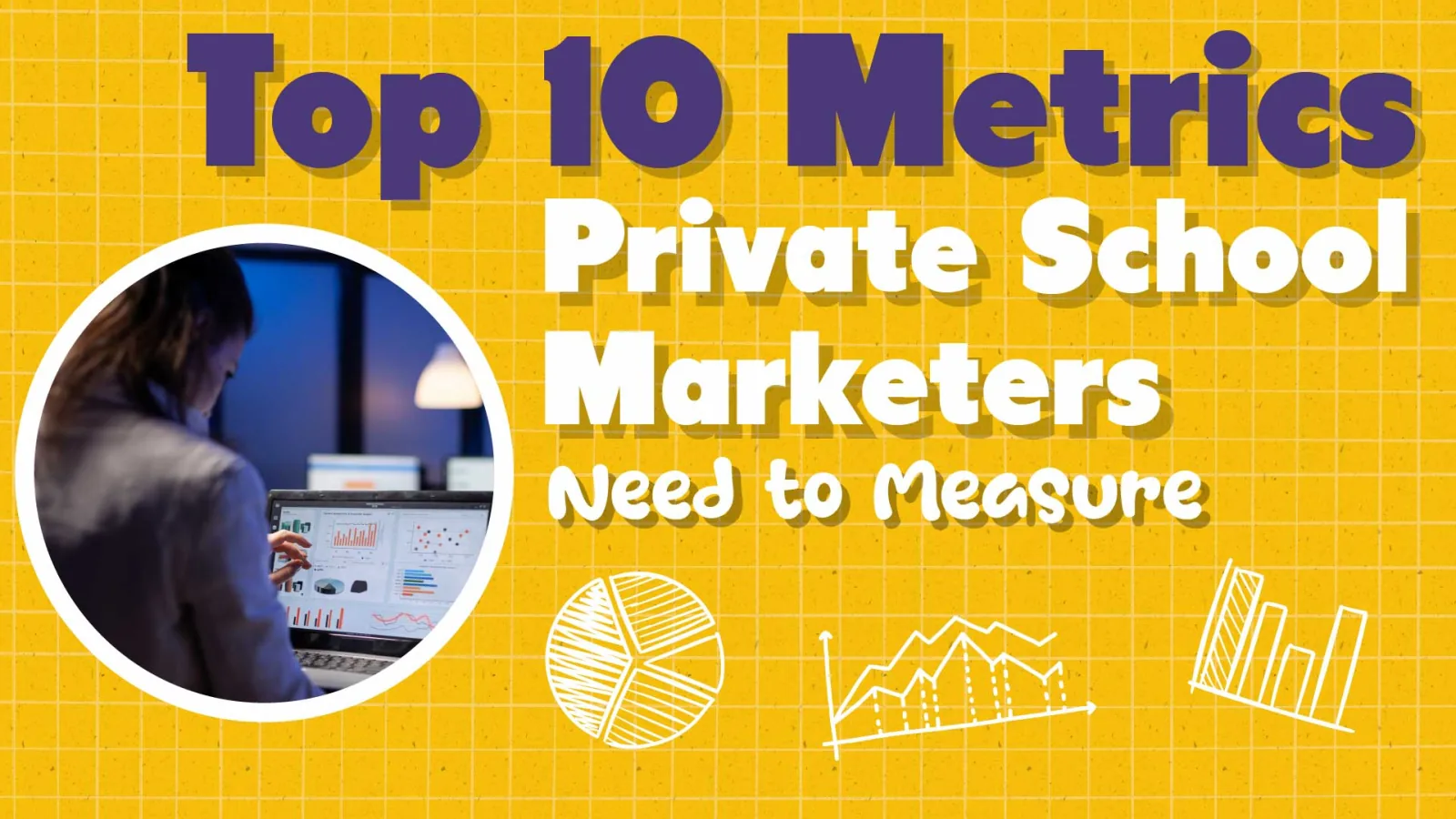
Private school administrators and principals understand the need for marketing, yet according to a report from Angela Brown at Niche.com, validating the impact of these efforts remains a challenge. Studies have shown that more than 7 out of 10 private school marketers need help quantifying the impact of their strategies. With many tools at their disposal in the digital age, there is no excuse for neglecting the tracking, analysis, and reporting of marketing data.
Tracking the right metrics gives school marketers perspective. Gaining insight into your analytic results helps you set goals and reasonable expectations. Let's take our fictional Greenfield Academy as an example. Let's suppose they currently have 2,500 users on their website per month. During goal-setting conversations, someone suggested that it should be 10,000 users per month. Unfortunately, this was unreasonable, given their location and budget. A more realistic goal would be 5,000 website users per month.
Social media analytics are similarly useful. For example, Greenfield can track the engagement metrics on their social media channels to help determine future content topics.
In today’s technology age, many digital marketing tools offer school marketers unprecedented data. This can pose a challenge for marketers, who can spend too much time on analytics that may not prove advantageous. School marketers need to be measuring the right metrics.
In the technology-driven landscape, an abundance of digital marketing tools empowers administrators. However, the challenge lies in avoiding excessive focus on non-advantageous analytics. Private school administrators must prioritize measuring metrics aligned with guiding principles:
Written By: Chad J. Treadway | January 31, 2024
Chad is our Chief Smarketing Officer. He will help you survey your small business needs, educating you on your options before suggesting any solution. Chad is passionate about rural marketing in the United States and North Carolina. He also has several certifications through HubSpot to better assist you with your internet and inbound marketing.
Social media isn't just a nice-to-have these days - it's a must-have that can make or break your enrollment goals. But simply creating accounts isn't enough. Tracking performance through data-driven metrics is crucial to demonstrate tangible returns on investment (ROI) and unlock social media's true potential for your k-12 private school.
Think about this, the average engagement in the education field hovers between 0.5-4% depending on the social media platform. This means that savvy private school admissions directors, marketers, and principals can use analytics to unlock far greater gains. Whether your current private school social media strategy lacks direction or needs a fresh injection of data intelligence, this post reveals how to transform digital efforts into enrollment momentum.

Written By: Hannah Kilpatrick | January 29, 2024
Hannah Kilpatrick Cube Creative DesignHannah Kilpatrick graduated from Western Carolina University in 2021 with a Bachelor of Science in Communication with a Minor in Marketing and a Concentration in Public Relations. She has been around social media since its creation. (Meaning, she was in the first grade when Facebook became available to the general public.) As our very own professional Gen-Z, Hannah is a whiz when it comes to social media creation and paid advertising.
In today's competitive educational landscape, private schools like yours must utilize effective marketing strategies to attract prospective families and increase enrollments. This task involves more than just advertising your school; it requires a multi-faceted approach highlighting your unique offerings, communicating your brand identity, and leveraging data for continual improvement.
This guide will delve into some key private school marketing strategies, including developing branded assets, promoting signature offerings, and tracking metrics for continual optimization. Whether you're a private school decision-maker, a marketer, or a parent researching educational options for your child’s school, this post will provide valuable insights into the world of private school marketing. Let's explore these strategies in more detail.
Written By: Adam Bennett | January 29, 2024
Adam is the president and founder of Cube Creative Design and specializes in private school marketing. Since starting the business in 2005, he has created individual relationships with clients in Western North Carolina and across the United States. He places great value on the needs, expectations, and goals of the client.
Communication is the lifeblood of any school community. For private schools, clear and effective communication is vital for building strong relationships with students, parents, faculty, alumni, and other stakeholders. An influx of information confronts today’s private schools — from social platforms to text alerts to old-fashioned flyers. So, how can schools cut through the noise to share their vision, values, and critical updates compellingly?
Enter email newsletters — an often overlooked yet highly potent communication tool in a private school’s arsenal. Email newsletters are more than a simple bulletin; they represent a customizable platform to inform, engage, and connect your community regularly.
This comprehensive guide shares creative strategies, formatting tips, metrics to track, and real-world examples of email newsletters successfully employed by top private schools. You’ll uncover common pitfalls to avoid and key ingredients that make these publications shine. So, let’s explore how email newsletters can become an invaluable communication vehicle to bind your community closer together!
Written By: Chad J. Treadway | January 24, 2024
Chad is our Chief Smarketing Officer. He will help you survey your small business needs, educating you on your options before suggesting any solution. Chad is passionate about rural marketing in the United States and North Carolina. He also has several certifications through HubSpot to better assist you with your internet and inbound marketing.
As a private school administrator or marketer, you know that online visibility is critical for student recruitment and retaining families. An experienced SEO agency can optimize your school's website and improve search engine rankings. Before hiring an agency, keep these five things in mind:
Written By: Adam Bennett | January 22, 2024
Adam is the president and founder of Cube Creative Design and specializes in private school marketing. Since starting the business in 2005, he has created individual relationships with clients in Western North Carolina and across the United States. He places great value on the needs, expectations, and goals of the client.
As a private school admissions officer, your primary responsibility is to get more potential families to enroll their children in your institution. While there are many ways to attract new students, leveraging email marketing is one of the most effective methods in today's digital age.
Email sales cadence is the art of crafting a set of automated emails that are sent to your prospective families, designed to be compelling and informative in order to nurture them through the sales funnel. In this blog post, we will discuss how a private school can effectively use an email sales cadence to walk a potential family through the sales funnel.
Written By: Adam Bennett | January 10, 2024
Adam is the president and founder of Cube Creative Design and specializes in private school marketing. Since starting the business in 2005, he has created individual relationships with clients in Western North Carolina and across the United States. He places great value on the needs, expectations, and goals of the client.
If your private school struggles with lagging enrollment, it’s time to get serious about marketing. With competition stiff, you need a strategic plan to stand out and attract families to choose your school.
This guide will walk you through everything you need to know, from defining your brand to measuring results. Follow these steps, and you’ll be on your way to boosting inquiries and enrollment at your school.
Written By: Chad J. Treadway | January 10, 2024
Chad is our Chief Smarketing Officer. He will help you survey your small business needs, educating you on your options before suggesting any solution. Chad is passionate about rural marketing in the United States and North Carolina. He also has several certifications through HubSpot to better assist you with your internet and inbound marketing.
Imagine an incoming class with rows of empty desks come fall, making for a looming and disheartening budget shortfall or the growing prospect of pivoting operations altogether.
For many storied private K-12 institutions, declining enrollments pose an existential threat. As birth rates taper off, public magnets siphon top talent, and families prioritize affordability, attracting and retaining students grows more cutthroat every admission cycle, no matter the school's heritage, awards, or Ivy League matriculation rates.
Yet a small but growing cadre of school administrators are halting the downward spiral through savvy digital marketing transformations. Rather than resigning their school's fate to changing demographics, these leaders actively court contemporary parents by revamping messaging, showcasing community, and eliminating friction across the prospect journey.
The results? Double-digit growth in applicant volume and enrolled students for five straight years and counting.
This will explore ten powerful strategies using real-world examples and data to showcase tangible impact. With declining enrollment plaguing many institutions, evolving your marketing approach is critical.
So whether you oversee admissions or marketing, consider these examples a blueprint for reversing the tide at your institution. With some concerted effort, defying downbeat projections remains within reach. Let’s get started.
Written By: Adam Bennett | January 08, 2024
Adam is the president and founder of Cube Creative Design and specializes in private school marketing. Since starting the business in 2005, he has created individual relationships with clients in Western North Carolina and across the United States. He places great value on the needs, expectations, and goals of the client.