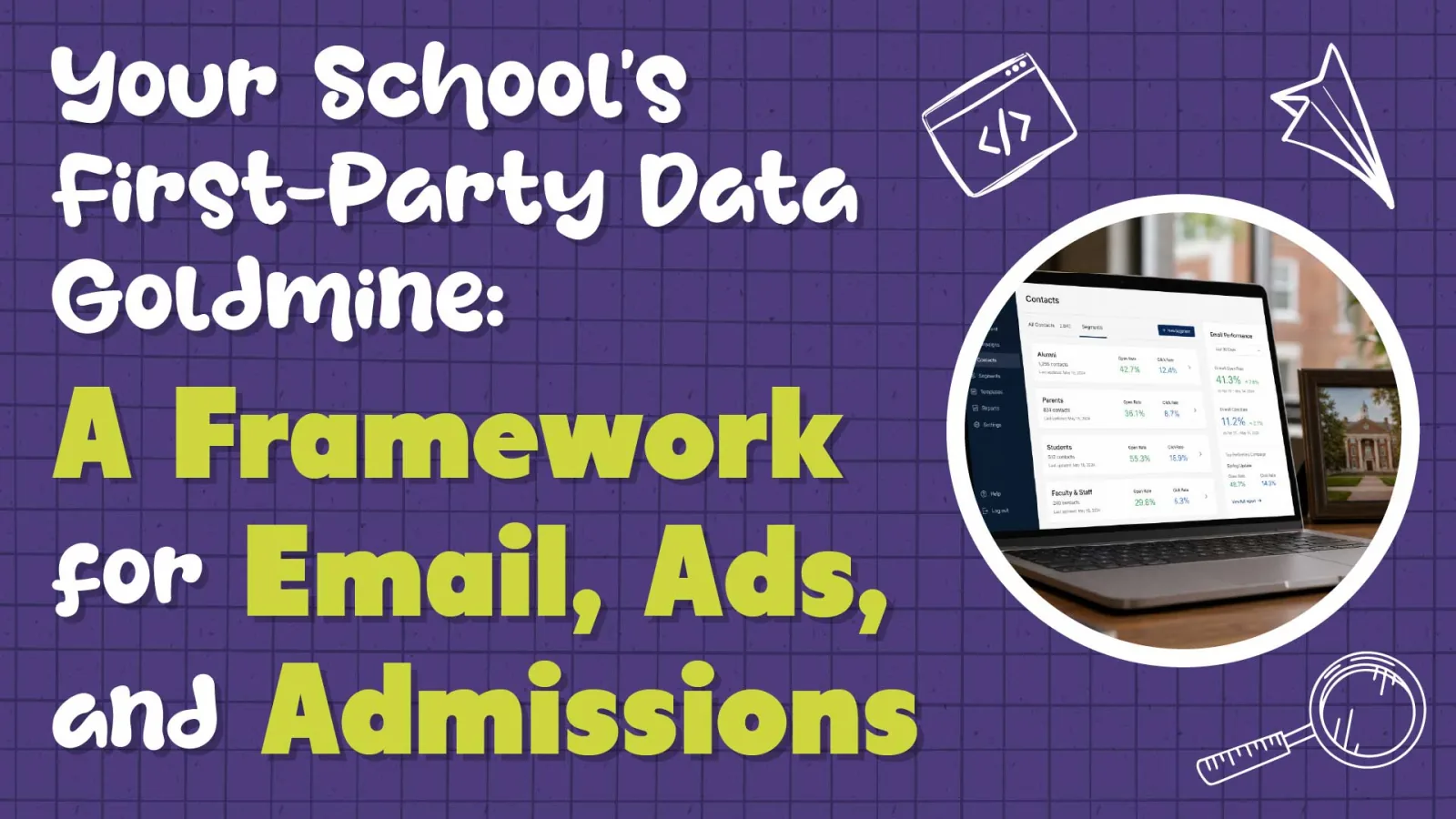
Your school is sitting on a goldmine of family insight; you probably don't even know it. Every time a parent visits your tuition page, clicks through an email, attends a webinar, or sits for an admissions interview, your school collects data. The problem is that most schools treat email as email, ads as ads, and outreach as outreach. These channels operate in silos, making decisions independently, missing the obvious patterns that sit right in front of them.
Here's the real opportunity: You don't need to buy another list to grow enrollment. You need to coordinate the data you already have. When your email team knows what pages families are visiting, when your paid ads team understands which segments your outreach team is focusing on, and when your admissions team gets real-time alerts based on family website behavior, something clicks. Campaigns stop feeling random. Families feel understood.
This is exactly where we help K-12 private schools unlock growth. We transform scattered engagement data into clear signals your team can act on. This guide walks you through that framework. what data matters, how to turn it into signals, and how to coordinate it across email, ads, and admissions outreach.
What First-Party Data Actually Means for Your School
Before we talk about activating data, let's be clear about what we're working with. First-party data is the information your school collects directly from families. no intermediaries, no third-party brokers, no purchased lists. It's data only you have, and no competitor can buy.
For private schools, that includes:
- Website behavior: Pages visited, visit frequency, time spent, content types consumed, form submissions
- Email engagement: Opens, clicks, replies, unsubscribes, content preferences
- CRM and admissions data: Application stage, school interest, program preferences, tour dates, family contact info
- Parent portal activity: Login frequency, documents viewed, communications opened
- Event attendance: Open house visits, webinar registrations, campus tour participation
The magic happens when you connect these dots. A family that visits your tuition page three times in two weeks, attends your webinar on financial aid, and opens every email you send isn't just "engaged." They're showing you intent. Your job is recognizing that signal and responding to it consistently across every channel.
From Raw Activity to Actionable Signals
Here's where most schools fumble: They collect data but don't translate it. A parent visits a page, an email gets opened, a form gets submitted; then what? These events sit in different tools, gathered by different teams, never speaking to each other.
The real power starts when you translate raw activity into signals your team can understand and act on:
Intent signals tell you families are in buying mode. A family that visits your pricing or tuition page three or more times in 14 days is actively considering enrollment. A parent who's read comparison content about different school types, or has attended your decision-stage webinar, is moving toward a decision. These families need relevant proof. case studies, outcomes data, parent testimonials; they need it fast.
Interest signals tell you what problems a family cares about. If a parent reads your STEM program page twice and downloads your robotics curriculum overview, they care about STEM. If they visit your scholarship information page multiple times, financial aid accessibility matters to them. These signals don't mean they're ready to enroll; they mean you now know how to speak to them.
Lifecycle signals tell you where a family sits in the journey. A brand-new inquiry that engages heavily with content in its first week is showing strong early momentum. A family who toured six months ago but has gone silent, suddenly returning to your implementation and logistics pages, is a re-engaged prospect worth prioritizing. A current parent exploring your upper school program is a retention expansion opportunity. These signals unlock different strategies.
Once you have these signals, your email, ads, and admissions teams stop guessing. They act.
How Email Changes When You Use First-Party Signals
Most school email programs send the same message to everyone. Maybe there's a newsletter. Maybe there are a couple of seasonal sequences. But they're generic.
When first-party signals inform your email, it becomes a precision tool.
Triggered journeys activate automatically when signals appear. A family lands on your tuition page for the third time? A five-email sequence starts, each one designed for someone in evaluation mode. It covers financial aid, scholarship opportunities, parent testimonials, and implementation timelines. No waiting. No guessing whether they'd value that content. They've already told you they care about cost.
A parent attends your financial aid webinar and then reads three articles about tuition payment plans? They're signaling that affordability is the sticking point. Send them comparison content about your payment options versus competitors. Send them real stories from families who chose your school despite higher tuition. Time it right. within 48 hours of that webinar attendance; you're part of their decision, not an afterthought.
Dynamic content and offers swap inside your emails based on what each family has done. Sarah sees a different call-to-action than Marcus because your email platform knows Sarah visited the STEM program page while Marcus was reading about athletics. Sarah's CTA is "Learn More About Our Robotics Program." Marcus's is "Explore Our Athletic Opportunities."
This level of personalization, informed by real behavior, converts better. Families feel understood. They stay engaged instead of unsubscribing.
Smart suppression prevents email fatigue for families at the wrong stage. If your admissions team knows a family is already scheduled for a tour, you don't blast them with "Come Visit" emails. If they've already completed their financial aid applications, you don't send them "Here's How Financial Aid Works" for the fifth time. Quiet the noise. Save your best content for families who actually need it.
The output is immediate and measurable: fewer irrelevant emails, higher engagement, better conversions.
How Paid Ads Sharpen When You Layer First-Party Data
Paid ads have always been about reaching the right person. First-party signals make that precision possible at a level most schools never achieve.
Instead of running general awareness campaigns, you build high-value retargeting audiences from families you know are interested. A family that visited your tuition page twice? They're in your high-intent audience. They see more specific ads about pricing and value. A family that reads your program pages? They're in your target audience. They see program-specific benefits. Someone who completed a form six months ago but hasn't engaged since? They're in your re-engagement audience, and you show them fresh content about what's new at your school.
This isn't blasting everyone who visited your website. It's targeting families whose behavior shows they're genuinely interested.
Smarter exclusions are equally important. You don't want to waste budget showing "Explore Our School" ads to your current families. They already know your school. You also don't want to pay for clicks from people who are clearly not a fit, like families searching for boarding schools when you're a day school. With first-party signals, you exclude these segments and focus your budget on higher-probability audiences.
You also stop showing generic awareness ads to families in late-stage opportunities. If your admissions team is actively working with a family and they're one month away from an enrollment decision, that family shouldn't see your $3 awareness ad. They should see your higher-converting decision-stage content. Redirect that budget. Serve them proof.
Better seed audiences for lookalike campaigns come from your best first-party data. Instead of seeding lookalike campaigns with random website visitors, you seed them with your highest-intent visitors and recently enrolled families. The people you see become your template. More high-intent-like people enter your audience. Your cost per lead drops.
The math is simple: Better targeting, less wasted spend, lower cost per qualified lead.
How Admissions Outreach Becomes Timely and Relevant
For your admissions team, first-party data is the difference between "just checking in" and "I know exactly why you're here."
Real-time alerts put data in front of reps the moment signals light up. A family you've been nurturing for three months suddenly returns to your implementation page and reads your logistics FAQ; that's a signal they're getting serious. Your admissions reps get an alert in their CRM: "The Rodriguez family is back, and they're looking at how your program works." This triggers a check-in call. It feels timely because it is.
Alerts work best when they hit the tools your team already lives in. Not a new app. Not another email in the inbox. A notification in HubSpot or Salesforce that says, "This account is showing buying signals now." Reps act on it because it's right there.
Rich account context shows reps the full picture. Instead of calling a family with no context, your rep opens the contact record and sees: "Last visited your website yesterday. Read the 'What Happens After Enrollment' page and download the parent handbook. Attended your webinar on curriculum design two weeks ago." Now your rep has talking points. You're not starting from scratch. You're building on a conversation that's already happening.
Opportunity coaching for open deals keeps teams aligned. While an admissions rep is working with a family, your team can see what that family is doing digitally. If a family in active conversation is revisiting your tuition page repeatedly, you know affordability is the remaining objection. Send the scholarship conversation. If they're reading security policy pages, maybe parents are worried about campus safety. Address it proactively.
This real-time insight compresses sales cycles. Reps spend less time guessing and more time solving actual problems.
Making It Work: The Coordination Framework
The magic only happens when email, ads, and admissions speak the same language.
Most schools have three separate teams using data in three separate ways. Email builds its own segments. Ads build their own audiences. Admissions tracks everything in their CRM. They hit the same family with contradictory messages across channels, miss obvious opportunities, and wonder why results are middling.
Real coordination starts with shared definitions. Your team needs to align on what "high-intent" actually means. Is it three tuition page visits in 14 days? Is it attendance at a financial aid webinar? Is it multiple visitors from the same family household? Document this once. Share it. Now, email, ads, and admissions all work from the same playbook.
Next, build central segments from those shared definitions. One source of truth. A segment called "ICP High-Intent Visitors. Last 14 Days" lives in one place and syncs to your email platform, ad accounts, and CRM. It stays fresh. updated daily, so everyone's acting on current signals, not stale data from three weeks ago.
Then run coordinated plays for each segment. For your high-intent segment:
- Email sends educational content on the first day the family appears in the segment, then adds them to a five-email decision-stage sequence. Daily engagement tracked.
- Ads show them your decision-stage creative. specific outcomes, parent stories, enrollment logistics. Budget allocated to reach them frequently.
- Sales gets an alert and schedules a check-in call within 48 hours.
All three channels reinforce the same message from different angles. Email educates. Ads remind. Sales close. The family feels supported from multiple directions. Your team feels coordinated. Your results spike.
For early-stage families, the strategy is different but equally coordinated:
- Email nurtures with broad educational content. Multiple programs, general questions answered, no aggressive CTA.
- Ads build familiarity and brand awareness. Friendly, not salesy.
- Sales stays in light-touch mode. One welcome email, then mostly quiet. Not ready yet.
This is coordination that works.
Starting With What You Already Have
You don't need a six-month rebuild to begin. You don't need to overhaul your whole tech stack. Start where you are.
Pick one or two key intent signals. "Families who visited the pricing page three or more times in 14 days." Or "Multiple family members logged into the parent portal from the same account in the last week." Something simple, observable, and clearly tied to intent. Don't try to layer ten signals in month one.
Build one shared segment from those signals. Pull it from your website analytics or CRM. If you use HubSpot, this is a standard contact list. If you use different tools, you're syncing a CSV weekly. Not elegant, but it works. The segment needs to be fresh, built daily or weekly, not a static list from three months ago.
Run one coordinated play in each channel. In an email, that might be a single triggered sequence. In ads, maybe one retargeting rule. In admissions, a simple alert rule and call schedule. Keep it manageable. You're proving the concept, not overhauling everything.
Then measure it. Track how many families in that segment move to the next stage. How long do they spend on email? What's their click rate? Do they accept the tour invite? Do the ads retarget them? Are reps actually calling them? What's their enrollment rate compared to families outside the segment?
Once you see results, you will. You iterate. Add another signal. Build another segment. Layer on more coordinated plays. Your system grows smarter with each cycle.
This isn't an overnight transformation. It's a methodical build on data you already own.
The Shift From Isolated Campaigns to Coordinated Strategy
Most schools run campaigns. They launch email campaigns, run ad campaigns, and do admissions campaigns. Each campaign has its own goals, its own timeline, its own success metrics. Families experience them as disconnected interruptions.
Real growth comes from a different model: coordinated strategy powered by data. It's the same family appearing in your email with relevant context. It's your ads reinforcing what email just introduced. It's your admissions team calling at the exact moment when the family's behavior shows they're ready to talk.
This model requires you to see your school's marketing not as separate channels, but as a system. Email isn't marketing's job. Ads aren't the growth team's job. Admissions outreach isn't the admissions office's job. It's everyone's job. shared data, shared signals, shared goals, coordinated execution.
The families you're trying to reach experience this immediately. They feel understood instead of spammed. Your school's messaging becomes coherent instead of random. Your team stops stepping on each other and starts amplifying each other.
And your enrollment grows.
You're no longer sitting on untapped data. You're activating it. And unlike paid lists or vendor tools, this data belongs to your school. Competitors can't access it. They can't replicate it. It's your competitive advantage.
If you're ready to stop treating data like a side project and start treating it like a system, let's talk. We help schools like yours coordinate first-party insights across every channel and turn scattered data into measurable enrollment growth.
Frequently Asked Questions
What counts as first-party data for a private school?
First-party data is any information your school collects directly from families: website visits, email opens and clicks, form submissions, CRM records, parent portal activity, event attendance, tour dates, and application stage. It's data you own, families provide, and no competitor can access. The key is connecting these dots across different sources to see the full picture of family intent.
How do we know if a family is showing intent signals?
Intent signals emerge from repeated, focused behavior. A family visiting your tuition or enrollment information page three or more times in two weeks, attending a decision-stage webinar, reading scholarship details repeatedly, or having multiple household members engage from the same domain all indicate buying intent. Track these behaviors in your CRM and email platform, then segment families who show them.
Do we need new technology to activate first-party data?
Not necessarily. If you use HubSpot, you can build segments and coordinate them across your email and ads accounts. If you use separate email and CRM platforms, you can sync segments via CSV weekly. It's less elegant than an all-in-one system, but it works. Start with the tools you have, prove the model, then upgrade your tech stack if results justify the investment.
How should we prioritize which families get more admissions attention?
Prioritize families showing clear intent signals and a good fit for your school. A family that's visited multiple times, attended your webinar, and opened every email you send should get more frequent contact than a family that registered once and has been silent. Use lifecycle signals in your CRM to track the stage. Alert your team to families showing signals that indicate they're moving toward a decision.
Can we do this if we don't have a formal marketing team?
Yes. You don't need a marketing department to activate first-party data. You need someone (or a small group) to define your signals, build segments, and sync them across your existing email and ads platforms. This can be an admissions director, a principal, or a committed parent volunteer. Start simple: one signal, one segment, one coordinated play per channel. Iteration happens naturally over time.