You give the same campus tour twice in one week, and both families ask a version of the same question: "Where do your graduates go?" You know the answer is strong. Your alumni are at good colleges, in good careers, and many still come back to visit. The problem is that none of that proof lives anywhere a prospective family can find it before they walk through your door. Cube Creative Design works with private and independent schools that sit on a goldmine of graduate outcomes and never put them to work. Alumni success stories are how you turn those outcomes into the kind of proof that moves a family from "interested" to "applied." This guide covers why these stories work, how to source them without a big team, where to share them, and the consent rules that make K-12 different.
What Are Alumni Success Stories in School Marketing?
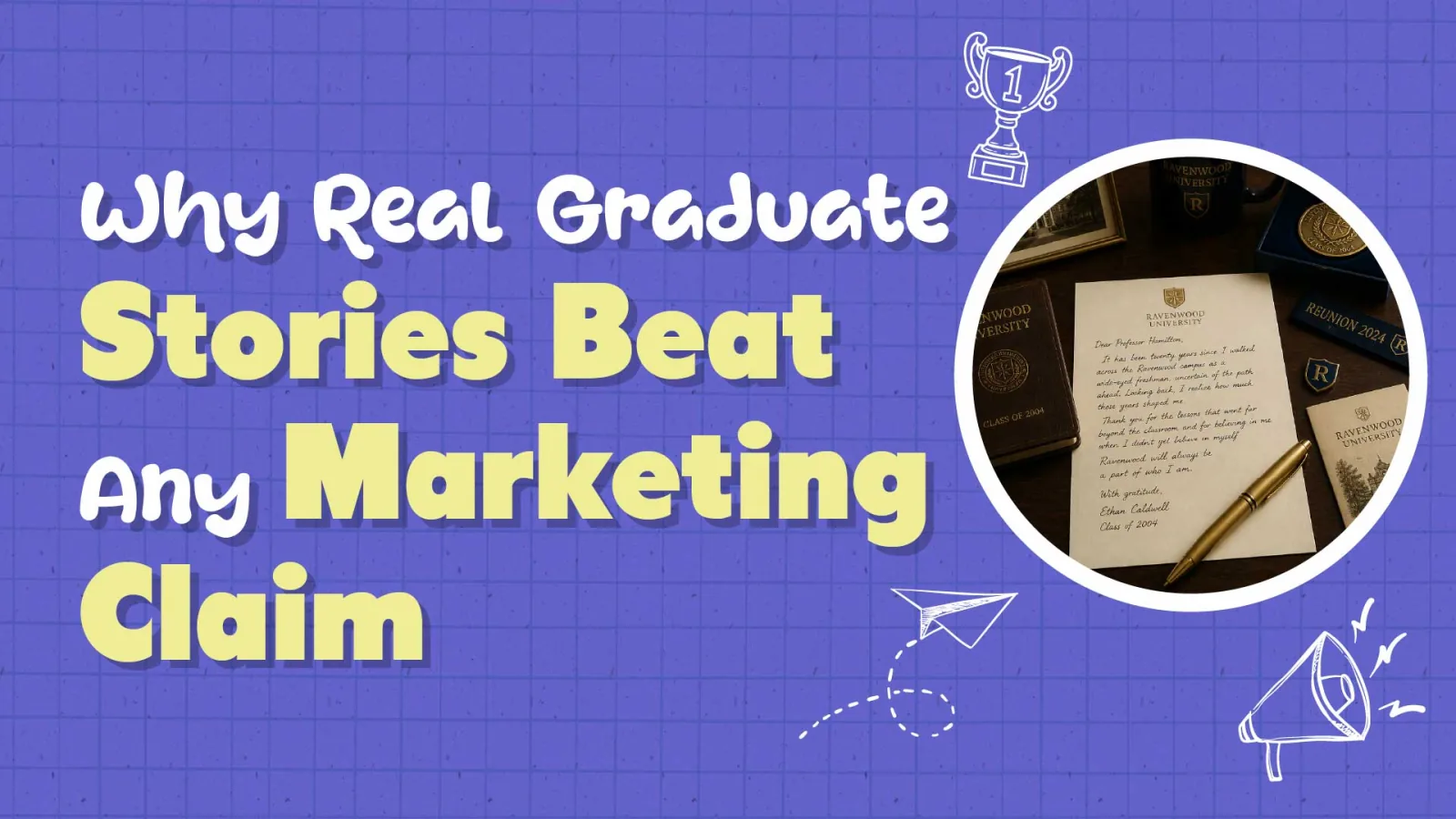
Alumni success stories are short, true accounts of what graduates have gone on to do and how your school helped them get there. They live on your website, in admissions emails, on social media, and in print, and they range from a written "where are they now" profile to a 90-second video testimonial. The point is not to brag. The point is to give a prospective family a concrete picture of the outcome they are buying. A story about a graduate who arrived shy and left as a confident college student does more than any list of statistics on a viewbook page.
Why Do Alumni Success Stories Work So Well for Schools?
Alumni success stories work because the outcome of an education is the thing families are actually trying to evaluate, and a graduate's story makes that outcome real. Parents cannot test-drive 13 years of schooling, so they look for proof of where it leads. The National Association of Independent Schools studied why parents enroll and found that the two largest motivations both center on long-term growth and reputation. When a real graduate tells that story, the abstract promise becomes believable.
The research backs this up clearly. In its 2020 national analysis, NAIS found that 40% of parents who changed schools were trying to ensure a capable child's continued growth and college preparation, and another 19% wanted an excellent program and strong reputation to reach selective colleges. Together, that is nearly six in 10 families whose decision hinges on the outcome that your alumni already represent.
That is the gap an alumni story fills. A tuition page tells a family what the experience costs. A program page tells them what the school offers. Neither one tells them what the school produces. A graduate's story does, and it does it in a way that sticks. It also answers the quiet question behind every tour: "Will my child turn out okay?" No marketing claim can answer that. A real graduate can.
How Does Trust in Word-of-Mouth Make Alumni Stories Persuasive?
Alumni stories are persuasive because they carry the weight of word-of-mouth, which people trust more than any form of advertising. A graduate sharing their experience reads as a recommendation from a real person, not a sales pitch from the school. That distinction matters to families who are skeptical of polished marketing. General marketing research supports the gap clearly.
According to Nielsen, 88% of people worldwide trust recommendations from people they know more than any other channel, and 50% more people trust those recommendations than lower-ranked channels like banner or search ads. That is general consumer data, not a school-specific number, but the principle holds: a believable human voice beats a brand claim. An alumni story is the closest a school can get to bottling that effect and using it on demand.
Academic research points in the same direction. A 2020 meta-analysis of 69 studies published in Information Systems Frontiers ranked emotional trust and the credibility of a message as strong predictors of whether word-of-mouth changes a decision. The sheer volume of reviews ranked among the least effective factors. The takeaway for schools is that credibility, not quantity, is what makes a story persuasive. One trusted graduate carries more weight than 20 anonymous quotes, so put your effort into stories families will believe rather than into chasing a high count.
Which Alumni Story Angles Should Private Schools Prioritize?
Schools should prioritize the story angles that match what families say they want most, which research shows are love of learning, academic challenge, character, and where students go next. Lead with the outcomes that map to those priorities instead of telling every story the same way. The Enrollment Management Association's survey data gives you a clear ranking to work from.
Drawing on data from the Enrollment Management Association, its 2020 survey of 2,887 families found that 98% are applying to develop or maintain their child's love of learning, 96% want a challenging education, 92% want strong moral character, and 73% want a superior next-school placement. So a story about a graduate who found a real passion, got into a research college, or became a person of genuine character is not a nice-to-have. It is the exact evidence your audience is searching for.
What Does Today's Independent School Parent Actually Want to See?
Today's independent school parent is pragmatic, outcomes-focused, and wants proof before they commit, which is why concrete graduate results land harder than aspirational language. The buyer has shifted, and your storytelling should shift with them. Generation X now makes up the clear majority of prospective families.
The same Enrollment Management Association report noted that 82% of parents considering independent schools are Gen X, while Gen Y and Boomers each account for less than 10%. This is a cohort that grew up checking references and reading reviews. They are not moved by a glossy promise; they are moved by a named graduate who can show, not tell, what the school produced. Build your stories around specifics: the college, the career, the turning point, the teacher who mattered.
How Can Schools Source Alumni Success Stories Without a Big Team?
Schools can source alumni stories using channels they already have, so a one-person marketing shop can build a library over time. You do not need a production budget or a dedicated storyteller. Start with the data and relationships already in your building.
A practical, low-lift sourcing mix looks like this:
- Alumni and parent surveys. Add one open-ended question asking graduates to share where they are now and what stuck with them. A NAIS practitioner profiled in 2025 described drawing on "parent, student, and alumni surveys" as a core way to demonstrate value, so you are in good company in building this.
- Advancement and reunion contact. Your development office already talks to engaged alumni; ask them to flag two or three willing storytellers a year.
- Self-recorded clips. Send a returning graduate three simple prompts and ask them to record answers on their phone. The result feels authentic precisely because it is not over-produced.
- Faculty nominations. Teachers remember the students who turned a corner. Ask them once a semester.
The trick is to make sourcing a small, recurring habit rather than a once-a-year scramble. A school that collects two or three stories every term ends up with a deep library in a single year, and the work never piles up. Keep a simple shared document where anyone on staff can drop a name and a note. The hardest part is starting; the system makes it easy to keep going.
What Makes an Alumni Story Believable Instead of Salesy?
An alumni story is believable when it is specific, lightly produced, and clearly told in the graduate's own voice rather than rewritten into marketing copy. Authenticity is the whole point, and over-polishing can quietly undercut it. Peer-reviewed marketing research points in the same direction.
A 2025 study in the Journal of the Academy of Marketing Science looked at consumer digital trust. It found that features that cut down suspicion that content has been faked make it more effective, while heavy filtering and polishing can weaken it. In plain terms, a real graduate naming a real college in a slightly imperfect clip will beat a flawless ad read. Keep names, dates, and details concrete. Let the graduate sound like themselves.
A few habits keep stories on the right side of that line. Use the graduate's real words instead of rewriting them into brochure language. Name the specific college, job, or milestone rather than gesturing at "great outcomes." Show a little texture, including the struggle before the success, because a story with only highlights reads as staged. And resist the urge to over-edit the video into something that looks like an ad. The goal is for a prospective parent to think "that could be my kid," and polish gets in the way of that more often than it helps.
Should Schools Use Written Alumni Profiles or Video Testimonials?
Schools should use both, leading with whichever format the channel and the story call for, because written profiles and video testimonials each do something the other cannot. Written profiles are searchable, fast to produce, and easy to skim. Video carries emotion and voice that text cannot match. The format trend across marketing is moving toward video.
Wistia reported that customer testimonial videos are trending up across industries, with the share of companies planning to make them rising from 17% in 2023 to 47% this year. That is general marketing data rather than a school benchmark, but it reflects a real shift in what audiences expect. A workable plan for a lean team looks like this. Publish written profiles often, since they are cheap and good for search. Then produce a handful of short video stories a year for your highest-intent moments, like open house and decision season.
How Do FERPA and Consent Rules Affect Alumni Stories at K-12 Schools?
FERPA and consent rules make K-12 storytelling different because you are often featuring minors, which requires permissions that corporate and higher-ed marketers rarely think about. This is the single biggest way school storytelling differs from general marketing, and getting it wrong is a real risk. The U.S. Department of Education addresses photos and videos directly.
The U.S. Department of Education advises that schools "often designate photos or videos of students participating in public events (e.g., sporting events, concerts, theater performances, etc.) as directory information and/or obtain consent from the parents or eligible students to publicly disclose photos or videos from these events." Practically, that means a signed photo and video release for any current student or recent graduate under 18, and clear records of who has opted out. Coordinate with your registrar so a family's directory information choice is honored in your marketing, too. Build this into the story workflow, not as an afterthought.
A Practical Look: Turning Outcomes Into Stories at a Mid-Sized College Prep
Picture a director of admissions and marketing at a mid-sized college prep serving about 550 families, with tuition in the $18,000 to $35,000 range and a goal of raising applications 15% to 20% a year. She has strong outcomes and no system to share them. Here is a realistic 90-day start that fits a small team and budget.
In month one, she adds one alumni story question to the existing graduate survey and asks two teachers to nominate recent graduates worth featuring. In month two, she publishes three written profiles on a new "Where They Are Now" page and shares each on social media, where prospective parents already check in before booking a tour. In month three, she films two short self-recorded video stories with signed releases and saves them for open house follow-up emails.
The outcome is not a viral hit. It is a small library that keeps building, one that her whole team can pull from, anchored to the outcomes families told researchers they care about most. Measured honestly, the win is a "Where They Are Now" page that becomes one of the most-visited sections of the site and a set of stories the admissions team reuses all season.
How Should Schools Distribute Alumni Success Stories?
Schools should distribute alumni stories where families are already researching, which means the website, admissions email sequences, and social media, with the same story repurposed across all three. One good story should never live in only one place. Plan the distribution before you produce the story.
The distribution map is simple. Build an evergreen "Where They Are Now" page on your site so stories work for search and for families browsing on their own. Drop a relevant story into your inquiry-to-application email follow-up so it lands at a decision moment. Post short clips and quotes on the platforms parents actually use. Your own website stays the workhorse. It is the one channel you fully control, and the place serious researchers go to confirm what they have heard.
How Do You Measure Whether Alumni Stories Are Working?
You measure alumni stories by tracking engagement and movement through your funnel, not by chasing viral numbers, because the goal is enrollment, not applause. Tie each story to a clear signal so you know what to produce more of. The metrics are ones your existing tools likely already capture.
Watch page views and time on your "Where They Are Now" page, click-through and reply rates when a story is included in an admissions email, and whether families mention a specific graduate during tours or interviews. Over a full cycle, the question that matters is simple: are the families who engaged with your stories more likely to apply and enroll? If a particular type of story keeps showing up in those conversations, make more like it.
A light tracking habit is enough for most schools. Note which stories get shared, which ones tour guides and counselors reach for, and which ones families bring up unprompted. Those qualitative signals often tell you more than a raw view count, because they show a story that actually changed how a family thinks about your school. Review the list once a season and let it shape what you produce next, so your library gets stronger and more targeted every year instead of just larger.
Conclusion: Put Your Graduates to Work
Your alumni are already proof that your school does what it promises. The work is turning that proof into stories families can find, trust, and act on. Start with the outcomes that match what parents say they want, source stories from the surveys and relationships you already have, keep them honest and specific, and handle student consent with care. You do not need a big team or a big budget to begin; you need one good story and a system to repeat it.
If you want help turning your graduate outcomes into an enrollment engine, reach out, and let's talk through where your school should start. No pitch, just honest direction.
Frequently Asked Questions
How Many Alumni Success Stories Does a School Need to Start?
Start with one strong story and build from there. A single well-told profile of a graduate whose outcome matches what families want is more persuasive than a dozen thin ones. Aim to publish three to five in your first quarter, then add a steady trickle so your library keeps building without overwhelming a small team.
Do We Need Written Permission to Feature Alumni and Students?
Yes, especially for anyone under 18. The U.S. Department of Education's guidance points schools toward designating event photos as directory information or obtaining consent from parents or eligible students. Use a signed photo and video release for current students and recent minor graduates, keep records of opt-outs, and coordinate with your registrar so directory-information choices carry over into your marketing.
Are Video Testimonials Worth the Effort for a Small School?
For most small schools, a mix works best. Written profiles are cheap, searchable, and quick, so make them your steady output. Reserve short video stories for high-intent moments like open house and decision season, where the extra emotion pays off. Self-recorded clips from graduates keep production costs near zero and often feel more authentic than polished ones.
Where Should Alumni Success Stories Live on Our Website?
Create an evergreen "Where They Are Now" page that prospective families and search engines can find on their own. Because outcomes and reputation drive a large share of enrollment decisions, this page often becomes one of the most-visited sections of a school site. Then repurpose each story into admissions emails and social posts so one story works across every channel, which is exactly the kind of work our school marketing services are built to support.
How Do Alumni Stories Compare to Just Listing College Acceptances?
A college acceptance list answers "where," but an alumni story answers "why it mattered," and families need both. The list provides quick proof at a glance; the story makes the outcome believable and emotional. Pair them: let the matriculation list establish credibility, and let a named graduate's story show the human path that produced it.