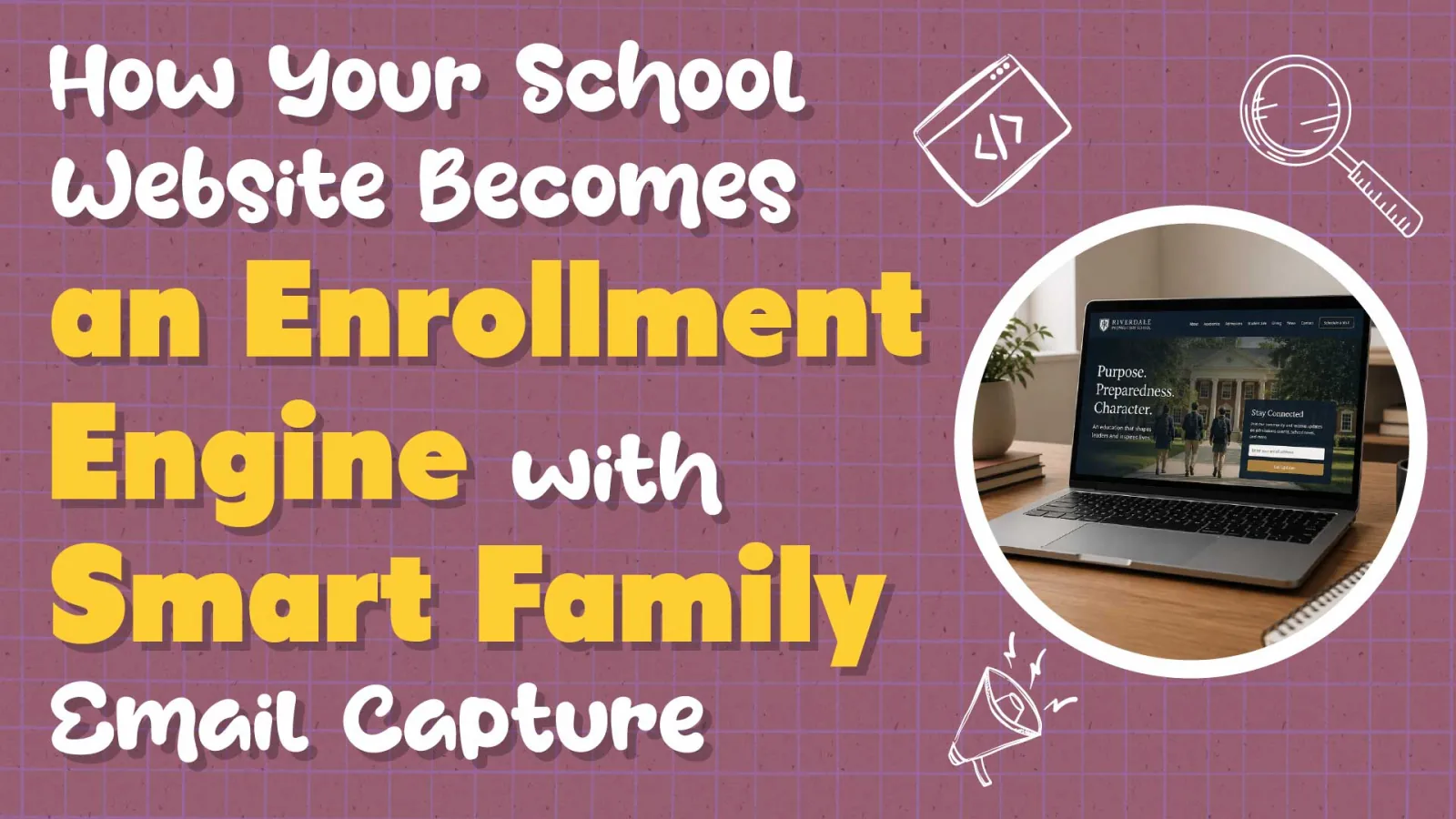
Your school website probably collects email addresses the way most websites do: a footer form that nobody notices, maybe a modal pop-up that appears at an awkward moment, and that's it. Then you wonder why your prospective family list grows at a crawl, and the families you do capture seem uninterested.
Here's the uncomfortable truth: you're not missing families. Your website is simply treating email capture as an afterthought instead of designing it as a system. When you build your website to actively identify high-intent visitors and invite them in with relevant offers, everything changes. You stop waiting for families to stumble onto your contact form and start turning qualified traffic into subscribers your admissions team can actually use.
you visit? Email
This isn't about bombardment or being pushy. It's about recognizing that private schools often leave massive opportunity on the table; families are already on your site, already interested, already telling you through their behavior exactly what matters to them. You just need to ask for the relationship at the right moment.
Why High-Intent Families Matter More Than List Size
Let's start with a hard truth: not all leads are equal. A list of 500 actively engaged families will move your enrollment needle far more than 5,000 uninterested email addresses gathering dust in your CRM.
High-intent families show up differently. They arrive from relevant channels. organic search, targeted ads, referrals. They spend real time on your site: multiple pages, longer session times, and return visits. They opt in around specific concerns they're actually trying to solve, whether that's curriculum fit, financial aid options, or campus culture. These are the people most likely to open your emails, engage with follow-up invitations, and move toward scheduling a tour or submitting an application.
Research in school enrollment demonstrates this principle. Schools without a nurture sequence convert only 25-30% of inquiries into enrolled students, while schools with a basic nurture sequence hit 35-40% conversion rates. The difference isn't the volume of names in the database. It's the quality of the relationship.
Building an enrollment engine means deliberately capturing these engaged families at moments when their interest peaks, then automatically nurturing that interest before it cools.
Design Your Website for Intentional Family Email Capture
Turning your website into a prospective family acquisition system starts with intentional placement. Stop thinking "one generic contact form" and start thinking "strategic invitation points."
High-value content hubs are your first opportunity. When a family lands on a blog post about curriculum philosophy, a detailed program guide, or a financial aid resource, offer them "more like this"; exclusive content, a deeper guide on that topic, or early notification when you host open houses related to that program. The offer feels connected to what they were already reading.
High-intent pages deserve targeted invitations too. Your pricing page, program comparison, or case studies section. These pages are already speaking to serious prospects. An email capture here isn't generic. Offer something that makes sense in context: a ROI calculator for their family situation, an admissions timeline checklist, or access to acceptance stories and campus videos.
Exit-intent offers are underutilized by schools. When a visitor is about to leave, trigger a light-touch invitation: "Not ready to apply yet? Get early notification about upcoming tours and admissions deadlines." Well-designed exit-intent offers convert at 4-5% on average, while top-performing campaigns hit 15% or higher. For your schools, that might mean offering a downloadable financial aid worksheet or a video message from the head of school.
Embedded CTAs within your content work because they feel natural. As you're explaining your enrollment process in an article, weave in: "Want this information delivered to your inbox? Join our prospective family newsletter." Families reading about your admissions process are exactly the people who'd benefit from a structured email sequence.
The common thread: every opt-in opportunity should feel like a natural extension of what the family is already doing. You're not interrupting. You're offering something relevant at the moment they're most interested.
Crafting Offers That Families Actually Want to Opt In For
People don't give away email addresses for generic "updates" anymore. They subscribe when the value is specific, immediate, and directly tied to questions they're actually asking.
Stronger offer concepts focus on concrete outcomes. A "5-Day Curriculum Deep-Dive Mini-Course" beats "subscribe for updates." A downloadable financial aid worksheet addressing "Can you really afford independent school?" beats a generic checklist. Access to an "Is Independent School Right for Our Family?" assessment that actually profiles their child's learning style, values alignment, and tuition comfort beats a vague resource library.
Many families research private schools before visiting the campus. Offer them curriculum overviews, student success stories, or a "Day in the Life" video series. Offer early notification about open house dates or virtual tour access. Offer a confidential financial aid calculator that shows potential scholarship ranges.
When your offer solves a specific problem, "How do we know if this school fits our family?" You attract families who are serious about making a decision. These are the high-intent prospects worth your nurturing effort.
Use Behavior Signals to Trigger Capture Opportunities
A true enrollment machine responds to what families do, not just where they land. You have far more data about visitor intent than you probably use.
Behavioral triggers let you present the right invite at the exact right moment. Time on page is your first signal. A visitor spending 3+ minutes on your science curriculum page is probably interested in that program specifically. Trigger a subtle offer: "Want more details about our science program? Get the full curriculum guide and upcoming lab tour dates."
Scroll depth tells you commitment. When someone reaches 60-70% of a long enrollment guide, they've invested real attention. That's a perfect moment to offer a downloadable summary or schedule a brief call with admissions.
Repeat visits signal serious consideration. If a family visits your campus life page three times in two weeks, they're evaluating. Surface a higher-value offer for those returning visitors: "Clearly interested in our community. Here's your invitation to an exclusive parent panel discussion on school culture."
Category interest clustering shows you topic patterns. Families consistently reading content about your competitive athletics program, arts opportunities, and scholarship information probably value all three. Route them into a sequence specifically about well-rounded academics and extracurriculars.
These micro-signals let you capture the families who are clearly engaged, without showing the same generic pop-up to every visitor. You're speaking to their actual interests.
Simplify Your Forms to Get More Qualified Submissions
The more friction in your forms, the fewer high-intent families you'll capture. That doesn't mean never ask questions. It means every field should earn its place.
Start lean with the essentials. For most private schools, that's the email address and grade level interested in. Sometimes you add campus preference. In some cases, you might ask, "How did you hear about us?" But the goal is ruthlessly minimal. Research shows each additional form field reduces completion by 3-5%. You're not saving time with those 15-field forms. You're just losing names.
Progressive profiling is your answer to needing more information. Capture the basics in the first form. Then, in follow-up emails, ask one or two additional questions through preference centers or simple surveys. In the welcome sequence, use engagement behavior to learn more: families who click on athletics content are probably interested in your sports offerings. You're building a picture of their interests over time instead of demanding it all at once.
Make the benefits obvious right near your form. "Join our prospective family newsletter and get monthly updates on admissions timelines, campus events, and parent perspectives. delivered every first Tuesday of the month." You're setting expectations, not creating surprises.
When families feel like forms respect their time and privacy, they're far more willing to complete them. Your conversion rates will prove it.
Route New Subscribers Into Smart Nurture Journeys
Capturing the email is only the beginning. You need automated journeys that nurture families based on what you already know about them.
For each major entry point, design a tailored welcome sequence. Deliver exactly what you promised: if they signed up for financial aid information, send that.
Follow it up with 3-5 emails that deepen the relationship: a parent testimonial about managing tuition, a video walkthrough of campus, an admissions timeline, and a soft invitation to register for the next tour. These sequences should deliver genuine value while subtly guiding families toward the next step.
Then implement behavior-based branching. Did a subscriber click through to your science program details? Move them into a sequence about STEM at your school. Did they request information about boarding options? Route them to content about residential life, retention statistics, and parent support. Did they ignore all academic content but open every email about community service? They're values-driven; show them mission-aligned opportunities.
Make the pathway to raise their hand simple and repeatable. Every sequence should include easy ways to book a tour, attend an open house, or schedule a conversation. "Questions before you visit? Email admissions&school.edu or book a 15-minute call with our director of admissions." Low-friction conversion points throughout the journey.
This transforms your website from a passive signup source into the front end of a real enrollment development system. Families move from awareness to interest to consideration to action.
Measure What Matters: Engagement Over Volume
To keep your email capture engine tuned and improving, measure more than just new subscribers per month. Those metrics matter, but they don't tell you if you're building a quality pipeline.
Track engagement by source and offer. Which email capture method produces families who actually open your follow-up emails? Which offers generate false positives? people who opt in but never engage? If your exit-intent offers convert at 10% but those subscribers have a 40% unsubscribe rate, that's a red flag. Switch the offer.
Monitor movement through your enrollment stages. How many subscribers progress to scheduling tours? How many tour attendees submit applications? How many applicants enroll? If families are opting in but never taking the next step, your nurture sequences or offer clarity need work.
Measure time to first meaningful action. How quickly does the average family move from opting in to booking a tour or asking a question? If it's 45 days, that's a long consideration window. If it's 2 days, you might have some really engaged families. Knowing this helps you adjust follow-up timing.
Watch churn and unsubscribe patterns too. If families from a particular capture method unsubscribe quickly, that offer attracts the wrong audience. If families always unsubscribe on the second email, your welcome sequence is over-promising or under-delivering.
These insights let you refine which pages, offers, and triggers actually produce families your admissions team values, and which should be reworked or retired.
Build Your School's Enrollment Engine
When you shift from hoping families will contact you to designing a system that identifies them, invites them in, and develops the relationship automatically, your school becomes a machine.
The website you have right now is even if it's beautiful. It is probably acting as a digital brochure. Visitors come, they look around, they leave. You capture maybe a handful of inquiries each month through your footer form or contact page.
When you treat your website as an enrollment engine, everything changes. You recognize high-intent visitors through their behavior. You present relevant invitations at moments when their interest peaks. You simplify the barrier to entry. You automatically nurture families based on their demonstrated interests. You measure not volume, but quality and conversion.
The payoff compounds. Your prospective family list becomes healthier and more responsive. Your admissions team spends less time chasing cold leads and more time nurturing warm relationships. Your enrollment conversion rates improve because you're working with families who opted in for good reasons. You get more revenue from the traffic you already have, without exhausting your budget chasing new visitors.
Stop hoping. Build a system.
Ready to transform your website into a true enrollment engine? Reach out, and let's talk about how your school can capture and nurture prospective families automatically.
Frequently Asked Questions
Why Should We Focus on Email Capture When We Have Direct Inquiry Forms?
Direct inquiry forms are fine. for the families already ready to contact you. But most families researching private schools aren't ready to fill out forms yet. They're browsing, learning, comparing. Email capture meets them where they are without requiring commitment. A family might read five blog posts before they're ready to speak to admissions. Capture their email on post one, nurture them through posts two through five, and they arrive at the inquiry form pre-qualified and warm.
How Do We Know If a Family Email Signup Is Actually High-Intent?
Intent shows through behavior. Did they find you through organic search (not random browsing)? Did they spend more than two minutes on a specific page? Did they return multiple times? Did they specifically sign up for content about a particular program? Track these signals in your automation platform. Families hitting multiple high-intent signals become your priority in outreach. Those who opt in but never return to the website probably weren't as interested as you thought. But you'll know this through your data, not guessing.
What's the Right Email Frequency for Prospective Families?
Most schools succeed with 2-3 emails per week during active enrollment seasons and 1-2 emails per month during slower periods. But the real answer is: whatever frequency your families expect. Be clear at signup: "You'll hear from us every Tuesday and Thursday with admissions updates and parent perspectives." Then honor that commitment. Consistency beats frequency. Monthly emails you always deliver are better than weekly emails you miss half the time.
Should We Require a Phone Number on Our Email Signup Forms?
No, unless you have a specific reason. Phone numbers reduce form completion rates significantly. You can capture that through progressive profiling in a follow-up email or through your welcome sequence. For email capture specifically, email address and one simple qualifier (grade level, campus interest) is usually enough to get strong conversion rates. Ask for more information later, when families are already engaged.
How Long Should Our Welcome Sequence Be?
Three to five emails are standard. Too short and you don't build a real relationship; too long and families unsubscribe. Deliver the promised offer in email one. Email two adds social proof or testimonials. Email three invites them to the next event or step. Email four might offer a calendar or resource. Email five is your gentle final invitation before transitioning to your regular newsletter. Keep each email short and valuable; families are still evaluating, not committed.