You're in April, and suddenly you're facing board questions about next year's marketing budget. Did your website drive enrollments? Which channels worked? What should you double down on, and what was just noise?
If you're like most private school administrators, you probably didn't track these answers in real time. You've got enrollment numbers, sure. But which marketing efforts actually moved the needle? That's the difference between a marketing report (here's what we did) and a marketing review (here's what worked and why).
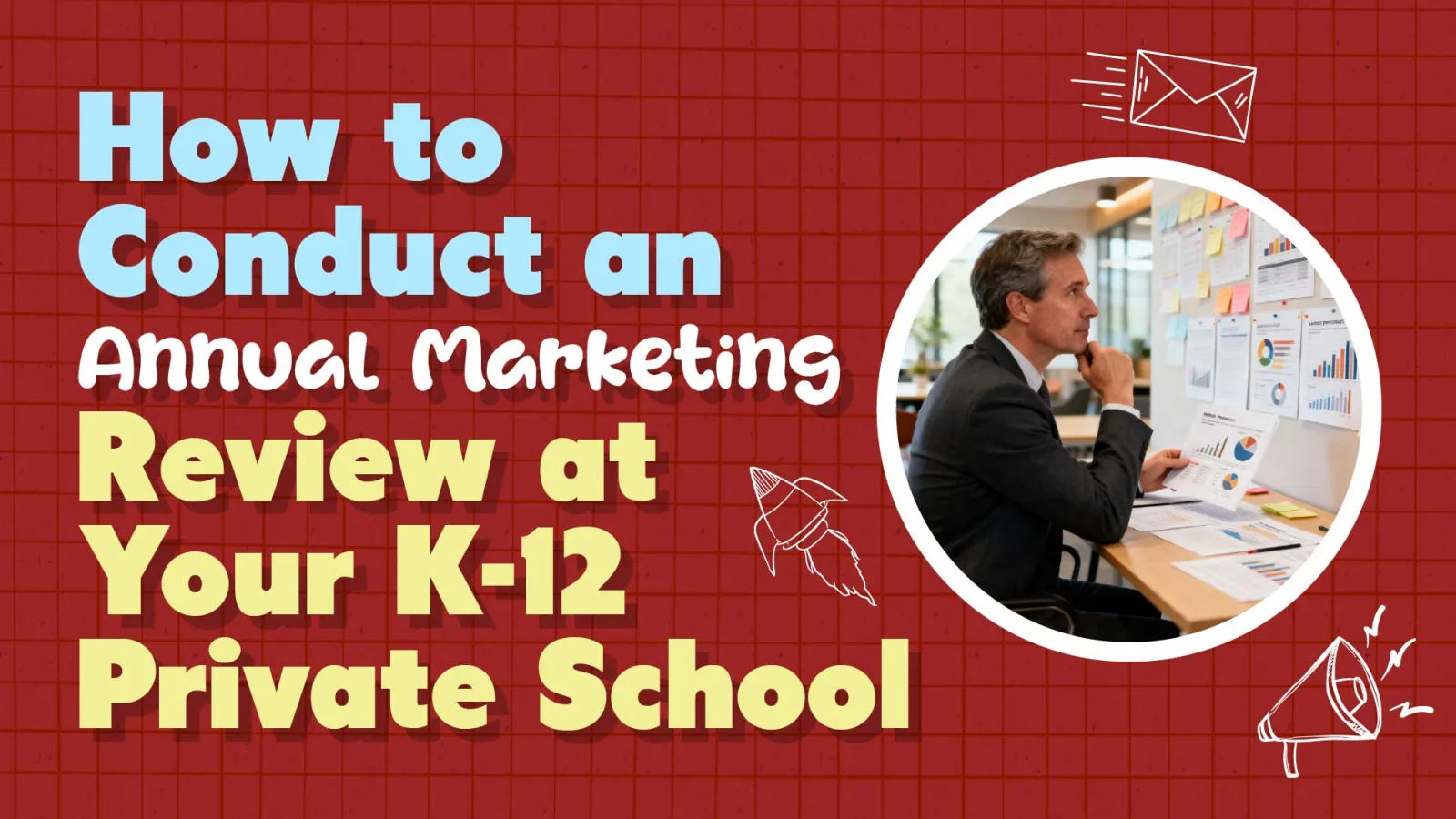
This post walks you through how to conduct a meaningful annual marketing review—the kind that turns last year's data into next year's strategy.
Why Is a Marketing Review Different from a Marketing Report?
A marketing report documents what happened; a review analyzes why it happened and what comes next.
Reports answer the basic question: "What did we do this year?" You'll see impressions, clicks, website traffic, email open rates, and social media followers. All useful data, but without context, it's just a list.
A review answers the harder questions: "Did our marketing actually attract the right families? Where did prospective parents drop out of our funnel? How are we positioned against schools our families also consider? What should we change?"
The difference matters because budget decisions come next. If you walk into that conversation with only a report, you'll justify last year's spending. If you walk in with a review, you can redirect next year's resources toward what actually works. (Not sure how to present marketing data to your board? That's a separate conversation, but the review comes first.)
When Should You Conduct the Review?
Timing matters. Late April through May is ideal for most schools.
By late April, your enrollment cycle is basically complete. You know your actual numbers. Tours have wound down. Applications are finalized. You're not making reactive adjustments anymore; you can think strategically about what the data actually shows.
Before summer matters more than most schools realize. If you wait until August or September, you'll be scrambling to build next year's strategy while simultaneously executing it. Late spring gives you time to synthesize findings, plan changes, and communicate a new direction to your team before the fall marketing push.
One practical note: coordinate with your business office and board calendar. If your board meets in May and reviews the budget in June, make sure your review is complete beforehand. You'll have actionable recommendations, not just observations.
Who Should Be in the Room?
A marketing review involves more people than just your marketing director.
Start with the core marketing team—whoever owns website, social, email, paid ads, and events. They understand execution. They know what worked and what was a struggle.
Then bring in admissions. Admissions teams talk to families every day. They hear objections, questions, and complaints that your analytics don't capture. They know which messaging resonates and which doesn't. They also know which referral sources produced the most qualified leads (not just the highest volume).
Your head of school or principal should attend at least the summary portion. Strategic decisions like whether to invest more in middle school recruitment or shift focus to younger families require a leadership perspective.
If you have a board member involved in marketing oversight, they'll want key findings, though they may not need to sit through the whole review.
Consider inviting one admissions counselor who's heavily involved in campus tours. That person hears prospective parent feedback that often contradicts what you assume about your marketing. Their voice prevents review groups from living in analytics bubbles.
What Should You Audit?
A comprehensive review covers every channel. You're not just checking whether you posted enough—you're assessing whether each channel worked for your specific enrollment goals.
Website Performance
Your website is your 24/7 enrollment funnel. Start by checking: Did visits increase year-over-year? What were the top landing pages? Where did visitors drop off most frequently—are they leaving tour request pages, tuition pages, or program pages?
Look at mobile traffic versus desktop. Look at conversion paths. Which pages actually led to tour requests or applications? A page with 10,000 visits but zero conversions might be beautiful; it's also useless for enrollment.
Check load speed, broken links, and outdated information. Families notice when a website hasn't been updated in months. A strong website strategy requires regular maintenance, not just annual reviews.
Search Engine Optimization (SEO)
How many visits came from organic search? Which keywords drove traffic to your site? Did you rank for terms families actually use when looking for schools?
Many schools focus on vanity keywords (their school name, for instance). But "private schools near me" or "college prep high school in your city" matter more if you're trying to reach new families.
Review your top 20 landing pages from organic search. For each, ask: Did this page serve its purpose? If a page about your K-3 program ranked well but got zero tour requests, why? Maybe the content didn't include your CTA. Maybe families weren't searching for K-3 content. Maybe the page ranked, but covered content families had already learned elsewhere.
Paid Advertising
Did you run Facebook, Instagram, Google, or other paid campaigns? What was your cost per enrollment? Compare that against NAIS data showing the median cost per enrollment at independent schools is $3,677. If your cost was significantly higher, it's time to examine why.
Ask about impression share, click-through rates, and most importantly, conversion: how many applications came from each campaign? A high-engagement campaign that didn't convert is entertainment, not marketing.
Review audience targeting. Did you reach families currently searching for schools? Did you include geographic boundaries, or were you wasting budget reaching people nowhere near your location? Did you include competitive school names in your keyword strategy, or rely only on your own brand?
Social Media
Most schools maintain Facebook and Instagram. Some use TikTok. This part of the audit can be sobering.
Review engagement metrics: likes, comments, shares, saves. But don't stop there. Did your social content drive traffic to your website? How many tour requests or applications came directly from social?
Many schools confuse follower growth with marketing success. You can have 5,000 Instagram followers and zero enrollments. What matters: Are you reaching families actively searching for schools?
Are you engaging current families (retention) or primarily recruiting? (Both have value, but the strategy is different.)
Look at posting frequency and timing. Did you post more consistently during peak enrollment periods? Did you test different content types: video, images, text-heavy posts, testimonials?
Email Marketing
How many people are on your email list? What's your open rate and click rate? Compare against benchmarks—typical nonprofits and schools see 20-35% open rates.
More importantly, did email drive conversions? Did families who clicked from emails convert to applications at higher rates than other channels?
Review your email frequency. Did you send too much (causing unsubscribes) or too little (falling out of mind)? Did you segment your list—different emails for prospective parents versus current families versus alumni versus donors?
Events and Open Houses
Did you hold tours, open houses, webinars, or other enrollment events? Track attendance, but also track outcomes. How many tour attendees submitted applications? How many applications were converted to enrollment?
Events are expensive. They require staff time, materials, refreshments, and coordination. So the audit question is simple: Were they worth it? Did a fall open house generate more applicants than a spring open house? Did campus tours convert at higher rates than virtual tours?
Look at your event marketing, too. How many of the families who attended found out about the event through which channel? If 80% of open house attendees heard about it through word-of-mouth or past parents, your paid promotion budget may have been wasted.
How Do You Assess the Enrollment Funnel?
Your enrollment funnel is the journey from first awareness to actual enrollment. Every family goes through the same basic steps: they learn you exist, they show interest, they take a tour, they apply, and they enroll.
The point of reviewing the funnel is to find where families leak out.
Start with raw numbers. How many prospective parents became aware of your school? Of those, how many became actual leads (tour requests, inquiries)? Of the leads, how many took a tour? Of the tour takers, how many applied? Of the applicants, how many enrolled?
At NAIS schools, 71.4% of accepted students enroll. If your acceptance-to-enrollment conversion rate is significantly lower, the problem isn't marketing—it's likely something after the acceptance: pricing, financial aid, fit, or competing offers from other schools.
But if your tour-to-application rate is low, that's a marketing problem. Your campus isn't selling the family once they're there. Could be a messaging disconnect—the tour experience doesn't match what you promised online. It could be a price shock once families see tuition. It could be questions about programs or culture that were not answered before the tour.
The inquiry-to-tour conversion is where many schools lose families. Niche's 2025 Parent Pulse Survey shows 66% of parents rated speed and timeliness of school communications as "high" or "very high". Are you responding to tour requests within 24 hours? After a family tour, do you follow up the next day?
Look at each conversion rate. Benchmark yourself against industry averages. Then ask: Which conversion is your biggest leak? Fix that first.
What Does a Competitive Review Look Like?
Most schools review themselves in isolation. They look at their website, their messaging, their results. But families don't evaluate schools in isolation—they compare you against the three to five other schools they're also considering.
A competitive review means taking an honest look at how you stack up against those competitors.
Start with a list of 5-7 schools that families most commonly mention alongside your school. These aren't necessarily your biggest competitors by enrollment; they're the schools that appear on the same shortlists. Ask your admissions team which schools families ask about most. Ask which schools your applicants also applied to.
Now visit each competitor's website. How does it compare to yours? Load speed, mobile experience, ease of finding program information, clarity of application process, and financial aid transparency? If their website makes it easier to schedule a tour, that matters.
Look at messaging. How do they position themselves? Are they focusing on college prep, values, arts, STEM, diversity, and faith? Are they using similar keywords you're targeting? Where do you differentiate?
Check their social media. What content are they sharing? How frequently? What's the engagement like? Are they showing student work, admissions information, testimonials, faculty, or events?
Price is a factor, too. Compare tuition, financial aid availability, and how openly each school displays pricing. Families notice which schools hide numbers.
The goal isn't to copy competitors; it's to understand where you're different and where you're the same. If five schools in your area use nearly identical messaging, yours will blur together. If your messaging is distinct and compelling, you stand out.
How Do You Turn Findings into Next Year's Strategy?
This is where most reviews fail. Schools collect data, nod thoughtfully, and then continue doing exactly what they did last year.
Don't be that school.
Take your key findings—the big insights, not every minor detail—and translate them into specific goals for next year. These should be measurable and realistic.
Example: "Our website got 2,000 visits, but only 15 tour requests. Most traffic landed on our programs page, but visitors dropped off without requesting tours. Next year we will (1) improve the programs page CTA, (2) add live chat to answer questions immediately, and (3) measure tour request conversion monthly to track progress."
Better goal: "Current tour request conversion is 0.75%. We'll target 1.2% by Q2 through improved CTAs and faster admissions follow-up."
Another example: "Our Facebook followers grew 40%, but tour requests from Facebook stayed flat. We're reaching people, but they're not converting. Next year we'll shift from lifestyle content to FAQ content, test Messenger campaigns, and measure application conversion by channel."
Make goals specific enough to track. Assign ownership. Identify which team member owns each goal. Set check-in cadence—monthly? Quarterly?
Also, identify what you'll stop doing. If an event returned low-quality leads and took 40 hours of staff time, is it worth repeating? If paid search campaigns cost $2,400 and drove zero applications, should you reallocate that budget?
The review is only valuable if it changes next year's behavior.
Practical Application: Sarah's Mid-Range School
Sarah Mitchell leads admissions and marketing at a mid-range independent school with 460 students and a $150,000 annual marketing budget. Her team is two people: herself and one marketing coordinator (the school's director also handles some oversight).
Sarah runs her annual review in May. Here are her findings:
Her website got 4,200 visits this year, but only 28 tour requests. Her cost per tour request was roughly $5,357 (total budget divided by tour requests). Of those 28 tours, 22 resulted in applications. Of those 22 applications, 19 enrolled. So her cost per enrollment was roughly $7,900—well above the NAIS median of $3,677. (This indicates inefficiency somewhere in her funnel.)
She digs deeper. Her Facebook campaign generated 1,800 site visits but zero tour requests. Her Google Ads campaign generated 1,200 visits with 18 tour requests. Her organic search (SEO) generated 800 visits with 8 tour requests. Email to past parents generated 200 visits with 2 tour requests. (The pattern is clear.)
Facebook is vanity metrics. Google Pay is working well, but it's also expensive. If she's paying $200 per click and only 1.5% convert to tours, she's spending significantly per qualified lead.
Sarah pulls her team together (herself, her coordinator, her director, plus the lead admissions counselor) to discuss why Facebook failed. The counselor mentions that Facebook posts were mostly lifestyle content—students doing things, school events. Nice photos, but they didn't make families curious enough to request tours. They didn't answer questions like "What's your tuition?" or "How do I start the application?"
Sarah's new goal: Shift Facebook content 50% toward FAQ-style posts answering common questions. Test Messenger for immediate response to inquiries. Track tour requests from Facebook monthly.
On Google Ads, they're doing well, but the cost per enrollment is still high. Why? The admissions counselor mentions that 40% of tour request leads come in on Friday after 5 p.m., and she doesn't respond until Monday. By then, some families have scheduled tours at other schools.
New goal: Implement automated same-day response to tour requests via chatbot or email. Measure tour-to-application conversion monthly. Target: increase from 78% to 85%.
On email, the school sent only four emails to prospective parent lists all year. They're leaving money on the table.
New goal: Increase email frequency to twice monthly for prospective parents. Test different types of content. Measure email click and conversion rates.
By the end of her review, Sarah had five specific goals, three team members accountable for executing them, and quarterly check-in dates. That's a review that leads to action.
Conclusion
An annual marketing review isn't busywork. It's the bridge between what you did last year and what you'll do next year. It's the difference between spending $150,000 because "that's what we've always spent" and spending $150,000 strategically based on what actually works.
Most private schools don't conduct formal reviews. They report metrics and move on. That's why most schools also feel like their marketing budget isn't driving results—because they haven't actually examined whether it is.
This year, be different. Run a review. Invite the right people. Audit every channel. Find where your funnel leaks. Compare yourself against competitors. Then set specific goals and measure progress.
If you want to move past guessing and start building a genuinely strategic marketing plan, schedule a conversation. We help schools like yours turn annual reviews into actionable strategy.
Frequently Asked Questions
What if we don't have detailed marketing data from last year?
Most schools don't. Use what you have—enrollment numbers, website traffic from Google Analytics, email list size, event attendance. Even rough data is better than guessing. Going forward, implement systems to capture data: track which channel families mention when they tour, use UTM parameters on links, set up Google Analytics goals for tour requests, and monitor email metrics. This year's holes become next year's improvements.
How long should the review process take?
Allocate 4-6 hours for the actual review meeting if you've already collected data. Add another 2-3 hours per team member for data gathering beforehand. Total: expect 2-3 weeks from start to actionable recommendations. Most schools spend this time in April and early May.
Should we compare ourselves to other schools, or just focus on our own metrics?
Do both. Comparisons within your own funnel (last year versus this year, channel versus channel) help you improve what's working. Comparisons to competitor schools help you understand positioning and identify gaps. Neither is complete without the other.
Who should see the final review results?
Your marketing team absolutely. Your leadership (head of school, principal) should see a one-page summary of findings and three to five key goals. Your board can receive a brief overview if they oversee marketing. Current families and prospective families should not see the review—it's an internal strategy.
What if the review shows our marketing didn't work?
That's actually useful information. You now know where to focus improvement. Most schools have some channels working and some not. The goal is to identify what's not working, understand why, and either fix it or stop doing it. Schools that avoid reviews never learn. Schools that review, analyze, and adjust get better every year.