Back in 1955, Chevrolet ads promised Americans "dream wheels," but today dozens of Chinese companies nobody heard of five years ago are flooding the market. BYD, Zeekr, Nio, Li Auto — these names meant nothing in automotive world, yet their products pack such impressive tech that consumers buy them for features, not heritage. An industry built on century-old reputations suddenly discovered that technology beats iconic logos.
Modern buyers don't limit themselves to famous brands like Mercedes, Fiat, or BMW when a Xiaomi car offers everything from pop-out door handles that appear as you approach and active aerodynamics to reduce drag (Xiaomi YU7) to insane motors (1526 hp in SU7 Ultra) and 0-60 mph in under 2 seconds, combining supercar dynamics with smart features and futuristic design. Shoppers will buy that car without paying extra for the badge, even if they only knew Xiaomi as the company making their power bank.
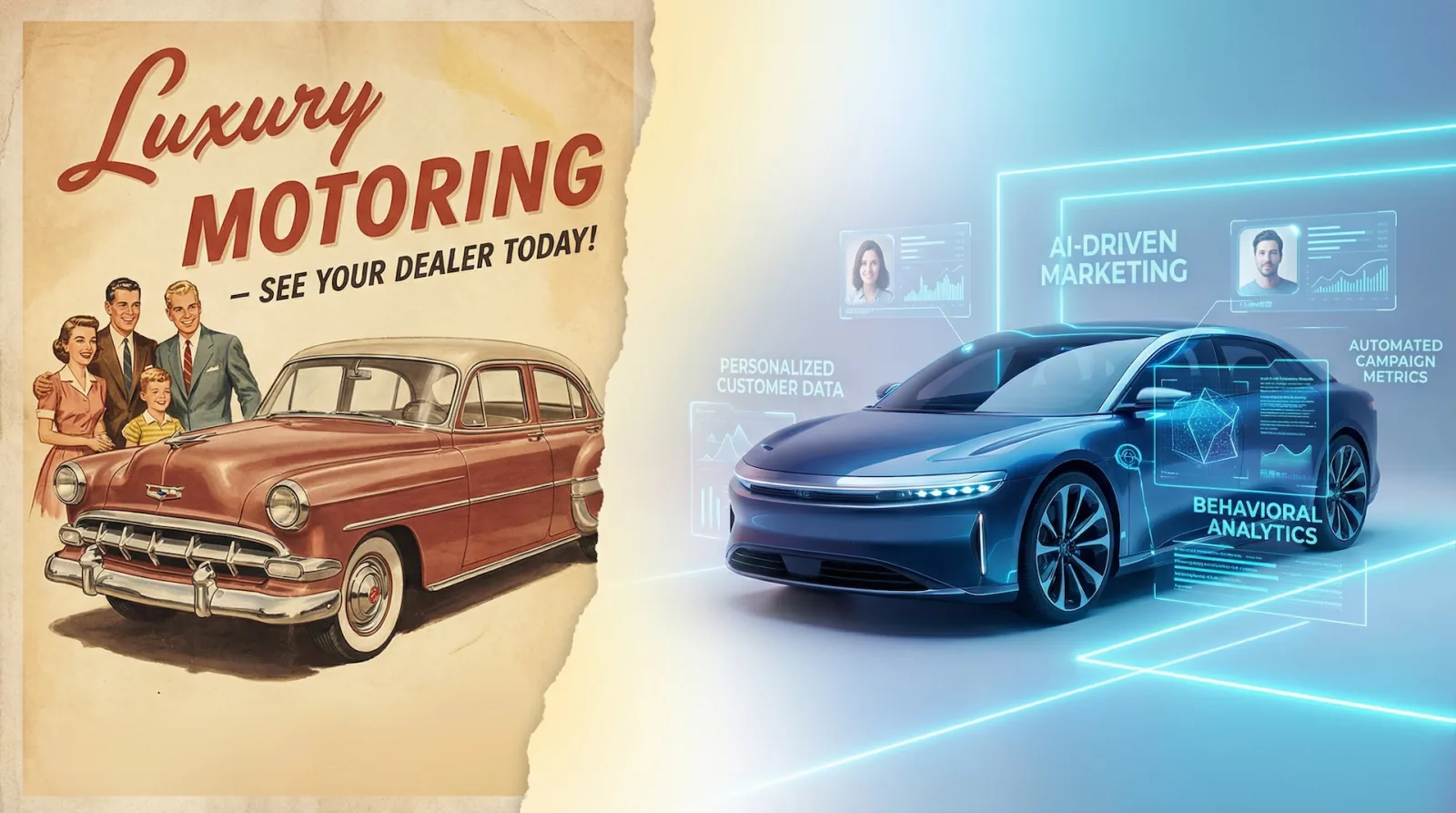
This article reveals how car marketing changed radically — from open marketing wars between giants to futuristic concepts that advertise themselves. We'll trace the path from retro posters to neural networks analyzing every click, examine real cases, and understand why even aviation sector started borrowing strategies from auto industry.
1950s-1970s: Golden Era of Posters and First Marketing Wars
Post-war America went crazy for chrome and fins. Cadillac and Buick ads looked more like spaceships than vehicles — artists hand-painted futuristic concepts, adding elegant women in evening gowns and men in suits. Volkswagen broke this system with the "Think Small" campaign in 1959, proving honesty sells better than fantasies.
1960s television brought new possibilities. Ford Mustang debuted simultaneously on all three U.S. national channels, reaching 29 million viewers in one evening. This was the first large-scale coordinated attack, but tools remained primitive — nobody knew how many people actually came to showrooms after that commercial block.
The real magic began when BMW and Mercedes-Benz launched a marketing rivalry that would define the industry for decades. For years, Mercedes-Benz anchored its identity in slogans like “Engineered like no other car in the world”.
In response, BMW carved out a different path. Since the 1970s, their North Star has been “The Ultimate Driving Machine”. This created a fascinating ideological clash: Mercedes marketed to the passenger who values engineering, while BMW targeted the driver who seeks an emotional connection. This interplay between being “Engineered” versus being “Driven” became the heartbeat of 1980s automotive advertising.
This battle between super-giants was absolutely hilarious. People drove specifically to see new billboards, picked their side, argued in bars about who won the latest round. This stimulated brand communities forming even before they could create internet groups or anything like that. Marketers realized: emotional attachment sells better than technical specs.
1980s-1990s: Computer Databases and Birth of Personalization
By late 80s, automakers started collecting customer data in computer systems. Toyota created one of the first CRM systems tracking purchase history and service records. This allowed sending personalized letters to Camry owners when a new model came out.
Lexus went further, implementing a system where every call to the service center got logged. When a client complained about squeaky doors, the brand didn't just fix the problem — they analyzed how many other owners faced the same issue and launched a preventive campaign. Automotive data analytics was born right here, though the term appeared much later.
BMW in the 90s experimented with CD-ROM catalogs that dealers handed out to potential buyers. The disc had an interactive model presentation with an option to "build" your ideal car. Revolutionary for its time, though today it sounds like a museum artifact.
2000s-2010s: Internet Boom and Digital Revolution
First automaker websites were terrible. Flash animations loaded for five minutes, and configurators constantly crashed. General Motors spent millions on a site where users could "virtually test-drive" a car by pressing keyboard arrows. The idea was brilliant, execution was catastrophic.
Audi changed the rules with an A3 campaign in 2006, completely abandoning TV ads for online video and interactive content. They created a series called "The Art of the Heist" where viewers searched for a "stolen" prototype through social media clues. The campaign won international awards and proved digital could be the main channel, not just a supplement to TV.
Facebook and Instagram gave brands a direct line to consumers. Suddenly marketers could see exactly who watched their posts, how much time they spent on videos, and what comments they left. Mini Cooper launched a campaign where users could "park" virtual Minis on friends' profiles — virality delivered millions of impressions without a dollar spent on traditional advertising.
2015-2020s: Data Becomes the New Oil
Modern connected cars collect terabytes of driving data. Ford uses vehicle data analytics to understand how owners actually use the F-150. Turns out most farmer-buyers never use four-wheel drive, so the next ad campaign focused on cabin comfort and fuel economy rather than ability to cross rivers.
Mercedes-Benz integrated MBUX system data into marketing strategies. If an owner constantly searches for gas stations through navigation, the system might suggest a hybrid model at the next upgrade. Or if the driver frequently uses the voice assistant, they get ads for an expanded AI package. Experts in automotive personalization constantly debate how deep you can go with personalization without violating privacy.
This raises ethical questions, but data analytics in automotive industry already became standard. Volvo openly tells buyers what data it collects and how it uses it — transparency turned into a competitive advantage, especially after data leak scandals in other industries.
Interestingly, even sectors far from automobiles adapted these technologies. Aviation software development companies started using similar approaches for marketing business jets. Custom aviation software development now includes modules analyzing potential client profiles on LinkedIn and offering personalized aircraft presentations. Several aviation software development company outfits even created specialized CRM systems for private aviation, borrowing best practices from auto industry.
Artificial Intelligence and Hyper-Personalization Today
Modern ad platforms use machine learning to predict who's ready to buy a car. Google Ads shows Hyundai Tucson ads to young families who just googled car seats and rising gas prices. This isn't magic — it's algorithmic targeting based on thousands of signals.
Volvo launched a social media analysis project where AI identified potential buyers' life events. New wedding, baby birth, move to suburbs — each event triggers appropriate advertising. The system even analyzed post moods: if someone complained about bad weather, they got ads for all-wheel-drive models.
Premium segment manufacturers invest in aviation management software development approaches for analyzing VIP client behavior. Bentley uses a system tracking when an owner plans international travel (through integration with private aviation companies) and offers car delivery to the destination airport. Aviation software development cost runs high, but for a segment where average check exceeds $200 thousand, the investment pays back through client loyalty.
Chinese Revolution: When Technology Beats Brand
The real upheaval happened with Chinese electric vehicles arriving. Zeekr 001 offers 0-60 in 3.8 seconds, 435-mile range, and a cabin with massage seats for the price of a Volkswagen ID.4. Li Auto L9 creates a cinema hall on wheels with a refrigerator, TV, and medical-grade air purification system. Xpeng P7 learned to automatically park in multi-story garages without the driver at all.
These companies barely spend on traditional advertising. Instead, they invest in technologies that become advertising themselves. When Nio launched a battery swap service taking 3 minutes, every automotive media outlet worldwide covered it. When BYD presented the Blade Battery that you can pierce with a nail without it catching fire, the video went viral without any ad budget. Behind the marketing flash, battery-swap and charging networks like Nio's run on increasingly complex software stacks — which is why software migration for EV charging businesses has become a serious operational discipline as these networks scale across new markets.
Hongqi E-HS9 positions itself as a Chinese Rolls-Royce for a third of the price. Voyah Free offers air suspension with adaptive ground clearance and Nappa leather interior. Tank 500 was built for extreme off-road but with Range Rover comfort levels. Marketing strategy is simple: let journalists test it, and they'll tell the world themselves.
Concepts as Advertising for the Future
Many companies invest in concepts that probably won't come out for the next 10-20 years, but even their release serves as huge advertising everyone talks about. Mercedes Vision AVTR was inspired by the Avatar movie — no steering wheel, biometric control system through the driver's pulse, and side panels moving like gills. This car will never go into production, but it gives hope of getting a spaceship to drive.
BMW Vision Next 100 promised a car growing with its owner, adapting interior and functions to their needs. Audi Skysphere can physically change body length by 10 inches, transforming from GT coupe to sports car. These concepts generate millions of YouTube views, tens of thousands of media publications, and endless social media discussions.
Chinese players also play this game. NIO ET Preview showed a car with a second autopilot for parking when the driver isn't around. Xpeng X2 is literally a flying car the company publicly tests. Human Horizons HiPhi Z has interactive LED panels through which the car "communicates" with pedestrians. Developing such concepts costs a fortune, but the advertising effect is priceless.
Virtual Reality and New Platforms
Audi opened VR showrooms where buyers "sit" behind the wheel of an e-tron GT without leaving home. Goggles reproduce engine sound, steering wheel vibrations, and even new leather smell. Conversion from such virtual test drives runs 40% higher than regular video presentations.
Hyundai bought virtual land in Roblox and created a full dealership there. Teenagers who won't get licenses for another five years already "drive" the Ioniq 5 in the metaverse and form emotional connections with the brand. This is a long-term investment, but automakers understand — today's 15-year-old gamer becomes a buyer in 2030.
Porsche experiments with NFTs, tying digital collectible tokens to real cars. A 911 GT3 owner gets a unique NFT with technical specs of their exact unit. So far this is more of an image thing, but the technology could become the foundation for future loyalty programs.
Ecosystems Instead of Selling Metal
Data analytics in automotive industry now determines not just where to place ads, but what to say. Nissan analyzes millions of social media comments to understand which characteristics actually matter for different segments. Turned out Rogue buyers discuss third-row seat convenience more than engine power — the next campaign completely changed focus.
Chinese manufacturers like NIO already built entire ecosystems: their own cafes under the NIO House brand, user communities with organized road trips, cultural events, and even a home goods line. The car becomes an entry point to a lifestyle brand, not the end goal. Western corporations are still trying to copy this model, but changing corporate culture takes years.
Xpeng created owner clubs with exclusive fast-charging stations and lounge areas. Li Auto organizes family festivals where owners' kids can meet each other. Lynk & Co lets owners rent out their cars through the branded app, creating a sharing economy inside the brand. This isn't selling a car anymore — it's selling a lifestyle.
The Future Is Being Written Now
From hand-painted posters to algorithms knowing more about us than we do ourselves — auto marketing traveled an incredible path. Every technological revolution changed not just tools, but the entire philosophy of communicating with customers. Modern brands don't say "buy our car" — they create personalized journeys where each touchpoint relies on data and analytics.
The most successful players learned to balance technology and humanity. Chinese startups prove futuristic functionality can matter more than a century-old brand history. Volvo shows that transparency in data use builds trust. And concept cars remind us that sometimes a dream about the future sells better than today's reality.
Coming decades will bring even more radical changes. Autonomy, metaverses, neural interfaces — technologies seeming like science fiction today will become standard marketing tools tomorrow. One constant remains unchanged: brands understanding their customers better than competitors always win. Just now that understanding gets measured not in an experienced salesperson's intuition, but in petabytes of data and millions of code lines analyzing our every move in digital space.