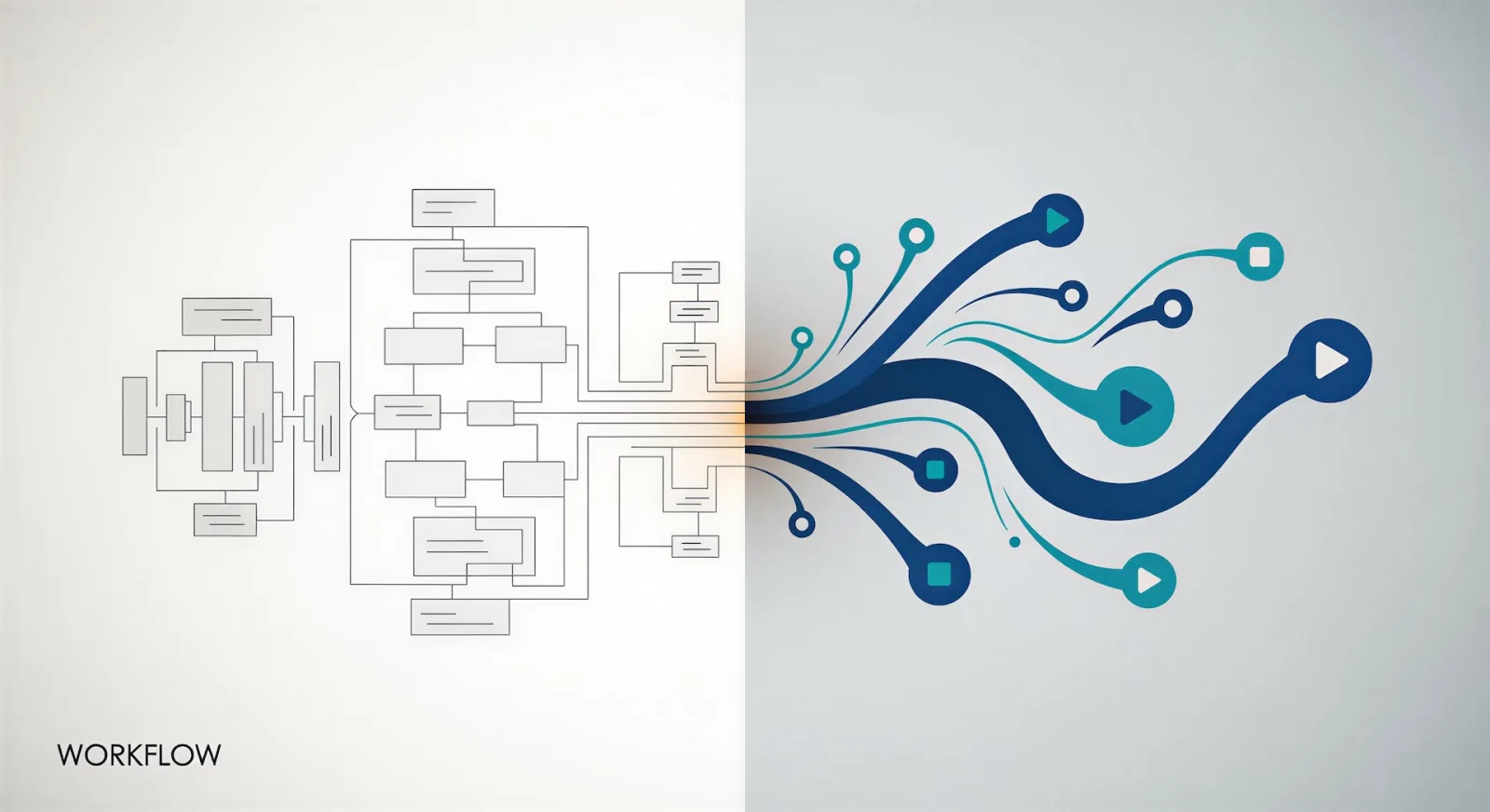
For years, automation followed a predictable formula. A trigger fired, a task ran, and the system waited for the next instruction. If a form was submitted, an email was sent. If a payment cleared, a record updated. These rule-based workflows quietly became the backbone of modern operations, reducing manual effort and helping teams scale without adding headcount.
That model worked well, until it didn’t.
As businesses grew more complex, the limits of task-based automation became harder to ignore. Workflows that relied on fixed rules struggled when conditions changed. Edge cases piled up. Exceptions required constant maintenance. Instead of reducing operational burden, automation sometimes created a new kind of overhead.
Artificial intelligence is now reshaping that landscape. Rather than executing rigid instructions, intelligent workflows can evaluate context, learn from outcomes, and adapt as situations evolve. This shift is not about eliminating human judgment. It is about removing the cognitive friction that keeps teams focused on managing systems instead of moving the business forward.
For small and mid-sized organizations especially, this evolution changes what is possible. Capabilities that once required enterprise budgets and dedicated operations teams are now accessible. The question is no longer whether to automate, but how to build workflows that can reason, respond, and improve over time.
The Limits of Traditional Task Automation
Traditional automation excels at predictable work. Scheduled scripts, rule-based triggers, and if-then logic handle repetitive tasks with speed and consistency. These systems are reliable when the world behaves exactly as expected.
Problems arise when it does not.
A rule-based workflow cannot distinguish between a routine request and a high-risk issue without explicit instructions. It cannot recognize when customer behavior signals a shift in demand. It cannot adjust priorities based on changing market conditions. Every exception requires a new rule, and every rule increases system complexity.
Over time, teams spend more energy maintaining automation than benefiting from it. Workflows become brittle. Small changes ripple through systems unexpectedly. Human intervention remains necessary for anything involving judgment, ambiguity, or context.
This creates a ceiling. Businesses automate the easy work, but the most valuable processes remain manual because they do not fit neatly into predefined logic. Traditional automation saves time, but it does not scale intelligence.
What Makes a Workflow Intelligent?
Intelligent workflows differ fundamentally from rule-based automation. Instead of following fixed instructions, they interpret information and respond based on context.
Three characteristics define intelligent workflows.
First, they are context-aware. They understand not just what happened, but what it means in a broader operational setting.
Second, they are data-driven. They learn from historical outcomes, recognizing patterns that inform future decisions.
Third, they are adaptive. Their behavior improves over time as conditions change and new data becomes available.
This intelligence comes from AI’s ability to model complexity that would be impossible to capture with explicit rules. Machine learning systems can weigh probabilities, detect anomalies, and recommend actions based on patterns humans would struggle to define.
In practice, this means workflows that prioritize tasks dynamically rather than chronologically, adjust actions based on real-time signals, and surface insights proactively instead of waiting for manual analysis.
How AI Agents Extend Workflow Intelligence
AI agents represent the next layer of evolution in workflow design. While intelligent workflows interpret context within defined processes, AI agents pursue objectives across systems, making decisions along the way about how best to achieve a desired outcome.
An AI agent is not a simple script or chatbot. It can understand goals, plan multi-step actions, execute tasks across tools, and adjust its approach based on results. Where traditional automation connects fixed points, agents navigate between them. Understanding how to create an AI agent conceptually helps teams recognize this difference and design workflows that take advantage of autonomy without adding unnecessary complexity.
Consider customer feedback management. Instead of merely collecting responses and storing them in a database, an AI agent can analyze sentiment, identify emerging issues, draft appropriate replies, escalate sensitive cases to human teams, and update internal documentation. Each action informs the next, creating a continuous loop of learning and response rather than a static process.
This orchestration capability is especially valuable in environments where work spans multiple platforms and requires coordination. AI agents act as operational conductors, bringing together data from different systems, maintaining context, and executing decisions while allowing humans to focus on strategy and oversight.
Importantly, agents are most effective when they operate between extremes. They do not replace executive judgment, nor do they outperform simple automation for straightforward tasks. Their real value lies in synthesizing information, managing transitions, and executing decisions at scale in situations where context, timing, and adaptability matter.
Real-World Applications in Daily Operations
The impact of intelligent workflows becomes clear when examining everyday use cases.
Operations and Resource Management
Intelligent workflows help teams anticipate demand rather than react to it. By analyzing historical patterns and real-time signals, systems can flag bottlenecks before they escalate, recommend staffing adjustments, and surface process inefficiencies automatically.
Instead of managing schedules manually, teams receive decision support that evolves as conditions change.
Marketing Execution
Marketing workflows benefit from intelligence that adapts rather than follows static plans. Modern systems analyze engagement across channels, adjust timing based on audience behavior, and identify emerging trends without constant manual analysis.
This approach is reflected in platforms such as Creatio, where AI agents increasingly coordinate actions across channels rather than relying on fixed automation sequences. Marketing teams spend less time managing tools and more time refining strategy.
Internal Reporting and Decision Support
Static reports often bury insights under noise. Intelligent workflows monitor metrics continuously, flag meaningful deviations, and generate summaries tailored to different stakeholders.
Instead of searching for answers, leaders receive context-rich insights when action is required.
Customer Communication
AI-driven workflows can classify inquiries by urgency, sentiment, and history, route them intelligently, and draft appropriate responses. Human teams focus on complex or sensitive cases, while routine interactions are handled consistently and quickly.
Across functions, the common benefit is not just speed, but clarity. Intelligent workflows reduce errors, surface insights earlier, and allow teams to apply human judgment where it matters most.
Challenges When Moving Beyond Automation
Adopting intelligent workflows introduces new considerations.
Data Quality and Accessibility
AI systems rely on data integrity. Poor data leads to poor decisions. Many organizations discover that moving toward intelligence requires addressing long-standing data hygiene issues, standardizing inputs, and improving system integration.
Trust and Transparency
Teams must understand how decisions are made. Intelligent workflows should never operate as black boxes. Clear decision boundaries, auditability, and human override mechanisms are essential for building confidence.
Change Management
Shifting from manual control to autonomous systems can be uncomfortable. Successful organizations invest in education, communicate clearly about roles, and introduce intelligence gradually.
Starting Small
The most effective implementations begin with low-risk processes where outcomes are measurable. Proof of value builds momentum and internal expertise before expanding to more complex workflows.
Human oversight remains critical. Intelligence augments expertise. It does not replace accountability.
Designing for Intelligence, Not Just Efficiency
The move from task automation to intelligent workflows represents more than a technical upgrade. It signals a change in how businesses think about work.
Efficiency alone is no longer sufficient. As complexity increases, organizations need systems that can reason, adapt, and support decision-making at scale.
The businesses seeing the greatest benefit share a common mindset. They design workflows intentionally. They match intelligence to the right problems. They remain realistic about AI’s limits. And they treat implementation as an ongoing process, not a one-time project.
As AI capabilities continue to mature, the gap between organizations that leverage intelligent workflows and those that rely on traditional automation will widen. The advantage will come not only from cost savings, but from agility, insight, and resilience.
The opportunity is substantial. Success depends on thoughtful design, strong data foundations, and clear alignment between technology and human expertise. When those elements come together, workflows stop simply executing tasks and begin supporting smarter ways of working.