
Not long ago, a private school’s reputation traveled mostly by word of mouth, discussed in country clubs, shared in church basements, and reinforced through alumni networks. Tradition and prestige did the heavy lifting, while the school’s thick, glossy brochure filled in the remaining details for prospective parents.
That world has changed. Today’s digital parents research schools the same way they research hotels or restaurants: online. Reviews, social media conversations, and education forums all shape first impressions.
And the stakes are high. According to the National Center for Education Statistics (NCES), roughly 29,730 K–12 private schools operated across the U.S. during the 2021–22 school year, giving families thousands of options to consider.
In this environment, reputation doesn’t begin at the front gate. It begins online. Tradition and prestige still matter, but they now work best when supported by a strong digital presence. For privately funded institutions competing for enrollment, a thoughtful online reputation strategy has become essential for standing out and earning parents’ trust.
In this article, we’ll explore several practical online reputation strategies private schools can use to strengthen credibility and attract prospective families.
Earning Parents’ Trust Before The First Campus Visit
With the average day school tuition nearing $50,000 per year, families expect more than strong academics, high-quality tutors, and extensive networking. They want an institution that offers security and credibility, while having a strong public image (both online and offline).
The importance of reputation in education is so significant that even major tech platforms have taken notice. As of April 30, 2025, Google removed reviews and star ratings from the Business Profiles of K–12 schools, including private institutions, to limit prank negative online reviews and curb misinformation.
A private school's reputation and online presence also play a role in attracting philanthropic support through annual funds, endowments, and fundraising initiatives.
However, everything starts with earning digital parents’ trust. Being able to convince enough parents to trust your institution with their children's education and future is a strong vote of confidence.
The good news? You have lots of examples to learn from. Even highly prestigious institutions, with hundreds of years of tradition, like Harvard and Stanford, are now online, building their presence.
Here’s what you can learn from their path to a strong online presence:
Harvard University’s Social Media Presence
Harvard’s approach to the online world was to create a global digital campus that spans several platforms, like:
- Instagram: focused on the Harvard Crimson aesthetic and student spotlights
- LinkedIn: for faculty research, alumni achievements, and executive education
- X (Twitter): used for breaking research news, Nobel Prize announcements, etc.
- TikTok: mostly student-run or student-focused, it humanizes the brand
- YouTube: long-form, free educational content
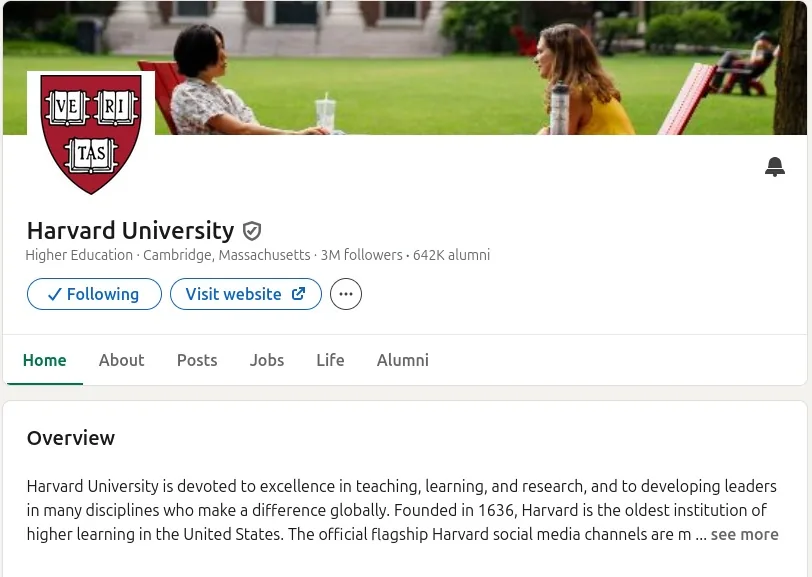
Screenshot of Harvard’s LinkedIn page
Harvard excels at translating dense academic papers into snackable social content, which boosts their authority online. They frequently use data visualizations and short-form video interviews with faculty to explain complex topics (e.g., climate change, AI ethics, or public health).
Stanford University’s Branding Efforts
Stanford’s branding strategy is defined by agility, proximity, and The Cult of the Future. Their marketing team leans heavily into the fact that its alumni have founded companies generating $2.7 trillion in annual revenue (roughly the GDP of the world's 10th largest nation).
Their Stanford Business Insights platform acts as a high-end media outlet. To maintain brand authority, they publish daily on how AI is changing marketing, consumer psychology, and leadership.
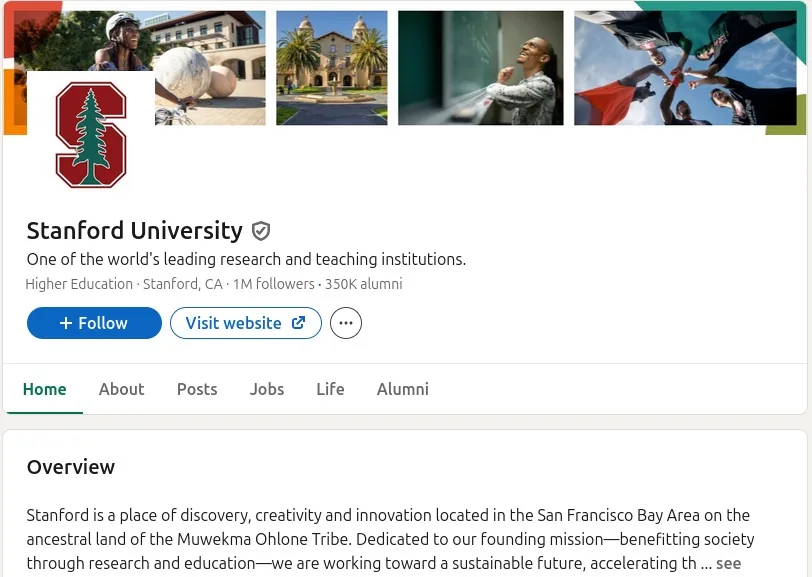
Screenshot of Stanford’s LinkedIn page
On social media, Stanford focuses on a simple aesthetic and tries to demystify the elite experience by offering a peek behind the curtain. This way, they attract students who enjoy a more practical approach to education.
Private School Online Reputation Strategies That Work
To be fair, most K-12 private schools don’t have Harvard or Stanford’s budgets, but that doesn’t mean there’s nothing to learn from their online presence-building strategies.
Here are a few, easy-to-implement steps that are almost guaranteed to earn digital parents’ trust:
Build Your Online Presence
The first step toward building trust online is a professional website. In the age of AI and apps, if you don’t have a clean-looking, easy-to-navigate website, you don’t exist. Also, today’s digital parent uses their phone to look things up, so a mobile-friendly layout is a must.
Use the “don’t tell, show!” rule wherever possible. Instead of saying "We offer small classes," make it clear with a data visualization showing your 12:1 student-teacher ratio and a video of a real seminar-style discussion.
Next, establish your institution as an authority in the field using clever content marketing. Here are a few ideas:
- A school blog that presents your special educational programs
- Offer high-value downloads to capture email leads
- Host faculty-written research or thought leadership on your website
- Encourage student and parent-generated content on your social media channels
- Include short-form video content in your strategy
Data Safety and Privacy Measures
After the PowerSchool data breach in December 2024 exposed millions of students’ sensitive information, parents are much more concerned about data safety and privacy. Furthermore, under the Family Educational Rights and Privacy Act (FERPA), schools are responsible for protecting the privacy of their students' education records.
Therefore, a solid cybersecurity system is a must-have for modern private schools. But it’s also a great opportunity to stand out. Use news, articles, social media posts, and other forms of content to let viewers know about your school’s data safety procedures and systems.
An even better way to attract digital parents’ attention is by getting an ISO 27001 certification for the school. ISO 27001 in the education sector covers many of the same requirements as GDPR, FERPA, and HIPAA, and schools that meet this standard are basically future-proof against evolving privacy laws.
Have an Online Reputation Management System
Even if Google no longer allows reviews on private schools’ Business Profiles, negative reviews and discussions are inevitable. This is not the end of the world; the real success comes from how you handle these situations.
Use a software tool to track the school’s mentions online, and try to respond as much as possible. It’s a great way to show your team is engaged and ready to listen.
If there are negative mentions, acknowledge the concern publicly ("We value this feedback and take it seriously...") but immediately move the conversation to a private channel ("...we would like to discuss this further with you via a call with our Head of School").
Also, regularly publish SEO-optimized blogs about student achievements to push negative news or old threads off the first page of search results.
Be Open About AI Ethics and Usage
Until recently, the use of generative AI by students and teachers has been a bit of a no-man’s-land. But things are starting to change. Over 30 US states have already adopted AI education policy guidelines, and the rest will most likely follow soon.
Beyond the obvious fear that improper use of AI in education could harm young minds, unregulated AI poses a data-breach risk. However, ignoring the topic is not the answer either.
Parents know this and want schools brave enough to broach the subject. The best approach is to create a public-facing AI Ethics & Integration Policy that explains how generative AI is used by teachers, staff, and students.
Trust Starts Online
Most parents today research between three and six schools before deciding which campuses are worth visiting in person. If your school’s online presence doesn’t inspire confidence during that initial search, those families and the top students you hope to attract will simply move on to the next option.
Check out our resources and services to learn more about strengthening your institution’s online game!