
SE Ranking API is a top Ahrefs API alternative. The SE Ranking API offers a focused set of endpoints tailored to practical SEO applications. Instead of trying to cover every possible dataset, it prioritizes the data most teams actually use—such as rankings, keywords, and search visibility. This approach results in faster integration and more predictable usage.
The best Ahrefs API alternatives allow flexible, linear scaling. Start with a $40 production plan. Scale to 5 million requests when the application actually gains traction and requires it. Never pre-purchase massive capacity based on assumed growth. Because when you dump three million rows into a Postgres database without sanitizing the JSON-RPC response first, you end up with massive memory leaks anyway.
Choosing an Ahrefs API competitor depends entirely on the technical stack you already use. Looker Studio integrations require clean CSV formats or native connectors. RAG agents require MCP servers to function correctly. Define the absolute output requirement first. Then select the provider that matches that exact schema.
Comparison Table of Best Ahrefs API Alternatives
| Tool | Best For | Starting Price | Key Limitation | Free Tier |
|---|---|---|---|---|
| SE Ranking API | Agency reporting & keyword tracking | $318/mo (annual) | 10 requests per second limit | 14-day trial (100k credits) |
| Zenserp | Real-time search engine scraping | $49.99/mo | Lacks proprietary SEO metrics | 50 searches per month |
| Semrush API | Enterprise marketing & huge databases | $499.95/mo | Requires Business Plan subscription | None |
| SearchApi | High-compliance SERP extraction | $40/mo | Hourly rate limits | 100 free searches |
| Moz API | Affordable historical link data | $20/mo | Smaller keyword database | 50 rows per month |
| ScaleSERP | Massive volume of unauthenticated queries | $23/mo | Severe timeout errors under load | 125 free searches |
SE Ranking API
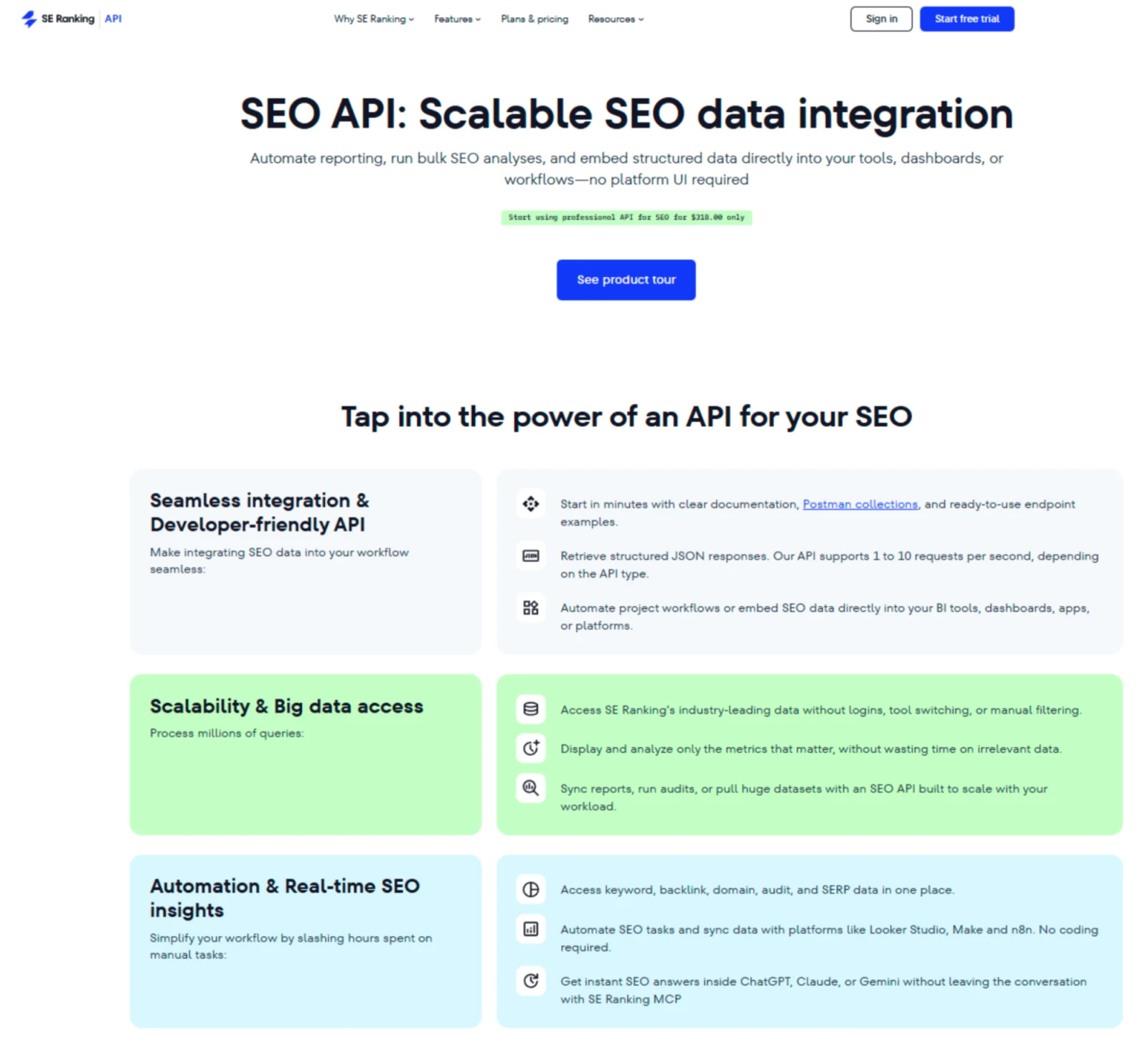
SE Ranking functions as a massive data repository for agencies and internal marketing teams. They split their technical architecture, with the SE Ranking API handling data extraction processes. This keeps heavy data extraction isolated from simple account management tasks.
What are the key features of SE Ranking API?
- Dual API Architecture: The system separates everything into a Data API and a Project API. The Data API handles the heavy lifting of raw extraction. Engineers hit this endpoint to retrieve SERP configurations or backlink profiles across massive lists of URLs. The Project API manages account resources like adding websites or updating tracking settings.
- Massive Keyword Database: The infrastructure connects to an internal database containing over 5.4 billion keywords. It also tracks 2.7 trillion historical backlinks. Making it a very serious Ahrefs API competitor for teams needing deep historical metric lookups.
- AI Search Tracking: Endpoints capable of tracking domain visibility across large language models. The system monitors 31 million domains tracked in Google AI Overviews. Which is insane given how fast search generative experiences change.
- Granular Error Codes: The API returns strict HTTP status codes that make debugging easy. A 403 error flags an incorrect token. A 404 error triggers for an unknown site engine ID. A 429 error fires when applications exceed the hard request limit.
- MCP Server Integration: They offer an official Model Context Protocol server. This allows AI assistants like Claude to query SE Ranking data using natural language directly within the chat interface. A major advantage over older tools stuck in the mud.
What are the pros and cons of SE Ranking API?
Pros:
- It acts as an incredibly fair alternative to Ahrefs API because the API package is available as a standalone product. You do not need an active software subscription to buy the API credits.
- The trial period is extremely generous. Developers get a 14-day trial that includes 100,000 free API credits to build out their test environments.
- Detailed asynchronous operations. For heavy requests like exporting backlinks the system generates a task. Your script then polls the status endpoint until the data is ready to download.
Cons:
- The rate limits are brutal for trial users. During the trial period the Data API restricts you to exactly 1 request per second. Production plans only bump this to 10 requests per second.
- Their database of 5.4 billion keywords is large but still falls short of the biggest players in the industry who boast over 27 billion keywords.
What is the pricing of SE Ranking API?
- Core plan: 25,000 credits/month; subscription starts at $103.20/mo billed annually.
- Growth plan: Includes 100,000 Data API credits/month; subscription starts at $223.20/mo billed annually.
- Annual Minimums: The cheapest entry point starts at $318.00 per month. But it requires annual billing upfront which totals $3,816.00 per year. This grants 24,000,000 credits per year.
- Credit Math: Retrieving records costs 10 credits per record. If you query 10,000 requests to pull a single record each that equals 100,000 credits burned.
- Endpoint Variability: Complex requests cost more. A simple SERP request costs 10 credits. A domain overview call requires 100 credits. Heavy LLM-related requests pull 2,000 credits per call.
SE Ranking provides two distinct APIs: the Data API, which uses a pay‑as‑you‑go credit system for raw data retrieval, and the Project API, which uses your subscription limits for project management functionality.
Zenserp
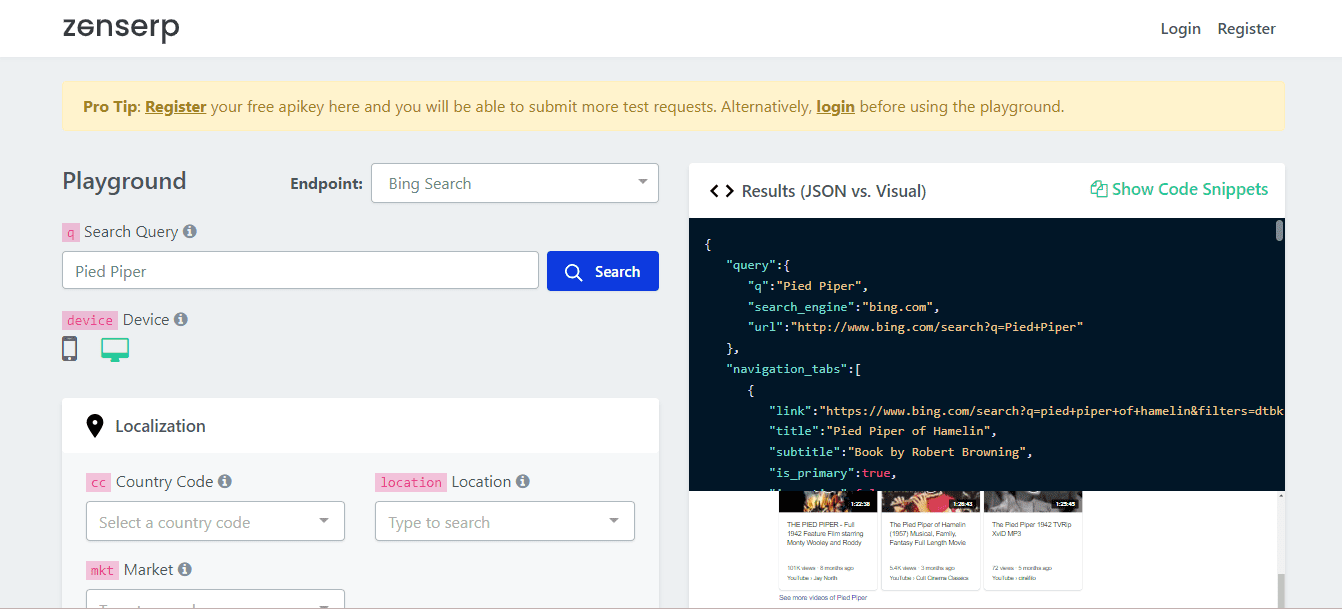
Zenserp operates entirely differently than proprietary metric databases. It functions as a proxy-based scraper. It pulls live data directly from the actual search engines in real time. Providing an alternative to Ahrefs API for developers who want raw live HTML.
What are the key features of Zenserp?
- Multi-Engine Capabilities: Endpoints cover a huge variety of search properties. This includes Google Search, Google Images, Google Maps, News, Trends, YouTube, Bing, Yandex, and DuckDuckGo.
- High Concurrency Processing: Standard paid plans encourage up to 400 concurrent connections. Heavy data pipelines can run thousands of queries simultaneously without massive queueing delays backing up the server.
- Asynchronous Batch Endpoint: Medium plans and higher unlock dedicated batch processing. You push a massive list of keywords to the server and retrieve the parsed JSON later. Removing the need to keep HTTP connections open.
- Interactive Request Builder: The platform provides a graphical interface that converts custom parameter selections into production-ready code snippets. You just copy the Python or Node code directly into your application.
- Precise Geolocation Spoofing: Parameters enforce strict geolocated results. You can spoof user searches from specific coordinates or exact zip codes anywhere in the world.
What are the pros and cons of Zenserp?
Pros:
- It is the best Ahrefs API competitor for matching raw data scale. The database holds 27.3 billion keywords globally. Which is massive.
- Integrates paid search data directly into the endpoints. You can extract PPC ad histories and product listing ads alongside organic rankings.
- Granular parameter control saves bandwidth. The export_columns parameter dictates exactly which fields return in the CSV output. Minimizing your total payload size significantly.
Cons:
- The barrier to entry is extremely high. Users must hold an active Business Plan subscription costing $499.95 per month just to have the privilege of purchasing API units.
- The unit consumption logic is notoriously complex. Different endpoints consume wildly different unit amounts per row. Making cost forecasting a nightmare for financial teams.
What is the pricing of Semrush API?
- Base Subscription Requirement: You cannot just buy the API. You must pay $499.95 per month for the Business Plan first.
- Unit Packages: API units are purchased on top of the base subscription. They sell them in scalable packages of 2 million, 5 million, 10 million, or 20 million units.
- Monthly Expiration: Unused API units expire at the end of your billing cycle. They do not roll over to the next month.
- Trends API Add-ons: The Trends API requires entirely separate subscription plans tailored for marketers focused on benchmarking traffic statistics.
SearchApi
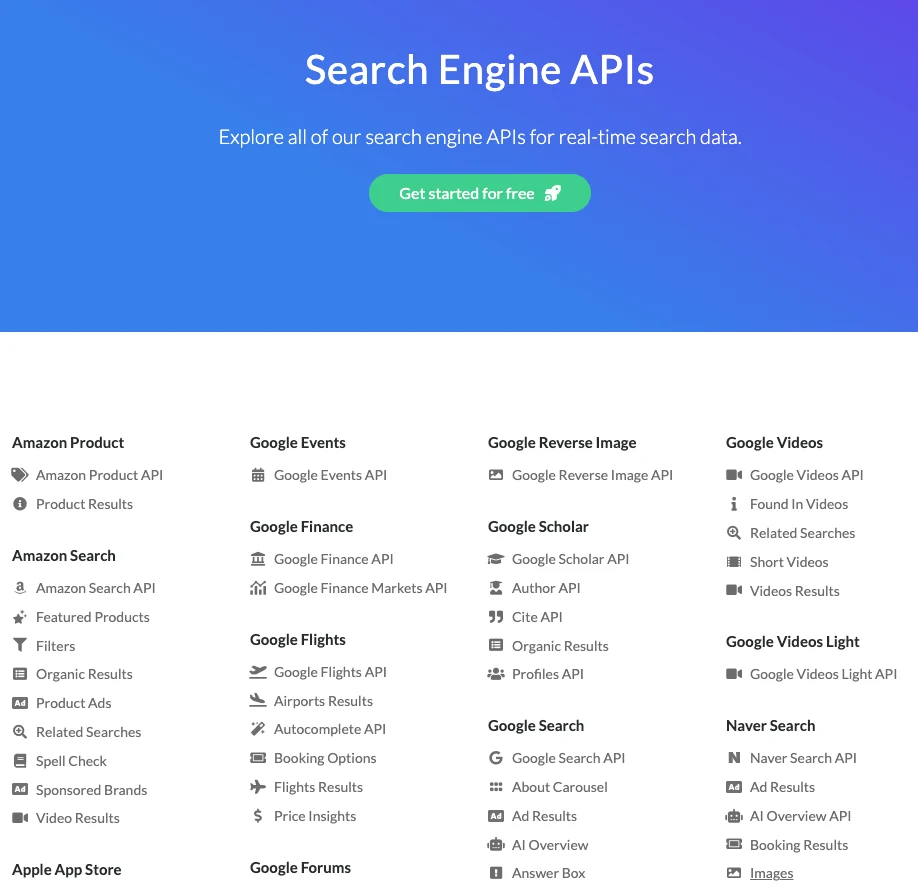
SearchApi engineers built a highly specialized scraping infrastructure. It bypasses bot protections to deliver raw public data reliably. It serves as a true alternative to Ahrefs API for teams actively monitoring generative search features.
What are the key features of SearchApi?
- Global Proxy Network: The system routes every single request through a pool of 20 million premium rotating proxies. This bypasses blocking mechanisms efficiently and prevents IP bans.
- Entity Identification Parameters: The API accepts specific Knowledge Graph identifiers. Passing a parameter like kgmid=/m/02_286 targets exact entities like New York precisely without text ambiguity.
- UULE String Generation: The API builds exact Google-encoded location strings automatically. Allowing for hyper-local search extraction without requiring you to encode the strings manually.
- Zero Data Retention Mode: An enterprise flag disables all server logging entirely. No request parameters, HTML payloads, or JSON responses are stored persistently on their servers. Useful for high-compliance projects.
- Account Analytics API: They provide an endpoint dedicated entirely to checking your current month usage, remaining credits, and hourly limits dynamically.
What are the pros and cons of SearchApi?
Pros:
- They are one of the best Ahrefs API alternatives for strict legal compliance. Production plans include a Legal Protection Guarantee backed by up to $2M in coverage under U.S. law.
- Billing is strictly success-based. Only HTTP 200 codes trigger a charge. Failures and timeouts are completely ignored by the billing system.
- The JSON outputs structure organic results, paid ads, local map packs, and AI overviews distinctly. Making the parsing process incredibly smooth.
Cons:
- A hard rate limit restricts velocity. Users can only consume up to 20% of their total monthly plan credits within a single hour. Which limits sudden massive batch jobs.
- The recent phasing out of the google_domain parameter forces developers to rewrite legacy code that relied heavily on country code top-level domains for localization.
What is the pricing of SearchApi?
- Developer Plan: $40 per month. This provides 10,000 searches resulting in a cost of $4 per 1,000 successful queries.
- Production Plan: $100 per month. Yields 35,000 searches and unlocks team management features alongside the legal guarantee.
- BigData Plan: $250 per month. Increases the limit to 100,000 searches.
- Scale Plan: $500 per month. Provides 250,000 searches and unlocks high throughput speeds.
- Octo High Volume Plans: Scales all the way up to $5,000 per month for 5,000,000 searches with completely dedicated server throughput.
Moz API

Moz completely rebuilt their delivery system recently. The transition from V2 to V3 introduced highly modern protocols. For raw link extraction it serves as a powerful alternative to Ahrefs API at a fraction of the cost.
What are the key features of Moz API?
- JSON-RPC 2.0 Protocol: Version 3 abandons standard REST endpoint architecture entirely. It exposes a single URL that accepts remote procedure calls. You pass a method name directly in the body of your request.
- Simplified Custom Headers: They removed the clunky signed authentication requirements of V1. Developers simply pass an x-moz-token header to authenticate instantly.
- Massive Link Index: Queries run against a historical database containing approximately 44.8 trillion links.
- Proprietary Authority Metrics: Endpoints return Domain Authority, Page Authority, and Spam Score instantly. These metrics power thousands of custom reporting tools globally.
- Beta Methods Quota: Beta testing endpoints draw from a completely separate quota allocation. This prevents your experimental queries from causing overage charges on your main production pipelines.
What are the pros and cons of Moz API?
Pros:
- Exceptionally low entry costs. This is the best Ahrefs API alternative for developers on a budget because plans start at just $20 per month.
- The unified V3 instance aggregates keyword metrics, link intersect data, and brand authority into a single clean data structure.
- Clean row-based counting mechanics. Single-object results consume exactly one row of your quota.
Cons:
- The keyword database contains roughly 1.25 billion keywords. Which is significantly smaller than the market leaders and limits long-tail research.
- Weighted endpoints like bulk link intersections consume multiple rows per call. This burns through small quotas very rapidly if you are not tracking usage carefully.
What is the pricing of Moz API?
- Free Plan: Allows one request every ten seconds. Strictly capped at 50 rows per month.
- Starter Medium Tier: $20 per month for 3,000 rows. No overages are permitted at this level.
- Starter Large Tier: $75 per month for 15,000 rows. Overages are billed at $5 per 1,000 additional rows.
- Growth Small Tier: $125 per month for 50,000 rows.
- Advanced Tier: $2,000 per month for 4 million rows.
- Enterprise Tier: $10,000 per month for 40 million rows. Designed for commercial product integrations.
ScaleSERP
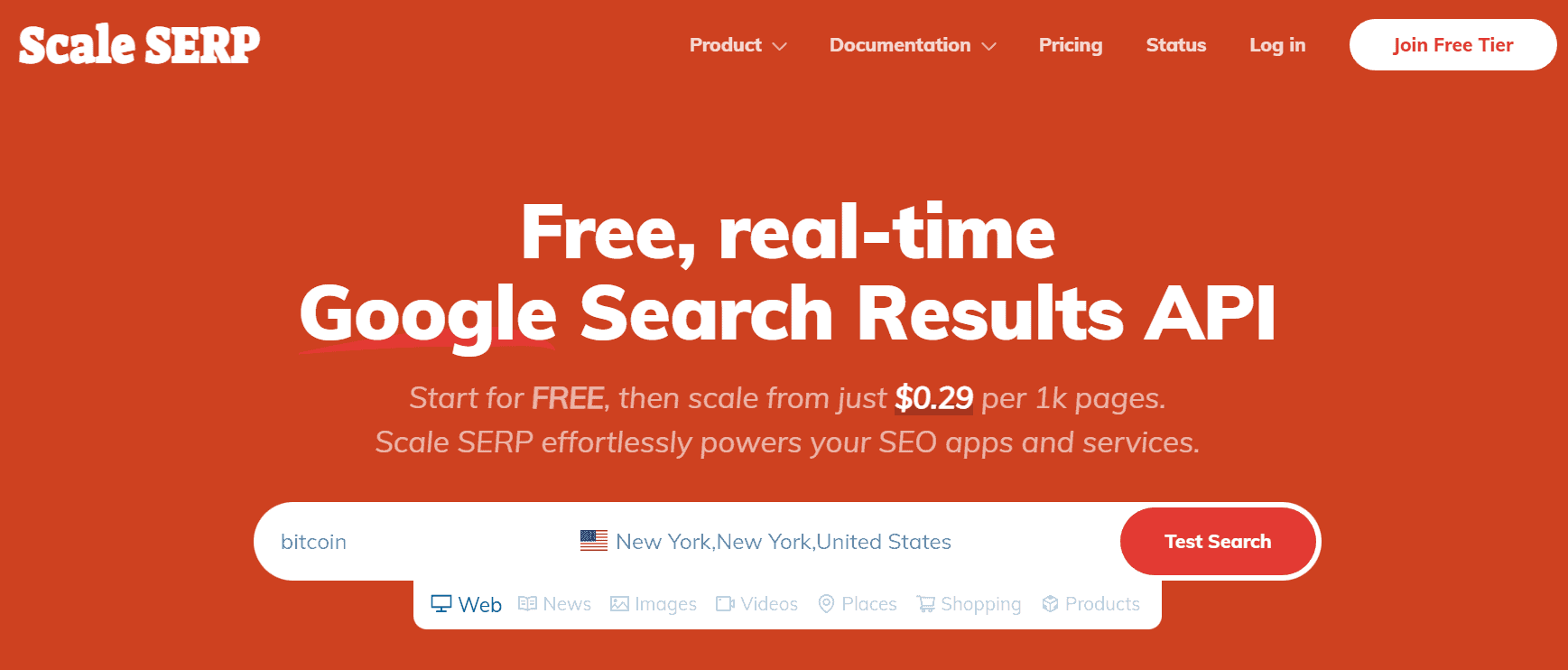
ScaleSERP targets extreme data volume above all else. The infrastructure handles millions of queries effortlessly. It appeals primarily to engineers building massive automated rank tracking applications who need alternatives to Ahrefs API for scale.
What are the key features of ScaleSERP?
- No Throughput Limits: The infrastructure permits unlimited concurrent connections. The API never throttles active data streams regardless of how many requests you fire simultaneously.
- Batches Feature: Developers push up to 15,000 requests into a single batch file. The server processes them asynchronously on an automated schedule.
- Real-time Processing: Bypasses queueing mechanisms for direct API calls. Returning scraped DOM data immediately to your application.
- Place Reviews Output: Specialized endpoints exist solely to extract local business reviews using data_id targeting parameters.
- Custom Cloud Destinations: Enterprise tiers allow the system to push batch result sets directly into Amazon S3 buckets or Google Cloud Storage automatically.
What are the pros and cons of ScaleSERP?
Pros:
- One of the absolute cheapest per-query costs in the entire sector. High volume accounts drop below $0.002 per search.
- Only successful searches deduct from the plan limit. Account calls and failed requests remain completely free.
- The main Ahrefs API competitors advantage here is raw speed across millions of unauthenticated SERP queries.
Cons:
- User reviews on platforms like Trustpilot frequently cite severe timeout errors and stability issues during massive traffic spikes.
- Support response times lag significantly behind competitors. Multiple reviewers note completely ignored support tickets when systems fail.
What is the pricing of ScaleSERP?
- Free Trial: 125 free searches per month to test the code. No credit card required.
- Entry Tier: $23 per month for 1,000 requests.
- 10K Tier: $66 per month when billed annually. Overages hit at $0.0118 per search.
- 50K Tier: $199 per month. Overages drop to $0.00796 per search.
- 250K Tier: $599 per month.
How to choose the best Ahrefs API alternative?
Evaluating technical data infrastructure requires absolute precision. Procurement teams fail miserably when they select providers based entirely on glossy marketing copy. To identify the optimal alternatives to Ahrefs API, engineers must first audit their exact internal data consumption patterns. If an application requires 100,000 daily keyword difficulty scores then raw scraping tools will fail completely. They simply do not possess proprietary metrics.
Conversely. If a team monitors hyper-local map pack rankings across 500 different zip codes then a proprietary database provides totally useless data. They lack the real-time geographic granularity needed to verify local pack shifts. The best Ahrefs API alternatives strictly align with the exact data format the application consumes. Analysts categorize technical requirements into three distinct buckets:
- Proprietary link graphs
- Search volume estimators
- Live SERP rendering engines
Latency metrics define the viability of the best Ahrefs API alternative. Synchronous applications require responses under two seconds to prevent user timeout errors on the front end. Asynchronous reporting dashboards tolerate five-minute batch processing delays perfectly fine. Providers utilizing rotating proxies experience wild latency spikes when target search engines deploy aggressive CAPTCHA blocks. This causes scripts to hang.
An Ahrefs API competitor must provide robust technical documentation. Look closely for OpenAPI specifications. Check for SDK availability in Python, Node, and Go. Examine the error handling protocols thoroughly. Does the provider return a generic 500 error when something breaks? Or do they specify a 404 for an unknown site_engine_id? Detailed error codes reduce debugging hours massively for your engineering team.
Security and compliance matter deeply for enterprise integration. SearchApi disables logging entirely for strict data compliance. Semrush utilizes OAuth 2.0 to secure tokens. Assess the legal frameworks too. Extracting public data carries inherent risk depending on your jurisdiction. The best Ahrefs API competitors offer explicit legal protection guarantees to shield enterprise clients from scraping litigation.
You have to look at the JSON structure. Some APIs dump a massive nested array that requires complex parsing logic to extract a single rank position. Others provide clean, flat JSON objects. Vibecoders and rapid prototypers usually prefer the latter because it saves hours of writing regex. Ask your development team what format they prefer to work with before signing an annual contract.
Conclusion
The data extraction market matured significantly over the past three years. Finding Ahrefs API alternatives no longer requires sacrificing data quality or settling for broken scrapers. Teams transition away from restrictive enterprise bundles by routing specialized queries to dedicated providers. SE Ranking covers budget-friendly metric data effortlessly. Zenserp handles massive proxy networks without breaking a sweat.
Engineers building custom internal tooling benefit massively from the fragmentation. They piece together alternatives to Ahrefs API to form resilient, multi-source data pipelines. A single provider dependency creates a dangerous single point of failure. If one API changes its pricing model overnight your entire tool breaks. Diversification is key.
FAQ
What are the primary use cases for these tools?
Developers use these data endpoints to build automated reporting dashboards, track competitor keyword movements at scale, monitor AI Overviews citations, and extract local map pack data for franchise businesses.
Is there a free tier available for testing?
Yes. SE Ranking offers 100,000 credits and a 14-day trial. Zenserp offers 50 free searches monthly. ScaleSERP provides 125 free searches. Moz includes a free tier capped at 50 rows per month. SearchApi gives 100 free testing requests to verify your code works.
Which provider has the largest backlink database?
According to our data, Semrush offers 43 trillion links. Moz provides an affordable entry point to a massive 44.8 trillion link index.
Which tool is best for AI agent integration?
SE Ranking provides MCP server access, allowing AI assistants to query SEO data using natural language directly.
Do the best Ahrefs API competitors suffer from strict rate limits?
Yes. SE Ranking restricts the Data API to 10 requests per second. SearchApi caps hourly usage at 20% of the monthly allowance. The best Ahrefs API competitor enforces these limits to guarantee high uptime across the network for all users.