
Families will ask your admissions office about a new tax credit. If you're a head of school with 260 students, a 12- to 15-member board, and an admissions office of two, you've probably heard about it already from a board member or a parent who read a headline. The federal scholarship tax credit private schools keep hearing about applies to gifts made on or after Jan. 1, 2027, according to the IRS. The proposed rules came out Oct. 1, 2026. The final rules haven't.
That timing puts you in an awkward spot. Say nothing, and your school looks unprepared at the November open house. Promise a dollar amount, and you've made a commitment nobody can back up yet. There's a calm middle path.
I work with private school leaders on tuition pages and inquiry flow, and policy changes like this reach the admissions desk months before anyone updates the website. This post covers what passed, who qualifies, what's settled, what's open, what families will ask, and five things to do before January. It's about what your school should do, not whether the law is a good idea.
One limit up front: this credit won't fill seats on its own. You don't control whether your state opts in, and SGOs, not schools, decide who receives a scholarship and how much. New programs like this also start slowly. EdChoice's 2023 analysis highlights that state tax-credit scholarship programs averaged 0.35% take-up among eligible students in their first year and about 1.86% by their tenth year. The first-year win is accuracy, not volume.

Written By: Adam Bennett | October 13, 2026
Adam is the president and founder of Cube Creative Design and specializes in private school marketing. Since starting the business in 2005, he has created individual relationships with clients in Western North Carolina and across the United States. He places great value on the needs, expectations, and goals of the client.
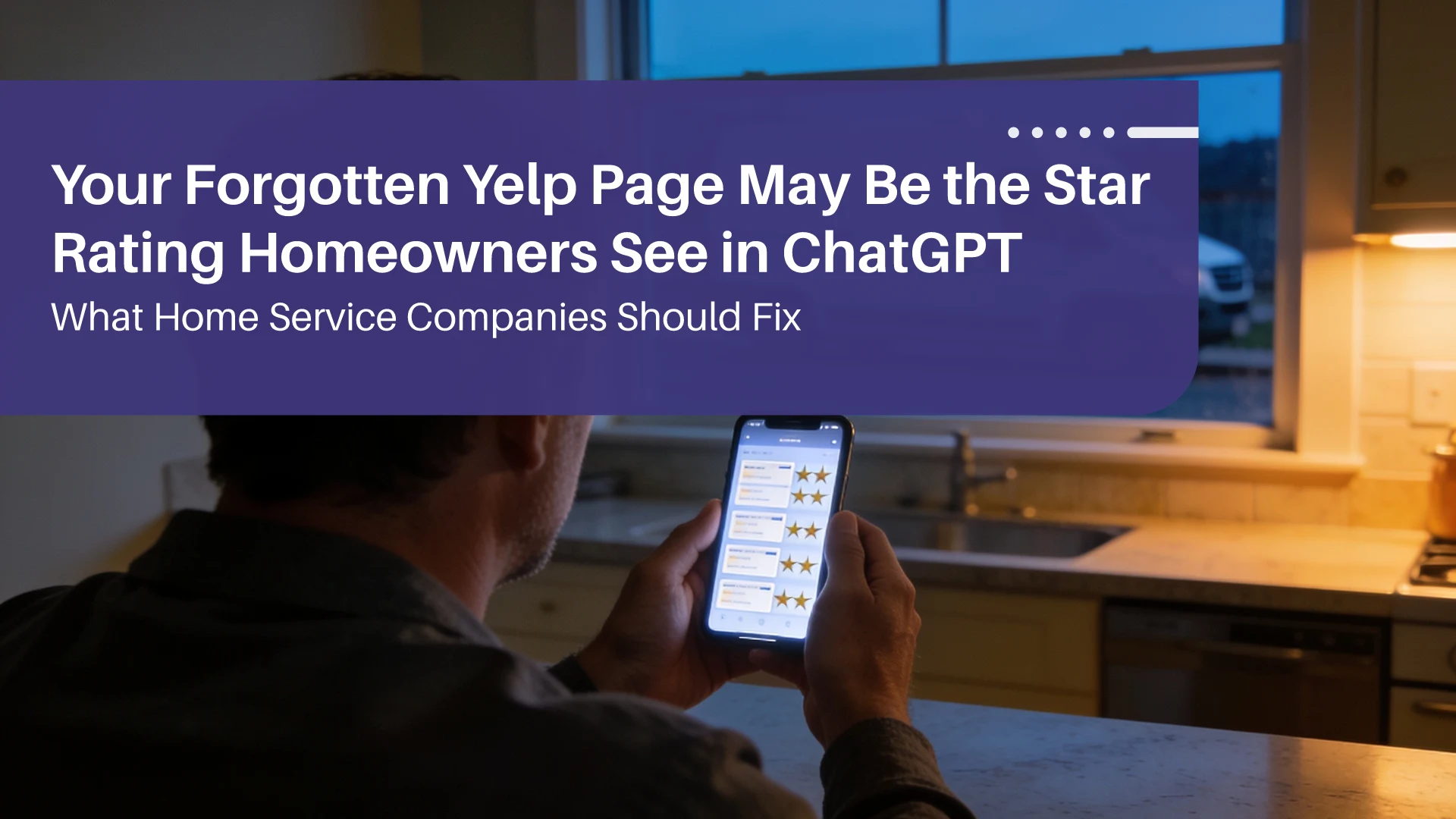
ChatGPT may be showing your customers a rating you've never seen.
Say you run the office at an eight-person HVAC, plumbing, and electrical company. You keep the Google Business Profile tidy. You haven't logged in to Yelp since your techs carried flip phones. In July 2026, Yelp started licensing its content to OpenAI, and that changes the math on Yelp, ChatGPT, and home services marketing. The Yelp page you wrote off may now be the star rating a homeowner sees in ChatGPT.
If you're among the home services business owners who haven't checked, you're not alone. This post covers what changed, what a homeowner actually sees, and what to fix first.
One limit up front: nobody can promise you a spot in ChatGPT's answers, and this post won't pretend otherwise. What you can control is the listing it reads.

Written By: Chad J. Treadway | October 13, 2026
Chad is our Chief Smarketing Officer. He will help you survey your small business needs, educating you on your options before suggesting any solution. Chad is passionate about rural marketing in the United States and North Carolina. He also has several certifications through HubSpot to better assist you with your internet and inbound marketing.
School social proof marketing has a placement problem, not a supply problem. Your school is already sitting on more usable proof than it publishes. It is in the thank-you email a fourth-grade parent sent last March, the exit survey nobody has opened since, and the 40 minutes of graduation footage cut down to a 90-second reel.
The proof is not missing. Nobody sorted it, nobody signed for it, and it sits on the wrong page. I work with school admissions teams who can name six families who would say something wonderful on camera, and cannot name the page that video would live on.
Fall inquiry season is when that gap costs money. Families are building shortlists right now, and they check what other families said before they read what you said. Niche findings suggest that 61% of parents weigh reviews from other parents when evaluating new schools, and that 30% would strike a school from their list because parent reviews were hard to find.
This post covers which assets to collect, how to get consent that holds up, how to keep the numbers honest, and which page each asset belongs on. Referral programs are a separate job, handled in the word-of-mouth enrollment post.
Written By: Adam Bennett | October 12, 2026
Adam is the president and founder of Cube Creative Design and specializes in private school marketing. Since starting the business in 2005, he has created individual relationships with clients in Western North Carolina and across the United States. He places great value on the needs, expectations, and goals of the client.
Your admissions team has heard all seven of them. The tuition line. The "we already love our current school" line. The "she would have to leave her friends" line. Private school objections show up in a small and depressingly predictable set of phrases, and most admissions teams answer the phrase instead of the concern sitting underneath it.
That is the expensive part. A family who says "it is too expensive" and a family who says "I am not sure we could justify the cost" have raised two different problems, and only one of them is about money. I spend a good part of my week with private school leaders who have an excellent answer ready for the wrong version of the question.
Fall inquiry season makes this worse. Applications are open, your calendar is full of tours, and the temptation is to move fast and answer what you heard. Families are not being coy. They are handing you the socially acceptable version of a worry they cannot say out loud without feeling like a bad parent.
This post walks through the seven objections that surface most often between September and February. For each one, you get four things: the objection in the family's own words, the concern underneath it, the content asset that should answer it before anyone picks up a phone, and a response your team can actually give without sounding like a telemarketer.
Written By: Adam Bennett | October 09, 2026
Adam is the president and founder of Cube Creative Design and specializes in private school marketing. Since starting the business in 2005, he has created individual relationships with clients in Western North Carolina and across the United States. He places great value on the needs, expectations, and goals of the client.

Search has split in two.
People still type queries into Google. But a growing share never click a result.
Ahrefs compared 300,000 keywords between December 2023 and December 2025. AI Overviews cut clicks to top-ranking content by 58%.
So what's link building actually for now?
The systems writing those answers don't count your backlinks. They build a picture of your brand from the places it gets mentioned. Then they decide whether you belong in the answer.
Which means the question isn't who can get you links.
It's who can get your brand named on the sites AI systems actually read.
Here are the ten services worth your budget in 2027, and how to pick between them.
Before you start: Pull a sample publisher list from any provider you're considering and check organic traffic, not just domain rating. It takes ten minutes and it disqualifies most of the category.
Learning how to choose pest control SEO services comes down to asking better questions before you sign, not after. It works a lot like hiring a subcontractor for a crawl space you will never crawl into yourself. You get a price, a promise, and a handshake, then you find out 90 days later whether the work actually happened. Most owners of independent pest control companies judge people well and judge a scope of work badly. Nobody ever handed them the list of questions. This post is that list. It covers the buying process itself: what to ask before you sign, what belongs in the contract, how to compare two proposals side by side, and what happens to your website and your data if the deal ends.
Written By: Chad J. Treadway | October 09, 2026
Chad is our Chief Smarketing Officer. He will help you survey your small business needs, educating you on your options before suggesting any solution. Chad is passionate about rural marketing in the United States and North Carolina. He also has several certifications through HubSpot to better assist you with your internet and inbound marketing.

Personalized video for schools means recording one short master video once and letting a template adapt it for each family with a name, grade, and program. For a private school sending 1,000 inquiry follow-ups or re-enrollment reminders, a self-run render pipeline can keep the render cost per video low, though it takes a one-time build effort. Hosted API prices vary widely, and sensitive news still deserves a hand-recorded message.
Picture your admissions office in the middle of admissions season. The same inquiry follow-up, campus tour reminder, and deadline nudge go out to hundreds of families. Often one or two people write them, and those same people also run open houses and answer the phone. Parents compare several schools at once, so their inboxes fill with messages that read almost word for word alike.
Parents on your fall tours are going to ask about AI. If you run admissions or marketing at a private school, you've probably already heard the question in some form: "How do you use AI here?" Most schools have a private school AI policy somewhere. It's usually in a faculty handbook, a board packet, or a PDF that no parent will ever open. That's the gap this post is about.
The timing isn't subtle. The Wall Street Journal ran a story by Shalini Ramachandran, Georgia Wells, and Molly Reinmann, originally headlined "Inside Google's AI Push Into Schools: 'It Slowed My Thinking Down,'" the same week Google announced its newest model. That headline quotes a student's worry in plain words: AI slowed their thinking. Parents read headlines like that. Then they book tours.
Google's own Gemini 4 Argon announcement on Sept. 30, 2026, said the model was rolling out first to trusted cyber defenders through its Fairwind Program. That's a long way from a seventh-grade classroom, but parents won't sort out that detail. They'll just ask you what your school does.
This post is for school admissions teams that want a clean answer. It covers what an AI policy page should say, where it belongs on your website, and how to keep every tour guide on the same script. One honest limit up front: a well-built page can't rescue a policy your faculty doesn't follow. The page makes your stance visible. It can't make the stance true.
Written By: Adam Bennett | October 08, 2026
Adam is the president and founder of Cube Creative Design and specializes in private school marketing. Since starting the business in 2005, he has created individual relationships with clients in Western North Carolina and across the United States. He places great value on the needs, expectations, and goals of the client.
You paid $85 for a raccoon call last Tuesday. You called back in 11 minutes, which is fast, and the homeowner had already booked somebody else. The $85 stayed spent. That is not bad luck and it is not a callback problem. It is the product working the way it was built to work, because the wildlife control leads you buy from an aggregator are not sold to you alone.
We look at a lot of sites belonging to independent wildlife control companies, and almost every owner-operator we talk to is buying leads, resenting it, and not sure what the alternative is. So this post does two things. It names exactly what an aggregator sells you, and it puts an honest price on the thing people tell you to do instead.
Written By: Chad J. Treadway | October 07, 2026
Chad is our Chief Smarketing Officer. He will help you survey your small business needs, educating you on your options before suggesting any solution. Chad is passionate about rural marketing in the United States and North Carolina. He also has several certifications through HubSpot to better assist you with your internet and inbound marketing.

Your board approves the financial aid line every spring, and every spring it is larger than the year before. Somewhere inside that number sits a scholarship fund a donor family started a decade ago, a merit award nobody can quite explain, and the discretionary money your admissions director uses to save a re-enrollment in April. The program works. Almost nobody outside the business office can describe it.
That gap is what school scholarship marketing fixes. The work is not creating more aid. It is taking the aid you already award and making it findable, understandable, and easy to act on for a family sitting at a kitchen table with a calculator and a spreadsheet. We build enrollment marketing for private and independent schools, and a buried scholarship program is one of the most common and most expensive problems we find.
Think of an unmarketed scholarship fund as a fire extinguisher in a locked closet. It exists, it costs real money, and nobody can reach it at the moment it matters.
This post covers your school's own institutional aid: choosing between need-based grants and merit awards, naming a fund, sizing an award, structuring the page, and running the application window. State vouchers and education savings accounts run on different rules and belong in a different conversation.
Written By: Chad J. Treadway | October 07, 2026
Chad is our Chief Smarketing Officer. He will help you survey your small business needs, educating you on your options before suggesting any solution. Chad is passionate about rural marketing in the United States and North Carolina. He also has several certifications through HubSpot to better assist you with your internet and inbound marketing.

A vendor tells you their program returns 10 times what you put in. Another guarantees a flood of calls in 30 days. You have run a business long enough to know that a number showing up without a method attached is decoration, not data. You still need a real answer, though, because a figure has to go in next year's budget.
Here is the honest version. A realistic pest control marketing ROI depends entirely on which ROI you mean, and most pitches quietly slide between two of them. This post gives you the cited ranges that actually exist, the arithmetic that ties them together, and the levers that change your return. The pattern I see most often with pest control business owners is not overspending. It is buying a projection nobody could trace to a source.
Written By: Chad J. Treadway | October 07, 2026
Chad is our Chief Smarketing Officer. He will help you survey your small business needs, educating you on your options before suggesting any solution. Chad is passionate about rural marketing in the United States and North Carolina. He also has several certifications through HubSpot to better assist you with your internet and inbound marketing.
Your missed Local Services Ads calls now cost you money. Since Oct. 1, 2026, Google bills a missed call during business hours once the caller stays on the line past 20 seconds, and voicemail counts. That's the new LSA missed calls charge, and it lands hardest on the owner running a few trucks who answers the phone from a crawl space.
I work with independent pest control companies that run LSAs, and the calls that slip through follow a pattern: the lunch-hour ring-out, the 5:15 p.m. voicemail, and the Saturday morning when everyone's on a route. Those calls used to cost you a job. Now they can cost you a job and a lead fee.
Below: which calls Google now bills, what "business hours" means, where pest companies miss calls, and a checklist for this week. One honest limit up front: no setting makes a missed call free when it rings during hours you've told Google you're open. The fix is coverage or a narrower schedule, and both have a cost.
Written By: Chad J. Treadway | October 06, 2026
Chad is our Chief Smarketing Officer. He will help you survey your small business needs, educating you on your options before suggesting any solution. Chad is passionate about rural marketing in the United States and North Carolina. He also has several certifications through HubSpot to better assist you with your internet and inbound marketing.