While the National Association of Independent Schools reports that 83% of private schools credit word-of-mouth as their most effective marketing channel, most are missing the strategic window when those conversations actually happen: the holiday season, when families have time to research and discuss their children's educational future. This reality makes developing a comprehensive private school marketing strategy more critical than ever.
Picture this: It's December 26th. Your campus is quiet, your staff is on well-deserved vacation, and your phone isn't ringing with tour requests. Meanwhile, across town, affluent families are gathered around their kitchen tables with laptops open, researching schools for next year's applications. They have time, mental bandwidth, and motivation to dive deep into their options. The question is: Will your school be part of that critical conversation?
While most private schools treat the holiday season as operational downtime, the savviest administrators recognize it as a strategic marketing goldmine. This isn't about a feel-good festivity—it's about positioning your school during the most reflective and future-planning period of the parent decision journey. The key lies in implementing proven digital marketing strategies that reach families when they're most engaged in school research. The data backing this opportunity is compelling, and the schools that execute it well see measurable returns that justify every dollar invested.
The Strategic Foundation: Why Holiday Marketing Demands Your Attention
The Critical Digital Window Opportunity
Let's examine the data that should reshape how you think about December and January. Research by the National Association of Independent Schools reveals that in-person events were by far the most effective traditional marketing tactic, followed by school fairs, with virtually all schools using word-of-mouth marketing. Those powerful parent recommendations don't emerge from curriculum alone—they come from moments of connection and belonging that holiday celebrations uniquely provide.
But here's where most schools miss the strategic opportunity:
During regular operations, families evaluate schools through multiple touchpoints:
- Campus tours and phone calls with admissions staff
- Conversations with current parents
- Social media activity and email communications
- In-person community interactions
During the holidays, most of these channels go dormant, creating a high-stakes environment where your digital presence becomes the sole brand ambassador.
The Research Behind the Opportunity:
Research shows that modern parents conduct dozens of searches over many months before making their first contact with a school. The holiday break provides the mental space and time families need for this deep research. A family's entire impression of your school might be formed exclusively by the content they discover online between Christmas Eve and New Year's Day.
EdChoice's research shows that parents have diverse preferences when selecting schools, with private school parents prioritizing safe environments (36%), academic quality or reputation (36%), and character/values instruction (23%). The holiday break provides the mental space and time families need for this crucial decision-making research. National Center for Education Statistics data indicate that private school students consistently made up about 9% of combined public and private enrollment, representing nearly 5 million students whose families made deliberate educational choices.
This reality makes holiday marketing investment not optional but essential. National Association of Independent Schools found that the most popular brand promotion strategies included developing a strong online presence, highlighting success stories, and using paid advertising—all tactics that become even more critical during the holiday research window when families browse from vacation destinations and relatives' homes.
The ROI Reality: What Success Actually Looks Like
The schools that approach holiday marketing strategically see measurable returns.
Key Success Metrics Schools Are Achieving:
- Cost Per Enrollment Reduction: 15-30% decrease through proper tracking
- Budget Efficiency Gains: 20-40% improvement in marketing ROI
- Lead Generation Increases: 25-50% more qualified inquiries during holiday campaigns
- Conversion Rate Improvements: Better inquiry-to-enrollment ratios
According to the National Association of Independent Schools, 54% of all schools have annual marketing budgets exceeding $70,000, with an additional 28% investing over $120,000. Schools that track performance properly understand that the results of January and February admissions events aren't determined by marketing done in those months alone—they're the direct echo of brand-building and lead-generation work accomplished over the holiday break. EdChoice found that 97% of private school parents indicated satisfaction with their choice, demonstrating that effective marketing successfully connects families with schools that meet their educational goals.
The Three-Phase Strategic Framework
Effective holiday marketing requires meticulous planning that begins long before the first festive decoration appears. This structured approach ensures all campaign elements are cohesive, strategic, and deployed for maximum impact. The foundation begins with understanding the most effective private school marketing strategies that have proven successful across diverse institutional contexts.
Phase 1: Strategy & Foundation (August-October)
This phase lays the strategic groundwork and requires the most intensive planning effort.
Strategic Planning & Goal Setting
Your goals must be specific and measurable. Instead of "increase interest," establish targets like:
- "Increase new family inquiries through the website's main inquiry form by 15% in January 2025 compared to January 2024"
- "Generate 50 qualified leads from holiday campaign activities"
- "Achieve 300%+ ROI on holiday marketing investment"
Budget Development & Allocation
National Association of Independent Schools found that 54% of all schools have annual marketing budgets exceeding $70,000, with an additional 28% investing over $120,000. Schools with larger budgets tend to employ more full-time marketing staff, with the typical independent school employing three or fewer full-time staff with marketing responsibilities. For holiday-specific campaigns, a recommended allocation model includes:
|
Budget Category |
Percentage |
Small School ($15k) |
Medium School ($45k) |
Large School ($85k) |
|---|---|---|---|---|
|
Digital Marketing |
40-50% |
$6,000-7,500 |
$18,000-22,500 |
$34,000-42,500 |
|
Events & Community |
20-30% |
$3,000-4,500 |
$9,000-13,500 |
$17,000-25,500 |
|
Content Creation |
15-20% |
$2,250-3,000 |
$6,750-9,000 |
$12,750-17,000 |
|
Technology & Tools |
10-15% |
$1,500-2,250 |
$4,500-6,750 |
$8,500-12,750 |
|
Contingency |
5-10% |
$750-1,500 |
$2,250-4,500 |
$4,250-8,500 |
Content Production Pipeline
High-quality assets require significant lead time. Begin production now for:
- Official holiday video (professional production recommended)
- Printed holiday cards for key stakeholders
- Digital viewbook designed for holiday promotion
- Email template designs for nurture sequences
- Social media content calendar through January
Phase 2: Launch & Engagement (November-Early December)
With your foundation in place, the campaign moves into public-facing launch and community engagement.
Multi-Channel Campaign Launch
Begin rolling out holiday-themed content in mid-to-late November:
Week 1 (Mid-November):
- Thanksgiving gratitude messages
- Initial event promotions
- Email sequence launch for prospects
Week 2-3 (Late November):
- Behind-the-scenes content creation
- Community partnership announcements
- Social media engagement campaigns
Week 4 (Early December):
- Event execution and content capture
- Real-time social media coverage
- Email follow-up sequences
Event Execution & Content Capture Strategy
Host your signature holiday events during this phase, but treat them as powerful content-generation engines. A single holiday fair or concert provides weeks of authentic marketing material:
Advanced Content Capture Protocol:
- Assign a dedicated content team: One photographer, one videographer, one social media manager
- Create shot lists in advance: Key moments to capture (student performances, parent reactions, community interactions)
- Real-time social media strategy: Live posting with branded hashtags every 15-20 minutes during events
- Post-event content calendar: Plan 4-6 weeks of social media posts from a single event capture
Pre-Holiday Scheduling Strategy
Use scheduling tools to program all social media posts and email newsletters during the official holiday break. Educational marketing experts emphasize that pre-scheduling ensures continuous professional presence while allowing your team the necessary time off. According to the Council for American Private Education, which represents about 80% of private school enrollment nationwide, consistent communication maintains the connection with families during critical decision-making periods. Assign monitoring responsibilities to ensure real-time engagement capability throughout the break period.
Phase 3: Peak Window & Conversion (Late December-January)
This phase capitalizes on the attention built in Phase 2 and converts interest into tangible admissions actions.
Advanced Email Automation Sequences
Deploy sophisticated nurture campaigns for different audience segments, leveraging the comprehensive private school marketing ideas that have proven most effective for educational institutions:
New Leads Sequence:
- Day 1: Welcome + Year in Review video
- Day 3: Academic program spotlight + student testimonial
- Day 7: Community service showcase + values alignment
- Day 10: Direct invitation to January Open House + application timeline
Warm Prospects Sequence:
- Day 1: Exclusive behind-the-scenes holiday content
- Day 5: Alumni success stories + outcome data
- Day 8: Financial aid information + affordability messaging
- Day 12: Urgent call-to-action for application deadlines
Research from marketing experts indicates that email marketing campaigns see higher engagement rates during holiday seasons when they include holiday-specific messaging. EdChoice found that private school parents prioritize safe environments, academic quality, and character instruction—key messaging themes that should be woven throughout these automated sequences.
Strategic Paid Advertising Framework
Launch multi-tiered advertising campaigns with sophisticated targeting:
Tier 1 - Awareness (December 20-27):
- Audience: Lookalike audiences based on current parent demographics
- Budget: 30% of digital ad spend
- Creative: Holiday event highlights, campus beauty shots
- Objective: Brand awareness and website traffic
Tier 2 - Consideration (December 28 - January 5):
- Audience: Website visitors from the past 60 days (remarketing)
- Budget: 50% of digital ad spend
- Creative: Student testimonials, academic program videos
- Objective: Lead generation and email sign-ups
Tier 3 - Conversion (January 6-15):
- Audience: Email subscribers and form completers
- Budget: 20% of digital ad spend
- Creative: Open house invitations, application deadline urgency
- Objective: Event registration and application start
Event Marketing: Creating Experiences That Convert
Holiday events offer unparalleled opportunities for prospective families to experience your school's culture firsthand. According to the National Association of Independent Schools, in-person events were by far the most effective traditional marketing tactic, followed by school fairs. Individual tours and group open houses were identified as the most effective admissions touchpoints. Successful event marketing requires strategic thinking beyond basic hospitality.
The Five High-Impact Event Categories
1. Community Gatherings: Lowering the Barrier to Entry
Holiday Fair or Winter Market
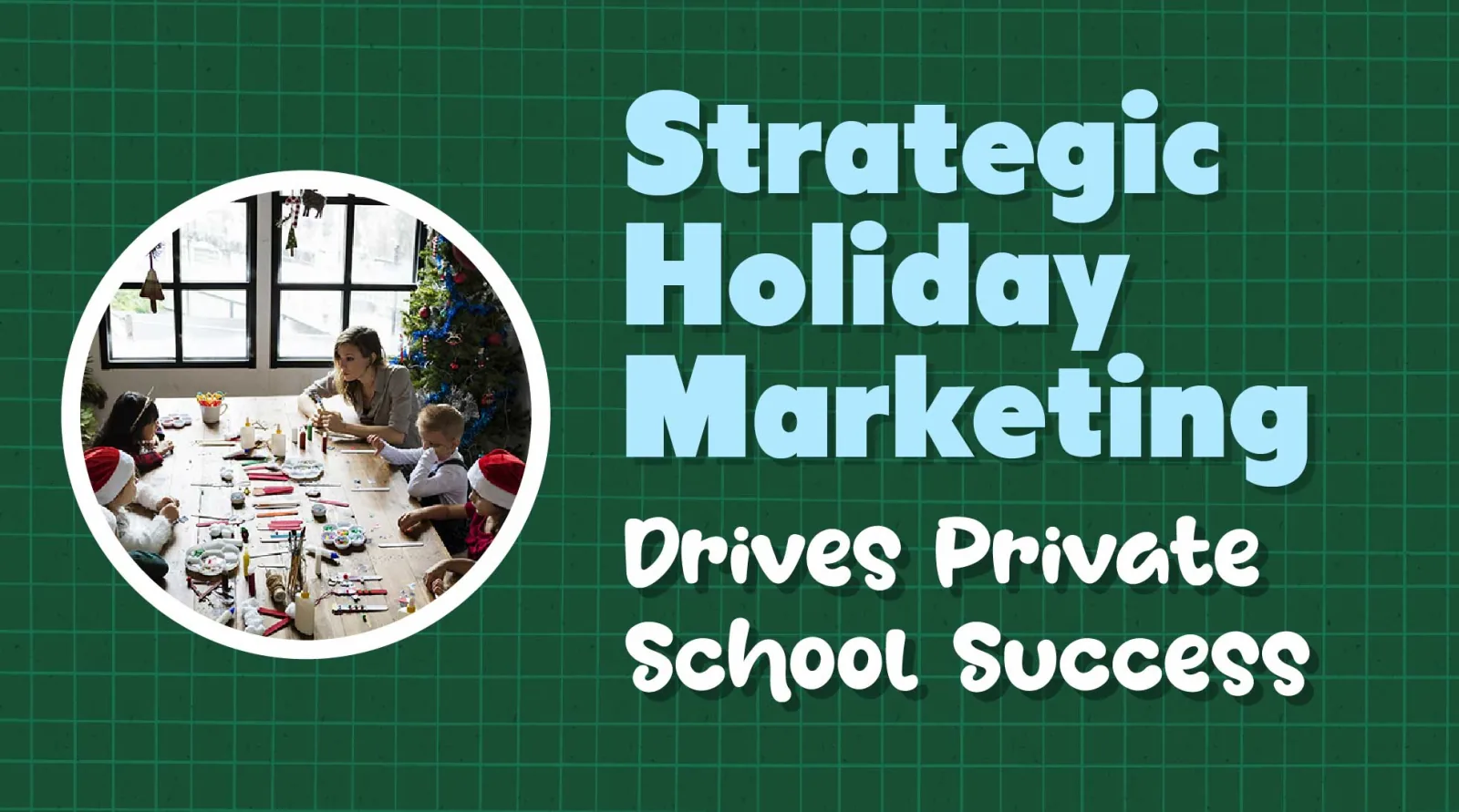
Transform your campus into a festive marketplace combining student crafts, local vendors, and seasonal activities. This positions your school as a community hub while providing natural, low-pressure campus exploration opportunities. Council for American Private Education data shows that private schools account for 25% of the nation's schools, making community differentiation essential for attracting families in competitive markets.
Advanced Implementation Strategy:
- Partner with 15-20 local artisans who pay $50-100 booth fees (revenue generation)
- Train 25-30 current parent "brand ambassadors" in natural engagement techniques
- Create 5-7 activity stations showcasing different academic programs
- Implement a digital check-in system to capture all visitor contact information
- Design clear navigation signage directing traffic through key campus areas
2. Performance Showcases: Demonstrating Excellence
Multi-Grade Holiday Concert
Unlike typical school concerts featuring single grades, multi-grade performances create powerful visual narratives of student development over time. Prospective parents literally see progression from kindergarteners to poised middle schoolers, helping them envision their child's journey. EdChoice research shows that 97% of private school parents indicated satisfaction with their school choice, with authentic demonstrations of student growth being key factors in this satisfaction.
Professional Production Elements:
- Professional lighting and sound system rental ($800-1,200)
- Multi-camera video recording for future marketing use
- Printed programs featuring teacher bios, program outcomes, and alumni achievements
- Reception area with information tables and admissions staff availability
- Digital program QR codes linking to online giving and inquiry forms
3. Service Projects: Values in Action
Community-Wide Giving Initiative
Launch holiday-themed service projects engaging students, staff, and families in addressing local needs. Document these initiatives thoroughly with professional-quality photos and videos capturing genuine moments of student leadership and compassion.
Strategic Service Project Framework:
- Partner with 3-5 local organizations (food banks, senior centers, shelters)
- Create age-appropriate service opportunities for every grade level
- Establish measurable impact goals (1,000 meals packed, 500 cards written)
- Develop a comprehensive documentation strategy for social proof content
- Connect service learning to curriculum standards and character education goals
For additional event inspiration, explore our comprehensive guide to school marketing campaign ideas that showcase creative approaches to community engagement.
Content Capture Strategy: Maximizing Event ROI
Every holiday event must be treated as a content-generation engine. Visual content is increasingly crucial for school marketing success. Understanding effective social media strategies for private schools ensures your captured content reaches maximum audience engagement across all platforms.
Professional Content Capture Protocol:
- Pre-event planning: Shot lists, key moment identification, equipment preparation
- During event execution: A Dedicated content team separate from event management
- Post-event processing: Same-day social media highlights, week-long content rollout plan
- Long-term asset development: Professional editing for website, admissions presentations, next year's promotion
National Association of Independent Schools found that the most popular brand promotion strategies included highlighting success stories—making authentic event documentation crucial for ongoing marketing effectiveness throughout the admissions cycle.
Advanced Digital Marketing Strategies
During holiday breaks, when campuses close and staff vacation, your digital presence becomes your primary—often only—front door. Strategic digital planning ensures accessibility and engagement during this critical research period.
Website Optimization: The Central Hub
Your website must reflect the season while maintaining professional standards. Create a dedicated holiday landing page consolidating all relevant information:
Essential Landing Page Elements:
- Event schedules and registration links
- Holiday-themed blog posts and success stories
- Embedded holiday greeting or year-in-review video
- Prominent calls-to-action guiding visitors toward admissions next steps
- Mobile-first responsive design (60%+ of traffic is mobile)
- Page load speeds under 3 seconds on all devices
Technical Optimization Requirements:
- Clear conversion paths with a maximum of two clicks to inquiry forms
- SEO optimization for "private school [your city] holiday events"
- Analytics tracking for all visitor behavior and conversion funnel analysis
Social Media Strategy: Consistent Engagement
According to the National Association of Independent Schools, the most popular brand promotion strategies included developing a strong online presence, highlighting success stories, and using paid advertising. Marketing research indicates that holiday-specific messaging increases engagement by 58% during seasonal campaigns. Develop a pre-scheduled content calendar ensuring active presence without requiring staff availability, utilizing systematic content planning approaches that successful private schools use to maintain engagement throughout the academic year.
Council for American Private Education notes that over 30,000 private schools serve 4.6 million students nationwide, making consistent digital differentiation crucial during the holiday research window when families evaluate their options.
Advanced Content Calendar Framework
Week 1 (December 16-22): Gratitude & Tradition
- Monday: Faculty appreciation post with behind-the-scenes video
- Wednesday: Historical tradition spotlight with archival photos
- Friday: Student-created holiday content (artwork, performances)
- Sunday: Community service project highlight with impact metrics
Week 2 (December 23-29): Community & Celebration
- Monday: Holiday event recap video with parent testimonials
- Wednesday: Alumni holiday update featuring recent achievements
- Friday: Campus beauty shots with seasonal decorations
- Sunday: "Year in Review" milestone celebration post
Week 3 (December 30 - January 5): Future & Opportunity
- Monday: "New Year, New Possibilities" academic program spotlight
- Wednesday: Student goal-setting and resolution content
- Friday: Open house announcement with early bird registration incentive
- Sunday: Application timeline reminder with supportive messaging
Email Marketing: Strategic Relationship Building
Email remains the highest-ROI digital channel for schools. Segment your strategy for distinct audiences with sophisticated automation workflows, building on the fundamental digital marketing strategies that form the foundation of successful school marketing campaigns.
Advanced Email Segmentation Strategy
Current Families (Retention Focus):
- Single holiday greeting with authentic gratitude messaging
- Video message from Head of School featuring diverse student voices
- Community highlight reel showing the year's achievements
- No fundraising asks or heavy promotional content
Inquirers (Nurture Focus):
- 5-email sequence over 21 days during break
- Personalized content based on grade level interest and inquiry source
- Progressive disclosure of school benefits and unique value propositions
- Soft conversion opportunities (virtual tour, parent coffee, academic program info sessions)
Applicants (Conversion Focus):
- Timeline reminders with supportive, non-pressured messaging
- Student and parent testimonial content addressing common concerns
- Financial aid information and accessibility messaging
- Direct access to admissions counselors for questions
Past Inquirers (Re-engagement Focus):
- "We miss you" messaging with a fresh perspective on school benefits
- New program launches or facility improvements since last contact
- Special re-engagement incentives (priority scheduling, exclusive events)
- Clear opt-out options to maintain list hygiene
Team Structure & Operational Excellence
Effective holiday marketing requires clearly defined roles, streamlined workflows, and quality control standards that reflect your school's educational excellence. The National Association of Independent Schools found that the typical independent school employs three or fewer full-time staff with marketing responsibilities, making strategic resource allocation crucial for campaign success. When considering resource allocation, schools often benefit from understanding whether to manage marketing in-house or work with external partners to achieve optimal results.
Comprehensive Team Structure
Key Roles for Maximum Efficiency
The Strategic Leader (Principal/Head of Marketing) Time Commitment: 10-15 hours total campaign involvement
Key Responsibilities:
- Final approval authority on all campaign messaging and budget allocation
- Board and parent communication about marketing initiatives
- Crisis management and escalation point for any issues
- Strategic vision alignment with overall school positioning
The Campaign Manager (Marketing/Admissions Coordinator) Time Commitment: 40-60 hours total campaign management
Key Responsibilities:
- Master timeline ownership and deadline management
- Cross-functional team coordination and daily check-ins
- Vendor relationship management and budget tracking
- Quality control checkpoint for all deliverables
- Performance monitoring and optimization recommendations
The Content Director (Internal or Contracted) Time Commitment: 30-50 hours of creative development
Key Responsibilities:
- Visual brand consistency across all materials
- Photography and videography during events
- Social media content creation and scheduling
- Email template design and copy development
- Website landing page optimization
The Community Engagement Specialist (Social Media/Events Lead) Time Commitment: 25-35 hours of community interaction
Key Responsibilities:
- Real-time social media monitoring and response
- Event coordination and volunteer management
- Parent ambassador training and coordination
- Online reputation monitoring and response strategy
Workflow & Quality Control Standards
Content Approval Workflow
- Content Creator develops initial asset (copy, design, video)
- Campaign Manager reviews for timeline adherence and brand compliance
- Strategic Leader provides final approval for publication
- 48-hour minimum between creation and publication for quality review
Quality Control Checklist
Every piece of content must pass this comprehensive review before publication:
Brand Compliance:
- School logo used correctly with proper sizing and placement
- Official school colors (hex codes) used consistently
- Typography matches brand guidelines
- Photography style aligns with established aesthetic
- Messaging tone consistent with the school's voice and values
Technical Standards:
- All links are tested and functional across devices
- Mobile responsiveness confirmed
- Loading speeds optimized (under 3 seconds)
- Contact forms tested for proper delivery
- Social media posts scheduled for optimal engagement times
Content Excellence:
- Grammar and spelling verified by two different reviewers
- Facts, dates, and statistics double-checked against source materials
- Call-to-action is clear and compelling
- Value proposition communicated effectively
- Legal compliance verified (photo permissions, privacy policies)
Crisis Management Protocol
Establish clear escalation procedures for potential holiday season challenges:
- Weather-related event cancellations (48-hour communication plan)
- Social media reputation issues (1-hour response protocol)
- Website technical failures (immediate backup page activation)
- Staff illness affecting campaign execution (cross-training requirements)
Performance Measurement & ROI Analysis
Move beyond vanity metrics to focus on Key Performance Indicators that directly measure enrollment progress. Implementing proper ROI tracking can reduce cost per enrollment by 15-30% and improve marketing budget efficiency by 20-40%. National Association of Independent Schools found that over half of schools report on website analytics, and more than 4 out of 10 report on campaign performance and customer relationship management (CRM) systems, providing the foundation for these dramatic improvements in marketing effectiveness. Additionally, understanding comprehensive ROI metrics frameworks provides the foundation for these dramatic improvements in marketing effectiveness.
The Complete KPI Framework
Awareness Stage Metrics
- Website traffic from holiday campaigns (target: 25% increase over baseline)
- Social media reach and impressions (track by platform and content type)
- Brand mention monitoring (social listening for school name discussions)
- Email list growth rate (target: 15-20% increase during campaign period)
Engagement Stage Metrics
- Website engagement (aim for <30% bounce rate, >2.5 pages per session)
- Email engagement rates (target: >25% open rate, >3% click-through rate)
- Social media engagement rate: (Likes + Comments + Shares) / Impressions (target: >3%)
- Event attendance vs. registration ratios (benchmark: 70-80% show rate)
- Content consumption depth (video completion rates, blog reading time)
Conversion Stage Metrics
- Lead generation (inquiry forms, tour sign-ups, content downloads)
- Cost per lead by channel (track to optimize budget allocation)
- Email subscriber conversion rate (visitors to subscribers: target >2%)
- Event registration conversion (website visitors to event registrants: target >5%)
ROI Stage Metrics
- Cost per enrollment (total campaign cost ÷ new student enrollments)
- Application-to-enrollment conversion rates (benchmark: 50-65% yield)
- Revenue per marketing dollar (tuition revenue ÷ marketing investment)
- Customer lifetime value for holiday-acquired families
- Attribution accuracy (tracking leads from first touch to enrollment)
Research from EdChoice demonstrates that 97% of private school parents are satisfied with their choice, indicating that effective marketing successfully connects families with schools that meet their needs—making accurate attribution essential for understanding which marketing activities drive these high-satisfaction enrollments.
Advanced Performance Dashboard
|
Metric Category |
KPI |
Target |
Week 1 |
Week 2 |
Week 3 |
Final |
|---|---|---|---|---|---|---|
|
Awareness |
Website Sessions |
2,500 |
||||
|
Awareness |
Social Media Reach |
150,000 |
||||
|
Engagement |
Email CTR |
>3% |
||||
|
Engagement |
Bounce Rate |
<30% |
||||
|
Conversion |
Form Completions |
75 |
||||
|
Conversion |
Event Registrations |
100 |
||||
|
ROI |
Cost Per Lead |
<$150 |
||||
|
ROI |
Campaign ROI |
>300% |
Attribution Modeling & Long-Term Tracking
Implement sophisticated tracking to understand the complete customer journey:
First-Touch Attribution: Track initial campaign touchpoint for each lead Multi-Touch Attribution: Credit multiple campaign elements in the conversion path Time-Decay Attribution: Give more credit to touchpoints closer to conversion Position-Based Attribution: Emphasize both first and last campaign interactions
Advanced Strategic Considerations
Community Outreach Integration
Holiday marketing provides the perfect context for demonstrating mission-driven values through authentic community engagement. This isn't peripheral programming—it's central to your value proposition.
Strategic Partnership Development
Local Business Collaborations:
- Joint holiday events and cross-promotional opportunities
- Sponsorship arrangements benefiting both organizations
- Shared marketing resources and audience expansion
Nonprofit Partnerships:
- Service learning integration with measurable impact
- Shared community goals and authentic mission alignment
- Content opportunities showcasing values in action
Feeder School Relationships:
- Joint holiday concerts and collaborative events
- Transitional family programming and support
- Academic continuity messaging and partnership
Cultural Institution Partnerships:
- Museum collaborations and educational enrichment
- Library programming and literacy initiatives
- Arts center joint events and creative showcases
Community Impact Measurement
Track both marketing metrics and authentic community benefit:
- Service hours completed by students and families
- Monetary value of goods and services donated
- Local media coverage of community partnerships
- Community organization testimonials about school partnerships
- Long-term relationship development beyond a single holiday season
Content Strategy for Community Initiatives
Document all community engagement with strategic intent:
- Before/during/after photography showing impact
- Student reflection videos on service learning experiences
- Community partner testimonials about school collaboration
- Quantified impact reports (meals served, families helped, funds raised)
- Connection to the school's mission and character development goals
Competitive Differentiation Through Authentic Storytelling
During the holiday season, differentiate through genuine community showcases rather than generic messaging. Research by the University of Bath found concerning tactics like misleading imagery and unsubstantiated claims in school marketing, making authentic representation crucial.
Authentic Differentiation Strategies
Unique Tradition Spotlight:
- Historical traditions specific to your school community
- Stories behind beloved customs and celebrations
- Alumni connections to ongoing traditions
Student Voice Amplification:
- Unscripted student perspectives on school experience
- Diverse representation across grade levels and backgrounds
- Genuine testimonials without heavy coaching
Faculty Expertise Demonstration:
- Teachers sharing passion projects and expertise
- Behind-the-scenes glimpses into classroom innovation
- Professional development and continuous learning culture
Alumni Connection Showcase:
- Recent graduates discussing transformational experiences
- Career outcomes and post-graduation success stories
- Ongoing relationships between the school and graduates
Behind-the-Scenes Access:
- Authentic glimpses into daily school culture and community
- Decision-making processes and educational philosophy in action
- Real challenges and how the school addresses them
Crisis Prevention & Reputation Management
Prepare comprehensive protocols for potential holiday season challenges that could impact marketing effectiveness:
Weather-Related Event Management
- 72-hour advance communication protocol for potential cancellations
- Virtual event backup plans with same-day pivot capability
- Make-up date coordination with all stakeholders
- Refund and credit policies are clearly communicated
- Social media messaging strategy for weather disappointments
Social Media Reputation Monitoring
- Daily monitoring of all mentions across platforms during the campaign period
- 2-hour response protocol for negative comments or concerns
- Escalation procedures for serious reputation issues
- Pre-approved response templates for common concerns
- Legal consultation availability for serious issues
Technical Infrastructure Backup
- Website backup servers with 99.9% uptime guarantees
- Email system redundancy to ensure delivery during peak periods
- Social media account security and backup access
- Data backup and recovery procedures for all campaign assets
- Vendor contract terms, including service level agreements
Conclusion: From Seasonal Marketing to Strategic Advantage
Holiday marketing isn't about adding festive flair to your existing efforts—it's about recognizing and capitalizing on a unique window when your prospective families are most receptive to deeper engagement with your school's story, values, and community.
The schools that master this opportunity don't just see immediate enrollment gains; they build systematic advantages that compound over time. They create content libraries that fuel year-round marketing efforts. They establish community connections that generate ongoing referrals. They develop marketing competencies that improve performance across all campaigns.
The Strategic Foundation for Long-Term Success:
Most importantly, they understand that in an increasingly competitive private school landscape, the institutions that invest thoughtfully in relationship building during reflective seasonal moments are positioning themselves not just for the next admissions cycle, but for sustained enrollment growth and community strength. The National Association of Independent Schools found that the top marketing goals were growing enrollment and building or strengthening school brands—both objectives that holiday campaigns uniquely support through authentic community showcase and strategic relationship building.
Your holiday marketing strategy is ultimately an investment in your school's long-term market position. The families you connect with this December become next year's ambassadors, advocates, and annual fund contributors. The content you create now serves your marketing efforts through graduation season. The systems you build for holiday campaigns improve your operational efficiency year-round.
The Competitive Reality:
As you plan your approach for this coming holiday season, remember that your competition is likely treating December as downtime. Your strategic investment in this critical window doesn't just differentiate your school—it demonstrates the thoughtfulness, planning, and attention to detail that discerning families seek in their educational partner. EdChoice research showing 97% parent satisfaction with private school choices indicates that successful marketing effectively connects families with institutions that meet their educational values and expectations.
The data is clear, the opportunity is significant, and the playbook is proven. The question isn't whether holiday marketing works for private schools—it's whether you're ready to execute it at the level your enrollment goals demand.
Ready to transform your holiday season from operational downtime into a strategic advantage? Let's develop a customized holiday marketing strategy that showcases your unique community and delivers measurable enrollment growth. Contact me to begin planning your most successful holiday campaign yet.
Frequently Asked Questions
How early should we start planning our holiday marketing campaign?
For comprehensive campaigns, begin strategic planning in August with creative development through October. Over 3 out of 5 marketers fail to maximize event value due to inadequate planning time. The schools seeing the strongest results invest 3-4 months in preparation, allowing for thorough creative development, vendor coordination, and content creation.
What's a realistic ROI expectation for holiday marketing investment?
Well-executed campaigns typically achieve 200-500% ROI, with some reaching over 1,000%. However, ROI calculation should include long-term value: families acquired during holiday campaigns often demonstrate higher retention rates and become strong word-of-mouth advocates. Proper attribution tracking reveals holiday campaigns often influence enrollment decisions 6-12 months later.
How do we balance celebrating current families with recruiting new ones?
The most effective holiday events don't feel like recruitment opportunities—they authentically showcase community while naturally incorporating ways for prospective families to learn more. Assign current parent "connectors" to organically engage visitors while maintaining celebration focus over sales pressure. National Association of Independent Schools data confirms that word-of-mouth from satisfied current families remains the most effective marketing channel.
What's the biggest mistake schools make with holiday marketing?
The most costly error is failing to capture professional-quality content during events for ongoing marketing use. Digithrive for Schools emphasizes that visual content is increasingly crucial for school marketing success. Assign dedicated personnel to systematically collect high-quality photos and videos—these assets fuel marketing efforts for months beyond the initial event and provide authentic social proof more effective than staged promotional materials.
How do we justify marketing budget increases to our board?
Present data-driven ROI analysis comparing marketing investment to tuition revenue generated. Research shows that schools investing 5-10% of tuition revenue in marketing see significantly better enrollment stability and growth. Frame marketing as enrollment insurance rather than an optional expense, demonstrating how consistent investment prevents costly enrollment shortfalls that require emergency recruitment efforts.
How do we measure success beyond basic attendance numbers?
Focus on conversion metrics throughout the entire admissions funnel: inquiry form completions, tour sign-ups, application starts, and ultimately, enrollment attribution. Track engagement quality through website analytics (bounce rate, pages per session), email performance (open rates, click-through rates), and social media interaction rates. The goal isn't maximum attendance but optimal lead generation and conversion to enrolled families.