Picture a principal at a faith-based K-8 school of about 165 students. She needs to fill a few open Kindergarten and sixth-grade seats, and her marketing budget has to stretch across everything. The big K-12 schools down the road outspend her on ads. What she has that they cannot copy is a building full of students whose small daily moments tell the real story of the school. Student spotlight content turns those moments into the proof families search for. It is also one of the most practical formats for the schools we work with at Cube Creative Design, including private and independent schools running lean marketing teams. This post covers why it works, the formats worth trying, how to stay compliant with student privacy, and a cadence a small team can keep.
Why Does Student Spotlight Content Work for Private Schools?
Student spotlight content works because it shows culture instead of describing it. Prospective families scroll your social feeds to answer a quiet question: would my child be known and cared for here? A brochure cannot answer that, but a genuine story about one student can. Social media is also where families form first impressions, and it is the channel independent schools rate as their most effective.
NAIS and Metric Marketing surveyed 251 independent school marketing professionals for their 2024-2025 State of Independent School Marketing report. Social media was named the most effective digital channel for driving new student leads by 52% of respondents, ahead of organic search at 48% and paid advertising at 45%. For a smaller school, that matters. The channel you can win on does not require the largest spend. It requires the most authentic content, and student stories are exactly that.
There is also a simple psychology at work. Families do not enroll in a mission statement. They enroll with the feeling that their child will belong. A single student's story carries that feeling in a way data points and program lists never will. It puts a face on the promise of "small class sizes" or "character development." It lets a parent imagine their own child in the same photo. Some faith-based K-8 schools fight the perception of being "too small" or "just an elementary school." One warm, specific story does more to counter that objection than a page of bullet points.
What Counts as Student Spotlight Content?
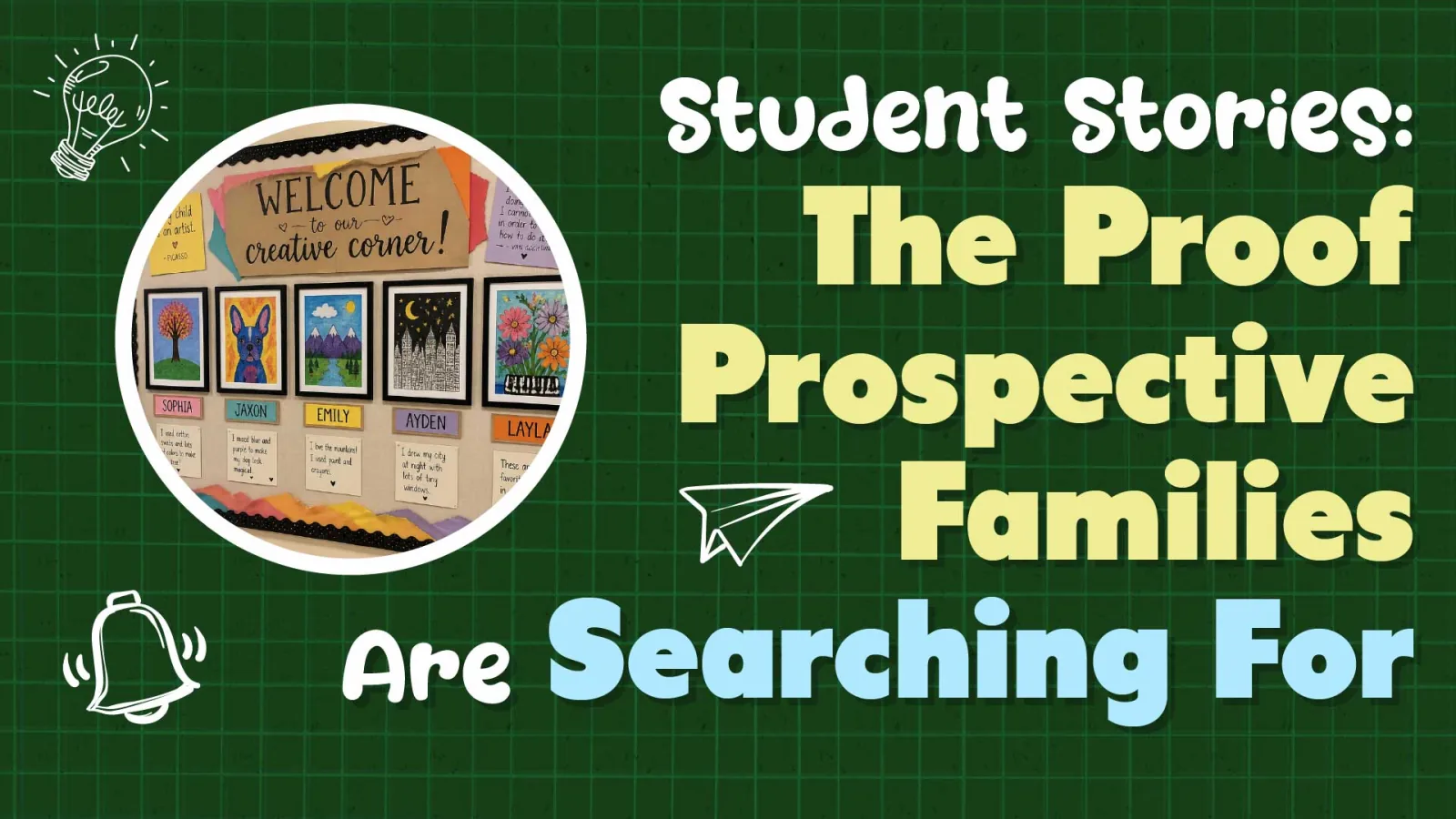
Student spotlight content is any feature that centers on one student's experience, growth, or story rather than a school-wide announcement. It can be a written profile, a photo with a short caption, a video, or a student takeover of your social account. The common thread is a single, real person whose moment reflects the school's character.
Andrea Gribble of #SocialSchool4EDU put the idea simply: "Social media is all about stories. And while your school is filled with hundreds or even thousands of students and staff who are collectively doing awesome things every day, sometimes we have to go back to the story of ONE." That one story is what families remember. The strongest spotlights are not the award winners and scholarship announcements; they are the smaller turning points, the student who finally felt at home, the quiet breakthrough in class, the friendship that formed over a shared project.
It helps to separate a spotlight from the everyday posts that fill a school feed. A reminder about picture day, a field-trip recap, or a sports score is useful. But those posts speak to families who already belong. A spotlight is aimed outward. It speaks to the parent who has not visited yet, the one quietly deciding whether your school is a place where their child would be seen. That difference in purpose is why a spotlight earns a place on your calendar even when the week is busy.
What Are the Best Student Spotlight Content Ideas to Try?
The best student spotlight ideas range from quick written features to short videos. That range lets a small team match the format to the time it has that week. Written profiles are the easiest entry point: a few reflective questions, one strong photo, and a short caption. Short video is where engagement is climbing for schools.
The 2026 #SocialSchool4EDU survey of 497 school communicators looked at how schools involve students in content. Among those that do, 49% have students create Reels or short videos, and 28% run a one-day Instagram Story takeover. A few formats worth rotating:
- A "what changed for me" written profile, built from reflection questions rather than résumé facts
- A short phone-shot video of a student describing a favorite class or moment in their own words
- A student Story takeover for a single day, showing campus life from their point of view
- A photo series following one student through a project, performance, or service activity
- A graduate or eighth-grade "next chapter" feature as families transition to high school
The format matters less than the honesty. Jerrica Thurman of Elation Communications said it plainly: "Perfect stories rarely build trust. Real stories do." Overproduced features read as marketing; small, true moments read as proof.
How Do You Handle Student Privacy and Photo Consent?
You handle student privacy by getting a separate, written opt-in release before any spotlight goes live. The U.S. Department of Education's Student Privacy Policy Office explains the rule under the federal Family Educational Rights and Privacy Act. A photo or video is an education record when it is directly related to a student and maintained by the school. A spotlight that names and centers one student almost always meets that bar.
The safest practice is not to lean on a directory-information policy. The New York State Education Department's June 2025 guidance says it plainly: "Best practice is to have a separate opt-in or opt-out form for photographs and videos rather than classifying photographs as directory information." The same guidance notes that "an opt-in form requires eligible student or parent/guardian approval before an educational agency may release a photo or video depicting a student." It adds that the form should spell out where images will appear, such as social media and newsletters.
For a faith-based K-8, that means a short, plain-language release collected at enrollment, listing your social platforms and website by name, with a checkbox parents can decline. Designate one person, often whoever runs communications, to keep the release file current and to honor any parent who later asks to opt out. Build this into your story workflow from the start, not after a post is already public.
What Makes a Student Spotlight Feel Authentic Instead of Staged?
A student spotlight feels authentic when it captures a real moment of growth rather than a polished achievement. The fastest way to get there is the interview question you ask. Most schools default to program-focused questions like "What did you learn?" and get generic answers families scroll past. Transformation-focused questions get the real story.
Jerrica Thurman of Elation Communications frames it as the gap between two questions: "The real story is rarely: 'What did the student do?' The real story is: 'Who did the student become?'" Questions that open students up tend to sound like "What were you unsure about before this experience?" or "When did you first realize you belonged here?" Those prompts move a student out of presentation mode and into reflection. Reflection is where the honest, specific detail lives.
For a small school, this is good news, because it costs nothing. You do not need better equipment or a bigger budget to ask a better question. A principal or communications lead can sit with a student for ten minutes and listen longer than they feel comfortable. That alone produces material no template can match. Keep the student's own words where you can. A slightly imperfect quote in a child's voice reads as true, and true is what prospective families are scanning for.
Which Platforms Should Small Schools Post Student Spotlights On?
Small schools should concentrate on Facebook and Instagram first, because that is where school audiences and engagement live. The same 2026 #SocialSchool4EDU survey found that 98% of school communicators manage a Facebook account and 86% manage Instagram, while only 9% manage TikTok. For a one- or two-person team, that is permission to ignore the platforms everyone feels pressured to join.
Engagement patterns back up that focus, though the broadest data covers the whole education sector, K-12 and higher education combined. Across that sector, educational institutions receive over 60% of their daily engagements on Facebook and Instagram. That figure comes from the Sprout Social 2025 Content Benchmarks Report, which analyzed nearly 3 billion messages. Format choice helps too. On Instagram, carousel posts generate almost double the engagement of Reels for education accounts, Hootsuite found in its March 2025 data. So a multi-image student feature can outperform a single clip. Treat these sector-wide numbers as direction, not as a private-school guarantee.
How Often Should a Small Team Post Student Spotlights?
A small team should aim for one reliable student spotlight a week rather than a scattered burst of content. Consistency beats volume, especially when staff is thin. Most independent school marketing teams run with three or fewer full-time people on marketing, the NAIS 2024-2025 survey found, so a sustainable rhythm matters more than an ambitious one.
A weekly anchor, the same day each week, trains your audience to look for it. It also gives you a planning slot you can fill in batches. Across the education sector broadly, institutions average about 7 posts a day across all platforms, per the Sprout Social benchmarks. But most of those are large institutions. A 165-student school does not need that pace. One strong student story a week, posted to Facebook and Instagram, with the occasional short video or Story takeover, is a cadence a faith-based K-8 can hold all year without burning out.
What Does This Look Like at a Faith-Based K-8?
At a faith-based K-8 of about 165 students, this looks like a Friday "student of the week" feature that costs almost nothing to produce. The communications lead keeps a running list of students whose families have signed the opt-in release. Each week, she picks one and asks three reflection questions. She snaps one good photo. Then she writes a short caption tying the student's moment to a value the school cares about, such as service or character.
Over a school year, that is roughly 36 stories. It becomes a quiet library of proof that a prospective family can scroll through while deciding whether to book a tour. The school does not need a video crew, a TikTok strategy, or a big ad budget to compete with the larger K-12 down the road. It needs one steady habit, a clean consent file, and the willingness to let real student moments speak. For a small school that competes on relationships, that is the most honest marketing it can do. It is also the kind of work a lean team can sustain.
Turning One Student's Story Into Steady Enrollment Proof
Student spotlight content is the rare format where a smaller school holds the advantage. You know your students. You can tell their stories with detail and warmth that no agency template can fake, and prospective families feel the difference. Start with a simple opt-in release. Pick one weekly format you can keep, and post where your audience already is. The proof builds quietly, one student at a time, until your feed answers the question every family is really asking.
If you want help turning your students' stories into a marketing system your small team can actually maintain, let's talk, and we'll map out a plan that fits your school's budget and calendar.
Frequently Asked Questions
What Is Student Spotlight Content?
Student spotlight content is any feature that centers on one student's experience or story rather than a school-wide announcement. It can be a written profile, a captioned photo, a short video, or a one-day student social media takeover. The goal is to show your school's culture through a single real person, which families trust more than general marketing claims.
Do You Need Parent Permission to Post a Student Spotlight?
Yes. A photo or video that names and centers one student usually counts as an education record under FERPA, so you need written parent or guardian consent first. Best practice is a separate opt-in photo and video release that lists exactly where images will appear, such as your social platforms and newsletters, rather than relying on a directory-information policy.
How Often Should a Small School Post Student Spotlights?
Aim for one reliable spotlight a week. A fixed day, such as a Friday "student of the week," trains your audience to expect it and gives you a slot you can batch-produce. Consistency matters more than volume, especially for the typical school marketing team of three or fewer full-time staff.
Can a Small School Run Student Spotlights Without a Big Budget?
Yes. Student spotlights are one of the few formats where a small school has the advantage, because you know your students and can tell their stories with real detail. A written profile with one good phone photo costs nothing but time. If you want help building a repeatable storytelling process, our school marketing services can set up a workflow your team can run on its own.