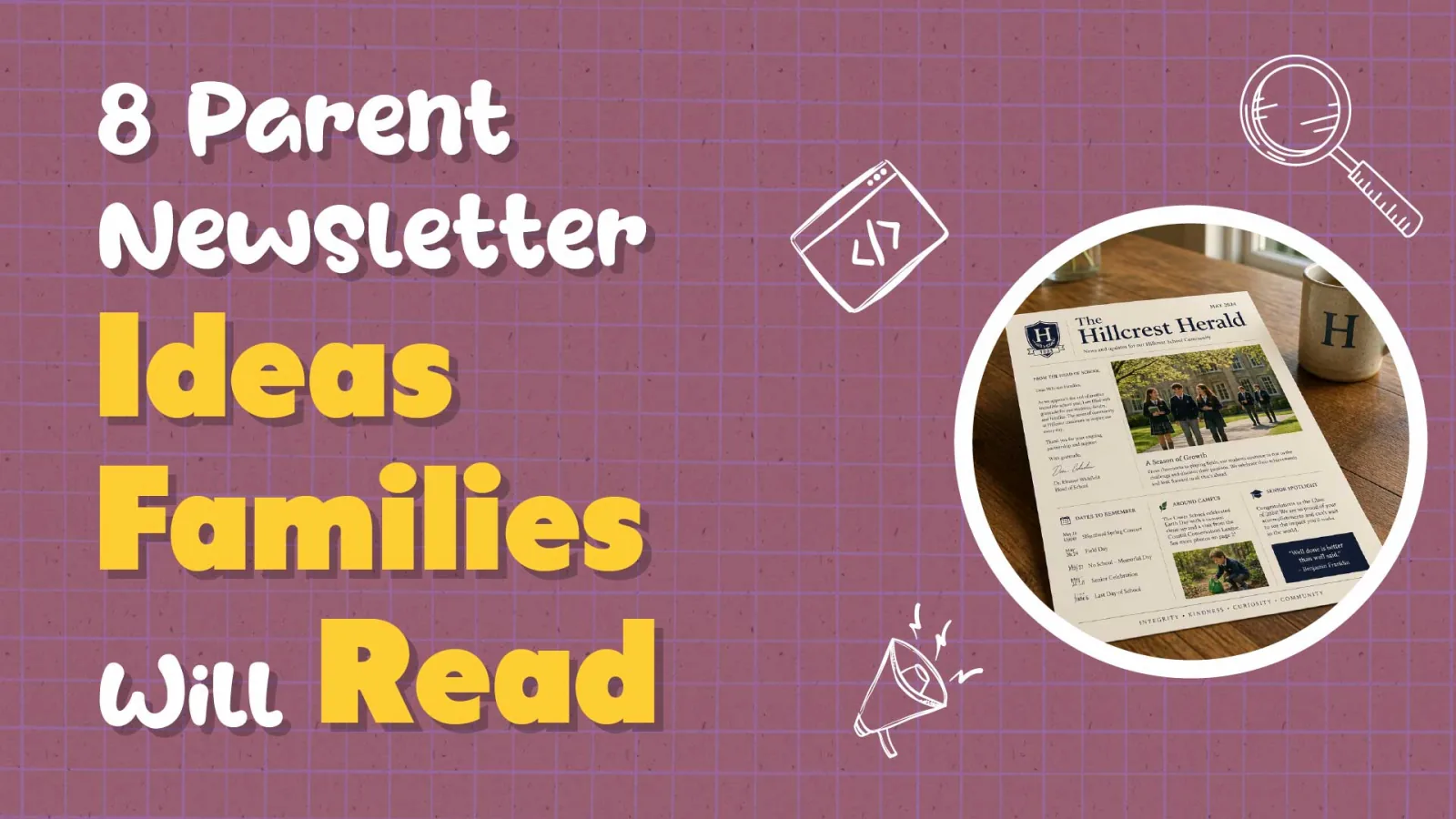
You sat down to write the newsletter, opened a blank template, and stared at it. Last week's went out to every family on the list, and you have no idea how many people actually read it. So you do what you did last time: paste in the lunch menu, the early-dismissal reminder, the spirit-week dates, and a line asking for volunteers. You hit send. Nothing comes back. The week resets, and you will do it again on Friday. That cycle is not a writing problem. It is a content problem, and the right parent newsletter ideas are what break it. The work goes in. The reading should come out too.
A parent newsletter is one of the cheapest and most durable tools a school owns, and at a small faith-based or independent school, it is often the main rhythm of school-home communication. It is the thing families look for each week to feel connected to what is happening inside the building. We work with private and independent schools that have warm communities and committed parents, but send a newsletter that reads like a memo from the office. This post is a menu of parent newsletter ideas built for a small team: eight content sections you can fill every week, why they matter for family engagement, and how to know whether anyone is reading.
What Makes a Parent Newsletter Worth Reading?
A parent newsletter is worth reading when it makes families feel connected to the school rather than assigned more tasks. Independent School Management puts it plainly: " Newsletters should not (solely) be a checklist of deadlines and responsibilities," and the celebratory content should take up more space than the reminders. Families open what makes them feel part of something. They skim past what reads like a to-do list.
That distinction is the whole game, and most small schools get it backward. The default newsletter is mostly logistics with a warm sentence at the top. The newsletter families look forward to flipping that ratio. It leads with the students, the classrooms, and the mission. It tucks the deadlines into a small, predictable corner. As Independent School Management noted, the goal is that "you want families to look forward to receiving your email, not feel chastised."
Why Does a Parent Newsletter Matter Beyond Logistics?
A parent newsletter matters because regular school-to-home communication is tied to better outcomes for students, not just smoother operations. When parents stay connected to what their child is learning, they reinforce it at home. The newsletter is one of the simplest, lowest-cost ways a small school keeps that connection steady across the whole year.
The research backs this up. A meta-analysis of 77 family-school partnership studies looked at what happens when families and schools work together. Educational Psychology Review reported a positive effect on academic achievement and an even larger one on student mental health. The same study named "school to home communication" as one of the relational parts that drove those gains. A newsletter is one steady way to keep that communication going. It is not a fix on its own. It is a vehicle for the kind of contact the research points to.
The bigger picture is just as clear. A research brief from CASEL, shared through the U.S. Department of Education's ERIC library, found that "positive outcomes of schools regularly engaging parents as partners in their children's education include improved academic performance, improved mental health, increased student engagement, and reduced school dropout rates." For a small school, word of mouth and parent loyalty drive enrollment. That same engagement is what keeps families enrolled year after year.
What Are the 8 Parent Newsletter Ideas Families Will Read?
The best parent newsletter content ideas are a fixed set of sections you can fill every week, built so that celebration leads and logistics follow. A repeatable structure does two things at a small school: it makes the newsletter fast to build for a one-person team, and it trains families to know where to look each week. The eight sections below give you a content menu you can rotate through without staring at a blank page.
The point is not to use all eight every single time. The point is to have a menu, lead with the human and mission-driven sections, and keep the reminders short. Pick the four or five that fit the week and keep the order consistent so families learn the rhythm.
1. How Do You Write a Principal's Column Families Read?
A principal's column families read is short, personal, and tied to the school's mission rather than the week's announcements. Independent School Management recommends a "Head's Column" that gives the school's leader a chance to talk about the mission and the issues affecting the school. At a small faith-based K-8, this is where your voice and the school's identity live, so keep it to a few sentences and make it sound like you.
Use it to tell one small story from your week: a moment you saw a value in action, a thank-you to a class, a reflection tied to the season, or a passage that fits the school's faith identity. Avoid turning it into a second announcements box. Three or four warm sentences from the principal do more for connection than a long letter nobody finishes.
2. What Student Spotlight Ideas Work in a Parent Newsletter?
Student spotlight ideas that work are short, specific, and spread across grades, so every family eventually sees their child's world reflected. Feature a class project, a piece of writing, an act of kindness, or a student who lived out a school value that week. The goal is for parents to recognize their own child's classroom, even when their child is not the one named.
Keep it small to keep it sustainable. One short spotlight per issue, rotated so you cover different grades over a month, is far easier to maintain than a big quarterly feature. Photos help here, since most families will scan the images before they read a word. Always confirm photo and name permissions against your school's media policy before publishing.
3. Why Include a Faculty or Staff Feature?
A faculty or staff feature matters because families enroll in relationships, and the people are the product at a small school. A short profile of a teacher, an aide, or an office staff member helps parents feel they know the adults caring for their children. It also quietly answers a question prospective families are asking: Who will my child spend the day with?
Keep these light and human. A few questions work well: what they love about teaching, a favorite moment this year, and something families would be surprised to learn about them. Independent School Management points out that you can reuse this kind of content, reformatting a faculty feature for the school blog or social media so one piece of writing earns its keep in more than one place.
4. How Can a Mission Moment Strengthen a Faith-Based Newsletter?
A mission moment strengthens a faith-based newsletter by tying the week's life of the school back to why the school exists. For a Christian or Lutheran K-8, this might be a short reflection, a verse connected to a classroom theme, a service project, or a chapel highlight. It is the section that reminds families they chose the school for more than academics.
This is also where a small faith-based school separates itself from larger K-12 competitors and from public schools. The research on family engagement holds across school types, but the mission content is yours alone. Keep it genuine and brief. One clear moment lands better than a long devotional that competes with the rest of the newsletter for attention.
5. What Classroom Window Content Should You Share?
Classroom window content is a short, plain-language look at what students are learning right now, written so parents can extend it at home. A sentence or two per grade or subject is enough: the third grade started a unit on local history, the middle school is reading a particular novel, and kindergarten is working on letter sounds. This is the section that turns a newsletter into a bridge between school and home.
This content does real work beyond connection. When parents know what their child is learning, they can ask better questions at the dinner table and back up the lesson at home. That is the kind of school-to-home contact the family-engagement research ties to stronger outcomes. Rotate which grades you feature so the section stays short. Over a month, every family sees their child's classroom.
6. How Do You Handle Calendar and Reminders Without Burying the Good Content?
You handle calendar and reminders by giving them one fixed, compact spot near the bottom, not by scattering them through the newsletter. Families need the early dismissal date and the picture-day reminder, so the information has to be there. The mistake is letting logistics lead and crowd out the content that families actually open the email to read.
Put a short "week ahead" block in the same place every issue: three to five dated items, scannable, no paragraphs. Independent School Management advises that deadline reminders "should take up comparatively less 'real estate'" than the celebratory content. A consistent template helps, because parents learn that reminders always live in the same corner and stop hunting for them.
7. What Is the Right Way to Make a Volunteer or Giving Ask?
The right way to make a volunteer or giving ask is to keep it small, specific, and limited to one ask per issue. A single clear request ("we need two parents to help at Friday's chapel") gets a better response than a long list of needs that readers tune out. When every newsletter is mostly asking, families start ignoring all of them.
Tie the ask to the connection you built in the rest of the newsletter. Parents who just read about their child's classroom and the school's mission are far more likely to say yes than parents who opened a logistics dump. Rotate the ask so it does not become the newsletter's main note, and thank the people who helped last time. Recognition is its own quiet recruiting tool.
8. Which Parent Resources Belong in a Newsletter?
Parent resources that belong in a newsletter are short, practical, and genuinely useful to a busy family, offered one at a time. This might be a quick reading tip, a note about a parenting or faith topic, a link to the lunch menu, or a heads-up about an upcoming family event. The section signals that the school is thinking about the parents, not only the students.
Keep it to one item per issue so the newsletter does not balloon. A newsletter's job is partly to inform families, partly to educate them, and partly to encourage them, and this section is where the encouraging part lives. A single helpful resource a week adds up to a school that feels like a partner to families, which is the relationship that keeps them enrolled.
How Do You Know If Parents Are Actually Reading the Newsletter?
You know parents are reading by watching click rate, not open rate, because the open number is no longer reliable. Email tools report opens. But Apple's Mail Privacy Protection marks many emails as opened, whether or not anyone read them, which inflates the figure. The click rate tells you who actually engaged with something in the email.
The benchmarks help you set expectations. Campaign Monitor reported an average open rate of 28.5% and a click-through rate of 4.4% for the education industry in its 2022 report. Mailchimp lists its Education and Training group at a 35.64% open rate and a 3.02% click rate as of December 2023. Treat both as broad education numbers, not school-specific ones. Those groups also include colleges and training companies. Either way, watch your own click trend over time. A section that earns clicks week after week is a section families value, and that beats any industry average as a guide.
What Cadence Should a Small School Send?
A small school should pick the cadence it can keep without fail and send one copy per family. A consistent weekly or biweekly newsletter beats an ambitious schedule that slips, because a missed send breaks the rhythm families rely on. The right answer is the one your team can sustain through the busy parts of the year.
Independent School Management offers one practical rule: send only once per family, consolidating your contact list so siblings' parents do not get duplicate copies. Whatever cadence you choose, keep it steady and keep the structure the same each time. Predictability is what turns a newsletter from a surprise into a habit.
Putting It Together at a Small Faith-Based School
Picture a faith-based K-8 with about 165 students, a tuition near $11,000, and a marketing budget that has to stretch across the whole year. The principal writes the newsletter herself between morning drop-off and afternoon meetings. She does not have time to reinvent it every Friday, and she cannot afford a tool that promises to do it all.
Here is the realistic path. She builds one template with the eight sections in a fixed order. It leads with her short column, a student spotlight, and a mission moment, and ends with the week ahead and a single volunteer ask. She fills four or five of the sections each week. She rotates which grades get the classroom window and the spotlight, so every family sees their child's world within a month. She sends one copy per family on the same day each week. Then she watches the click rate, not the open rate, to see which sections families engage with.
None of this requires a bigger budget. It requires a repeatable structure and a decision to let celebration lead. Over a year, the payoff is a community that feels connected, parents who reinforce learning at home, and families who feel known well enough to stay. For a school competing against larger K-12 options and well-funded public schools, that quiet, steady connection is one of the most affordable advantages you have.
Conclusion
A parent newsletter does not need to be longer or fancier to work. It needs the right content, in a repeatable structure, with celebration leading and logistics tucked into a small corner. Lead with your voice, your students, and your mission. Keep the reminders short and predictable. Watch clicks instead of opens, pick a cadence you can keep, and send one copy per family. Those few shifts turn a newsletter from a chore nobody reads into the steadiest line you have to the families who chose your school.
If you want help turning your newsletter into part of a real plan for parent engagement and enrollment, let's talk. No pressure and no pitch, just an honest look at what is working and what could work harder for your school.
Frequently Asked Questions