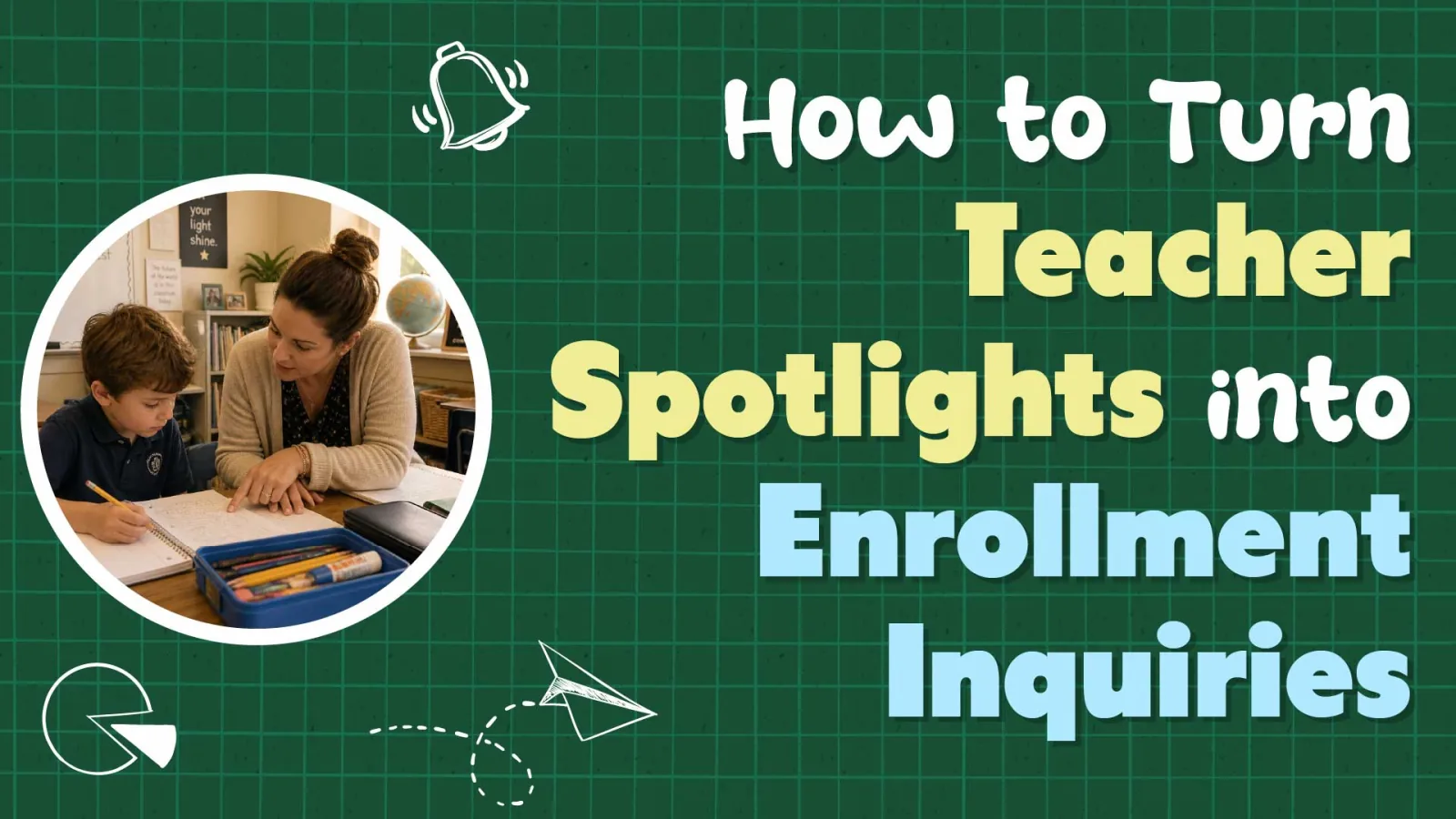
Walk a prospective family through your hallways and watch where they slow down. It is rarely the trophy case or the mission statement on the wall. It is the moment a teacher kneels to a student's eye level, or a staff member greets a kid by name. That is the school families are actually trying to buy, and faculty content marketing is how you put it in front of them. If you lead a faith-based or independent school, your teachers are the reason families stay, and they can be the reason new families come. At Cube Creative Design, we help faith-based and independent schools turn the people who already make their school special into content that earns family trust. This post explains how faculty features work, why families respond to them, and how a small team can produce them without a budget or a film crew.
What Is Faculty Content Marketing for Schools?
Faculty content marketing is the practice of featuring your teachers and staff to show families who will care for their children. It includes teacher spotlights, faculty profiles, and staff feature content shared on social media, your website, and newsletters. The goal is not to brag about credentials. It is to let real people show what your school feels like.
Think of it as the difference between a feature list and a face. A program page tells families you have small classes. A short profile of the teacher who runs that classroom shows them the person who makes those small classes matter. Families researching schools online are reading between the lines for exactly this. They want to know who their child will spend the day with. A polished brochure cannot answer that. A teacher's own words can.
For a small faith-based school, this is also where your identity comes through. A faculty feature shows how a teacher lives out the school's mission. It does not state the mission. It tells a real story about a student's moment instead. That is hard for a larger, less personal competitor to copy. It is one of the most defensible kinds of content a small school can make.
Why Does Featuring Teachers Build Family Trust?
Featuring teachers builds trust because the teacher-student bond is what families are really weighing, even when they cannot name it. Parents are not choosing a building or a logo. They are choosing the adults who will know their child. Content that shows those adults answers the quiet question every family is asking.
The research on what makes a great school teacher points in the same way. In a study of 755 independent school hiring administrators, NAIS found that 100 percent rated "building strong relationships with students" as important or extremely important. It was the top-ranked attribute of a high-quality teacher. If relationships are the heart of teaching quality, then showing those relationships is the most honest marketing you can do.
Families sense this even when schools forget it. NAIS reported that 76 percent of independent schools say faculty and staff are what set them apart from competitors. The same survey found that 75 percent attribute parent loyalty to their "people." Your teachers are already the things families remember and recommend. Faculty content makes that strength visible to families who have not toured yet.
What Makes Teacher Spotlight Content Different From Bragging?
The difference is whose voice leads and whose story it tells. A brag centers on the school and its accolades. A true teacher spotlight centers on a real person and a specific moment, and lets the school's quality show through. Families have learned to skip past self-praise. So the spotlight that sounds like an ad gets ignored.
The fix is to lead with the person, not the resume. Do not write "Mrs. Lopez holds two degrees and has won three awards." Instead, show why a student in her class lit up about reading for the first time. Specifics carry trust. Generalities read as marketing. One concrete story about a single child does more than a paragraph of qualifications.
There is national evidence that this human framing works. Sprout Social found that when organizations post about their employees' achievements and stories, 86 percent of highly engaged social users call the brand authentic, 85 percent call it approachable, and 84 percent call it interesting. That research covers brands broadly, not schools. So treat it as a signal about how people respond to employee stories, not a school benchmark. The point still holds. Stories about your people make your school feel more real, and real is what families reward.
What Kinds of Faculty Content Should a Small School Create?
The most useful faculty content is simple, repeatable, and built around real moments rather than staged shoots. A small school does not need a content studio; it needs a short list of formats it can run again and again with whatever happened that week.
A few formats carry most of the weight. A "meet the teacher" profile pairs a phone photo with three honest questions: why they teach, a favorite student moment, and what they want families to know. A "why I teach here" piece lets a teacher tie their work to the school's mission in their own words. That format is especially strong for a faith-based school. A behind-the-scenes post shows a teacher prepping a lesson or coaching at recess. It captures the quiet care that families rarely see but deeply value.
Two underused sources round out a content library. Staff feature content beyond the classroom matters too. The office manager who knows every family's name shows the whole community that a child will join. New-hire introductions give you a natural reason to post. They also signal momentum to families watching your school add to its team. The point is variety with low effort. That way, you are never staring at a blank calendar wondering what to post next.
How Can a Small School Produce Faculty Content Without a Budget?
You produce it with a phone, a simple routine, and one feature at a time. The barrier is almost never money; it is the lack of a small system for catching stories while they happen. Build the habit, and the content takes care of itself.
This matters because most schools are working with tiny teams. NAIS data shows that the typical independent school employs three or fewer full-time staff with marketing responsibilities, and its survey found that highlighting success stories is among the most popular brand strategies schools use. Small teams already lean on people-driven stories because those stories scale in a way that glossy production never will.
A handful of habits keep it sustainable. Keep a running list of teachers to feature so you are not deciding under pressure. Shoot vertical phone video and natural photos. Do not wait for a formal shoot that never gets scheduled. Reuse every feature across channels. One teacher profile can become a social post, a newsletter blurb, and a quote on a program page. Get a simple written photo and video release on file first. Let teachers answer in their own words rather than handing them a script. The realness is the entire point, and it costs nothing.
Where Should Faculty Content Live to Reach Families?
Faculty content belongs wherever families are already researching your school, with your strongest pieces on social media, your website, and your inquiry follow-up. Posting a great teacher story to a page nobody visits wastes the work. Put it on the path families actually walk.
Social media is the front door for most prospective families today. Research by NAIS shows that 63 percent of elementary schools credited social media as one of the digital channels most effective at driving new student leads. That is exactly the audience a teacher spotlight is built to reach. Beyond social, add faculty profiles to your staff and program pages, where serious researchers go. Then include a short teacher story in the emails you send after a family inquires.
The in-person connection still matters most, and faculty content supports it rather than replacing it. As NAIS put it, "student tour guides and school staff can share insights about school culture in a way that prospective families won't get from a website." Faculty content warms families up before the tour, so the people they meet on campus already feel familiar.
Consider a Faith-Based K-8 Putting This to Work
Picture a faith-based K-8 with 165 students, $11,000 tuition, and a principal who handles most of the marketing between morning drop-off and the next budget meeting. The school is near its 185-student capacity but needs to fill kindergarten and sixth grade each year, and it competes against larger K-12 schools that families assume offer more.
Instead of a new website or a paid campaign, the principal starts a once-a-week faculty feature. She asks one teacher the same three questions, snaps a phone photo, and posts a short profile to Facebook and the parent newsletter. A kindergarten teacher's story about a shy student finding her voice eases a nervous parent more than any brochure could. Over a semester, the school builds a small library of real teacher stories. One is a "why I teach here" piece that quietly shows the school's faith identity in action.
By the second semester, teachers start sending the principal their own student moments without being asked. The features become part of the tour follow-up email. Families who have visited already recognize names and faces. The realistic result is not a flood of new students. It is a handful of warmer kindergarten and sixth-grade inquiries, plus tour conversations that start from trust instead of doubt. That is the kind of repeatable gain a small school can defend to its board.
Why Does Faculty Content Help You Keep Teachers, Too?
Faculty content helps retention because being seen and valued is a major reason teachers stay, and public recognition is a visible form of being valued. The same content that earns family trust also tells your teachers that their work matters, which is no small thing for a small school competing on culture rather than salary.
This is well documented in independent school leadership research. Independent School Management frames teacher retention as a culture issue. It notes that "teachers stay where they feel known. Supported. Listened to. Trusted." A regular feature puts a teacher's story in front of the whole community. That is a low-cost way to make people feel known.
It also helps your recruiting. When prospective teachers see that your school celebrates its faculty in public, your culture becomes part of your pitch. A faith-based school cannot always match larger competitors on pay. A visible, supportive culture is a real advantage instead. Faculty content is one of the easiest ways to make that culture something candidates can actually see.
Faculty content marketing is not a nice-to-have extra; it is one of the most direct ways a small school can market the thing families care about most. Your teachers are already your strongest asset. Featuring them turns that strength into trust, and trust is what moves a family from searching to inquiring to enrolling. You do not need a budget or a big team to start, just one teacher, three honest questions, and a phone. The schools that win on this do not wait for the perfect plan. They simply begin, then keep the habit going through the slow weeks when nothing seems to be happening. If you want help building your teachers into a marketing habit that earns family trust, get in touch. No pressure, no pitch, just an honest conversation about where to start.
Frequently Asked Questions
What Is Faculty Content Marketing?
Faculty content marketing is the practice of regularly featuring your teachers and staff in your school's marketing to show families who will be caring for their children. It includes teacher spotlights, faculty profiles, and "why I teach here" stories shared on social media, your website, and newsletters. The goal is trust, not bragging, by letting real people show what your school feels like every day.
How Often Should a Small School Post Faculty Features?
Aim for a sustainable rhythm you can actually keep, such as one feature every week or two, rather than a burst you cannot maintain. Consistency matters more than volume, because a steady stream of real teacher stories builds a brand over time. Keep a running list of teachers to feature so you are never deciding what to post under pressure.
Do We Need Permission to Feature Teachers and Students?
Yes. Get a simple written photo and video release on file from teachers and from the families of any students who appear before you publish anything. Let teachers tell their own stories in their own words rather than scripting them, since the authenticity is what makes the content work. If you want help building a content plan that respects privacy, our school marketing services can map it out with you.
What Should a Teacher Spotlight Actually Include?
A strong spotlight pairs a natural phone photo with a short, specific story, not a list of degrees and awards. Three honest questions usually do the job: why they teach, a favorite student moment, and what they want families to know. Lead with the person and one concrete moment, and let the school's quality show through the story.
Does Faculty Content Really Influence Enrollment?
Faculty content supports enrollment by building the family trust that drives inquiries and tours. Research shows teachers are central to how families and schools define quality, and that schools see their people as their biggest differentiator. Treat results as a long-term trust investment, and track which features spark replies, questions, and tour conversations at your own school.