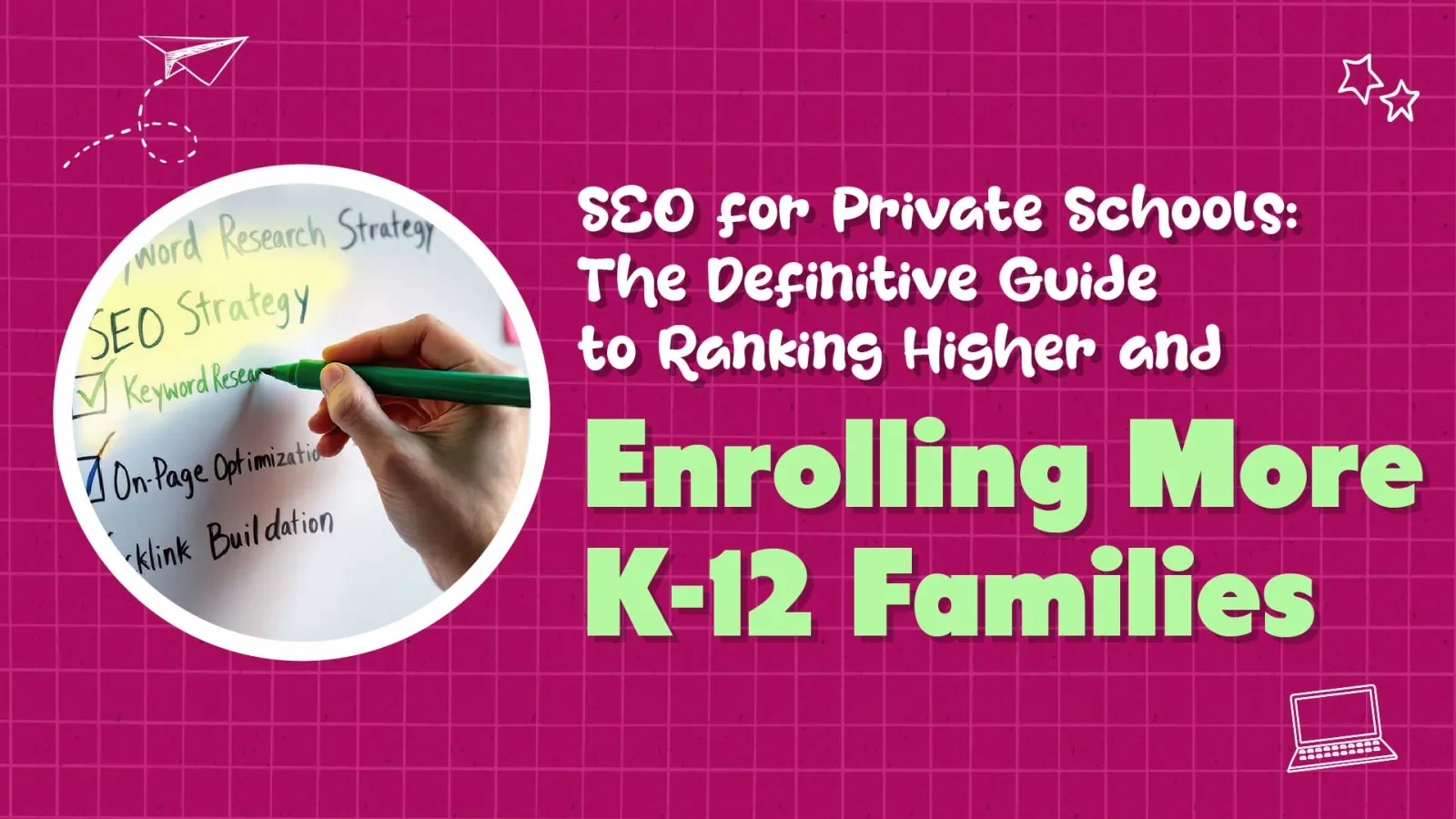
Your school's website is either working for you or against you. There is no neutral. If enrollment growth is on your radar (and if you're reading this, it is), SEO should be near the top of your priority list. Below, we break down exactly how to make Google work in your favor.
What Does SEO for Private Schools Actually Mean?
Search engine optimization for private schools is the practice of making your school's website more visible in Google search results when families are actively looking for schools like yours. It's not about gaming the system. It's about making sure Google understands what your school offers, who you serve, and why a family should choose you.
Here's the thing most school administrators get wrong: they think SEO is a one-time project. Install a plugin, add some keywords, and you're one. In reality, SEO is an ongoing strategy that touches everything from your website's technical performance to the content you publish and the way your Google Business Profile represents your school to local families.
The payoff, though, is significant. Research by Conductor found that on average, organic search produces 33% of overall website traffic across seven key industries, making it one of the largest sources of visitors for most websites. For schools, that number matters because every visitor who finds you through Google is a parent or guardian who raised their hand and said, "I'm looking for a school."
Why Should Private Schools Care About SEO in 2025?
Private schools should prioritize SEO because the overwhelming majority of prospective families begin their school search online, and schools that don't appear in those results simply don't get considered. The shift toward digital research is not slowing down; it's accelerating.
Let's start with the numbers that should keep every admissions director up at night. The National School Choice Awareness Foundation's January 2025 survey found that 60% of parents considered new or different schools for their children. That's a massive pool of families actively evaluating their options.
And where do they start that evaluation? Google. Research indicates that the overwhelming majority of school-related searches begin in a search engine. Not on Facebook. Not through word of mouth. On Google.
The pipeline is straightforward: parents search, they find (or don't find) your school, and they make decisions based on what they see. If your school isn't showing up on page one for relevant searches in your area, you're effectively invisible to the largest pool of prospective families available.
Here's what makes this even more urgent: The foundation's 2024 survey found that 64% of parents wished they had more information about their education options, and while the January 2025 survey shows this has improved to 51%, a majority of families still want better access to school information. Families want to find you. They're actively looking for schools that meet their needs. SEO is how you make sure they can.
The Enrollment ROI Connection
This isn't just about website traffic. It's about enrollment applications and tuition revenue. When schools integrate SEO into their strategy, the cost per inquiry typically drops significantly compared to traditional marketing channels like direct mail or print advertising. The ROI becomes clear when you track enrollments back to their organic search origin.
Schools investing in digital marketing strategies are seeing measurable results. Research compiled by Sixth City Marketing found that higher education institutions using comprehensive digital marketing strategies experience up to a 50% increase in student inquiries and a 30% boost in conversion rates — trends that carry similar implications for K-12 private school enrollment marketing.
For a school like yours, with 400 to 800 students and a marketing budget of $50,000 to $250,000, those numbers translate directly to seats filled and revenue secured.
How Have Google's Algorithm Updates Changed School SEO?
Google's 2024 and 2025 algorithm updates have prioritized content quality, expertise signals, and user experience over keyword density and technical tricks. Schools that publish authentic, authoritative content are being rewarded; those relying on thin pages and outdated tactics are losing ground.
Google rolled out six major core algorithm updates between March 2024 and December 2025. The March 2024 core update was particularly aggressive, running for 45 days and targeting low-quality content. Google's stated goal was a 45% reduction in low-quality, unoriginal content appearing in search results.
For school websites, this is mostly good news. Schools that publish genuine, helpful content about their programs, admissions process, and educational philosophy are exactly the kind of sites Google wants to surface. The schools getting hurt are the ones with thin "About" pages, duplicate content across program pages, and blog sections that haven't been updated since 2019.
E-E-A-T: The Framework That Matters Most
The concept that should be guiding every piece of content on your school's website is E-E-A-T: Experience, Expertise, Authoritativeness, and Trustworthiness. Google uses these signals to evaluate whether a page deserves to rank for a given query.
A SEMrush study found that pages with strong E-E-A-T signals had a 30% higher chance of ranking in the top three positions. For a school website, strong E-E-A-T looks like:
- Experience: Content written by actual educators, administrators, or admissions professionals (not generic marketing copy)
- Expertise: Detailed program pages that demonstrate deep knowledge of curriculum and pedagogy
- Authoritativeness: Backlinks from educational organizations like NAIS, regional accrediting bodies, and local community organizations (similar to strategies covered in private school marketing ideas that focus on community partnerships)
- Trustworthiness: Secure website (HTTPS), clear contact information, transparent tuition and admissions details, and genuine parent testimonials
The practical takeaway: stop writing content that could have been written by anyone. Your school's unique voice, expertise, and community are your competitive advantage in search.
How Are AI Overviews Affecting School Website Traffic?
Google's AI Overviews are reducing click-through rates for informational education queries by providing answers directly in search results. Schools need to shift strategy toward queries that AI cannot fully answer, particularly school-specific and local search terms.
This is the biggest shift in search behavior since mobile-first indexing, and most schools aren't talking about it. Analysis from The Digital Bloom found that AI Overviews appeared on 6.49% of all queries in January 2025, more than doubling to 13.14% by March 2025 — a 102% increase. Critically, 88.1% of queries triggering AI Overviews are informational in nature, which directly threatens the types of educational content school websites typically produce. That's a 69-percentage-point increase in a single year.
When an AI Overview appears, click-through rates drop dramatically. Research from DataSlayer shows that queries with AI Overviews see an average click-through rate of just 8%, compared to 15% for traditional search results. A more granular study by Seer Interactive found that CTR dropped from 1.76% to 0.61% for affected queries.
What This Means for Your School
If your school's content strategy revolves around answering generic questions like "What is the best private school curriculum?" or "How much does private school cost?", you're fighting a losing battle. Google's AI is increasingly answering those questions directly in the search results, and users never need to click through to your site.
The winning strategy is to focus on queries that AI cannot fully answer:
- School-specific queries: "[Your School Name] reviews," "[Your School Name] admissions timeline"
- Local comparison queries: "Best private schools in [your city] for STEM."
- Decision-stage queries: "Private school tour questions to ask," "How to evaluate a private school."
- Unique program content: Detailed descriptions of your specific programs, faculty, and outcomes that no AI summary can replicate
Your school's website should be the definitive source of information about your school. AI can summarize general concepts, but it cannot replicate the depth, authenticity, and specificity that your own content provides.
Why Is Local SEO the Most Important Factor for School Websites?
Local SEO is the most important ranking factor for private school websites because the vast majority of school searches include geographic terms, and Google's local results appear above standard organic listings. An optimized Google Business Profile and consistent local presence outweigh almost every other SEO tactic for driving enrollment inquiries.
Data from multiple sources confirms this: approximately 80% of school-related searches include location terms like "near me" or a specific city name. When a parent in your area searches for "private schools near me," Google shows a local map pack with three to four results before any standard organic listing appears. If your school isn't in that map pack, you're below the fold before the page even loads.
Google Business Profile Optimization
Your Google Business Profile (GBP) is the single most impactful local SEO asset your school has. According to MapRanks' 2026 analysis, Google's AI now identifies nearby businesses with geographic precision down to a few blocks. More importantly, AI prioritizes profiles with rich media (photos, updated services, FAQs, and complete business descriptions) over sparse profiles that only list basic contact information.
Here's what an optimized school GBP looks like:
- Complete and accurate NAP (name, address, phone number) matching your website exactly
- Current photos updated at least monthly (campus, classrooms, events, student life)
- Regular Google Posts sharing school news, upcoming events, and enrollment deadlines
- Parent reviews actively requested and responded to (both positive and constructive)
- Complete service categories and program descriptions
- Accurate hours, including admissions office hours and tour availability
- The FAQ section addresses common parent questions directly
NAP Consistency Across the Web
NAP consistency means your school's name, address, and phone number appear identically across every online directory and platform. This includes your website, Google Business Profile, Yelp, GreatSchools, Niche.com, your local chamber of commerce listing, and any other directory where your school appears.
Even small discrepancies (abbreviating "Street" vs. spelling it out, or listing a different phone number on one platform) can hurt your local rankings. Search engines use NAP consistency as a trust signal. If the information doesn't match, Google has less confidence in the accuracy of your listing.
Building Local Citations
Local citations are mentions of your school on other websites. The strongest citations come from:
- Educational directories: GreatSchools, Niche, Private School Review
- Local business directories: Chamber of commerce, local business associations
- Community organizations: Local news outlets, neighborhood associations, parent groups
- Accrediting body listings: Your regional accreditation organization's directory
Each consistent citation reinforces Google's confidence that your school is a legitimate, established institution at the address you claim. Think of it as building your school's reputation across the internet, one directory listing at a time.
What On-Page SEO Elements Should Every School Website Include?
Every school website needs properly structured title tags and meta descriptions for each page, a clear heading hierarchy with H1 through H3 tags, keyword-optimized content that reads naturally, and internal linking between related pages. These foundational elements tell Google what each page is about and how it relates to the rest of your site.
On-page SEO is where many school websites fall apart. Not because the concepts are complicated, but because most school sites were designed with aesthetics in mind and SEO as an afterthought (if it was considered at all).
Title Tags and Meta Descriptions
Every page on your site needs a unique title tag (under 60 characters) and meta description (120-155 characters) that:
- Include your primary keyword for that page
- Clearly describe what the page offers
- Give parents a reason to click
- Include your school name for brand recognition
A title tag like "Home - [School Name]" is a wasted opportunity. Compare it to "Top-Rated Private K-8 School in Raleigh | [School Name]," and the difference is obvious.
Heading Structure
Your pages should use a logical heading hierarchy:
- H1: One per page, containing your primary keyword (e.g., "Admissions at [School Name]")
- H2: Major section headers that break content into scannable sections
- H3: Subsections within each H2 area
Google uses heading structure to understand the content hierarchy of your page. A well-structured page with descriptive headings tells Google exactly what topics you cover and how they relate to each other.
Content That Serves Both Users and Search Engines
The 50/50 content balance works well here: half your focus on making content genuinely helpful for parents, half on ensuring search engines can understand and index it properly. In practice, this means:
- Primary keyword in the first 100 words of each page
- Natural keyword use throughout (1-2% density for primary, 0.5-1% for secondary)
- Question-based subheadings that match how parents actually search
- Internal links connecting related pages (admissions to financial aid, programs to faculty, etc.)
- Image alt text that describes what the image shows (not keyword-stuffed nonsense)
Schema Markup for Schools
Structured data helps Google understand your content at a deeper level. For school websites, the most valuable schema types include:
- EducationalOrganization schema with your school's details
- Event schema for open houses, tours, and admissions deadlines
- FAQ schema for frequently asked questions pages
- Review schema for parent testimonials (if applicable)
Adding schema won't directly make you rank higher, but it can earn you rich snippets in search results (star ratings, event dates, FAQ dropdowns) that significantly increase click-through rates.
How Does Technical SEO Affect School Website Performance?
Technical SEO directly impacts how well Google can crawl, index, and rank your school's website. Poor page speed, broken mobile experiences, and site architecture problems can prevent even the best content from ranking. Schools that address Core Web Vitals and mobile optimization see measurable improvements in both rankings and conversion rates.
Most school websites are built on platforms like Finalsite, Blackbaud, WordPress, or Squarespace. Each has its own technical strengths and limitations. Regardless of your platform, certain technical fundamentals apply to every school site.
Core Web Vitals
Google's Core Web Vitals measure three aspects of user experience:
- Largest Contentful Paint (LCP): How quickly the main content loads. Target: under 2.5 seconds.
- Cumulative Layout Shift (CLS): How much the page layout shifts during loading. Target: under 0.1.
- Interaction to Next Paint (INP): How quickly the page responds when a user clicks or taps. This replaced First Input Delay in March 2024.
Here's the sobering reality: according to data compiled by Huckabuy (citing Search Engine Journal research), only 43% of mobile URLs and 44% of desktop URLs meet Google's LCP benchmark across the web. For education websites specifically, Huckabuy found that only 5% of URLs would receive a ranking boost from Core Web Vitals. That means 95% of education websites are leaving performance (and rankings) on the table.
Page Speed and Conversions
The connection between page speed and enrollment inquiries is direct and measurable. Research from NitroPack shows that for every one-second delay in page load time, conversions drop by up to 20%. According to Huckabuy, 53% of mobile visitors abandon pages that take longer than three seconds to load.
Think about that in terms of your admissions funnel. If your school's website takes five seconds to load on a phone (and many do), you've already lost more than half the parents who clicked through from Google. They didn't decide your school wasn't right for their family. They just got tired of waiting.
Mobile Optimization
Mobile traffic now accounts for the majority of web visits. Data from SQ Magazine puts the 2025 split at approximately 59.6% mobile versus 38.1% desktop globally. For school websites, this means your mobile experience isn't secondary; it's primary.
However, there's an important nuance. While mobile generates more traffic, desktop still generates more conversions. Research from SQ Magazine shows desktop conversion rates at 4.3% compared to 2.2% on mobile. Mobile bounce rates are also 12% higher than desktop.
The implication: parents are discovering and researching your school on their phones, but many are completing inquiry forms and applications on their laptops. Your website needs to deliver an excellent experience on both. Make the mobile experience fast, readable, and easy to browse. Make the desktop experience optimized for form completion and deeper content consumption.
Site Architecture
A well-organized site structure helps both Google and parents find what they need. For school websites, the ideal architecture follows a clear hierarchy:
- Homepage → Key landing pages (Admissions, Academics, About, Campus Life)
- Admissions → Application Process, Financial Aid, Tour Schedule, FAQ
- Academics → Programs by Division (Lower, Middle, Upper), Curriculum, Faculty
- About → Mission, History, Leadership, Accreditation
Every important page should be reachable within three clicks from the homepage. If parents (or Google's crawlers) need to dig through five layers of menus to find your tuition page, that's a problem.
What Content Strategy Works Best for Private School SEO?
The most effective content strategy for private school SEO targets decision-stage and school-specific queries that Google's AI Overviews cannot fully answer, while building topical authority through consistent publishing around core themes like admissions, academics, and campus life.
Content is where many schools either win big or waste time completely. The difference comes down to strategy: are you writing content that prospective families are actually searching for, or are you publishing campus newsletter updates and calling it a content strategy?
Keyword Research for Schools
Effective keyword research for schools starts with understanding search intent at each stage of the enrollment funnel:
- Awareness stage: "Types of private schools," "Benefits of private school education," "Private school vs. public school."
- Consideration stage: "Best private schools in [city]," "Private school tuition [state]," "Private school financial aid."
- Decision stage: "[School Name] reviews," "[School Name] admissions," "[School Name] vs. [Competitor School]"
Your content strategy should address all three stages, with particular emphasis on consideration and decision-stage content. These queries signal higher intent and are less likely to be fully answered by AI Overviews.
Blog Content That Drives Enrollment
A school blog should not be a news feed. It should be a strategic content asset that attracts organic traffic and moves families through your enrollment funnel. The most effective school blog topics include:
- Program deep dives: Detailed explanations of your STEM program, arts curriculum, athletic offerings, or service learning initiatives
- Parent guides: "What to expect at your first open house," "Questions to ask during a school tour," "Understanding private school financial aid."
- Community stories: Faculty spotlights, student achievement features, and alumni updates (written for SEO, not just internal audiences)
- Comparison and evaluation content: "How to choose between two private schools," "What to look for in a K-8 program."
- Seasonal admissions content: Application timeline guides, enrollment deadline reminders, accepted student event previews
Content Freshness
Google rewards websites that regularly publish and update content. For school websites, this means:
- Publishing at least two to four new blog posts per month
- Updating program pages annually (or whenever significant changes occur)
- Refreshing admissions pages with current deadlines and requirements each cycle
- Adding new photos and media regularly
A school website that hasn't published new content in six months sends a signal to Google (and parents) that nobody's home.
How Can Schools Measure SEO Success?
Schools should measure SEO success through a combination of organic traffic growth, keyword ranking improvements, inquiry form submissions from organic visitors, and ultimately, the number of enrolled students attributable to organic search. Vanity metrics like total page views mean little without conversion data to back them up.
One of the biggest frustrations school administrators express about SEO is that it feels immeasurable. You invest money and time, and then... what? How do you know it's working?
The answer is to track the right metrics and connect them to enrollment outcomes.
Primary Metrics
- Organic traffic: Total visitors from non-paid search results (Google Analytics)
- Keyword rankings: Positions for your target keywords (tracked via SEMrush, Ahrefs, or Moz)
- Organic conversion rate: Percentage of organic visitors who complete an inquiry form, schedule a tour, or start an application
- Cost per organic inquiry: Your SEO investment divided by the number of inquiries from organic traffic
Secondary Metrics
- Click-through rate (CTR): The percentage of people who see your listing in search results and click on it
- Bounce rate: The percentage of visitors who leave after viewing only one page (lower is generally better)
- Pages per session: How many pages the average visitor views (more indicates engagement)
- Average session duration: How long visitors stay on your site
Benchmarking Against Industry Standards
According to Unbounce's education conversion benchmark data, the median conversion rate for education landing pages is 8.4%, which is 27% higher than the all-industry baseline of 6.6%. However, private school websites specifically tend to convert at less than 2% when unoptimized and above 5% when properly optimized.
If your school's organic conversion rate is below 2%, there's significant room for improvement. If you're above 5%, you're performing well; focus on increasing traffic volume. The sweet spot is optimizing both traffic and conversion simultaneously.
Connecting SEO to Enrollment
The ultimate metric is enrolled students attributable to organic search. Here's a simple framework for tracking this:
- Tag all inquiry form submissions with traffic source (organic, paid, direct, referral)
- Track inquiries through your admissions pipeline to enrollment
- Calculate the cost per enrolled student from organic traffic
- Compare to your other channels (paid search, social media, direct mail, events)
When you can confidently say, "We enrolled 35 students this year who first found us through organic search, at a cost per enrollment of $1,200 versus $4,500 for paid advertising," you've made the case for ongoing SEO investment.
How Would a Mid-Sized College Prep School Apply This?
Consider a non-denominational college preparatory school serving 550 families with an annual tuition of $26,000 and a marketing budget of roughly $144,000 per year. The admissions director manages a small team and is tasked with increasing applications by 15-20% while competing against both public schools and other private institutions in the area.
This school's website is built on WordPress, loads in about four seconds on mobile, and hasn't had a technical SEO audit in three years. The blog publishes sporadically (maybe one post every two months), and the Google Business Profile has 12 reviews with a 4.2-star average. Their website ranks on page two for "private schools in [their city]" and doesn't appear in the local map pack at all.
The 90-Day Plan
Month 1: Technical Foundation The school runs a full technical audit, discovering that page speed on mobile is the biggest issue. Large, uncompressed images and a bloated theme are the culprits. After image optimization, plugin cleanup, and enabling server-side caching, mobile load time drops from 4.2 seconds to 2.1 seconds. They also fix 17 broken internal links and add schema markup to their homepage, admissions page, and events page.
Month 2: Local SEO and Google Business Profile The team claims and fully optimizes their Google Business Profile. They add 30 new photos of campus life, respond to all existing reviews, and launch a review request campaign asking current families to share their experience. Within four weeks, they go from 12 reviews to 28 reviews with a 4.6-star average. They also audit and correct NAP inconsistencies across 14 online directories.
Month 3: Content Strategy Launch The school begins publishing two blog posts per month, each targeting a specific keyword cluster relevant to their admissions funnel. The first two posts target "best private schools in [their city]" and "[their city] private school open house." Each post is optimized with proper heading structure, internal links to the admissions page, and a clear call to action to schedule a tour.
Projected Results (6-12 Months)
Based on industry benchmarks, this school could reasonably expect:
- Organic traffic increase of 40-60% from the combination of technical fixes, local SEO improvements, and new content
- Appearance in the local map pack for "private schools in [their city]" within three to six months
- 20-30 additional monthly website inquiries from improved rankings and conversion optimization
- Reduction in cost per inquiry from approximately $200 to under $100 as organic traffic scales
These aren't aspirational numbers. They're grounded in the benchmarks we've cited throughout this guide. The compounding effect of SEO means results accelerate over time. Month one might show modest improvement, but by month six, the trajectory becomes clear.
Putting It All Together
SEO for private schools isn't a mystery, and it isn't optional. With 60% of parents actively considering new schools and the overwhelming majority starting their search on Google, the question isn't whether your school needs SEO. It's whether you can afford to keep ignoring it.
The framework is straightforward: fix your technical foundation, own your local search presence, publish content that parents are actually searching for, and measure everything against enrollment outcomes. Every element we've covered in this guide (algorithm updates, AI Overviews, local SEO, on-page optimization, technical performance, content strategy, and measurement) works together as a system. Pulling one lever helps. Pulling all of the compounds results.
The schools that will win the enrollment game over the next three to five years are the ones investing in organic search visibility today. Not because SEO is a silver bullet, but because it's the most sustainable, cost-effective way to put your school in front of families who are actively looking for exactly what you offer.
If you're looking at your school's website and realizing there's work to do, you're not alone. Most schools are in the same position. The good news is that getting started doesn't require a six-figure budget or a dedicated SEO team. It requires a plan, consistent execution, and a willingness to prioritize the digital experience as much as the on-campus one.
Ready to find out where your school's SEO stands today? Contact me for a no-pressure conversation about your school's online visibility and what it would take to start showing up where families are searching.
Frequently Asked Questions
How Long Does It Take to See Results from SEO for a Private School Website?
Most private schools begin seeing measurable improvements in organic traffic within three to six months of implementing a comprehensive SEO strategy. Technical fixes like page speed improvements and broken link repairs can produce results within weeks. Local SEO gains, particularly Google Business Profile optimization and review generation, typically show within two to three months. Content-driven keyword rankings take longer, often six to twelve months to fully mature. The key is consistency; SEO compounds over time, and schools that publish content and maintain their technical foundation regularly see accelerating returns in the second year.
How Much Should a Private School Budget for SEO?
There is no universal number, but schools with annual marketing budgets of $50,000 to $250,000 should consider allocating 15-25% toward SEO and organic content marketing. For a school spending $150,000 annually on marketing, that means $22,500 to $37,500 directed at SEO activities, including technical audits, content creation, local SEO management, and ongoing optimization. Schools with smaller budgets can start with foundational work (Google Business Profile optimization, technical fixes, one to two blog posts per month) and scale as results justify the investment. The benchmark to evaluate is cost per enrolled student; organic search typically delivers one of the lowest costs per enrollment of any marketing channel.
Can a School Handle SEO In-House or Should They Hire an Agency?
It depends on your team's capacity and expertise. Schools with a marketing coordinator who has some digital experience can handle foundational tasks: Google Business Profile management, basic content publishing, and monitoring analytics. However, technical SEO audits, keyword research strategy, schema markup implementation, and ongoing optimization typically require specialized knowledge that most school marketing teams don't have in-house. Many schools find that a hybrid approach works best: an agency handles strategy, technical work, and reporting while the school's team handles content creation and day-to-day updates. This keeps costs manageable while ensuring the technical work is done correctly.
What Is the Difference Between Local SEO and Regular SEO for Schools?
Local SEO focuses specifically on improving your school's visibility in location-based searches and Google's local map pack. It emphasizes your Google Business Profile, local citations, reviews, and geographic keywords. Regular (or "organic") SEO encompasses everything else: on-page content optimization, technical site performance, backlink building, and content strategy. For private schools, both matter, but local SEO typically delivers faster, more direct enrollment results because families searching "private schools near me" or "private schools in [your city]" have high intent. A strong school SEO strategy addresses both local and organic SEO as complementary efforts, not separate initiatives.