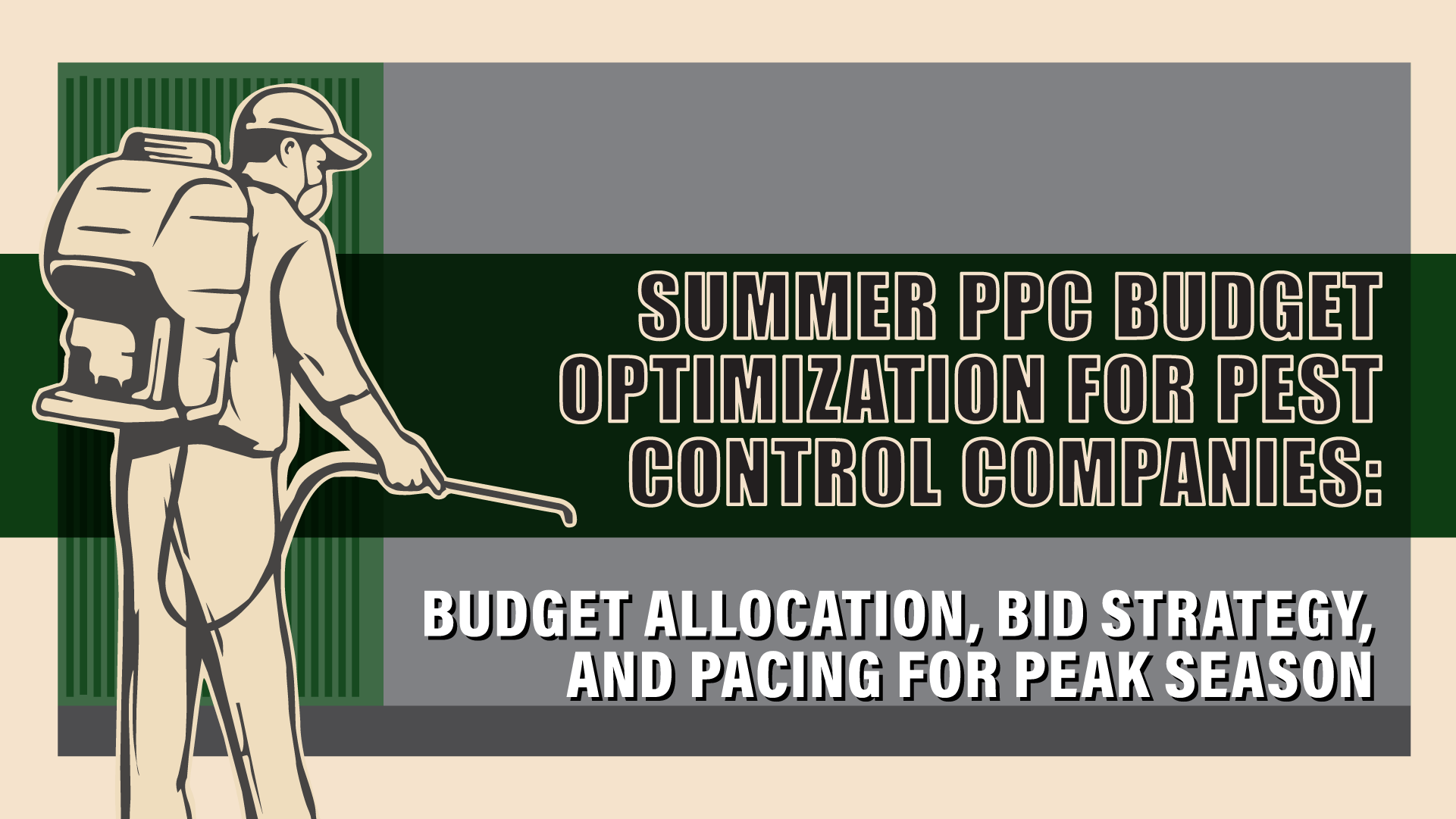
PPC for pest control is a lot like managing inventory for a seasonal retailer. You can't sell what you didn't stock, and you can't stock what you didn't budget for. The pest control owners who win peak season are not the ones with the biggest annual budgets; they're the ones who allocated correctly across months that don't look anything like each other.
A pest control company spending $5K per month in February and $5K per month in May is leaving leads on the table. February is shoulder season; the demand isn't there to absorb the budget efficiently. May is peak; $5K runs out by the second week, and the company stops bidding while competitors keep showing up. Same total budget. Worse outcome. This post is about fixing that pattern for pest control companies running paid search through 2026's summer demand cycle.
I'll cover the seasonal demand curve, how to allocate budget across the year, bid strategy adjustments for peak, daily and dayparted pacing, competitor bidding dynamics, and the specific tactics that protect your cost per lead when CPCs spike. None of this is theoretical. It's the same playbook we run for the pest control PPC accounts we manage.
The specific percentages in this post are drawn from Cube Creative's pest control PPC management across clients in mid-sized U.S. markets. Your account's numbers will vary based on market seasonality, service mix, and competitive intensity. Use these as directional benchmarks, not prescriptions. Where an industry source applies directly, I will link it.
The Seasonal Demand Curve You're Bidding Into
Before allocating a single dollar, understand the curve. Pest control demand is highly seasonal in most U.S. markets, with sharp peaks in late spring through early fall and pronounced troughs in deep winter. The exact shape varies by region (Florida and Texas have flatter curves; Minnesota and Maine have steeper ones), but the broad pattern holds nearly everywhere: Q2 is the inflection point and Q3 sustains the volume.
Q2: April Through June
This is the high-demand window. April brings the spring pest emergence (ants, termites, mosquitoes, wasps). May is typically the highest single month for residential pest control searches in most markets. June extends the demand with summer infestation calls and the termite swarming season. Combined, Q2 commonly accounts for around 40% of annual pest control search demand, which means it should account for a proportional share of your annual PPC spend if you are optimizing for share of voice rather than smoothing.
Q3: July Through September
The volume holds. Mosquito season peaks in many markets. Bed bug calls trend upward as people travel and bring infestations home from hotels. Wildlife calls spike in late summer as raccoons, squirrels, and bats look for shelter. The competition is still intense, but the customer behavior is slightly less panicked than spring emergency calls.
Q4: October Through December
Demand drops in most markets except for rodent calls (cooler weather drives mice and rats indoors). Wildlife exclusion calls rise as homeowners notice movement in attics. The shoulder season is a good time to focus on long-tail keywords, branded campaigns, and content that builds for the next year's peak.
Q1: January Through March
The trough. February typically sees the lowest residential pest control search volume of the year in northern markets. The companies that survive this period either operate in markets with year-round demand (Florida, southern California, Texas) or shift budget to commercial accounts, recurring service plan promotions, and brand-building campaigns that prepare for spring.
The 3.75x Rule and How to Build Your Annual Budget
The single biggest budget allocation mistake in pest control PPC is treating the budget as a flat monthly number. If your annual PPC budget is $120K and you divide it into $10K monthly increments, you've created two problems: you're under-budgeted in May, and you're over-budgeted in February.
Across Cube Creative's pest control PPC accounts, a pattern holds: the highest-performing accounts run May budgets that are roughly 3 to 4 times their December budgets. We call this the 3.75x rule internally; it is a useful calibration against a flat monthly allocation. Your exact ratio will depend on your market's seasonality, but the underlying logic (match budget to demand) is durable.
Worked Example
Let's say you have $120K to spend on PPC across 12 months. A flat allocation gives you $10K per month, which gets crushed in May and wasted in February. A demand-weighted allocation might look like:
- January: $5K
- February: $4K
- March: $7K
- April: $13K
- May: $18K (peak)
- June: $15K
- July: $13K
- August: $12K
- September: $10K
- October: $8K
- November: $6K
- December: $5K
- Total: $116K (with $4K reserved for opportunistic spend)
That allocation matches the demand curve. May runs at 3.6x the December number. April and June support the peak. The shoulder months don't waste budget on traffic that wasn't there.
Adjusting for Your Market
The exact percentages should reflect your market's pattern. A pest control company in Phoenix has a different curve than one in Buffalo. Pull two years of your own Google Ads data, identify the months that produced your highest impression share and conversion volume, and weight your budget allocation to match.
What If You Do Not Have Historical Data?
If you do not have two years of Google Ads data (new account, agency transition, broken reporting), three starter moves get you to a defensible first-year peak plan:
- Use Google Trends as a demand template. Search for "pest control near me" or "exterminator [your city]" and overlay 12 months of search volume. The shape of that curve is the shape your budget should follow.
- Use the 3-4x rule as a directional anchor. Set your May budget at 3 to 4 times your December budget. Adjust other months proportionally.
- Use Lost Impression Share as a weekly adjustment signal. Start conservative on the peak allocation and increase the budget weekly when Lost Impression Share to Budget exceeds 20%. A first-year plan will not be perfectly tuned, but it will still beat a flat monthly allocation.
Bid Strategy by Season
Bid strategy in pest control PPC is one of the most over-engineered topics in agency consulting and one of the most underthought topics in DIY accounts. Here's the practical version.
Smart Bidding (Maximize Conversions, Target CPA, Target ROAS)
Smart bidding works best when the algorithm has consistent data to learn from. That means stable demand, stable conversion rates, and stable budget pacing. In the shoulder seasons (Q1 and Q4), smart bidding often outperforms manual bidding because the auction dynamics are predictable and the algorithm has room to optimize.
In peak season (May through July), smart bidding can struggle. Demand is changing daily. CPCs are spiking. New competitors enter the auction. Conversion rates fluctuate. The algorithm tries to optimize against a moving target and often overspends in the wrong moments.
Manual CPC and Enhanced CPC
Manual bidding gives you direct control. You set the maximum CPC for each keyword, and Google bids up to that limit. Enhanced CPC adds an algorithmic bid lift in moments when conversion is more likely.
For peak season, manual or Enhanced CPC bidding is often the better choice for pest control accounts because you maintain control over the most expensive keywords. The trade-off is more day-to-day management. The benefit is you're not letting the algorithm chase volume at the expense of CPL.
Recommended Approach by Season
- Q1 and Q4 (low season): Smart bidding with Target CPA, conservative target. Let the algorithm find efficient leads.
- Q2 peak: Manual or Enhanced CPC bidding with active monitoring. Daily CPC checks. Aggressive pause on terms running over your target.
- Q3 sustained demand: Hybrid. Smart bidding on stable, well-performing campaigns. Manual bidding on emergency keywords (bed bug, wildlife).
- Brand campaigns year-round: Manual bidding with conservative bids. Brand traffic is low-risk and high-conversion, so paying the minimum to maintain top position is the right move.
Daily Budget Pacing for Peak Season
A monthly budget is just a framework. The actual pacing happens daily, and the daily decisions are where most pest control accounts leak money.
The Monday Problem
Pest control search volume often spikes on Mondays as homeowners deal with weekend-discovered issues. A flat daily budget that's set evenly across the month will burn out by mid-day Monday and miss high-intent leads in the afternoon and evening. The fix: weight Monday budgets higher, with progressive declines through the week.
A representative weekly distribution for a peak-season pest control account:
- Monday: 20% of weekly budget
- Tuesday: 16%
- Wednesday: 14%
- Thursday: 14%
- Friday: 14%
- Saturday: 12%
- Sunday: 10%
The exact percentages vary by market, but the principle holds: front-load the week.
Dayparting
Within each day, search volume isn't evenly distributed either. Most pest control searches happen between 6 a.m. and 10 p.m., with peaks at 8-10 a.m. and 5-9 p.m. Dayparting (Google Ads scheduling) lets you reduce or pause spend during low-intent hours and concentrate budget in the windows that produce calls.
For most residential pest control accounts:
- 6 a.m. to 10 a.m.: 100% bid (peak morning)
- 10 a.m. to 4 p.m.: 80% bid (work hours)
- 4 p.m. to 10 p.m.: 100% bid (peak evening)
- 10 p.m. to 6 a.m.: 50% bid or paused (low intent, except for emergency/bed bug terms, which can run 24/7)
The exception: emergency keywords (bed bug, wildlife, "near me" terms) should generally run 24/7 because the intent is urgent regardless of the hour. Reserve dayparting for educational or lower-intent terms.
Pacing for Demand Spikes
Within peak season, certain weeks spike harder than others. The first warm week of spring drives an emergence-related search spike. Memorial Day weekend triggers travel-related bed bug calls. The first frost in the fall produces a rodent search spike. Build buffer into your budget allocation for these spikes so you don't max out at the wrong moment.
If you want help turning last year's Q2 data into this year's budget plan, the free peak season PPC audit does exactly that. Five business days. No sales call required. Request the audit.
Managing Competitor Bidding Pressure
Every pest control company in your market is bidding against you in peak season. Their budgets are also at peak. CPCs inflate. The companies that handle this well plan for it; the companies that don't plan for it watch their CPL double in May and panic-pause campaigns.
Expected CPC Inflation
In most pest control PPC accounts, peak-season CPCs run 15% to 30% higher than shoulder-season rates. The increase is concentrated on the highest-intent terms (bed bug, wildlife, "near me") where competition is fiercest. Lower-intent terms see less inflation.
Plan for this in your budget. If your shoulder-season CPL is $40, expect peak-season CPL to land in the $52-$60 range on the same keywords. That doesn't mean you should pull spend; it means you should pre-set your CPA targets to match the seasonal reality.
Competitor Conquest Bidding
Some competitors will bid on your brand name during peak season. The defensive play is to bid on your own brand to maintain top position (which is cheap and high-converting), and to optionally bid on competitor names if their brand traffic is high enough to justify it.
Brand bidding is non-negotiable in peak season. If you don't bid on your own brand, a competitor may show up above your organic listing for branded searches and skim your traffic. The CPC is low (usually under $2), and the conversion rate is high (often 30%+) because the searcher already knows you.
Negative Keyword Discipline
Peak season also brings out search query patterns you don't want to pay for. Research queries ("how to get rid of bed bugs naturally"), DIY queries ("homemade bed bug killer"), and informational queries ("what do bed bug bites look like") all spike with general pest awareness in spring and summer.
Run your search terms report weekly during peak season and add negative keywords for anything that does not match buying intent. The negative keyword list is the single highest-impact maintenance task in pest control PPC during peak.
Local Services Ads in Summer
Google Local Services Ads (LSA) deserve their own section because they behave differently from Google Ads in peak season. LSA cost per lead is typically more stable than Google Ads CPL because the auction model is different (pay per lead, not per click). LSA leads also tend to come pre-qualified through Google's verification process.
The challenge with LSA in peak season is responsiveness. Google scores businesses on how quickly they respond to LSA leads. During peak, when call volume is high and your CSRs are stretched, response times slip. When response times slip, your LSA lead score drops, and Google sends you fewer leads at a higher cost.
The fix is operational: budget for after-hours coverage, increase CSR capacity in peak months, and treat LSA leads as the highest-priority calls in your queue. The companies that maintain a 90%+ live answer rate on LSA leads in peak season see costs per lead stay flat or even drop.
For a deeper LSA strategy, see our Google Local Services Ads guide for pest control.
Tracking and Reporting Through Peak Season
You can't optimize what you don't measure. Peak season is when accurate tracking and weekly reporting become non-negotiable.
Weekly Metrics to Track
- Total spend vs. budget pace
- Cost per click by keyword group (emergency, service-specific, branded, geographic)
- Cost per lead by campaign and keyword group
- Conversion rate by ad group
- Impression share lost to budget
- Impression share lost to rank
- Top-performing search terms (weekly review)
- Top-wasting search terms (weekly negative keyword list updates)
The "Lost Impression Share to Budget" Signal
This single metric tells you whether you're under-budgeted. If your lost impression share to budget is over 20% in peak season, you're losing leads to the budget cap. If it's under 5%, you might be over-budgeted (or the demand isn't there to support more spend).
The right target during peak is usually 10% to 20%. That range means you're spending efficiently without leaving major opportunities unaddressed.
CPL Volatility
Expect CPL to be volatile week-to-week in peak season. A bad week (CPL spikes 25%) doesn't mean the campaign is broken. It might mean a competitor entered the auction, or it might mean a particular ad creative is fatiguing. Look at the trend over 4 weeks before making major changes.
The exception: if CPL spikes 50% or more for two consecutive weeks, something has changed materially, and you should investigate. Common causes include new competitors, a broken landing page, ad disapproval, or a tracking issue.
Building the Summer PPC Plan
Here's the order of operations for getting your peak season budget right:
This month (whatever month you're reading this in): Pull last year's Q2 PPC data. Identify the weeks you ran out of budget, the weeks you underspent, the keywords with the highest CPL spikes, and the conversion rate by week. That data is your starting point.
Two months before peak: Build a daily budget allocation for April, May, June, and July. Set up dayparting schedules. Update negative keyword lists. Confirm your landing pages are mobile-fast and converting. Verify call tracking is working on every campaign.
One month before peak: Increase CSR capacity to handle peak call volume. Confirm after-hours coverage for emergency keywords. Pre-build any new ad creative or landing page variants you want to test in peak.
During peak: Daily monitoring of spend pacing, CPL, and conversion volume. Weekly review of search terms and negative keyword updates. Bi-weekly review of bid strategy effectiveness. Monthly competitive analysis.
After peak: Document what worked and what didn't. The post-peak review is the most valuable hour of the year because it sets up next year's plan.
Ready to Optimize Your Peak Season Budget?
If your pest control PPC needs a second set of eyes before peak season hits, start with the free peak season PPC audit. Here is what is included:
- Month-by-month budget recommendation for May through August based on your account data
- Top three budget pacing or bid strategy changes we would make in the first 30 days
- A dayparting recommendation specific to your service area
- Your current Lost Impression Share to Budget benchmarked against the 10-20% peak-season target
Delivered in five business days. No sales call required. Request the audit.
Summer PPC for Pest Control: Frequently Asked Questions
What's the right monthly PPC budget for pest control during summer?
The "right" budget depends on your service area, competition level, and growth goals, but most established pest control companies in mid-sized markets run $5K to $20K per month at peak. Larger regional operators in competitive metros often run $25K to $60K monthly. The better question is: what percentage of revenue should marketing be? Most healthy pest control operations spend 6% to 10% of revenue on total marketing, with roughly 30% to 50% of that going to PPC during peak. That math gives you a budget framework grounded in your actual business size.
How much will my pest control CPL go up in summer?
Expect peak-season CPL to run 15% to 30% higher than shoulder-season rates on the same keywords. The increase is concentrated on emergency and competitive terms (bed bug, wildlife, "near me"). Branded keywords typically don't see major CPC inflation. Plan your peak-season CPL targets accordingly. If your shoulder-season CPL is $40, set your peak target at $52-$60 and don't panic when you hit it.
Should I switch to smart bidding for summer?
Counterintuitively, no. Smart bidding works best in stable demand environments. Peak season is volatile (demand changes daily, new competitors enter, CPCs spike), and the algorithm often struggles to optimize against a moving target. Manual or Enhanced CPC bidding gives you more control during peak. Switch back to smart bidding (Target CPA, Maximize Conversions) in shoulder seasons when demand is steady, and the algorithm has room to learn.
How do I know if I'm under-budgeted in summer?
The clearest signal is the "Lost Impression Share to Budget" metric in Google Ads. If it's running over 20% during peak season, you're losing leads to the budget cap. If it's running over 30%, you're significantly under-budgeted and likely losing share to competitors. The fix is either to increase the budget or to be more aggressive with negative keywords and dayparting to concentrate spend on high-intent moments.
Should I bid on my competitors' brand names?
It depends. Competitor conquest bidding works when the competitor brand has substantial search volume, and your offering is meaningfully differentiated. It often doesn't work when the competitor brand has loyalty (the searcher knows them and isn't open to alternatives) or when the bid costs are too high to justify the conversion rate. Test it with a small budget on one or two competitors. Track conversion specifically for those campaigns. Keep what works, kill what doesn't.
How important is dayparting for pest control PPC?
Dayparting matters more for accounts with constrained budgets and less for accounts with unlimited spend. If you have $5K to spend in May and need it to last 30 days, dayparting (concentrating spend in 6 a.m.-10 a.m. and 4 p.m.-10 p.m. windows) extends your effective reach. If you have $30K with high impression share targets, dayparting matters less because you can afford to bid through low-intent hours. As a default, daypart aggressively in peak season and loosen up in shoulder months.
What's the worst PPC mistake pest control companies make in summer?
Setting a flat monthly budget and walking away. The seasonal demand curve is too pronounced for a "set it and forget it" approach. The companies that win peak season are the ones actively managing daily spend, weekly performance, and monthly bid strategy through Q2. The companies that lose peak season are the ones that set the budget in February and hope for the best in May.
Should I run Google Ads, LSA, or both in the summer?
Bot, have different roles. LSA is your high-intent, pre-qualified lead source. Google Ads is your higher-volume, more flexible lead source. Run both during peak. LSA delivers leads at a lower CPL but is capped by the lead volume Google chooses to send you. Google Ads gives you control over volume and can scale up. The mix that works for most pest control operations is 40 to 60% LSA and 60 to 40% Google Ads, adjusted based on which channel produces better lead quality in your market.
What about Performance Max, Shopping, or YouTube in peak season?
Pest control is primarily a Search and LSA game because the buying intent is query-driven ("exterminator near me") rather than browsing-driven. Performance Max has a role in retargeting and brand reach, but is rarely the primary lead channel for pest control. YouTube and Display work for brand awareness campaigns in competitive metros but carry longer attribution windows. For most pest control operators, Search plus LSA delivers the large majority of measurable lead value. Spend on other surfaces should come after the Search budget is fully optimized.