The pest control industry is facing a transformative shift in how customers find and choose their service providers.
With Google's AI Overviews now appearing in over 1.5 billion searches monthly (Source: Search Engine Journal), the traditional pathways connecting customers to your pest control business have fundamentally changed. This isn't just another marketing trend—it's a complete rewiring of the customer discovery process.
For pest control professionals, the stakes couldn't be higher. When homeowners discover ants streaming into their kitchen or hear scratching in their attic, they're not casually browsing—they're seeking immediate solutions. And increasingly, AI is determining which pest control companies they call.
This begs the question of how visible is your pest control business when customers use voice search or AI-powered devices?
What You'll Learn in This Guide:
- How AI search engines evaluate and recommend pest control businesses
- Practical strategies to optimize your online presence for voice search and AI Overviews
- Ways to leverage your local expertise to outperform larger competitors
- Step-by-step tactics to implement Answer Engine Optimization for your pest control business
- Future trends that will shape pest control marketing in 2025 and beyond
The New Local Search Landscape
How AI Interprets Your Pest Control Business
When potential customers search for "pest control near me" or "exterminator in [your city]," they're no longer seeing simple lists of local businesses. Instead, AI is interpreting these queries with unprecedented sophistication, pulling together hyper-relevant results based on a complex understanding of both the query and the searcher.
Google's AI Overviews have changed the game by providing concise, AI-generated summaries at the top of search results. For home service businesses like pest control companies, these AI overlays are significantly impacting click-through rates, with Seer Interactive reporting that organic click-through rates were cut by more than half (from 1.4% to 0.64%) between January 2024 and 2025 when AI Overviews appear.
(Data Source: Seer Interactive)
According to BrightEdge, overall search clicks have fallen by 30% in the last year since AI Overviews launched, despite search impressions increasing by 49%. Semrush research reveals that as of March 2025, AI Overviews now appear in 13.14% of all search queries, up from just 6.49% in January 2025, showing rapid adoption of this feature.
It's important to note that this trend is part of a larger shift in search behavior. SparkToro's 2024 study found that nearly 60% of Google searches now end without any clicks, as users find answers directly on the search results page.
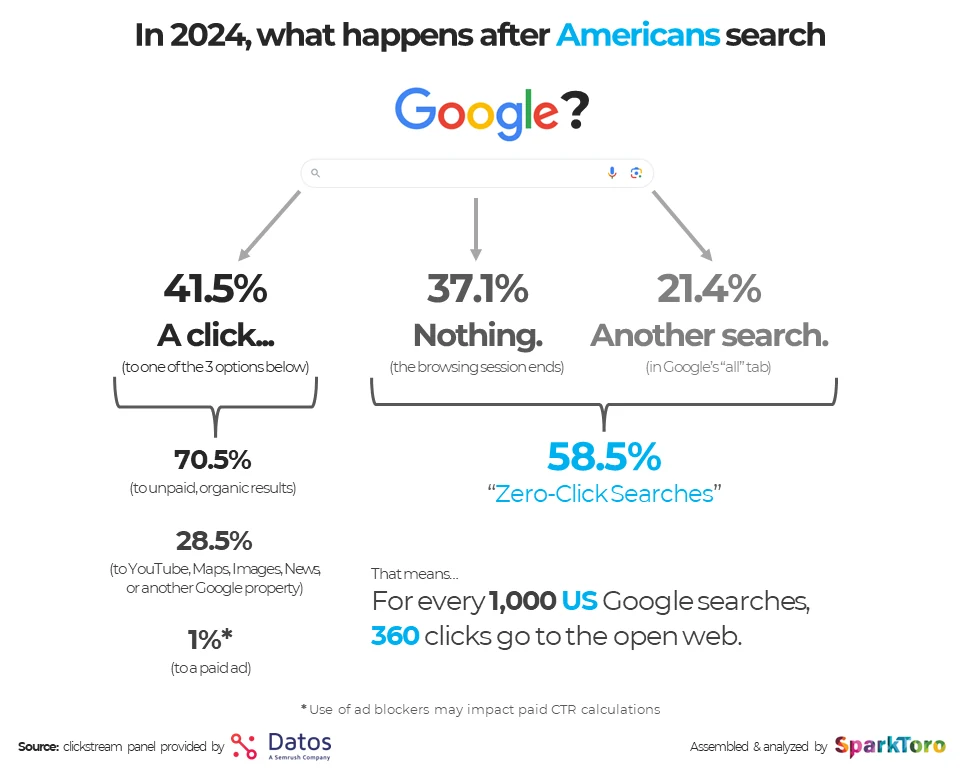
(Image Source: SparkToro)
This means potential customers might get their questions answered directly in search results, without ever clicking through to your website. While this might sound alarming, being cited within AI Overviews significantly boosts your credibility and brand visibility. AI-powered search engines are designed to understand the context and relationships between concepts, not just exact keyword phrases, prioritizing content that demonstrates expertise, experience, authority, and trustworthiness (E-E-A-T). The goal is no longer just driving website traffic but becoming the "default AI recommendation" for pest control in your area.
Geographic Entity Recognition: Understanding Your Service Area
AI search engines have become remarkably sophisticated at understanding geographic relationships through what's called Geographic Named Entity Recognition (GNER). This technology allows search engines to identify and classify geographic entity names within text, making truly hyperlocal marketing possible at scale.
For pest control businesses, this means AI can understand highly specific location-based queries with contextual factors. When someone searches for "pest control for lake houses in [specific neighborhood]" or "termite inspection in historic district," AI can match these queries with pest control companies that have demonstrated relevance to these specific areas.
This shift requires pest control companies to move beyond broad keyword targeting to what's called "thematic relevance." Instead of simply optimizing for "pest control services," successful companies are now optimizing for concepts like "eco-friendly pest control for historic homes" or "emergency rodent removal for restaurants." This approach aligns your digital presence with what searchers are actively looking for, increasing your visibility in AI-generated categories.
Is your content specifically tailored to the unique pest challenges in your service neighborhoods?
Hyperlocal Content: Your Secret Weapon
Creating hyperlocal content has become essential for pest control companies looking to dominate in AI search results. This means developing content that addresses pest issues specific to your geographic area, including:
- Dedicated landing pages for each service area and core service
- Content that incorporates locally relevant details like landmarks, neighborhood names, and city-specific pest challenges
- Location-specific testimonials and FAQs about common pest problems in different areas you serve
- Seasonal pest content relevant to your specific region
The most effective hyperlocal content directly addresses questions in a structured format, utilizing clear headings and bullet points. According to Surfer SEO, "Content should be written clearly, concisely, and in a natural, conversational tone, avoiding unnecessary jargon." This makes your content easily digestible by AI systems, making your business a prime candidate for featured snippets and AI Overview inclusion.
Local pest control companies have an inherent advantage here—your deep understanding of your community allows you to create genuinely unique hyperlocal content that AI will highly value for its specificity and relevance. By tailoring content to specific local pest issues and seasonal patterns, pest control businesses can capture highly specific, high-intent queries, which directly leads to better conversion rates and more qualified leads. This can become a significant competitive advantage against national chains, enabling you to dominate niche, high-intent local queries by providing the most authentic and relevant information.
Mobile-First AI Search Behavior
The dominance of mobile devices in web traffic continues to grow, with SOAX research reporting that as of January 2025, 62.69% of all global web traffic comes from mobile devices. This upward trend is even more pronounced in certain regions, with MobiLoud showing that in 2025, mobile devices account for 62.45% of global internet traffic compared to desktops' 35.71%. GO-Globe reports that mobile traffic is projected to make up nearly 75% of all web traffic as users continue to rely on smartphones for browsing, e-commerce, and entertainment.
This mobile-first reality is especially critical for emergency pest control situations, where customers often search from their mobile devices. According to TechJury, 51% of mobile users search for information when they are on the go, and another 53% search for information while they are at home—both scenarios that align perfectly with pest control emergencies.
AI algorithms increasingly factor in user experience signals, prioritizing websites that are mobile-friendly and load quickly. Key metrics such as Largest Contentful Paint (LCP), Interaction to Next Paint (INP), and Cumulative Layout Shift (CLS), collectively known as Core Web Vitals, are critical for assessing mobile performance and overall SEO.
For pest control companies, this means ensuring your website:
- Loads quickly on mobile devices
- Features a responsive design with readable fonts
- Includes thumb-friendly navigation
- Provides critical information like your phone number and service areas immediately
- Offers simple contact forms optimized for mobile completion
The convergence of mobile, voice, and AI is creating a new category of "on-the-go" search behavior, where users expect instant, accurate, and contextually relevant local pest control information delivered seamlessly. This is particularly important for urgent pest control needs, where potential customers want immediate solutions to their pest problems.
Voice Search and Pest Control Services
Is your pest control business prepared for the voice search revolution?
The Rise of Voice-Activated Pest Control Searches
Voice search continues to show impressive adoption rates, creating new opportunities for pest control businesses. As of 2025, approximately 20.5% of people worldwide utilize voice search, a slight increase from 20.3% in early 2024, according to DemandSage. The voice search user count in the United States is projected to reach 153.5 million in 2025, reflecting continued growth in this technology.
What's most relevant for pest control companies is that 76% of consumers use voice search to find local businesses, and voice searches are three times more likely to be local than text-based searches, as reported by Synup and FindStack. Invoca notes that 46% of users perform voice searches to look for information on local businesses on a daily basis. When someone discovers a spider infestation or notices termite damage, they're increasingly likely to ask their voice assistant for help rather than typing a query.
The proliferation of voice-activated devices is driving this trend. By 2025, it's projected that 75% of US households will own at least one smart speaker, according to data from Statista. This widespread availability underscores the increasing integration of voice technology into daily life—and into the customer journey for pest control services.
"Hey Siri, Find a Pest Control Company Near Me"
Voice search queries for pest control are distinctly different from traditional text searches. They're more conversational, often posed as direct questions, and typically begin with interrogative words such as "who," "what," "where," "when," "why," or "how."
A significant driver for voice search in the pest control sector is urgency. When homeowners discover a wasp nest or hear rodents in their walls, voice assistants offer a faster, hands-free method to find help compared to typing, especially during these home emergencies.
Common voice queries in pest control include phrases like:
- "Hey Siri, find a pest control company near me"
- "Alexa, which exterminators are open today?"
- "Ok Google, who can get rid of bed bugs in [your city]?"
- "Siri, what's the best-rated termite control company nearby?"
These queries often include explicit location indicators like "near me" or specify a particular geographic area. Beyond service providers, users also seek specific information such as business hours, phone numbers, or pest identification help through voice.
This pattern reveals that voice search for pest control is predominantly driven by an immediate, problem-solving intent. Users are articulating a pest problem and seeking an instant, local solution. Your business needs to be positioned as that solution.
Optimizing Your Pest Control Content for Voice
Optimizing for conversational queries requires a strategic shift toward natural language and user-centric content. Your pest control website should focus on long-tail, conversational keywords and phrases that mimic how people actually talk about pest problems.
Voice search users typically seek quick, actionable answers about pest control services. Therefore, your content should directly answer key questions concisely, ideally within 40-60 words for optimal AI parsing. FAQ pages are particularly effective for this purpose, with questions formatted as headings and direct, clear answers immediately following.
Structure your pest control FAQ content using complete questions as headings (e.g., "How quickly can you respond to a bed bug emergency?" or "What should I do if I find termites in my home?"). Direct, clear answers should immediately follow each question, mirroring the conversational nature of voice search interactions.
Integrating FAQ Schema markup is also crucial. This structured data helps search engines better understand your content's context, significantly improving the chances of appearing in featured snippets and voice search results. By explicitly labeling questions and answers about pest control, you provide AI with a clear roadmap to your valuable content.
Smart Speaker Strategies for Pest Control Businesses
Smart speakers offer unique marketing opportunities for pest control companies. By 2025, projections indicate that 75% of US households will own at least one smart speaker, creating a new channel to reach potential customers right in their homes.
Consider these smart speaker integration opportunities for your pest control business:
- Develop a simple voice application (skill or action) that provides pest identification help or seasonal pest prevention tips
- Create voice-activated promotions ("Ask [your company name] about this month's termite inspection special")
- Offer voice-scheduled appointments for routine pest control services
- Provide voice-accessible emergency pest control information
The goal is to transition from mere discoverability via voice search to becoming an integrated, convenient part of a customer's home management routine. This fosters deeper brand loyalty through seamless, voice-activated interactions, especially valuable in the recurring service model of pest control.
Featured Snippets and Answer Boxes
When potential customers ask about pest problems, does your content provide the definitive answer that appears at the top of search results?
Becoming the Definitive Pest Control Answer
Featured snippets, often called "Position Zero," appear prominently at the top of Google's search results, above traditional organic listings. For pest control companies, securing these prime positions can significantly boost visibility and establish your authority on pest management topics.
These snippets come in various forms that can work well for pest control content:
- Paragraph snippets (ideal for defining pest control terms or explaining treatment approaches)
- List snippets (perfect for prevention steps or treatment processes)
- Table snippets (great for comparing treatment options or showing seasonal pest activity)
- Video snippets (effective for showing identification guides or prevention techniques)
While featured snippets offer significant visibility benefits, there's an important strategic consideration: if your web page listing is elevated into the featured snippet position, it no longer repeats in the standard organic search results. This policy can lead to a trade-off, as recent data shows considerable differences in click-through rates (CTR). According to First Page Sage, featured snippets can achieve an impressive CTR of 38.9%-42.9%, significantly higher than traditional results. However, Sistrix research indicates that when a featured snippet appears, the CTR for position one drops by an average of 5.3%.
The impact is even more pronounced with AI Overviews present. Recent studies by Ahrefs and Amsive, via Search Engine Land, found that AI Overviews decreased CTR for traditional organic listings by 34.5% and 15.49%, respectively, with an alarming 37.04% drop when combined with featured snippets. This creates a complex strategic decision for pest control marketers, where appearing in these special positions can provide greater visibility but may result in fewer overall clicks compared to a standard top organic position. The key is understanding which format will drive the most qualified traffic for your specific service offerings.
The decision to optimize for featured snippets should be based on the type of query. For informational queries about pest identification or prevention, featured snippets can establish your authority. For transactional queries like "emergency pest control," prioritizing the #1 organic ranking might drive more immediate calls.
FAQ Optimization: The Bug Stops Here
Optimizing your pest control content through Frequently Asked Questions (FAQ) sections has become highly effective for AI search, particularly for voice queries. These sections allow you to directly and concisely answer common pest control questions, which aligns perfectly with how AI processes and presents information.
Effective pest control FAQs should address questions like:
- "How can I tell if I have termites or carpenter ants?"
- "What is the safest pest control method for homes with pets?"
- "How often should I schedule pest control treatments?"
- "What are the signs of a bed bug infestation?"
- "Do I need to leave my house during pest treatment?"
Surfer SEO advises that for optimal AI parsing and voice search readiness, structure your FAQ content using complete questions as headings, followed by direct, clear answers. This format helps AI systems quickly identify and extract the most relevant information to answer user queries about pest control.
Implementing FAQ Schema markup further enhances this optimization. This structured data helps search engines understand the content's context, significantly improving the chances of appearing in featured snippets and voice search results. By explicitly labeling your pest control questions and answers, you provide AI with a clear roadmap to your valuable content.
Seasonal Content That Captures Featured Snippets
Pest control is inherently seasonal, with different pests becoming problematic at different times of the year. This seasonality creates perfect opportunities for featured snippet optimization.
Create dedicated content addressing seasonal pest concerns:
- Spring: Termite swarm season, ant prevention, mosquito preparation
- Summer: Mosquito control, wasp and hornet management, and fly prevention
- Fall: Rodent prevention, overwintering pests, spider control
- Winter: Indoor pest management, rodent control, preventative measures
Optimize each seasonal piece for featured snippets by:
- Creating clear, concise answers to seasonal pest questions (40-60 words)
- Using structured headings that match common seasonal pest queries
- Including bulleted lists of prevention tips or treatment steps
- Adding structured data markup specific to the seasonal content
- Updating content annually with fresh information and statistics
By anticipating seasonal pest questions and providing authoritative answers, your pest control business can secure featured snippets throughout the year, maintaining visibility regardless of season.
AI-Powered Review and Reputation Management
How is AI analyzing what your customers are saying about your service, and what story is it telling potential clients?
How AI Reads Your Pest Control Reviews
Artificial intelligence is transforming how online reviews for pest control businesses are analyzed and presented to potential customers. AI-powered sentiment analysis utilizes Natural Language Processing (NLP) to scan and analyze customer reviews, categorizing them as positive, negative, or neutral.
More advanced AI models can even identify specific emotions (e.g., relief, satisfaction, frustration) and themes in pest control reviews. According to Semrush, NLP in SEO helps search engines understand the context and intent behind content, not just keywords. For example, AI can detect patterns in reviews mentioning "technician professionalism," "effectiveness of treatment," or "scheduling convenience"—all crucial aspects of the pest control customer experience.
This capability allows pest control businesses to gain actionable insights at scale, without manually sifting through hundreds of reviews. The technology can aggregate sentiment trends and flag recurring keywords (e.g., "thorough inspection" or "friendly technician"), enabling you to detect recurring compliments or address potential service issues proactively.
Beyond basic sentiment, AI models are increasingly sophisticated at detecting fake reviews. They analyze review patterns and linguistic structures to identify anomalies that indicate suspicious behavior, such as unnatural repetition or phrasing, inconsistencies in review patterns, or suspicious clusters of reviews. This helps protect your pest control business's online reputation from competitors who might attempt to post fake negative reviews.
The Impact of Sentiment Analysis on Business Recommendations
Google's AI heavily factors in local authority and reputation when generating responses and recommendations in search results. Reviews and overall reputation are considered "non-negotiable" for maintaining local search visibility for pest control businesses.
When someone searches for "best pest control company in [your city]" or asks a voice assistant for pest control recommendations, AI is analyzing your review sentiment to determine if you should be recommended. This goes beyond simple star ratings to include the actual content of reviews, the consistency of positive sentiment, and how you respond to negative feedback.
For pest control companies, building a strong positive sentiment profile requires:
- Consistently delivering excellent service
- Actively soliciting reviews from satisfied customers
- Promptly and professionally addressing concerns
- Building a substantial volume of authentic reviews
- Highlighting your expertise in specific pest control areas
This process transforms reviews into a powerful, real-time source of business intelligence for operational improvements. Local pest control businesses should integrate AI-powered sentiment analysis tools into their operations to actively use customer feedback for identifying service gaps, enhancing treatment offerings, and improving overall customer experience.
Building an AI-Friendly Reputation Profile
AI offers significant capabilities for optimizing review responses and building robust, AI-friendly reputation profiles for pest control businesses. AskNicely suggests some tools can streamline the process of responding to reviews by suggesting personalized replies based on a review's sentiment and content. These tools maintain a human-like tone while ensuring consistency and efficiency in responses.
Building an AI-friendly reputation profile for your pest control business involves several key strategies:
- Encouraging High-Quality Reviews: Actively request reviews from satisfied customers through multiple touchpoints (post-service emails, text follow-ups, cards left after service), encouraging them to mention specific services, technicians, or positive experiences. This provides AI with richer, more detailed data points for analysis.
- Responding to All Reviews: Consistently respond to both positive and negative reviews to demonstrate engagement and a commitment to customer satisfaction, which AI algorithms factor into their assessment of your business's reputation.
- Maintaining a Complete Google Business Profile: Keep your Google Business Profile (GBP) updated with accurate hours, service areas, and pest control services offered. This is fundamental, as AI heavily relies on this information for local authority and recommendations.
- Implementing Structured Data: Utilize review schema markup on your website to showcase ratings directly in search results, providing AI with structured data about your reputation.
While AI can automate aspects of reputation management, human authenticity remains indispensable. The objective is to use AI to enhance human-driven engagement, leveraging AI tools for initial drafting and sentiment analysis, but always applying a human touch to ensure empathy and genuine connection in your responses.
Competitive Implications
Are you leveraging your local expertise to outperform national chains in AI search results?
National Chains vs. Local Pest Control Companies
The integration of AI into local marketing presents a complex dynamic between national pest control chains and local companies, potentially serving as both an equalizer and an amplifier of existing disparities.
National chains often possess significant advantages in AI adoption due to their scale and resources. They can invest in centralized platforms for location data management, enabling automated GBP updates, streamlined review management, and efficient distribution of localized content templates across hundreds or thousands of locations. This scalable technology ensures consistent adherence to AI optimization standards across all their outlets.
Furthermore, national pest control companies benefit from broader experience across diverse regions, bringing established, standardized processes that ensure uniformity when implementing AI strategies across multiple markets.
Despite the resource disparity, local pest control companies possess inherent advantages that AI can amplify:
- Deep Local Knowledge: Local pest control companies understand the specific pest challenges in their communities, from termite species prevalent in certain neighborhoods to seasonal rodent patterns in specific areas. This hyperlocal knowledge is pure gold for AI algorithms that value specificity and relevance.
- Community Connections: Local pest control businesses often have stronger community ties and more personal relationships with customers. These authentic connections generate more detailed, personal reviews that AI tends to value highly.
- Agility and Adaptability: Smaller pest control operations can often implement changes more quickly without navigating corporate approval processes, allowing them to adapt to AI search changes faster than national chains.
- Authentic Local Content: Local businesses have an inherent advantage in creating genuinely unique hyperlocal content that AI values for its specificity and relevance.
For local pest control businesses, these advantages can translate directly into higher visibility in local search results. By tailoring content to specific local pest issues and seasonal patterns, pest control businesses can capture highly specific, high-intent queries, which directly leads to better conversion rates and more qualified leads.
Interestingly, a growing number of consumers, particularly Gen Z and millennials, actively prefer shopping locally, with 85% of Gen Z shopping locally at least a few times a month. This preference, combined with strategic AI adoption, can create significant opportunities for local pest control companies.
Technology Adoption Barriers and Opportunities
While AI presents transformative opportunities for local pest control businesses, its adoption is not without significant barriers, particularly for smaller entities.
A survey conducted in April 2025 revealed a significant decline in small business AI adoption, dropping from 42% in 2024 to just 28% in 2025. According to NEXT's recent survey of 1,500 small business owners, cost and complexity were cited as primary deterrents, with a substantial 58% of small businesses indicating no plans to use AI at all.
Other significant barriers include:
- Cost and Complexity: AI projects often entail substantial upfront costs for software, cloud computing, and data management.
- Lack of In-House Expertise: Many small pest control businesses lack staff with the necessary technical skills to implement and maintain AI systems.
- Risks and Ethical Concerns: Issues around data privacy, AI-generated content quality, and maintaining authentic customer communications can create hesitation.
The core barrier for small pest control businesses is often not just the AI technology itself, but the human capacity within these businesses to understand, strategize, implement, and ethically manage AI. This "AI literacy gap" prevents them from realizing the technology's full potential.
Despite these challenges, AI offers compelling opportunities for pest control businesses:
- Efficiency and Automation: AI can automate time-consuming tasks such as scheduling, basic customer inquiries, and even preliminary pest identification from customer-submitted photos.
- Data-Driven Insights: AI excels at analyzing data to identify seasonal pest trends, predict customer behavior, and optimize service routes for greater efficiency.
- Enhanced Customer Service: AI chatbots can provide 24/7 customer communication, answer common questions about pests, qualify leads, and even book appointments.
- Competitive Analysis: AI tools can track competitors' pricing strategies, service offerings, and customer sentiment in real-time, helping you stay competitive.
For local pest control businesses, overcoming the AI literacy gap requires prioritizing education and strategic planning over immediate, large-scale technology investments. Starting small, proving concepts, and fostering team buy-in are crucial steps. Focus on practical, problem-solving AI applications that enhance existing human capabilities, rather than complex, expensive overhauls.
Future Predictions and Preparation
What AI-powered changes are coming next, and is your pest control business prepared to adapt?
Emerging Trends to Watch
The landscape of AI in local pest control marketing is evolving rapidly, with several key trends poised to shape its future through 2025 and 2026:
- Hyper-personalization at Scale: AI is moving beyond generic personalization to predictive anticipation, dynamically adjusting content based on factors like seasonal pest patterns, local weather conditions that trigger pest activity, and even individual property characteristics.
- AI-Powered Decision-Making: AI-driven strategy planning, forecasting, and optimization are becoming standard across marketing departments, significantly improving decision-making about when and where to promote specific pest control services based on predictive models.
- Rise of AI Agents: AI agents capable of gathering data, making decisions, and taking action toward predefined goals are expected to become mainstream in 2025. These agents could manage entire marketing workflows, allowing your team to focus on service delivery and customer relationships.
- Continued Growth of Voice Search: Voice search will become more integrated into daily life, making optimization for voice-driven pest control queries increasingly crucial for local businesses.
- AI-Driven Visual Search: This trend is gaining traction, allowing consumers to find pest control services by uploading photos of pests or pest damage. AI can identify the pest and connect customers with appropriate local providers.
- Emphasis on Ethical AI: As AI adoption grows, there is an increased priority on developing ethical frameworks and ensuring transparency in data use. Responsible AI is becoming a brand trust issue, especially important in a service like pest control that requires significant customer trust.
Technology Investment Recommendations
Pest control businesses should approach technology investments with a clear strategic vision, identifying specific pain points that AI can solve:
- Centralized Data Management Platforms: Invest in platforms that centralize location data management to automate Google Business Profile updates and streamline review workflows. This ensures consistency and accuracy, which AI highly values.
- AI-Powered SEO Tools: Leverage tools for advanced keyword research, content creation, on-page optimization, and performance monitoring. These tools can automate time-consuming tasks and provide deeper insights into customer search behavior.
- Sentiment Analysis and Review Management Tools: Tools like Local Falcon, Reputation.com, BrightLocal AI, or Chatmeter are valuable for analyzing review content, detecting fake reviews, and automating personalized response suggestions.
- AI Chatbots and Virtual Assistants: Implement AI chatbots for 24/7 customer communication, lead qualification, and appointment booking to improve responsiveness and customer experience.
- Predictive Analytics Platforms: Invest in platforms that analyze historical data to predict seasonal pest trends and consumer behavior, allowing you to anticipate future service needs and allocate resources more effectively.
Focus on integration and scalability, prioritizing AI solutions that seamlessly connect with your existing systems. Most importantly, maintain human oversight for authenticity, strategic direction, and ethical considerations. The most effective approach involves building an "AI-augmented" marketing team that leverages automation for efficiency while upholding your company's service standards and personal touch.
Conclusion
The AI revolution in search engines isn't just changing how pest control businesses market their services—it's fundamentally transforming how customers discover and choose pest management partners. From AI Overviews and voice search to hyperlocal content strategies and reputation management, every aspect of digital marketing for pest control is evolving rapidly.
While national chains may have resource advantages, local pest control companies possess invaluable community knowledge and agility that AI increasingly rewards. The key is bridging the AI literacy gap through strategic adoption, focusing on practical applications that enhance your existing service excellence rather than wholesale technological transformation.
As we move deeper into the AI era, pest control businesses that embrace these changes will find themselves not just surviving but thriving. The companies that combine technical adaptation with authentic local expertise will ultimately win both in search results and in customer loyalty.
Ready to adapt your pest control marketing strategy for the AI-driven future? Contact me for a personalized assessment of your digital presence and actionable recommendations to thrive in the new AI search landscape.
Frequently Asked Questions
How Will AI Search Affect My Pest Control Business's Local Visibility?
AI search is shifting from keyword-centric to intent-focused results, meaning your visibility will increasingly depend on your reputation, content quality, and how well you answer specific pest control questions. Businesses with complete Google Business Profiles (GBP), consistent NAP (Name, Address, Phone) information across platforms, and authentic customer reviews will gain visibility, while those with outdated information or poor sentiment scores may see declining visibility regardless of traditional SEO efforts.
What Are the Most Important AI Optimization Steps for Pest Control Websites?
The most critical optimization steps include structuring your content to directly answer common pest control questions, implementing FAQ schema markup, ensuring mobile-friendly design with fast loading speeds, creating hyperlocal content that addresses specific neighborhood pest issues, and maintaining consistent business information across all platforms. Focus first on your Google Business Profile (GBP) completeness and review management, as these are foundational for AI visibility.
How Can Small Pest Control Companies Compete With National Chains in AI Search?
Small pest control companies can leverage their local expertise by creating highly specific content about local pest issues, seasonal challenges, and neighborhood-specific services. Emphasize your community connections through detailed case studies and customer stories. Collect and highlight detailed reviews that mention specific locations and pest problems. While national chains have resource advantages, AI increasingly rewards authenticity and specificity that local experts can provide better than template-driven national content.
What AI Tools Should Pest Control Businesses Invest in First?
Start with tools that address your most pressing business challenges. For most pest control companies, this means investing first in reputation management tools that help generate, monitor, and respond to reviews. Next, consider AI-powered content tools that can help create locally relevant blog posts and FAQs. Customer service chatbots can provide 24/7 response to common questions and schedule appointments. Begin with affordable, specialized tools rather than enterprise-level AI platforms until you've proven their value.
Are Voice Assistants Really Important for Pest Control Marketing?
Voice assistants are increasingly important, especially for emergency pest control services. With 76% of consumers using voice search to find local businesses and voice searches being three times more likely to be local than text searches, pest control companies should prioritize voice search optimization. According to Synup, voice searches with "near me" or "close by" queries have surged by 900% in recent years, making them particularly valuable for location-based services like pest control.
This is particularly relevant because pest control often involves urgent situations where customers might use voice search for hands-free, immediate help. As smart speaker adoption continues to grow (projected to reach 75% of US households by 2025 according to Statista), the importance of voice search will only increase for pest control marketing.