Small pest control companies start out with one goal: land the first few customers. So most of them buy the old-school ad playbook: coupon mailers, billboards, out-of-home, and print ads. Then they sit back and wait, because they figure good service will bring people to the door on its own.
That plan can bring in some money, but there's a better approach. Use the internet to reach buyers online, and pair it with the ads you already run. No pest control business is too new to skip digital. It's where the leads are, and it's where interest turns into paying customers.
Still not sold? Lead Forensics (2025) reports that the average buyer conducts 12 online searches before interacting with a business website. That's a dozen chances to be found, or a dozen chances to be missed. Research by InBound Blogging found that nearly 3 out of 4 buyers spend more than half of their research time online before making offline purchases. Knowing how to measure your marketing ROI is what turns those clicks into real money.
Lean only on old-school ads and you miss a big slice of your future clients.
What Is Digital Marketing?
Before we get to the reasons and the practical tips, let's define the term.
Digital marketing is any marketing a business runs through a screen or the internet. Companies use it to reach and connect with their clients. Put simply, it's marketing that happens over the internet.
What Digital Marketing Works Best for Pest Control?
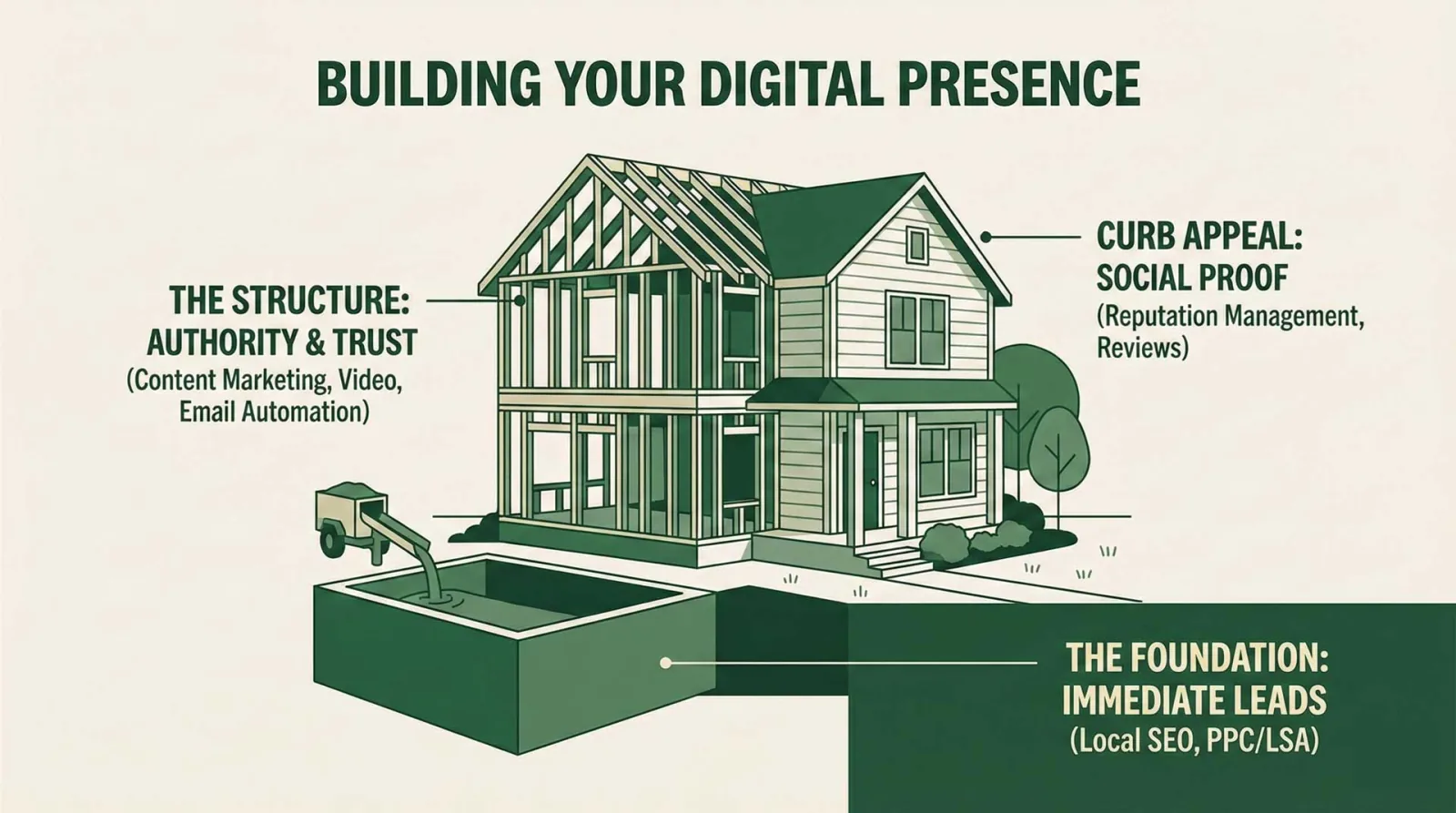
The best mix pairs high-intent local channels with slow, steady trust. Local SEO (Google Business Profile) plus PPC and LSA bring in high-value leads today. Content marketing (blogs, video) and email automation build trust and lift what each client is worth over the years.
Think of it like building a house, where you need a solid foundation and a good-looking front porch. The foundation is the set of channels that bring leads now. Your content and brand work are the curb appeal that makes people pick you over the guy down the road.
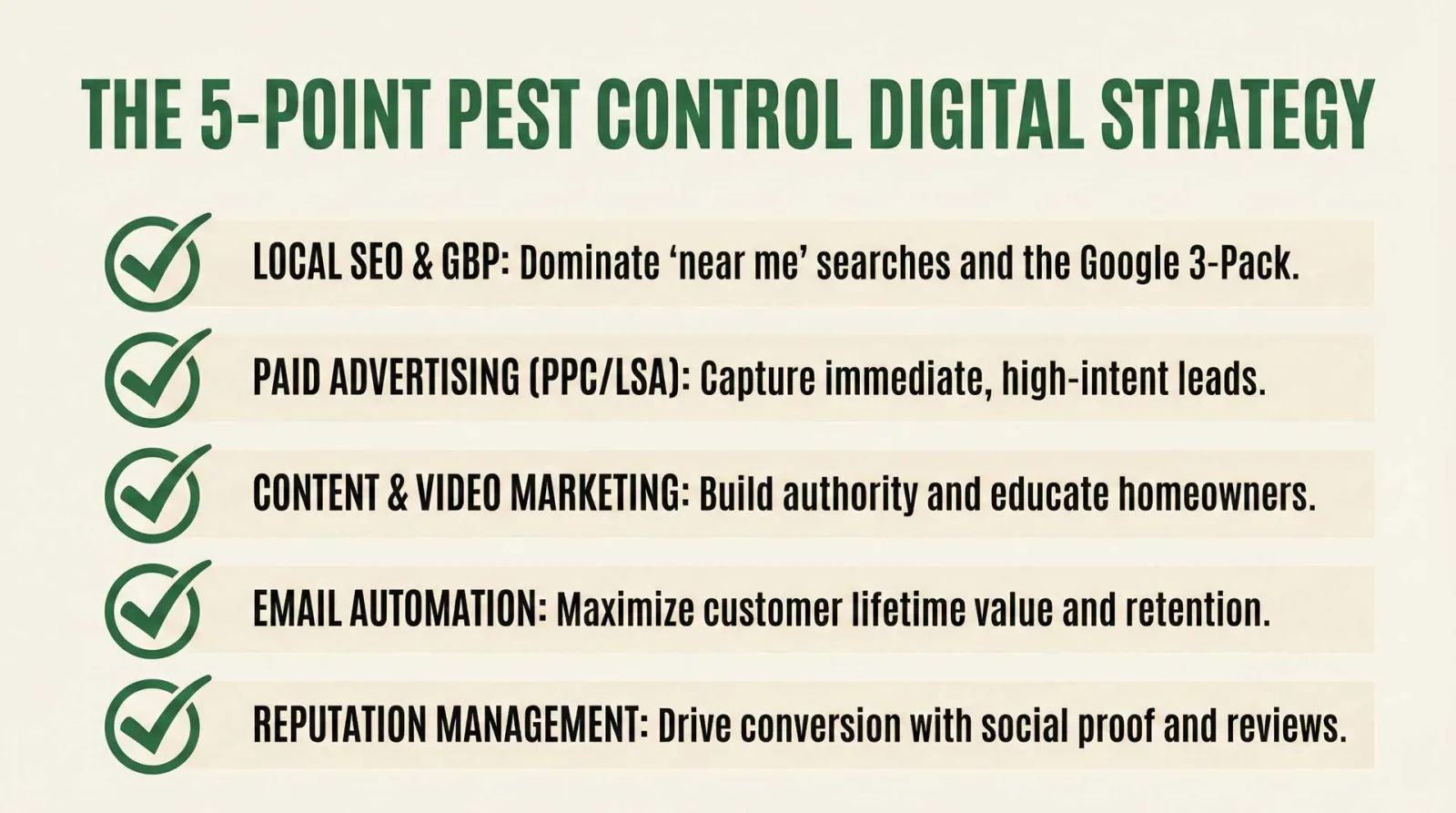
The five best plays for a pest control business work together to own your local market:
- Local SEO (Google Business Profile & "Near Me" Optimization) - Dominate local search results where customers are actively looking for pest control services
- Paid Advertising (Google Local Services Ads & PPC) - Generate immediate, high-intent leads from customers ready to book services
- Content & Video Marketing - Build authority and trust while capturing organic traffic through educational content
- Email Marketing & Automation - Maximize customer lifetime value through targeted campaigns and automated follow-ups
- Reputation Management (Reviews & Testimonials) - Build social proof that converts prospects into customers
Each one hits a different stage of the buying process. Some catch a first-time look, some close the deal, and some keep a client for years. According to Hook Agency (2025), nearly half of all Google searches have local intent. That alone makes local SEO a must for any company with a set service area. Research from Email Monday shows that email marketing delivers an average return of $36 for every dollar spent, with automated email workflows generating returns 30 times higher than one-off campaigns.
Digital marketing covers a lot of ground, so here's each piece and what it does for your company:

Web Design
A clean, mobile-ready website is the foundation for everything else you do, and it's where you show your services, your experience, and your reviews.
Search Engine Optimization (SEO)
Tune your website and content for the keywords people really type, such as "pest control services" or "exterminator near me." Do that and you climb the search results and pull in more free traffic. Local SEO matters most here, because most buyers look for help in their own town.

Content Marketing
Helpful, plain-spoken content aimed at homeowners with a pest problem isn't optional. Think blog posts, videos, or infographics on common pests, prevention tips, and solutions. Write for the person staring at a bug in the kitchen and looking for answers. Do that well and you become the trusted name in your trade.

Online Reviews & Reputation Management
Ask happy clients to post reviews on Facebook and your Google Business Profile (GBP). Those reviews build trust with buyers who've never met you. Review automation keeps them coming in, so no tech has to remember to ask. Then read and answer every review, good or bad, because it shows customers that you listen.
Social Media Marketing (SMM)
Facebook, Instagram, and LinkedIn let you talk straight to clients and buyers, share tips, and show off a little personality. Paid social ads can zero in on the ZIP codes and age groups you want.
Pay-Per-Click (PPC) Advertising
PPC tools like Google Ads put your ad in the search results and on other websites. You reach people hunting for pest control right now, and traffic hits your site the same day.
Email Marketing
An email list of current and future clients lets you send the right note to the right person. Promotional offers, how-to tips, or news from the shop. It keeps your company in mind and brings people back.
Learn these methods and use them well, and you'll reach the right audience, earn their trust, and book more jobs.
What Are the Benefits of Digital Marketing for Pest Control Companies?
Here are a few of the biggest payoffs for a pest control business:
Lower Cost
Digital costs less up front than print, radio, or television, and done right, the payback can be enormous. Setting the right marketing budget for your stage keeps you from spending too little and missing your chance to expand.
Larger Reach
An online presence costs less and reaches past your normal service area. You get in front of homeowners while the problem is still small.
Measurable Results
Digital is far easier to measure than a billboard. With Google Analytics and call tracking software, you can point to the exact moment a new client first found you.
Keep Up With the Competition
Buyers expect every pest control company to be online. Without a presence, you may not even make the short list.
Personalization
Digital lets you match the message to the search. When a homeowner sees content about the exact bug in their kitchen, they stick around. That's how a visitor turns into a lead, and then into a client.
Top 7 Reasons Your Pest Control Company Needs Digital Marketing
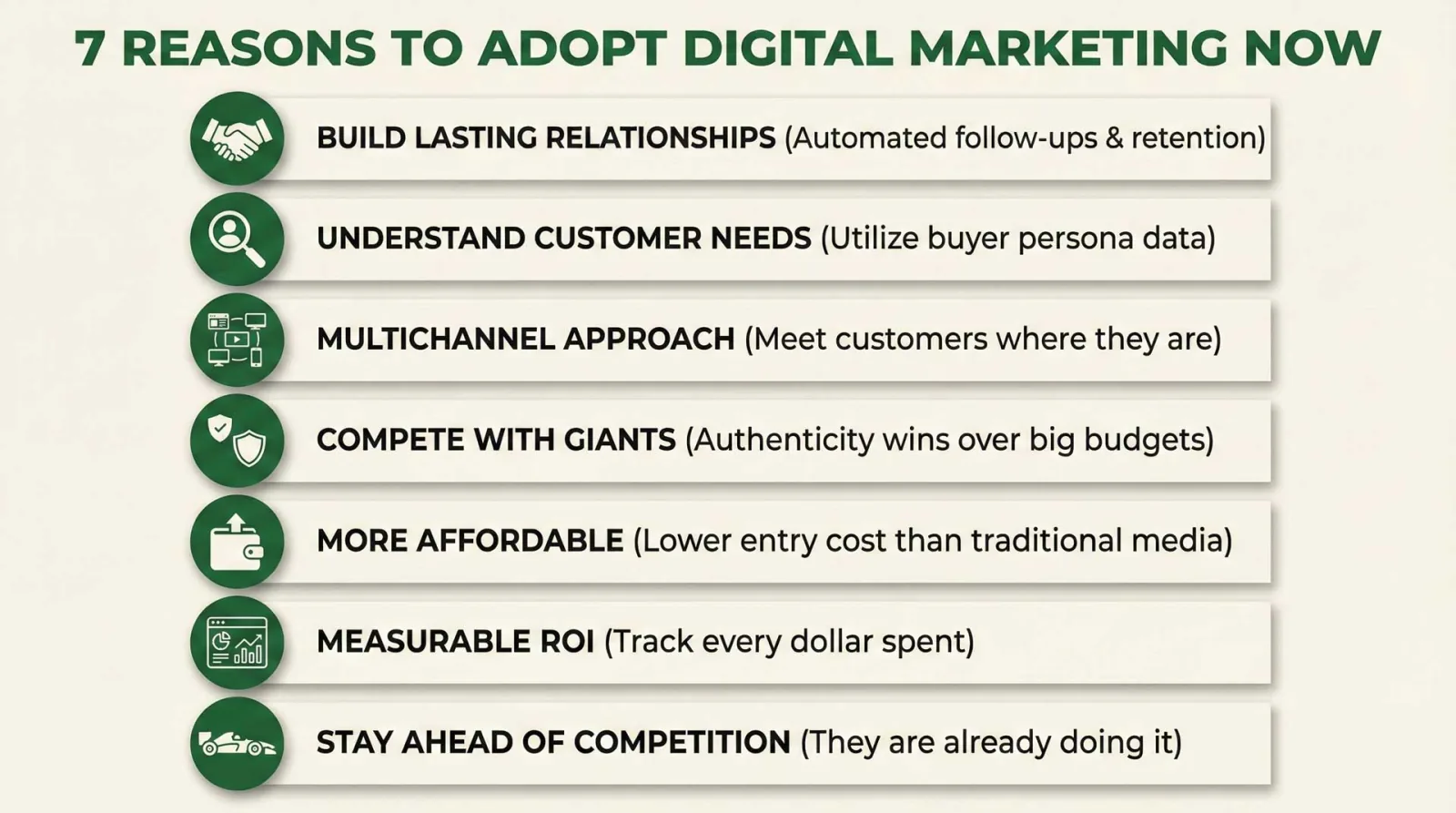
Digital marketing matters more to a pest control business every year. It builds customer relationships that last, and it keeps you a step ahead of the competition. Here are the top seven reasons to take it seriously.
1. Digital Marketing Helps Pest Control Companies Build Lasting Relationships
Commerce Institute (2025) reports that 5.5 million new businesses were started in 2023, marking the highest year on record. On average, 4.7 million businesses are started annually in the United States. That's a flood of new competitors, which makes keeping customers happy harder than it used to be. "Losing" customers is easier today than it was in the late 90s or early 2000s. But if you know your buyers well and your work is even better, digital keeps them coming back to you instead of the next guy.
In pest control, repeat customers pay the bills, and your job doesn't end with the first treatment. The goal is to turn a happy client into someone who talks you up at the ball field. Helpful content about the pests they're fighting makes you the name they trust, year after year. According to ThinkImpact, a 5% increase in customer retention results in a 25% to 95% increase in revenue. Companies that focus on customer retention can be 60% more profitable compared to those that chase new sales. Automated email sequences keep those touchpoints steady, so nobody slips away.
Here's how digital beats the old way of keeping clients:
- Instead of relying solely on the more traditional "word of mouth" referral method, digital marketing uses online testimonials and reviews from satisfied clients. Encouraging clients to leave reviews on platforms like Facebook and your Google Business Profile (GBP) can help build trust and credibility with potential customers.
Pro Tip: Put those reviews on your website and in your social posts, too.
- Instead of physical letters or brochures, use automated, personalized thank-you and follow-up email marketing. You may reach a broader audience for much less money and email the right people at the right time. Segment your email list based on factors like location, service type, or customer lifecycle stage to deliver targeted, relevant content.
- Engaging prospects and clients on social media will help to entice them to call you next time they have a pest problem. Share helpful tips, industry news, and behind-the-scenes glimpses of your company to build a strong, relatable brand presence. Use mobile-friendly social media features like Instagram Stories or Facebook Live to reach clients where they spend their time.
2. You'll Learn More About Your Customers' Needs so You Can Profitably Fulfill Them
Keeping customers is one half of the job, and finding them is the other. Plenty of companies struggle to find leads, catch them, and turn them into booked work. To fix that, you have to know exactly who you're selling to. Build a buyer persona, then aim every ad and every page at showing that person you can solve their pest problem.
Smart pest control companies don't guess. They use some of the top marketing tools to learn what their customers search for and what they need. According to Delve AI, 71% of companies that surpass their revenue targets have formally documented buyer personas in place. Research from ClearVoice shows that marketers using buyer personas enjoy 73% higher conversions than those without. Data from MarketingSherpa reveals that personas can result in a 171% increase in marketing-generated revenue and a 111% increase in email open rates.
In pest control, that means knowing the gap between two callers. One has bed bugs tonight and wants help within the hour. The other is pricing out quarterly service and shopping around. Your marketing should talk to each of them in a different voice.
3. Digital Marketing Offers a Multichannel Approach to Boost Conversions
Your buyers could be anywhere online. Think about this:
- More than 2 out of every 3 people on Earth now use social media, with 5.66 billion social media user identities as of October 2025. (Source: DataReportal)
- "The average person spends 2 hours and 21 minutes per day on social media platforms." (Source: Backlinko)
- "93% of marketers say video marketing has given them a good return on investment, the highest figure since they began tracking this data." (Source: Wyzowl's 2025 Video Marketing Statistics)
- "Facebook remains the most used social media platform with 3.07 billion active users globally, followed by WhatsApp and Instagram with 3 billion users each, and YouTube with 2.58 billion users." (Source: DataReportal)
Google and Facebook Ads, email marketing, social media marketing, PPC, and Local SEO are just a few of the channels open to you. Each one needs its own approach. With a clear plan, though, it's easy to shape the message for each slice of your audience.
A multichannel plan matters because your buyers sit at different stages. The guy with a wasp nest on his porch is searching Google right now. A homeowner worried about termites is watching YouTube, and property managers who need commercial service are on LinkedIn. Meet each of them where they are.
4. With Digital Marketing, Small Pest Control Companies Can Compete With Larger Businesses and Actually Win
Ann Smarty, one of the biggest names in the field, put it this way in her article for Digital Marketer:
"The great thing about digital marketing is that ingenuity and creativity can always win over big marketing budgets."
In plain terms: a small pest control company doesn't need a huge budget or fancy tools to win online. What counts is what the owner knows, or what the agency knows. Know your audience, and know the services you sell. According to DemandSage, 58% of small businesses now rely on digital channels to connect with their customers. Research from G2 shows that small and medium-sized businesses spend an average of $10,000 on content marketing per year, with nearly 4 out of 5 very successful content marketers spending more than 10% of their total marketing budgets on content. Data from SimpleTexting reveals that 49% of small businesses that consistently integrate customer feedback into their marketing strategies report achieving marketing success.
Here's your edge over the big guys: you're real, and you know the town. The national chains run the same generic corporate ad everywhere. You can write about the termite species in your county and the exact week ants show up in local kitchens.
Consider these fictional examples of pest control companies that hold their own against much bigger rivals:
Bug Off Pest Control is a start-up in Charlotte, NC. At first it got no traction in a competitive market, so the team leaned on local SEO and wrote content about the bugs people fight in that area. Bug Off climbed the search results and pulled in more free traffic. Leads went up, customers went up, and the company earned a real foothold in the market.
Gary founded Dream Weaver Pest Control, an established company in Hickory, NC, that keeps expanding. He saw that social media was where his customers hang out, so he posted helpful tips, answered questions, and put the crew's expertise on display on Facebook and Instagram. Dream Weaver built a loyal following, and happy clients sent more referrals.
Green Pest Elimination is an eco-friendly company in Asheville, NC. It stood apart by writing plain guides to green pest control methods. The team tuned those blog posts and videos for the right keywords, then promoted them through social media and email. Green Pest drew a niche crowd of homeowners who care what gets sprayed. Today it's the trusted name in that corner of the market.
5. Digital Marketing Is More Affordable Than Traditional Marketing
Most small pest control companies can't buy radio, TV, or billboard space in a major urban market, but almost all of them can afford digital.
Research by WebFX found that most businesses pay between $50 and $6,000 per month for digital marketing services. In pest control, basic service usually runs $500 to $2,500 monthly. A fuller package costs between $3,000 and $7,500 per month. DesignRush reports that full-service digital marketing agencies offer packages ranging from $1,000 to $20,000, so you can scale your spend as results come in.
What does that actually buy you? A $1,500 monthly budget might cover Google Business Profile setup, basic local SEO, and a starter PPC campaign aimed at your best-paying services. At $3,000 monthly, you add steady content, wider PPC, and email automation. Now compare one month of billboard space in a big metro. That can run $5,000 to $15,000 with no way to track results or change course midstream.
6. Digital Marketing Offers Measurable ROI
Digital aims tighter than a mailer ever could, and better still, you can measure exactly what each campaign delivered. So you start with a small investment, watch the numbers, and only then commit more.
7. Your Competition Is Already Using Digital Marketing to Spur Ahead
More small businesses move to digital marketing every year. Data from Business Dasher (2024) shows that 60% of small businesses now use digital marketing to attract customers and sales, a big jump in recent years. What does that mean for you? Most of your competitors are already there.
Want to know what your competitors are running? Start with their website and their social accounts. Do they post to a blog on a regular schedule, update Facebook, or share photos on Instagram? And are they buying Facebook ads?
Then Google their brand name and see who mentions them and who links to them. Use tools like Ahrefs site explorer to find the sites linking to your rivals, SimilarWeb to see their traffic sources, and SpyFu for their paid search ads.
Document everything you find, including follower counts and the keywords they target. You'll use those notes on every campaign you run later, from SEO and paid search to social ads, content, and email.
2026 Digital Marketing Priorities for Pest Control Companies
In 2026, a handful of emerging trends are changing how marketing works. Three key areas deserve your attention and your dollars this year.
AI and Automation Budget Allocation
Smart pest control operators now put 5-8% of their marketing budget into AI and automation tools. For a company with a $100,000 annual marketing budget, that means $5,000 to $8,000. Learn how to set your full 2026 marketing budget across every channel.
Why spend it? Salesforce (2025) found that 76% of small and medium businesses that are increasing their tech spending are experiencing growth. The payback is there. According to McKinsey research cited in Harvard Business Review, companies using AI in their sales processes can increase their leads and appointments by more than 50%, reduce call time by 60-70%, and achieve cost reductions of 40-60%.
But here's what many owners miss: this isn't just about efficiency tools like chatbots and content generators. The big ad platforms are baking AI into the core, and Meta's full ad automation lands by the end of 2026. Meta's engineering team reports that advertisers using Advantage+ AI-driven targeting features experienced a 22% increase in return on ad spend. Ignore that shift and you'll pay more for worse results while your rivals tune their campaigns with automation.
Think of AI like trading a flip phone for a smartphone. Both make calls, but only one opens a whole toolbox that your competitors are already using against you.
Smart Monitoring Technology as a Marketing Differentiator
Smart monitoring is turning into a real selling point in 2026. Companies like Anticimex are scaling their digital IoT offerings globally with over 200,000 connected devices installed worldwide. Ecolab is pushing a digital pest intelligence program that pairs deep data with smarter service calls. This has quickly become a competitive battleground.
The marketing value works two ways. First, smart sensors let you treat only where the bugs are, so you spray far less, which lines up with what buyers care about today. Second, it hands your sales pitch hard numbers. McKinsey research cited in Business News Daily (2024) found that 75% of millennial consumers consider sustainability when making purchases, and real-time pest monitoring delivers proof of chemical reduction and data-driven treatment.
The tech turns a fuzzy "peace of mind" service into something a client can see. Instead of a quarterly spray visit, they get 24/7 monitoring reports and proof the money worked. Sell it as "Data-Driven Healthy Home Protection" rather than "smart traps," and green services can command a 25-40% price premium. That's how you step out of the race to the bottom.
Think about what a Fitbit did for fitness. It moved us from "I worked out today" to "I walked 10,247 steps and burned 487 calories." Smart monitoring does the same for pest control, where vague promises turn into concrete numbers you can share, and numbers justify a premium price.
Video Content as an SEO Priority
Video belongs near the top of your 2026 plan, but not for the reason you've heard. That famous claim that video makes you "53 times more likely" to reach page one comes from outdated 2009 research, and the author who wrote it publicly took it back in 2012.
The real value sits in the signals Google can measure. Multiple sources confirm that video drives a 157% increase in organic traffic from search results. Saga Pixel's analysis found that video search results have a 41% higher click-through rate than text-based results. Wyzowl (2025) reports that 84% of video marketers say video has helped keep visitors on their website longer.
Video works because it holds attention and people stay to watch. Those good signals (higher CTR, longer time on page, and fewer bounces) are exactly what search engines count. For a knotty topic like integrated pest management or termite prevention, video does the heavy lifting. Research cited by Speach found that viewers retain 95% of a message via video compared to just 10% via text.
So invest in how-to video that shows what you know, from pest identification guides to walk-throughs of an actual treatment. Trust gets built before the phone ever rings. A sharp three-minute video on your bed bug process does the work of 2,000 words of text, and people actually remember it.
Emerging Channels for Pest Control Marketing
Past the standard tactics, three emerging channels are opening doors in 2026, and each one helps you reach buyers and build authority.
TikTok for Pest Education Content
TikTok isn't a kids' app anymore, and it's become a real place to build trust. Statista reports that 64% of Gen Z now use TikTok as an online search engine, while Revel Interactive found that 51% of Gen Z choose TikTok over Google as their go-to search engine. Get in now and you own the next wave of homeowners.
The best pest control content isn't polished and corporate. It's raw footage from the field. Adam Holt, founder of Namedatbug Consulting, amassed over 536,000 TikTok followers by pivoting to what he calls "gross-out content," Pest Management Professional reported. One of his first viral hits, a video showing effective tick removal with dental floss, reached nearly 10 million views. Knowing which social platforms deliver the best engagement tells you where to spend your time.
Why does it work? As Holt explains, the content is "visually striking, anxiety-inducing, and undeniably engaging." It hits a nerve, then hands you the fix. That one-two punch proves you know your stuff and earns real trust. You can do the same with behind-the-scenes treatment videos, pest ID clips, and simple demos that put your skill on screen.
Think of it like a cooking show versus a recipe card. Both teach you the dish, but only one makes you feel like you could actually pull it off. That's the power of showing your skill instead of describing it.
Connected TV Advertising for Geographic Targeting
Connected TV (CTV) advertising fixes the worst part of regular TV: massive wasted money. A broadcast spot hits an entire media market. CTV ads run down to the ZIP code, so you reach the right homes while people relax on the couch.
A pest control company can shoot a slick TV spot and send it only to homes in the ZIP codes it serves. Companies bent on expansion already use this to move into new towns.
Real-world numbers back this up. When one Michigan pest control company cut their CTV budget, they saw a decline in brand performance year-over-year. They had to spend more on non-brand PPC campaigns to make up for it, which shows that CTV acts as a "brand shield." It makes every channel at the bottom of the funnel work better, and it pulls down what you pay for each new client. If you spend big on PPC, which averages $34 per click in pest control, CTV can make the whole budget go further.
Picture a billboard that follows your ideal client home and only bills you when they look at it. That kind of aim is what puts high-end video ads within reach of a regional pest control company.
Voice Search Optimization for "Near Me" Queries
Voice search is the new front line for local, ready-to-buy questions. The data leans local, and it leans hard. BrightLocal found that 76% of smart speaker users perform local voice searches at least weekly. And research shows that over half of consumers (58%) use voice search to find local business information.
These aren't idle questions. They're high-intent "money" questions like "Alexa, find a termite inspection near me" or "Hey Google, what's the best pest control in Charlotte?"
Winning those queries is the same job as winning AI answers. Conversational keywords and FAQ pages still help, but the technical foundation matters more. Voice assistants and AI search results give one reply, and they pull it from clean, well-labeled data.
Schema markup has become the language that AI reads. Good sitemaps and structured data (LocalBusiness, Service, Product, FAQ) let search engines and language models pull the facts that matter most: your service areas, your specialties, and your ratings. Label your services right and you're the one the AI assistant names. That's how you catch the zero-click leads coming down the pike.
Voice search work is like training Alexa and Google to be your best salespeople. They're already talking with your buyers. You just have to feed them the right facts so they name you instead of the shop across town.
The Importance of Mobile Optimization in Digital Marketing for Pest Control Companies
Mobile comes first now, and the market is crowded. More people research and contact a service company from a phone every year, so your website and your marketing have to work on a small screen.
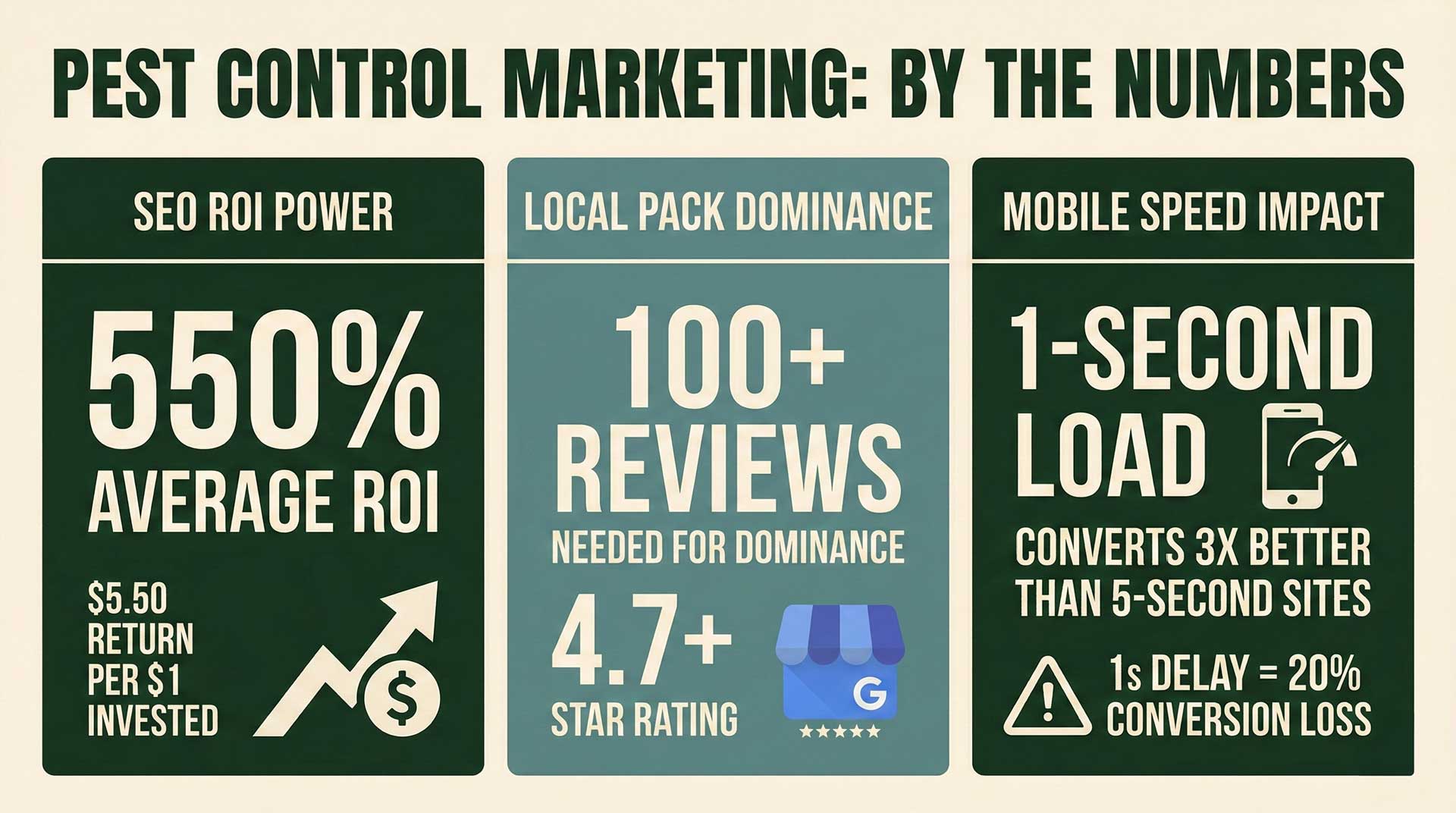
Research shows that mobile devices account for approximately 63% of all global searches as of early 2025, and 30% of all mobile searches are related to location. That local habit is where your leads live. According to Google, 76% of people who search for something nearby on their phones visit a business within a day. And 88% of consumers who perform a local smartphone search visit or contact a store within a day.
A phone-ready website lets potential clients move around, find the information they need, and contact you, no matter the device. See the features your pest control website needs to turn phone traffic into paying jobs. Studies indicate that 61% of mobile searchers are more likely to contact a local business if they have a mobile-friendly site. Google leans on mobile-first indexing as well, so a phone-ready site can lift your rankings.
Mobile-only tactics help too, whether that's social ads set to phones only or SMS marketing campaigns. They meet buyers on the device they already hold. To keep those lists clean, a phone number carrier lookup can verify each contact so your texts reach real people.
Top 5 Digital Marketing Strategies for Pest Control Companies
For quick reference, here are the five best plays for a pest control business:
1. Local SEO (Google Business Profile & "Near Me" Optimization)
Own the local results where buyers are already looking. Red Local SEO research found that 44% of local searchers clicked on Local 3-pack results, compared to 29% for organic results. Businesses in the Google 3-pack receive 126% more traffic and 93% more conversion-oriented actions than businesses listed in positions 4-10.
That means claiming and tuning your Google Business Profile, building a page for each town you serve, and keeping your NAP (Name, Address, Phone) the same in every online directory.
2. Paid Advertising (Google Local Services Ads & PPC)
Pull in immediate leads from people ready to book today. Local Services Ads put your business at the very top of the results with the "Google Screened" or "Google Guaranteed" badge. PPC lets you aim at exact services and exact areas.
3. Content & Video Marketing
Earn trust and free traffic with content that teaches. Write blog posts, shoot videos, and make infographics that cover common pests, prevention tips, and how each treatment works. Do that and you're the trusted expert in your market.
4. Email Marketing & Automation
Get more from each client with targeted campaigns and automatic follow-ups. Email marketing generates between $36 and $40 for every dollar spent, or a 3,600% to 4,000% return on investment. According to Omnisend's research, automated emails drove 37% of all email-generated sales in 2024, despite accounting for just 2% of email volume.
5. Reputation Management (Reviews & Testimonials)
Stack up the social proof that turns lookers into customers. Ask happy clients for reviews on Google, Facebook, and industry sites. Answer every review, good or bad, and keep it professional, because it shows you care how the job went.
These five plays work as one system. They bring in new clients, build the kind of bond that lasts, and set you up to keep expanding in a crowded market.
Final Thoughts: Open Your Pest Control Company's Door to the Digital World
Online marketing keeps shifting, and keeping pace with it is how a pest control company keeps expanding. Lean into it and you stay a step ahead of the field while you reach the people you want.
A plan that works needs these pieces:
- A mobile-optimized website that showcases your services, expertise, and customer reviews
- Local SEO efforts to improve visibility in search engine results for potential clients in your service area
- Valuable, informative content that addresses the needs and concerns of property owners dealing with pest issues
- A strong presence on relevant social media platforms to engage with potential and current clients
- Targeted PPC advertising to reach potential clients actively searching for pest control services
- Email marketing campaigns that deliver relevant content to current and potential clients
- A focus on building and managing your online reputation through customer reviews and testimonials
Keep up with industry news and use the newest tools. Invest in digital marketing and you'll get the most out of what you've built, and reach new heights. Don't let your competition get ahead.
Take action today by:
- Conducting a thorough audit of your current digital marketing efforts and identifying areas for improvement.
- Setting clear, measurable goals for your digital marketing strategy, such as increasing website traffic through lead generation tactics, generating more leads, or improving customer retention.
- Creating a content calendar that includes a mix of blog posts, videos, infographics, and social media content that aligns with your target audience's needs and interests.
- Partnering with a reputable digital marketing agency, like Cube Creative Design, that specializes in working with pest control companies to help guide your strategy and implementation.
Stay focused on your goals. Put digital marketing to work, expand your pest control company, and serve your clients better, at home and beyond.
Frequently Asked Questions About Digital Marketing for Pest Control
What is the most cost-effective digital marketing strategy for small pest control companies?
Local SEO and your Google Business Profile give small pest control companies the best return. They cost little and bring in steady leads from people searching for help in your area. Start by claiming and tuning your Google Business Profile, then ask clients for reviews and add pages to your website about each town you serve.
How much should a pest control company budget for digital marketing?
Most pest control businesses should put 7-10% of gross revenue to marketing, with 60-70% of that going to digital channels. For a company generating $500,000 annually, that means $35,000 to $50,000 for total marketing, with $21,000 to $35,000 for digital efforts. A smaller shop can start with $500 to $1,000 monthly and scale as results come in.
How long does it take to see results from digital marketing?
It depends on the channel. PPC and Local Services Ads can bring leads within days, while social media engagement builds over 2-3 months. SEO and content marketing need 3-6 months to show real results, but they pay best over the long haul. Email to current clients can show results in weeks. A good plan mixes quick wins with long plays.
Should pest control companies focus on residential or commercial digital marketing?
Most pest control companies do well in both markets, but the plans differ. On the home side, lean on local SEO, reviews, and seasonal content. On the commercial side, you need LinkedIn, case studies, and a pitch aimed at property managers and facility directors. Match your budget to the split you want in sales.
What makes pest control digital marketing different from other industries?
Pest control marketing has to serve two callers at once. One is in a panic over bed bugs or termites, and the other is shopping for preventative service and wants proof you can be trusted. Seasons swing, so campaigns shift all year. Service area aim matters, because nobody drives across the state for pest control. Photos and video of real work do very well here. And reviews carry huge weight when you're letting someone into your home.