You've seen it before. You're searching for a local dentist, and three different practices in your city have the same smiling woman in scrubs on their homepage. Or you're comparing coffee shops, and they all feature an identical latte art photo that looks like it came from the same Shutterstock search.
This isn't just lazy marketing. It's actively destroying trust.
Local businesses invest thousands in websites, Google Ads, and SEO, only to sabotage themselves with visuals that scream "I'm exactly like everyone else."
The irony?
Stock photos were supposed to make businesses look more professional. Instead, they've created a sea of sameness that makes potential customers wonder if your business is even real.
The solution isn't just throwing money at custom photography, though that helps. Smart local marketers are rethinking their entire visual strategy, mixing authentic imagery with newer tools like AI-generated graphics where appropriate. The goal isn't perfection but recognizability and trust.
The Trust Problem
We need to understand why generic imagery creates such a visceral problem for local brands before we can fix it.
The Psychology of Visual Familiarity
Our brains are wired to notice patterns, and when we see the same image across multiple websites, something feels off. Psychologists call this cognitive fluency which is the ease with which our brains process information.
Stock photos are designed to be instantly recognizable and pleasant, which sounds great until you realize that familiarity breeds contempt, not trust.
When a potential customer sees that same "diverse team having a meeting" photo on your site that they saw on five other local business sites, their subconscious registers it as fake. Not just generic, fake.
The professional polish that stock photography promises becomes a liability. Your brain recognizes the image isn't connected to the actual business, creating what researchers describe as an authenticity gap.
Real Consequences for Local Brands
This isn't theoretical. The competitive disadvantage is measurable and significant.
Consider the local real estate market. Search "realtors in [your city]" and count how many agent sites use the same stock photos of "sold" signs, happy families holding house keys, or generic suburban exteriors.
When a seller is choosing between agents, the one whose website shows their actual listings, their real face, and recognizable local neighborhoods has an immediate credibility advantage.
The same pattern repeats across industries:
- Dental practices using identical stock photos of perfect smiles lose patients to clinics showing their actual office and staff
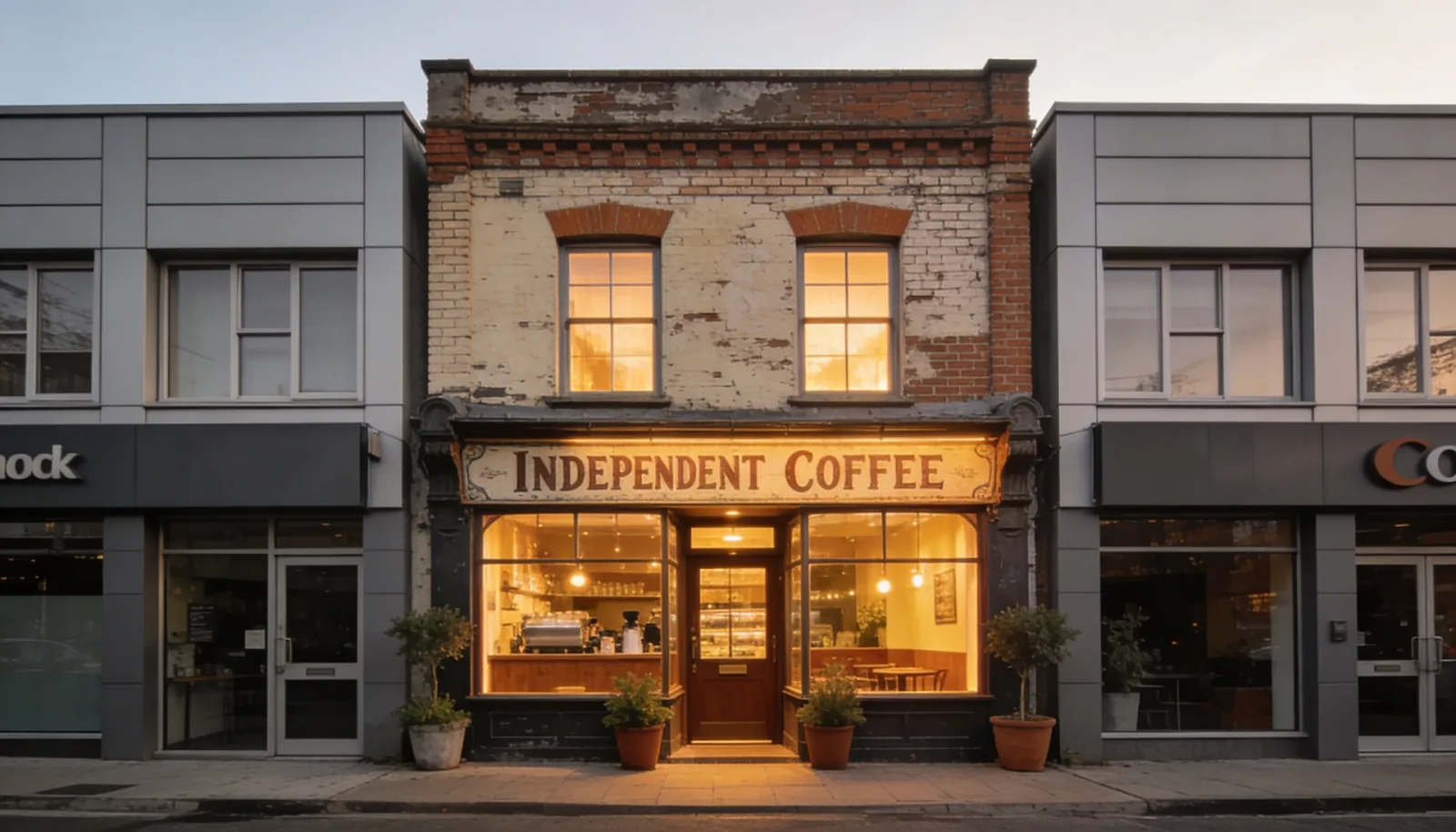
- Coffee shops with generic latte art get skipped for competitors whose Instagram shows their real baristas and interior
- Law firms with stock gavels and handshakes feel less trustworthy than those with photos of their actual attorneys
The engagement metrics tell the story. Websites with authentic, business-specific imagery consistently see lower bounce rates and higher conversion rates than those relying on stock photography. When visitors can't visually distinguish your business from competitors, they have no reason to choose you.
Perhaps most damaging is the credibility gap. In an era of fake reviews and scam websites, stock photos make legitimate local businesses look suspicious. "Is this even a real business, or just a lead generation site?" becomes a reasonable question.
Why Stock Photos Became the Default (And Why That's Changing)
Understanding how we got here helps explain why the shift away from stock imagery is happening now.
Stock photography made perfect sense for decades. It was cost-effective, legally safe, instantly available, and far more polished than what most small businesses could produce themselves.
A dental practice could get professional-looking website imagery for $200 instead of paying $2,000 for a custom photo shoot. The math was simple.
But consumer expectations have fundamentally shifted, particularly since 2020.
Social media trained entire generations to value authenticity over perfection. The rise of platforms like Instagram and TikTok normalized "imperfect" content. People now prefer shaky smartphone videos, unfiltered photos, behind-the-scenes glimpses.
Younger consumers, especially, have developed a sharp eye for manufactured content. They can spot stock photography instantly and judge businesses accordingly.
The professional polish that once signaled credibility now signals disconnection. Customers want proof that your business is real, local, and genuinely invested in your community. A perfectly lit stock photo of a handshake doesn't do that. A slightly awkward photo of your actual team at a local charity event does.
What Smart Local Marketers Are Doing Instead
The good news is you don't need a big budget to build visual authenticity. Here's what's actually working for local businesses right now.
Option 1: Authentic DIY Photography
Modern smartphones have cameras that would have cost $10,000 a decade ago. You already own professional-grade equipment.
The key is embracing "good enough" over perfect. Your customers aren't looking for magazine-quality imagery. They're looking for proof you're real. A smartphone photo of your actual storefront, taken in decent natural light, builds more trust than a stock photo of a generic shop interior, even if the lighting isn't perfectly balanced.
This approach works especially well for service businesses, retail, and hospitality.
Show your real workspace, your actual team, your genuine customers (with permission). The slight imperfections make the images feel legitimate.
Option 2: Professional Local Photography
For businesses where visual credibility is critical, investing in custom photography pays immediate dividends.
A professional photo shoot might cost $1,500-$3,000, but you're building a library of brand-specific images that can be used across your website, social media, print materials, and advertising for years.
The ROI becomes obvious when you calculate how many customers choose you over competitors because your website looks authentic and established.
The strategy is to maximize value through smart planning. Schedule shoots to capture seasonal variations, multiple team configurations, different services or products. A single well-planned shoot can generate 50-100 usable images that give your brand visual consistency across all platforms.
Option 3: AI Image Generation
This is where many marketers get excited, but it's crucial to understand where AI fits and where it absolutely doesn't.
AI image generators excel at creating custom visuals for concepts rather than people. They're useful for abstract representations of services, stylized location-specific imagery, illustrations, and background elements.
For example, a local marketing agency might use AI to generate a stylized cityscape featuring recognizable landmarks, creating something that feels locally specific without the cost of hiring an illustrator.
The practical applications include:
- Hero section backgrounds with local architectural elements
- Abstract visualizations of services or concepts
- Decorative graphics that match your brand aesthetic
- Social media graphics and blog post headers
The "local specificity" advantage is real. Instead of using a generic stock photo of "technology," you can generate an image that incorporates visual elements from your actual city while maintaining a cohesive brand style.
When NOT to Use AI Images
Here's where many businesses make catastrophic mistakes: never, ever use AI-generated images to represent real people, your team, or your customers.
The credibility pitfall is instant and severe. If a visitor discovers that your "team photo" is AI-generated, they'll question everything about your business. Are your reviews fake too? Is your address real? The trust destruction is comprehensive.
Industry-specific considerations matter enormously. Real estate agents must show actual properties. Healthcare providers need real staff photos to meet regulatory requirements and build patient trust.
Law firms require authentic attorney headshots. In these industries, AI imagery isn't just ineffective but potentially unethical.
If you do use AI-generated content, transparency matters. Don't try to pass AI imagery as photography. Use it for what it is: custom graphic design.
The Hybrid Approach
The most effective strategy combines all three approaches strategically.
Start with authentic photography for anything involving people or physical locations. You can even use AI chat tools for detailed prompts and high- quality photos.
Your team, your workspace, your actual products or service delivery—these must be real photos. Invest in professional photography here if budget allows, or use quality smartphone photography if necessary.
Use AI-generated imagery for conceptual and decorative elements where authenticity isn't the point. Background graphics, abstract concept illustrations, stylized representations—these are where AI adds value without risking credibility.
Keep stock photography only for truly generic needs where specificity doesn't matter. An image representing "cloud computing" for a blog post about data security doesn't need to be custom. But anything suggesting "this is us" or "this is our work" absolutely does.
The practical framework is simple: photograph people and places, generate concepts and graphics, buy only when neither custom option makes sense. Start your content audit by identifying stock images that make specific claims about your business—those are the first to replace.
Conclusion
Visual authenticity isn't about having the most polished imagery. It's about having imagery that's genuinely connected to your business, recognizable as yours, and trustworthy enough to convert browsers into customers.
In local markets where you're competing against businesses in the same geographic area, often for the same customers, visual differentiation creates competitive advantage. When three dental practices have identical stock photos but yours shows your actual office and staff, the choice becomes obvious.
Here's your action item: audit your current visuals right now. Would a customer be able to pick out your business from your imagery alone? If not, you're leaving money on the table.
The beautiful irony of our AI-saturated, stock-photo-flooded digital landscape is that real has never been more valuable. The businesses winning local markets aren't the ones with the most polished visuals—they're the ones customers can actually recognize.